Where a Decentralised Mesh Earns Its Keep in 2026
A $12M defense swarm collapsed mid-mission when a jammed signal took down the central control node. The autonomous vehicles were…
Where a Decentralised Mesh Earns Its Keep in 2026

A $12M defense swarm collapsed mid-mission when a jammed signal took down the central control node. The autonomous vehicles were state-of-the-art. The network architecture was not.
The idealized era of autonomous hardware has officially run into the unyielding wall of network reality. In 2026, we are no longer wondering if a drone can fly a grid or if a humanoid can carry a tote; the world is saturated with capable machines. Yet, as thousands of independent platforms take to the fields, factories, and skies, they share a critical, unresolved flaw: they are tethered to brittle, single-master architectures or siloed corporate databases.
When the link drops, the central server stalls, or an adversary jams the signal, the illusion of autonomy evaporates. The future belongs not to the loudest machine, but to the quietest coordination fabric.
By taking the core primitives proven in tactical environments, Tashi Vertex provides the edge-native, Byzantine fault-tolerant (BFT) consensus mesh needed to transition autonomous machines from isolated tools into a single, leaderless system.
1. The Tactical Frontier: Contested Land, Air, and Sea Defence
Modern defense initiatives, such as the US Army’s Replicator, India’s Sovereign Swarm Warfare Project, and the deployment of loyal wingmen like the HAL CATS Warrior or Anduril Fury, demand that hundreds of heterogeneous vehicles execute actions as a unified front.
The Operational Pain
Existing control stacks are vendor-locked and rely on vulnerable, point-to-point data links like Link-16 or traditional Ground Control Stations (GCS). If an adversary jams the frequency or destroys the single master node, the entire multi-million-dollar swarm collapses. Furthermore, a single pilot cannot micromanage dozens of auxiliary loitering munitions during rapid mid-air reassignments.
Where Vertex Plugs In
- Eliminating the Master GCS: A perimeter of Unmanned Ground Vehicles (UGVs) or interceptors run an ad-hoc Vertex mesh. Each node acts as a peer on a shared Directed Acyclic Graph (DAG), holding the threat picture independently.
- Byzantine Resilience: If a node is captured or corrupted mid-mission, the mesh tolerates the rogue behavior up to one-third of nodes being compromised (the Byzantine threshold), preventing it from poisoning the operational kill chain.
- Cryptographic Strike Authorization: Human-in-the-loop (HITL) decisions enter the mesh as signed root-of-trust events. Swarms evaluate target priorities and abort conditions deterministically across the DAG in under 100 milliseconds, leaving an immutable audit trail for rules of engagement (ROE) compliance.
2. The Industrial Underbelly: Agriculture, Factories, and Field Teams
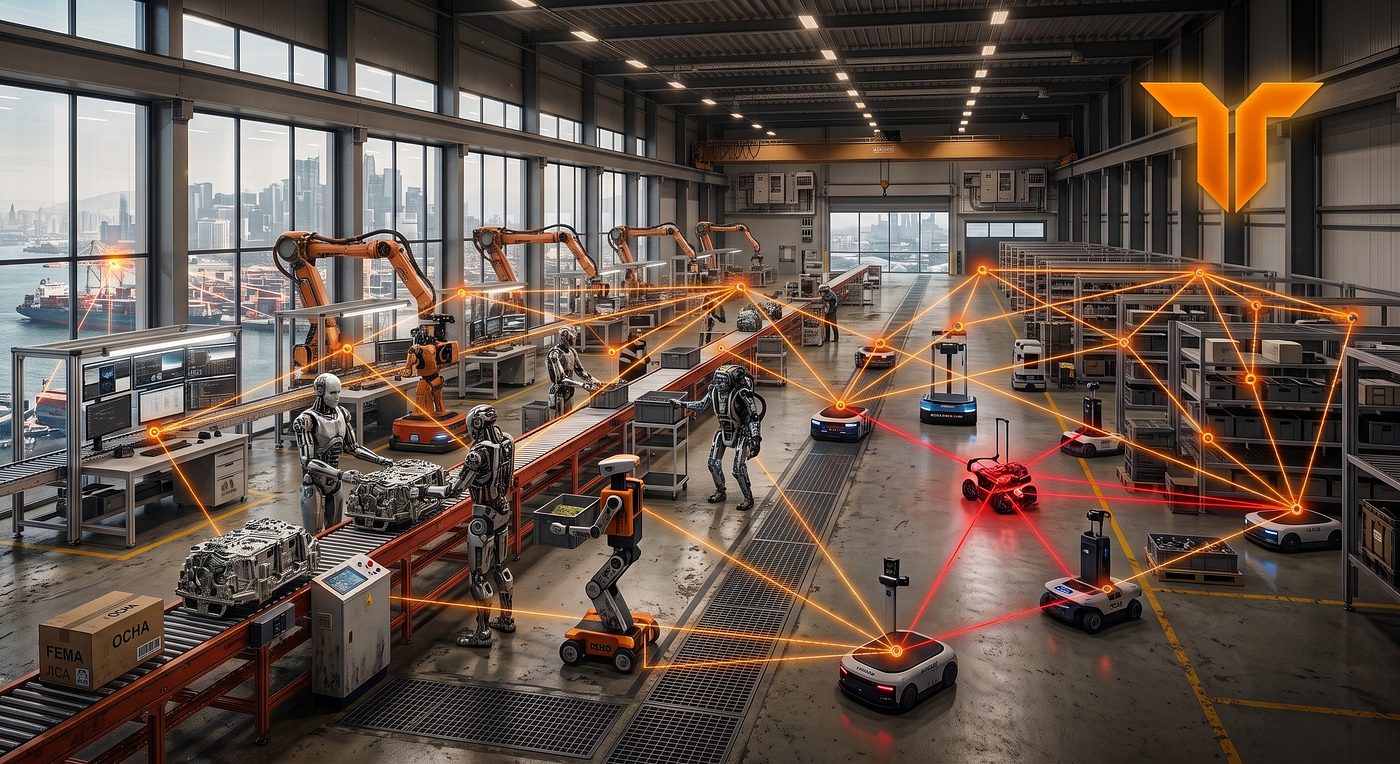
Outside the military arena, autonomous hardware is scaling to massive numbers. Fleets of agricultural drones manage broadacre spraying, while thousands of humanoid robots, including Tesla’s Optimus Gen 3, Figure 03, and Agility’s Digit, are arriving on high-volume manufacturing lines.

The Operational Pain
Industrial operations are fundamentally multi-vendor. Nobody runs a single-brand facility. Forcing an Optimus robot to handshake with a different brand of Autonomous Mobile Robot (AMR) via a centralized Warehouse Management System (WMS) database creates a massive single point of failure. If the central network lag spike occurs, the entire floor freezes. In agriculture, point-to-point systems lack a verifiable ledger to satisfy chemical compliance regulators, such as the EPA’s FIFRA or the EU’s SUR.
Where Vertex Plugs In
- Multi-Vendor Interoperability: Humanoids, AMRs, conveyor PLCs, and field sensors participate as equal peers on the same local mesh, regardless of their native proprietary stacks.
- Self-Healing Task Allocation: Utilizing the compute_redistribution primitive, if an AMR fails mid-run or a drone returns for a refill, the pending workload is deterministically redistributed without a central scheduler.
- Verifiable Field Logs: Tote handoffs, tool checkouts, and agricultural chemical doses are logged as hardware-signed transactions, providing an instant, tamper-evident audit trail for regulatory compliance or quality forensics.
3. The Extreme Network Edge: Infrastructure, Smart Cities, and Horizons
From regional eVTOL transit corridors to subsea autonomy and municipal robotaxi fleets, such as Waymo or Baidu Apollo Go, autonomous vehicles must negotiate spatial intent in real time.
The Operational Pain
In dense urban areas or underwater zones, communication is patchy, intermittent, and structurally limited. Competitive operators refuse to host their proprietary routing data on a rival’s server, yet their vehicles must safely deconflict right-of-way at a smart intersection or an eVTOL vertiport in milliseconds.
Where Vertex Plugs In
- Zero-Trust Cross-Operator Coordination: Competitors share a localized neighborhood domain. No single operator owns the ledger, yet slot claims, vehicle reservations, and emergency vehicle pre-emptions propagate faster than human radio dispatches.
- High-Churn Synchronization: Surface buoys and Uncrewed Surface Vessels (USVs) maintain high-bandwidth connections, while submerged Uncrewed Underwater Vehicles (UUVs) transition smoothly through the STANDBY to LATE_REJOIN state machine, fast-forwarding missed events via deterministic history replays upon re-establishing a link.
- In-Orbit Deconfliction: Mega-constellations can resolve conjunction-avoidance maneuvers peer-to-peer using local satellite clusters, bypassing the lag of ground-station control passes.
Blueprint for Immediate Deployment
We do not need to invent new mesh architecture to achieve this. The essential coordination primitives already exist within the tested repository. To capture the highest commercial pull and satisfy immediate regulatory demand, development resources will prioritize three immediate 2-to-4-week simulation builds:
- Factory Floor Co-bots: Multi-vendor hardware path-synchronization.
- Counter-UAS Perimeter: Ad-hoc local threat mapping and BFT air defense.
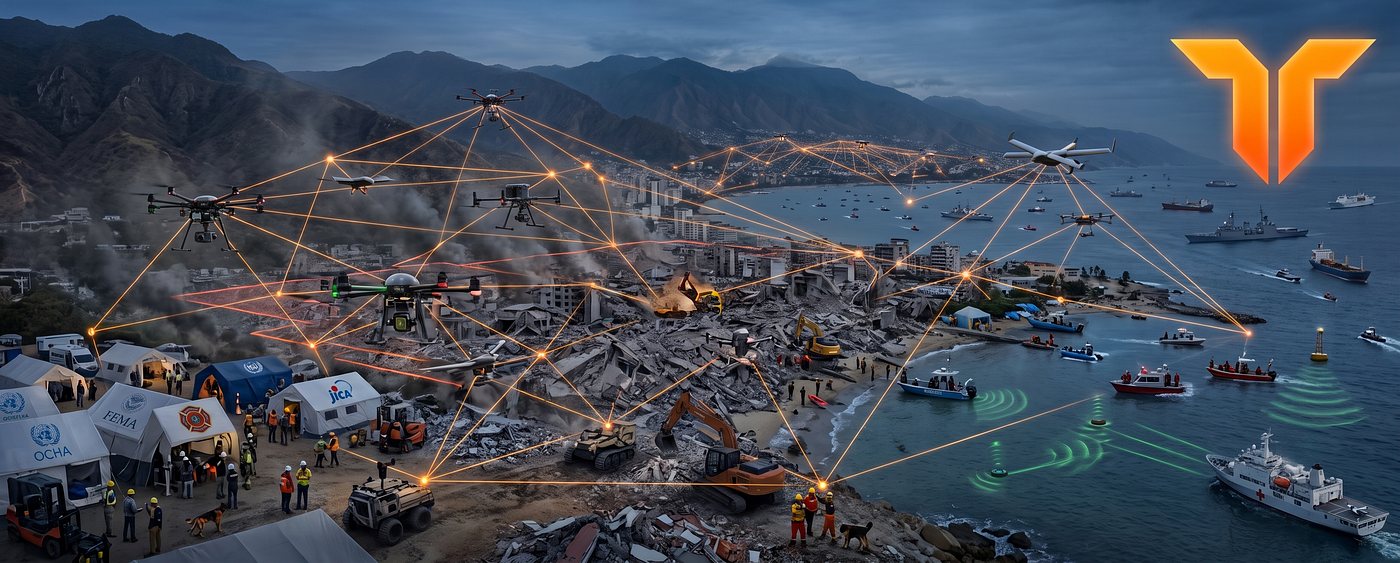
- Multi-Agency Rescue: Cross-boundary, zero-trust coordination for crisis zones.

The speculative era of autonomous systems operating in clean, centralized vacuums is over. Vertex bridges the gap, giving the machine economy the local, un-jammable coordination layer it needs to get to work.
메타데이터
- post_id
- 4b1931f58e80
- slug
- where-a-decentralised-mesh-earns-its-keep-in-2026-4b1931f58e80
- url
- https://medium.com/tashi-network/where-a-decentralised-mesh-earns-its-keep-in-2026-4b1931f58e80
- canonical_url
- https://medium.com/tashi-network/where-a-decentralised-mesh-earns-its-keep-in-2026-4b1931f58e80
- author_url
- https://medium.com/@george_37501
- status
- ok
- fetched_at
- 2026-06-12 10:20:10