Vowels and Consonants in English
The foundational pillars of the English language are vowels and consonants, which often go unnoticed despite their pivotal role in shaping…
Vowels and Consonants in English
The foundational pillars of the English language are vowels and consonants, which often go unnoticed despite their pivotal role in shaping sounds and pronunciation. It is imperative, particularly for children, to grasp these fundamental aspects as they are instrumental in developing literacy skills and enhancing language comprehension. Let’s get into the realm of vowels and consonants.
Unveiling Vowels
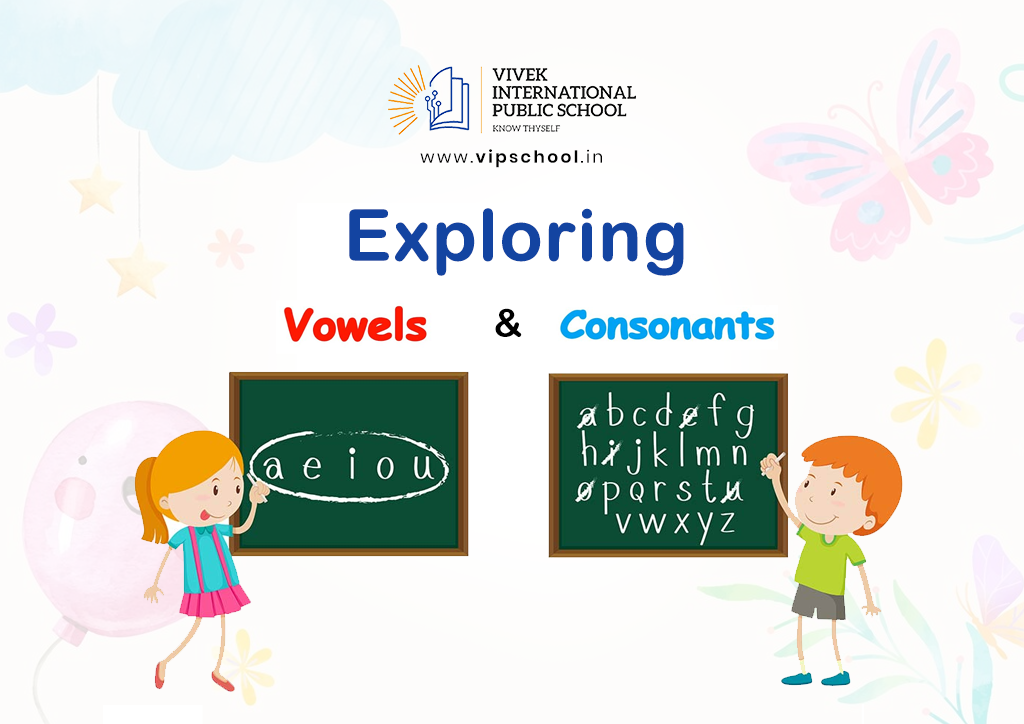
Vowels are letters through which air flows smoothly with minimal obstruction and audible friction during pronunciation. The primary vowels are “a, e, i, o, and u,” with the occasional inclusion of “y.”
Phonetically, vowels are categorized based on tongue position, lip configuration, and how air is released from the mouth. High vowels, like the “U” in “rule,” are articulated when the tongue arches towards the roof of the mouth.
Conversely, low vowels are produced when the tongue is flat or low in position. Mid vowels, exemplified by the “E” in “bed,” involve extreme highs and lows in tongue placement.
Deciphering Consonants
Consonants are alphabets pronounced by completely or partially restricting airflow. All letters except “a, e, i, o, u” are considered consonants, with “y” occasionally joining their ranks.
When two consonants are pronounced successively, they form a consonant cluster or blend, as seen in the word “dream.” Consonants can also be silent, such as the silent “K” before “N” in “know.”
Some consonants, known as stop consonants, obstruct vowels from producing sound. Examples include “B,” “D,” and “G,” where the sound of the vowel “i” is halted in the word “Kit.”
Also Read: Birth of Zero and its Impact on Mathematics
Distinguishing Vowels from Consonants
After this brief overview, let’s get into the details between vowels and consonants.
Long vowel sounds and short vowel sounds constitute the two main categories of vowels. Long vowel sounds, as the name implies, are pronounced for an extended duration, while short vowel sounds are brief, requiring a shorter duration. Examples of short vowel sounds include “elephant,” “umbrella,” and “apples,” while “grapes,” “boat,” and “kit” exemplify long vowel sounds.
Consonants, on the other hand, come in clusters and demand more intricate pronunciation. The English language comprises 24 consonant sounds and 21 consonant letters. Pronouncing consonants involves constriction of airflow at various locations, with letters like “p,” “t,” and “b” entailing the stopping and releasing of air. It’s important to note that mastering consonant pronunciation requires more practice than vowels, necessitating diverse teaching approaches for children.
In Conclusion
The significance of consonants and vowels in English language acquisition cannot be overstated. Demonstrating the pronunciation of different words to children is essential. Once they grasp the nuances of consonant and vowel articulation, they will excel in reading, writing, and communicating in English.
메타데이터
- post_id
- 4b1e69f65cbf
- slug
- vowels-and-consonants-in-english-4b1e69f65cbf
- url
- https://medium.com/@vipschoolbaddi/vowels-and-consonants-in-english-4b1e69f65cbf
- canonical_url
- https://medium.com/@vipschoolbaddi/vowels-and-consonants-in-english-4b1e69f65cbf
- author_url
- https://medium.com/@vipschoolbaddi
- status
- ok
- fetched_at
- 2026-07-28 03:40:04