Food Waste Recycling Bin in 2026: The UK Investment Angle for HNIs
The UK’s move toward more consistent food waste separation is not just a “bin change.” For high net worth investors, it is a multi-year…
Food Waste Recycling Bin in 2026: The UK Investment Angle for HNIs
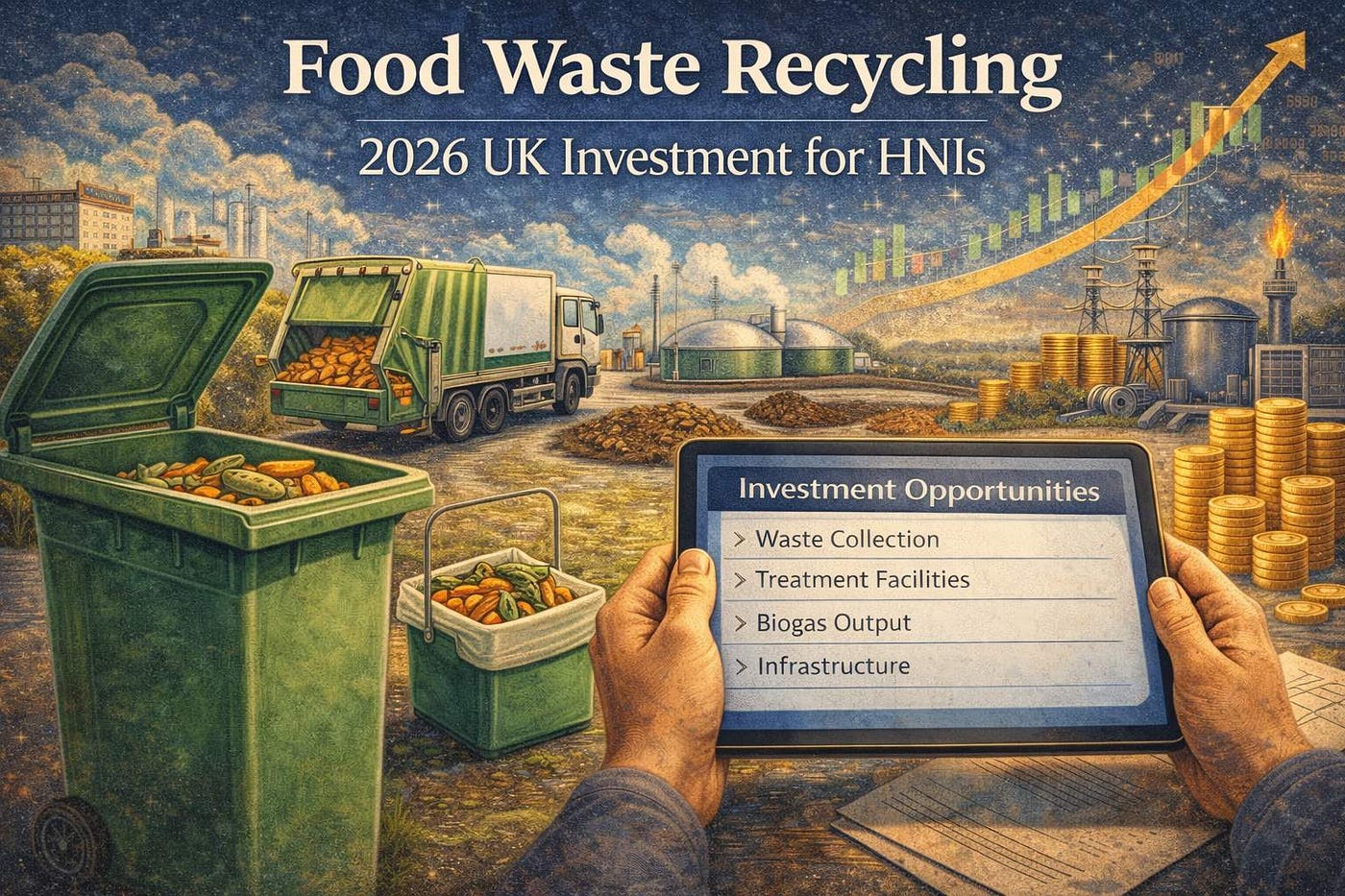
The UK’s move toward more consistent food waste separation is not just a “bin change.” For high net worth investors, it is a multi-year infrastructure and services upgrade cycle hiding in plain sight. When regulation standardises behaviour at scale, the winners are rarely only the councils. The winners are often the companies that provide collection, treatment, logistics, equipment, software, compliance services, and downstream markets for the outputs.
In England, the government’s “Simpler Recycling” reforms set a clear direction: households move toward weekly food waste collections as part of standardised recycling streams, and workplaces already have requirements to separate food waste and dry recyclables. That combination creates a predictable investment theme: higher volumes of separated organic waste, more stable feedstock for treatment facilities, and more demand for the operational ecosystem around it.
This article explains the investable “supply chain” behind food waste recycling in 2026, the profit pools that matter, and how HNIs can think about exposure without chasing headlines.
Why 2026 Matters More Than Most People Think
2026 is a forcing function because it accelerates adoption from “patchy and local” to “mainstream and standardised.” Standardisation matters because it changes unit economics. It reduces consumer confusion, improves collection quality, and increases consistency of feedstock. Consistent feedstock is what makes treatment capacity investable. Treatment facilities, in turn, create long-duration cash flows when secured by long-term contracts and predictable volumes.
For investors, the key point is not whether one borough gets a new caddy. The key point is that separation becomes a behavioural norm, which changes the flow of material and money.
The Investable Value Chain Behind Food Waste Recycling
Food waste recycling is a system. If you want an investable thesis, you need to map the system end-to-end and identify who gets paid, who controls contracts, and where margins are most defendable.
Collection and Logistics: The First Margin Pool
Separated food waste increases operational complexity. It requires dedicated routes, containers, contamination management, and often more frequent collections. That supports revenue growth for waste management operators, route optimisation providers, and subcontracted logistics fleets. The operational winners tend to be the ones with density, fleet scale, and local authority relationships.
HNIs should watch for companies that can add food waste as a high-frequency service layer on top of existing routes. Once a route is established, incremental margins improve because overhead is shared across multiple waste streams.
Caddies, Bins, Liners, and Hardware: The Quiet Manufacturing Cycle
Every system change triggers a hardware cycle. Households need indoor caddies, outdoor lockable containers, and compatible liner solutions. Even when councils procure, the procurement spend flows into manufacturers and distributors. There is also a longer tail: replacement cycles, upgrades, and ongoing consumables.
This category often looks “small” until you realise it scales across millions of homes and thousands of businesses, and the recurring element can be meaningful when linked to supply contracts.
Treatment Capacity: Anaerobic Digestion and Composting as Infrastructure
Food waste does not become valuable until it is treated. In practice, much of the separated food waste flows into anaerobic digestion, in-vessel composting, or related organics processing pathways. Treatment is where longer-duration cash flows can appear because facilities are capital-intensive, regulated, and often run on multi-year contracts.
For HNIs, this resembles infrastructure investing more than “recycling hype.” The core question becomes: does the operator have secure feedstock contracts and predictable offtake for outputs?
The Output Markets: Biogas, Biomethane, Digestate, and Soil Products
Downstream monetisation is where the economics can strengthen, but it is also where volatility appears.
Anaerobic digestion can produce biogas that can be converted to electricity and heat, or upgraded into biomethane for injection and transport use. Digestate can become soil conditioner, subject to quality and regulation. Compost products can serve agriculture and landscaping. Each output market has its own pricing dynamics, policy supports, and constraints.
The investable angle is not “biogas will go up.” It is “who controls the conversion and who has contracted offtake.” Contracting reduces volatility and increases bankability.
Compliance and B2B Services: A Growing Layer of Recurring Revenue
Workplaces in England are already required to separate food waste and dry recyclables, with micro-firms having additional transition time. This creates a compliance market: bins and signage, training, audits, contamination reduction, and simplified vendor management. Businesses want simple solutions, not complexity. Providers that offer bundled services can build sticky recurring revenue.
This is where software and operational compliance platforms become relevant. The more fragmented the business landscape, the more valuable standardised compliance products become.
Data and Software: The Underappreciated “Operating System”
Once separation is enforced at scale, measurement becomes valuable. Councils and operators need contamination metrics, route efficiency, cost-per-ton visibility, and performance reporting. Businesses need proof of compliance and ESG reporting inputs. Software providers that sit between regulators, operators, and customers can become embedded.
From an investor perspective, this can be an attractive “picks and shovels” layer because software margins can be higher than hauling margins, and switching costs can be real when reporting becomes routine.
Where the Most Attractive HNI Opportunities Usually Sit
HNIs generally have three ways to express a theme like this, depending on risk appetite and ticket size.
Public Equities: Listed Waste Operators and Environmental Services
Listed players can offer liquidity and diversified exposure. The advantage is easier entry and exit. The drawback is that the “food waste bin change” is only one driver among many. HNIs should evaluate whether the company has meaningful exposure to organics and whether it has secured contracts or capacity expansion tied to organics volumes.
Private Markets: Project Finance and Build-Own-Operate Platforms
Treatment facilities, route platforms, and specialist operators often sit in private markets. This can offer more direct exposure to the organics cash flows, especially if backed by long-term feedstock contracts. The risks are execution, planning, permitting, and contract complexity. The reward is more targeted exposure and potentially more stable yield-like characteristics.
Real Assets and Infrastructure-Style Vehicles
Where long-term contracts, stable volumes, and regulated frameworks exist, the theme can overlap with infrastructure. Investors who already understand renewables, utilities, and long-duration contracts will recognise the pattern: capex-heavy assets with contractual cash flows, sensitive to policy and offtake structure.
The Key Risks HNIs Should Underwrite Before Investing
This theme is attractive, but it is not risk-free. The risks are knowable, and that is the point: you can underwrite them.
Contamination Risk
Separated food waste only works if contamination stays manageable. High contamination can increase processing costs and reduce digestate quality. Operators that invest in education, enforcement, and monitoring tend to protect margins better.
Contract and Counterparty Risk
Local authority contracts can be stable, but they can also be politically sensitive. Contract structure matters: indexation, performance clauses, contamination thresholds, and termination terms can materially alter returns.
Planning and Permitting Risk
New treatment capacity can face planning hurdles. Timelines slip, costs rise, and community resistance can appear. Investors should prefer platforms with proven delivery capability and existing site pipelines.
Output Price Volatility
Biogas and power economics depend on pricing, offtake structures, and policy supports. Digestate markets depend on standards and demand. The best operators reduce volatility through contracts and diversified outputs.
Operational Intensity
Collection and treatment are operational businesses. They require uptime, logistics excellence, and cost control. This is not a passive “green” investment. It is an industrial services theme with ESG tailwinds.
What to Watch in 2026 as an Investor
If you want to track this theme like a professional, focus on evidence, not announcements.
Watch for capacity expansion announcements tied to secured contracts. Watch for margin commentary around organics processing. Watch for contract wins in municipal and commercial segments. Watch for disclosure around contamination management and operational efficiency. And watch for consolidation, because scale often improves route economics and increases negotiating leverage.
The HNI Lens: Why This Theme Fits 2026 Portfolios
For many HNIs, the most useful role of this theme is diversification. It is linked to regulation, essential services, and infrastructure-like cash flows rather than purely discretionary consumer demand. It also aligns with ESG mandates in a way that can be measured through diverted landfill volumes, emissions reduction, and renewable output, which matters for family offices and institutional-grade reporting.
The strongest strategy is to treat it as a medium-term structural theme with multiple entry points, rather than a one-off trade on “new bins.”
Conclusion: The Real Opportunity Behind the “Food Waste Bin” Story
The 2026 food waste recycling shift is a system upgrade. The profit pools sit across collection, hardware, treatment, compliance, and data. The most durable returns typically come from businesses that control contracts, protect operational margins, and monetise outputs with stable offtake structures.
If you approach it with the same seriousness you apply to energy transition or infrastructure investing, this theme can offer a practical, cash-flow-oriented angle for UK-focused HNI portfolios.
https://rajeevprakash.com/food-waste-recycling-bin-in-2026-the-uk-investment-angle-for-hnis/
메타데이터
- post_id
- 4b1fe0f48e63
- slug
- food-waste-recycling-bin-in-2026-the-uk-investment-angle-for-hnis-4b1fe0f48e63
- url
- https://medium.com/@singhmah040/food-waste-recycling-bin-in-2026-the-uk-investment-angle-for-hnis-4b1fe0f48e63
- canonical_url
- https://medium.com/@singhmah040/food-waste-recycling-bin-in-2026-the-uk-investment-angle-for-hnis-4b1fe0f48e63
- author_url
- https://medium.com/@singhmah040
- status
- ok
- fetched_at
- 2026-07-13 06:23:13