Why the China–North Korea Relationship May Be Governed by Networks, Not Capitals
An exploration of frontier systems, distributed incentives, and the overlooked architecture beneath one of the world’s most studied…
Why the China–North Korea Relationship May Be Governed by Networks, Not Capitals
An exploration of frontier systems, distributed incentives, and the overlooked architecture beneath one of the world’s most studied geopolitical relationships.
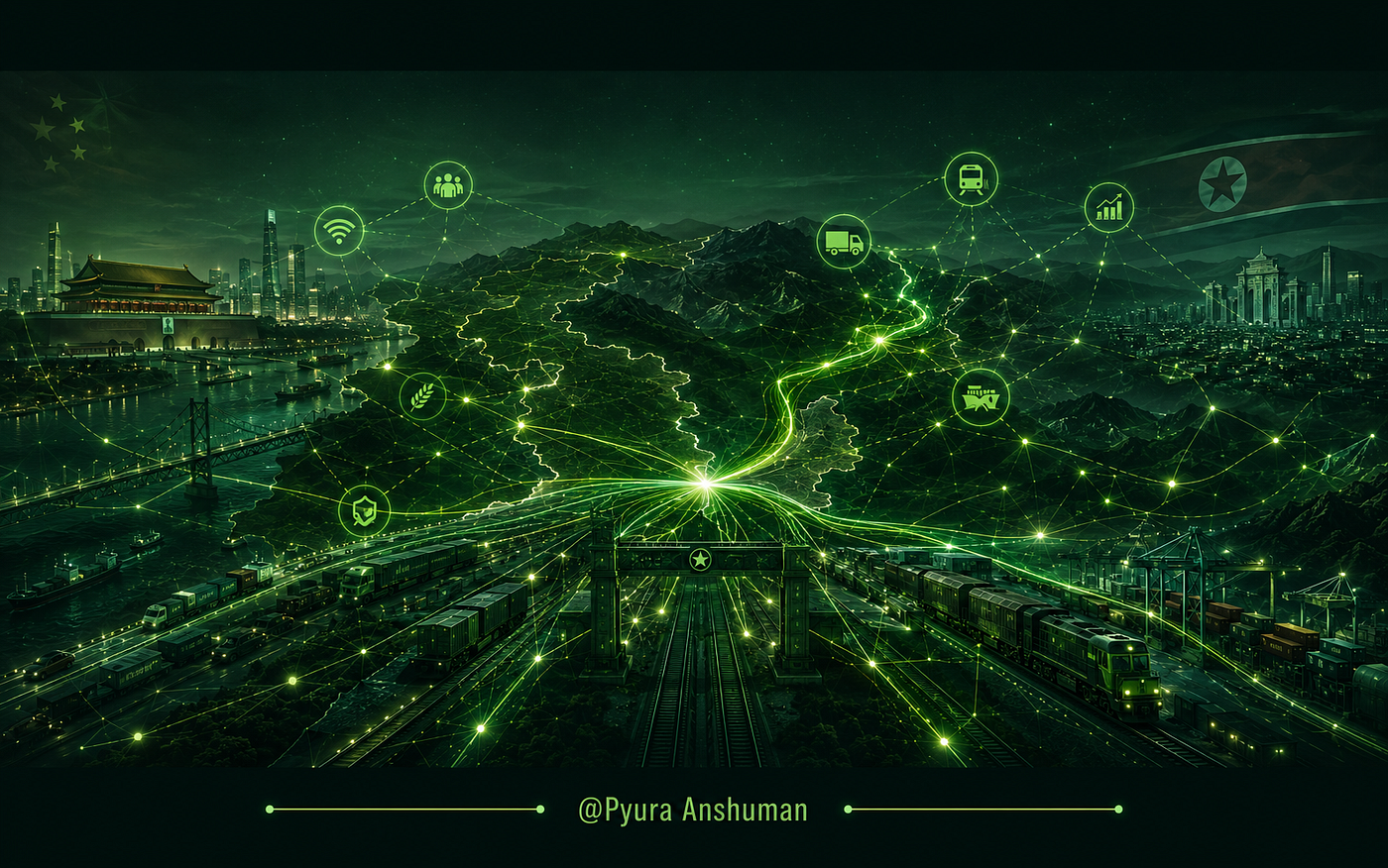
Image @ PYURA ANSHUMAN
There is a tendency in international affairs to imagine that history is written in capitals.
Washington speaks.
Beijing decides.
Pyongyang reacts.
Moscow intervenes.
Maps are drawn, speeches are delivered, and analysts construct narratives around leaders, summits, and official statements.
Yet a curious pattern is often observed in complex systems.
The visible center is not always where the system is controlled.
In biology, intelligence is not concentrated in a single cell.
In markets, prices are not determined by a single trader.
In the internet, information is not routed through a single computer.
The same possibility may exist on the Korean Peninsula.
After spending time examining the China–North Korea relationship, I became increasingly unconvinced that the most important interactions are occurring between Beijing and Pyongyang.
The evidence suggests something more subtle.
Perhaps the relationship is not primarily a state-to-state relationship at all.
Perhaps it is a network-to-network relationship.
And if that is true, much of the conventional analysis may be looking in the wrong place.
The Traditional Model
Most geopolitical commentary implicitly assumes a structure that looks like this:

Two capitals.
Two governments.
One relationship.
Within that framework, questions become straightforward.
- What does Beijing want?
- What does Pyongyang want?
- How much influence does China possess?
- How dependent is North Korea?
These are reasonable questions.
But they may not be sufficient questions.
A Different Way to View the System
Suppose the relationship is decomposed into its constituent parts.
China is not a single actor.
North Korea is not a single actor.
Instead:
China
- Central government
- Provincial governments
- Border cities
- Customs authorities
- State enterprises
- Logistics operators
- Traders
- Financial intermediaries
- Security agencies
North Korea
- Central leadership
- Military institutions
- Provincial authorities
- Trading organizations
- Border administrators
- Transport systems
- Commercial networks
The picture immediately changes.
What appears to be one relationship becomes hundreds.
The Geography That Disappears in Most Analyses
A simple fact tends to receive remarkably little attention.
The China–North Korea border extends for approximately 1,350 kilometers.
That frontier is not merely a line.
It is a system.
Trade.
Transport.
Labor.
Energy.
Food.
Construction materials.
Machinery.
Information.
All have historically crossed through this region in varying forms and volumes.
The border therefore functions less like a wall and more like an interface.
The Frontier Hypothesis
An alternative proposition can be formulated.
Instead of:

consider:

In this formulation, the frontier becomes an active variable rather than a passive location.
The relationship is no longer driven solely by diplomatic decisions.
It is also influenced by the incentives embedded within local systems.
The Incentive Problem
Complex systems often become interesting when different layers pursue different objectives.
Consider a simplified example.
Central Government Objective

Border City Objective

The two sets of incentives overlap.
But they are not identical.
That distinction matters.
Because whenever different layers of a system pursue different objectives, adaptation emerges.
The Network View
The conventional model assumes:

The network model proposes:

The difference is enormous.
A network does not simply obey.
A network adjusts.
Routes are altered.
Transactions are rerouted.
Flows are redistributed.
Connections are reorganized.
The network survives.
The Mathematics of Resilience
One of the most useful concepts in systems theory is path redundancy.
Consider two structures.
Structure A
One path.

If the path is removed:

Structure B
Many paths.

If one connection disappears:
The system continues operating.
This principle can be represented as:

The greater the number of pathways available to a system, the greater its ability to absorb shocks.
Visualizing Network Resilience
Illustrative resilience by network structure
Systems with more independent pathways tend to absorb disruptions more effectively.

The numbers are illustrative rather than measured values.
The principle, however, is foundational to network theory.
Why the Border May Matter More Than the Capital
A curious possibility emerges.
The most important variable may not be:

but rather:

This is not a claim that central governments are irrelevant.
Far from it.
It is a claim that the system’s behavior may be influenced as much by its architecture as by its leadership.
A system can only be understood by examining both.
The Dandong Effect
One way to think about the frontier is through what might be called the “Dandong Effect.”
Not because a single city determines the relationship.
But because border regions often serve as interfaces between political objectives and economic realities.
The capital formulates policy.
The frontier experiences consequences.
Between those two points lies the actual system.
The Hidden Equation
Most analyses implicitly assume:

A more complete representation may be:
Relationship= Leadership + Local Incentives + Network Density + Trade Connectivity + Adaptation
This equation is not intended as a forecasting model.
Rather, it serves as a conceptual map.
It highlights variables that are frequently omitted.
A Broader Lesson
The significance of this observation extends beyond North Korea.
Many geopolitical relationships are described as if they were negotiations between governments.
In reality, they often behave like interactions between networks.
Networks of:
- infrastructure
- trade
- institutions
- incentives
- logistics
- people
When viewed through that lens, the question changes.
Instead of asking:
What does Beijing want?
a systems thinker begins asking:
How many pathways exist through which the relationship can continue functioning?
The first question focuses on intent.
The second focuses on structure.
History has often been shaped by the latter.
Final Reflection
Perhaps the most important lesson is philosophical rather than geopolitical.
Attention is naturally drawn toward capitals.
Power appears to reside there.
Visibility certainly does.
Yet many systems derive their durability from places that rarely appear in headlines.
The roots of a tree are seldom discussed while the branches are being admired.
But when storms arrive, it is the roots that determine what remains standing.
The China–North Korea relationship may be similar.
Much of the world’s attention remains fixed on Beijing and Pyongyang.
Meanwhile, the border continues quietly doing what networks do best:
absorbing shocks,
adapting to constraints,
and keeping the system alive.
메타데이터
- post_id
- 4b201c6c4fa3
- slug
- why-the-china-north-korea-relationship-may-be-governed-by-networks-not-capitals-4b201c6c4fa3
- url
- https://medium.com/the-pyura-network/why-the-china-north-korea-relationship-may-be-governed-by-networks-not-capitals-4b201c6c4fa3
- canonical_url
- https://medium.com/the-pyura-network/why-the-china-north-korea-relationship-may-be-governed-by-networks-not-capitals-4b201c6c4fa3
- author_url
- https://medium.com/@anshpyura
- status
- ok
- fetched_at
- 2026-06-14 11:28:49