Shrinking (and Weaponizing) the Information Space
Citizens are transformed into users made easier to manipulate
Shrinking (and Weaponizing) the Information Space
Citizens are transformed into users made easier to manipulate
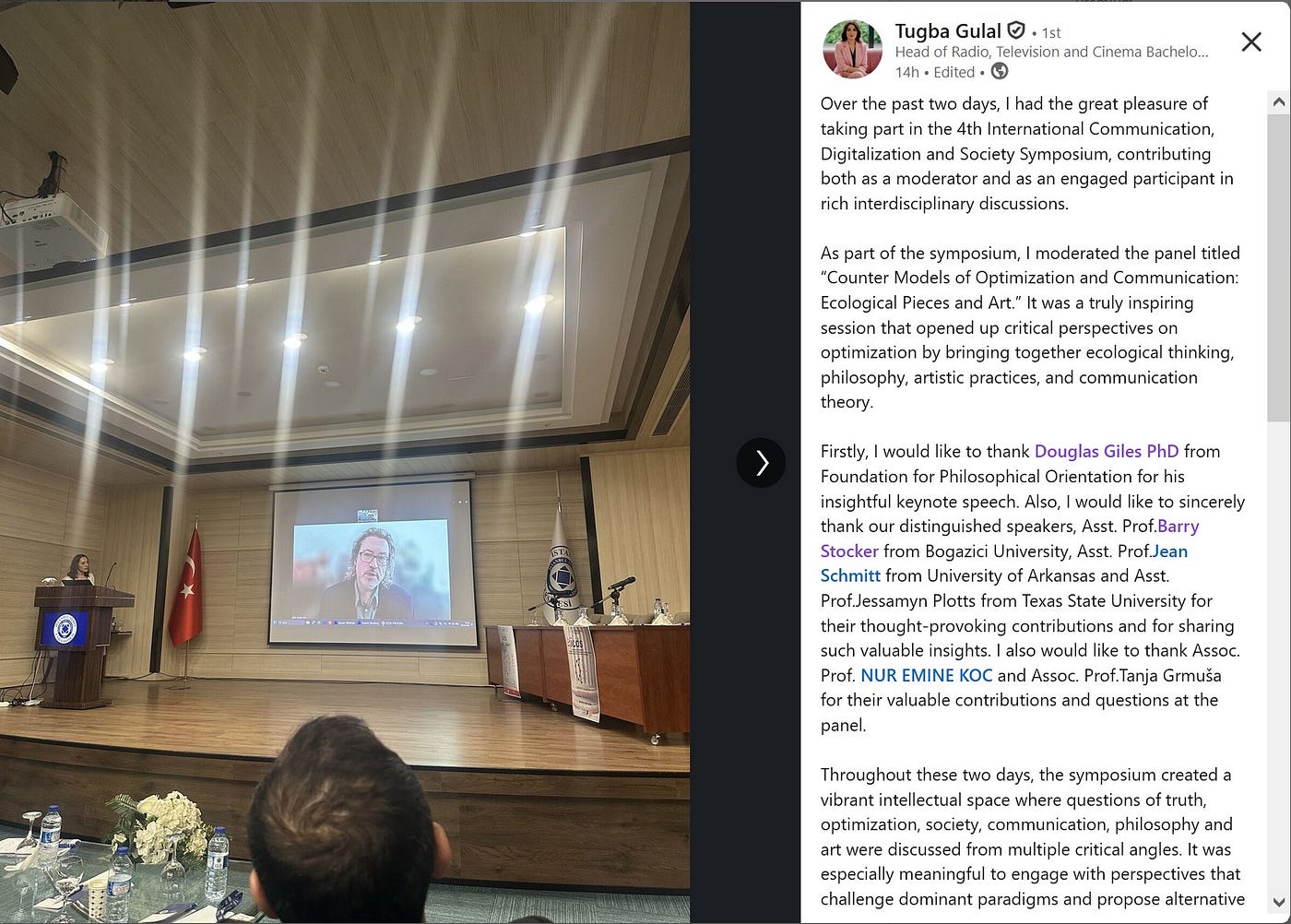
(Source: Tugba Gulal via LinkedIn)
Note: I was honored to be invited to give the keynote address at the 4th International Communication, Digitalization and Society Symposium. This is the text of my speech.
First, let me frame the topics of democracy and infocracy as I see them. Politics is about power, and I refer to politics in a broad sense of the term. Information is power, and here I refer to information also in a broad sense of the term. Control of the information space is one path to greater power.
This relation of information and political power is very old, but the term infocracy, meant as a new epoch, makes sense with information technology enabling wider, deeper, and greater access than ever to content. The irony of the infocracy is that although the information space has the potential to be larger than ever, there are forces that seek to shrink and weaponize the information space.
A theme of this symposium is the concern that individuals have been transformed from citizens into users. This is a very appropriate concern about a very real problem. I contend that we move toward a solution when we answer the problem with the correct understanding of what contributes to information silos and why they are successful instruments of knowledge-power.
This symposium has problematized the ontological shift in the public sphere that is accompanying new information technologies and communication regimes. We do well in focusing on the effects of these technologies that are optimizing the information space. The optimized information space has disrupted the social order, eroding truth and democratic ideals.
But I frame my discussion less in terms of technology and more in terms of the human elements in the relation of information and political power. I argue that today’s information technologies enhance age-old social realities.

Filter Bubbles
Today, people use the term filter bubble to express how the Internet and algorithms filter information and create in users a state of intellectual isolation. We can look to history to see that information isolation has long been present before our digital age of online filter bubbles.
Since ancient times, the nature of information and political uses of information have created filter bubbles. Written materials have always been vehicles for the control of information from ancient stone stele to medieval vellum manuscripts to printed paper books.
Advances in technology allowed the wider distribution of information but did not change the basic relation of information and political power or the human instinct to manipulate information in the service of power. In general, technology enhances existing human tendencies. Ten people can lift a huge boulder with their bare hands if they use enough time and effort. Technology can create a machine that can lift that boulder in much less time, but the technology doesn’t change the reality that a boulder has been lifted because someone wanted it to be lifted. The point is that technology quickens and extends human activity but doesn’t fundamentally alter it.
People have always been faced with the dilemmas of needing to make decisions under time pressures and without full information. People try to ensure that their beliefs are in harmony with the evidence, but lacking time and full evidence, they take the most direct paths to what works, and what works is what becomes true for them. What we call truth are abbreviations of the world, and such abbreviations are a basic need because no one can attain absolute knowledge.
The technology that creates online filter bubbles enhances the human need for abbreviating the complex and confusing world. People communicate information through abbreviations. Filter bubbles work when they give people useful abbreviations — quicker paths to decisions that seem to work. But filter bubbles are abbreviations distorting information in ways that serve the interests of tech and media corporations. Mass media, especially digital media, propagate abbreviations and thrive on them.
The development of electronic media technologies in the early 1900s accelerated and intensified the presence of filter bubbles. In their 1944 essay, “The Culture Industry: Enlightenment as Mass Deception,” Max Horkheimer and Theodor Adorno warned of the filter bubble of radio. Unlike the telephone, a new technology that allowed two-way active participation, they argued that radio is a one-way medium that “turns all participants into listeners and authoritatively subjects them to broadcast programs which are all exactly the same.”
I don’t endorse the entirety of Horkheimer’s and Adorno’s expansive theory of the culture industry; nevertheless, there is a resonance with today’s situation when they wrote that “the whole world is made to pass through the filter of the culture industry.”
The Illusion of Choice
Friedrich Kittler began his book Gramophone, Film, Typewriter**[1]** with the declaration that media determine our situation and that “what remains of people is what media can store and communicate.” He made his declaration in 1986, but it presaged the Internet and the infocracy.
Kittler understood that the emergence of optical fiber networks would soon connect people to a communication channel that could be used for any type of media — movies, music, phone calls, and texts. Optical fiber would combine the previously separate media of television, radio, telephone, and mail into a single standardized medium.[2]
Indeed, today’s Internet combines all types of media — visual, audio, and written — all accessible through a single device. We have wired and wireless connections to information both stored and live from all over the world. We can learn almost anything we want, anytime, and communicate with potentially anyone anywhere in the world.
At least that’s the promise of the Internet — almost infinite choice. There are hundreds of TV networks available, thousands of online publications, hundreds of thousands of video channels, and millions of songs available online.
There are two reasons why this choice is an illusion. Other contributors to this symposium will, much better than I could, give their expert analyses on how corporations and state actors use surveillance, algorithms, and other means to restrict access and choice and to create online filter bubbles.
I will focus on the other force that limits choice. Filter bubbles describe information isolation imposed onto people. There is another social ontology — the human instinct to self-segregate in which people willingly isolate themselves.

The Instinct for Self-Segregation
I once saw a news report that included an interview with a supporter of a right-wing anti-immigrant political party. The person shared his belief that democracy only works in a single ethnic society. What he said is uncomfortable but understandable. People tend to vote for those who represent them. Across history and cultures, political parties have emerged from ethnic groups and social classes to give those constituencies a voice in government.
There is a degree of fear of difference that motivates segregation, but it is also a human instinct to prefer the company of people who are similar to us. A 2014 sociological study found that high schools with larger student bodies or a network ecology that offers students more choice — such as more elective courses, a larger range of potential friends, and more freedom to select seats in a classroom — are more likely to end up with a student body that is rank-ordered, cliquish, and segregated by race, age, gender, and social status.[3] Given greater choice, the study found, adolescents tended to find friends who are similar to themselves.
This is an instinct called homophily — we like and feel more comfortable around people who are similar to us. This is the case both offline and online. Social media users, like high schoolers, find online friends who are similar to themselves.
The instinct of homophily extends beyond race, gender, and social status into ideology. Data show that when liberals live in conservative areas, they migrate to more liberal areas and that when conservatives live in liberal areas, they migrate to more conservative areas.[4] To physically relocate one’s home is a significant commitment, so it should not surprise us that people would be willing to take much easier paths to ideologically self-segregate online and link with and listen to people and ideas they agree with.
Ideological self-segregation of information is not a recent phenomenon. For many years in the United States and Europe, newspapers were openly funded by political parties, and newspapers were still deeply partisan in their coverage. The newspaper you bought and read depended on your political allegiance. The idea of a free, neutral media has always largely been an unrealized ideal. People, when given a choice, gravitate toward media that tell them what they want to hear, rather than be challenged by facts and different ideas. Media corporations have been happy to oblige and manipulate that sentiment.
Given the greater choice of information sources, Internet users prefer sources with which they are more ideologically comfortable, and two studies a decade apart illustrated that people are becoming increasing self-segregated. An analysis of Internet users between 2004 and 2008 found no evidence that ideological segregation on the Internet had increased over that time.[5] That finding contrasts with an analysis of Facebook users’ behavior between 2017 and 2020, which found their engagement with news was biased toward their ideological leaning.[6]
The infocracy reflects a combination of human tendencies and technological tools. My theory is that tech corporations have willingly leveraged the human instinct for self-segregation. In some cases, they have actively exploited the positive and negative sides of homophily. This returns us to the issue of power.

(Source: Piqsels)
Creating Echo Chambers and Information Silos
Let’s take a look at one of the ways that power manifests in the online information space, which will lead us to how that space has been weaponized.
Thomas Hobbes said that the end purpose of knowledge is power.[7] This, of course, is the Hobbes who wrote the book, Leviathan, in which he called for a concentration of power in the absolute sovereign. Hobbes’s sovereign embodies the will of the population and uses his power to compel obedience from the population so as to preserve the peace. One specific power Hobbes confers on the sovereign is to be a grand censor of information. Hobbes writes that the sovereign should examine the doctrines of all books before they are published, judge what opinions are problematic, and determine who should be allowed to communicate to the population.
We can compare Hobbes’s conception of the sovereign with how tech corporations operate today. They are grand censors of information. Elon Musk is the sovereign of Twitter; he bought it for the purpose of being a grand censor. Mark Zuckerberg is the sovereign of Meta and its platforms of Facebook, Instagram, and WhatsApp. Google has a more byzantine organizational structure, but there’s little doubt that as a corporate entity it exerts power in the manner of Hobbes’s sovereign.
Whether or not these and other tech corporations set out to be concentrations of power with sovereignty in the information space, they have become that. Social media were initially open environments. It was initially relatively easy for people to find information and connect with other people. Over time, the information spaces on social media platforms gradually shrank, creating echo chambers.
Media corporations use algorithms and other actions to create filter bubbles and control information. Observers have appropriately focused on the mental, emotional, and social harms that these actions have inflicted on social media users. Looking at effects is important, but so is looking at causes. Social media echo chambers have two causes, and filter bubbles are only one of them. The other is the human instinct to ideologically self-segregate.
To better describe these two causes and their effects, I adopt the terms information silos and siloization. These are terms used in business management to describe the process of groups becoming isolated from each other, especially in ways that hinder communication and cooperation. Siloed departments in an organization don’t adequately communicate and cooperate with each other, reducing efficiency and productivity. Silos on social media function in much the same way in hindering communication and cooperation.
The term filter bubbles describes the filtering process of algorithms, but the term silos includes users self-segregating themselves, which is an important force in the shrinking of the information space.
What we have with online siloization are two types of self-interest working synergistically. One is users’ self-interest in segregating themselves into silos, and the other is media corporations’ self-interest in segregating users into demographic silos. Both users and media corporations want silos, and they both actively create and maintain them.
The online information space has shrunk to a constellation of silos segregated by race, age, gender, social status, and ideology. The control of information is power, so politicians, political parties, and corporations seek to influence individuals into adopting silos of group orientations. Social media, the corporate owned news, and political parties have vested interests in maintaining the siloization of the populace. It’s good for business. It’s good for political power. It’s also convenient because people need so little encouragement to arrange themselves into silos.

(Source: iStock)
Weaponizing Information
All of this lays the groundwork for us to discuss the shrinking and weaponizing of the online information space and how this shrinking connects with the paradox of democracy and authority.
Information technology enables access that is wider and deeper than ever to content with the potential to increase interpersonal communication and enhance participation in society. We are nevertheless holding a symposium with more than 100 papers discussing why that same information technology is having the opposite effects.
As I’ve argued, online information silos have evolved through the combined forces of individuals’ instinct for self-segregation and the digital media corporations’ filter bubbles. The online silos are weaponized in that they are the subjects and objects of power used to control information.
The formation of silos has contributed to the ontological shift into infocracy. The public sphere is increasingly fragmented, fragile, and vulnerable to manipulation. The next question is why and how these silos work and how they contribute to the rise of misinformation and authoritarianism.
At this point, I will introduce one last concept, one that is emblematic of the infocracy. That concept is diasimocracy. It is formed from the ancient Greek word for celebrity, διάσημος, and a diasimocracy is rule by celebrities.
The infocracy is also a diasimocracy because popularity is synonymous with authority. The human tendency toward diasimocracy comes from the combination of two common logical fallacies. The fallacy of argument from popularity is believing something is good and/or true because many people believe it. The fallacy of argument from authority is believing that something is good and/or true because someone who is believed to be an authority thinks it is.
These two logical fallacies, like all logical fallacies, come from a lack of adequate critical thinking. But as I mentioned before, we are faced with a basic need to abbreviate the world because we are under time pressure and can never attain absolute knowledge. Out of expediency, we abbreviate the world, adopting signs that provide the most direct paths to what seems to work. Needing such signs, we are tempted to grasp ones provided to us.
Providing easy-to-grasp signs is a service that the digital media of the infocracy are eager to provide. The current infocracy is a diasimocracy, and digital media provide the most powerful engine.
What characterizes current digital media platforms more than anything else is their constant use of the appeal to popularity. Users are shown the most popular accounts and posts. The algorithms are weaponized to reflect and fortify the popularity of what is already popular, and the diasimocracy is stronger in digital media than in any other social arena. Digital media leverage the power of diasimocracy to fragment the public sphere and turn citizens into siloed passive users, making them more vulnerable to manipulation.
In the infocracy, subject matter experts are no longer the measure of authority. Authority is now established by popularity. Online posts are abbreviations of the world packaged for easy adoption. Truth is now what “goes viral” because online posts that have “gone viral” are the easiest signs to grasp and the quickest paths to deciding what to believe. Deep analyses and discussions of complex issues have been replaced by memes and vibes that abbreviate the world and enforce silos of group orientations.
Digital media corporations have a vested interest in maintaining the divisions of siloization. The algorithms are programmed to agitate users because antagonism and outrage fuel continued interaction with social media platforms. But, curiously, users don’t have much interaction with people who hold differing opinions. Users instead post memes that denigrate the other side within online silos to generate likes from an audience of like-minded people. Social media algorithms reward this human tendency toward self-segregation by showing posts to those who already agree with what is posted.
Social media’s digital manipulation of users hides behind a veneer of democracy. The digital media corporations can claim that their algorithms are responding to what people want. There is some truth to that because the algorithms take data from user activity. Social media thus partly mimic democracy.
Plurality, if not majority, is the core of democracy. This is the strength of democracy — that its polling of the populace helps establish the rule of law. A populace votes, and the vote gives elected office holders the authority to act.
This is the paradox of democracy and authority. Democracy gives power to the plurality and thus grants authority to that plurality of opinion. It is an artificial authority created by people, and it is an authority contingent on time, place, and other factors.
Democracy includes accountability. Office holders are accountable to the voting public, and they can be voted out by a plurality. Digital media don’t have the same level of accountability. In theory, users can simply not use a social media platform. But this is not so easy, and studies have shown that social media can be addictive. The filter bubbles exert power over people, keeping them engaged with the platform and stuck within information silos. Even when many people leave a social media platform, a plurality of users remains, and the filter bubbles continue to exert influence on society.
The positive principles of democracy are that it empowers individuals to have a voice and that it holds elected officials accountable. These are ideals that aren’t always realized. Democracy works if the rule of law is in place and the guardrails hold against corruption.
Democracy’s weakness is that because a plurality becomes an authority, one can claim authority by achieving a plurality of support without needing to show knowledge or expertise. Plato understood this and said that democracy can “promote [to leadership] anyone who merely call[s] himself the people’s friend.”[8] Plato feared that someone with enough charisma and guile would grab power by securing the loyalty of enough voters. Once in power, the politician could become a tyrant and suppress those who might challenge the tyrant’s power.
History records that Plato’s fear has at times become reality. Control of the information space, controlling what people hear or read, is one path to political power. Tell people what they want to hear, provide them with easy-to-grasp signs, encourage them toward self-segregation by convincing them you are on their side, and they will support your attempts to gain power. This is one path for a tyrant to gain power.
That doesn’t mean we should abandon democratic ideals — in fact, quite the opposite. The tyrants of Plato’s fears turned democracy against itself by manipulating information and corrupting the public sphere, destabilizing the rule of law and transgressing its guardrails.
The promise of digitalization was that it would bring greater democracy to the information space. That promise has not been realized. What I have tried to do in this paper is explain some of the reasons why the digital society is an infocracy rather than a democracy. Leveraging the human tendency for self-segregation, digital media use the manipulation of filter bubbles to herd people into online information silos.
Those silos fortify the diasimocracy — the rule of the digital information space by celebrities — with those celebrities being selected by the owners of the digital media platforms, a selection process that hides behind the veneer of democracy. Citizens are transformed into users who are deceived into believing that what is popular online is what is authoritative.
Society is being optimized, but the question is optimized for whom? For political tyrants? At times, certainly. For the owners of media and technology corporations? Definitely. The weaponization of online information silos turns democracy against itself, using knowledge-power to extract profits from online users. Today’s information technologies enhance the age-old social ontology of self-segregation.
Conclusion
I hope that my emphasis on history and human nature does not lead anyone to think that I believe the problems of the infocracy cannot be solved. I believe that accepting the truths taught by history and human nature is the answer to the problems of the infocracy. We have perhaps believed too much in the promise that digitalization’s enhanced access to information will benefit everyone. We perhaps forgot that technology is an expression of human society and forgot to adequately apply the rule of law to the digital information space.
One could argue that each technological innovation of digital mass media has further degraded meaningful discourse. But technology only quickens and extends human activity; it doesn’t fundamentally alter it. We will always have with us some people who want to degrade discourse so that they can more easily manipulate others to gain political power. Digital technologies are tools, and tools can be used for positive and negative purposes.
I ask that we take a particular orientation toward the infocracy and its communication and information technologies. We need to orient ourselves to the truth of other people, to the real humanity behind the data. We can’t completely ignore the tech sovereigns like Musk and Zuckerberg, but our focus should be on our fellow citizens. We need to approach technology as proactive citizens of the world rather than as passive consumers of it. We need to remember that our democratic ideals have been eroded less by technology than by our own inactivity. Yes, society is becoming a machine controlled by optimizing algorithms. But when we orient ourselves to the humanity that the machine tries to hide from us, we begin to reshape the fabric of our society, and we gradually take back our power.
[1] Friedrich Kittler. Gramophone, Film, Typewriter. Stanford University Press. 1999.
[2] Friedrich Kittler, Dorothea von Mücke and Philippe L. Similon. “Gramophone, Film, Typewriter,”
October Vol. 41 (Summer, 1987), pp. 101–118. 1987.
[3] D. A. McFarland, J. Moody, D. Diehl, J.A. Smith, & R. J. Thomas. “Network Ecology and Adolescent Social Structure.” American Sociological Review, 79(6), pp. 1088–1121. 2014.
[4] Matt Motyl, Ravi Iyer, Shigehiro Oishi, Sophie Trawalter, Brian A. Nosek. “How ideological migration geographically segregates groups.”Journal of Experimental Social Psychology, Volume 51, pp. 1–14. 2014.
[5] Matthew Gentzkow and Jesse M. Shapiro. “Ideological Segregation Online And Offline.” The Quarterly Journal of Economics. 126, pp. 1799–1839. 2011.
[6] E. Fraxanet, A. Kaltenbrunner, F. Germano, et al. “Analyzing news engagement on Facebook: tracking ideological segregation and news quality in the Facebook URL dataset.” EPJ Data Sci. 14, 73. 2025.
[7] Thomas Hobbes. De Corpore.
[8] Plato. Republic VIII.558.
메타데이터
- post_id
- 4b2c1ff4b68b
- slug
- shrinking-and-weaponizing-the-information-space-4b2c1ff4b68b
- url
- https://medium.com/original-philosophy/shrinking-and-weaponizing-the-information-space-4b2c1ff4b68b
- canonical_url
- https://medium.com/original-philosophy/shrinking-and-weaponizing-the-information-space-4b2c1ff4b68b
- author_url
- https://medium.com/@dgilesphilosopher
- status
- ok
- fetched_at
- 2026-06-14 11:28:49