This Pride Month, boycott WIRED Magazine
Queer communities and disabled communities must unite. We have much in common, and are fighting very similar fights.
This Pride Month, boycott WIRED Magazine
Queer communities and disabled communities must unite. We have much in common, and are fighting very similar fights.
As you may already know, ableism undergirds anti-queer sentiment. It’s maybe a little less obvious now than it was, say, a century ago, when queer behaviour could get you institutionalised, experimented on, or killed.
It’s a little more obvious, perhaps, for asexuals than for the allosexual homosexualities. If you take a close look at contemporary anti-asexual sentiment — a “newer” (more recently acknowledged) — orientation, you’ll see that asexuality is going through the same crap all the other sexual orientations went through earlier. Meaning, if you self-identify as asexual, a surprisingly high proportion of people will consider your body or mind broken. Some will say this to your whole face. Others will try to fix you.
Pretty much every sex education artefact from the mid 20th century onwards either suggests or says outright that sexuality is human, all humans are sexual beings, or some variation thereof. No surprise people truly believe that sex is compulsory, and people who don’t experience an outward facing orientation, or persistent desire for sex, are not quite human.
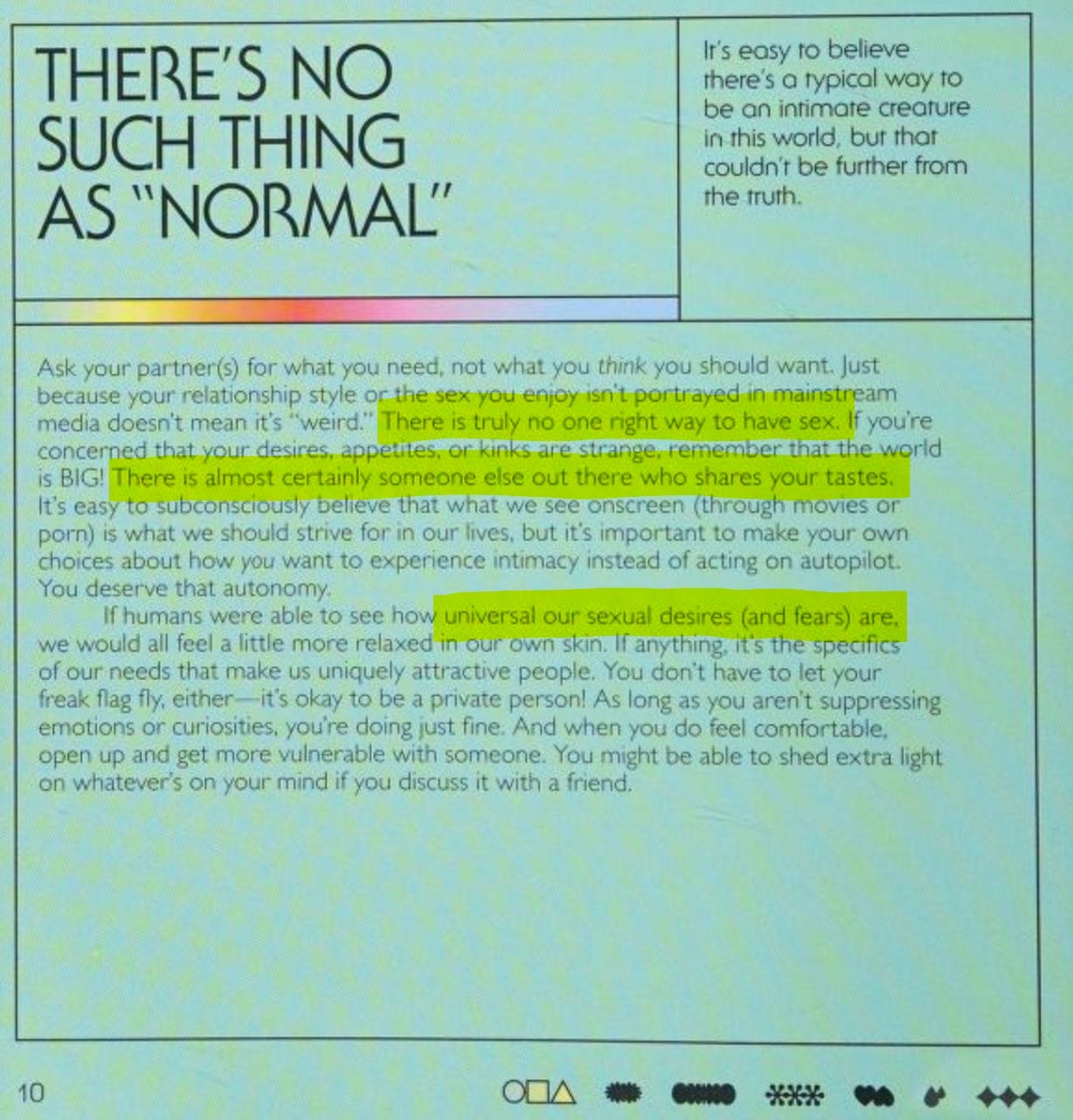
Carnal Knowledge: Sex Education You Didn’t Get In School (2020) by Zoe Ligon and Elizabeth Renstrom. Even when authors avoid attributing sexuality to “humanity,” they still very frequently say something about its “universality”.
Stay with me for this brief history of asexuality and lesbianism:
In the 1800s, people were allowed to not have sex. Especially women. In fact, women weren’t allowed to have sex outside marriage. Within marriage, they weren’t expected to enjoy it.
The one up-side to this: (upper class and middle class) women had the freedom to explore “romantic friendships” with other women. No one was worried about this because women were seen as non-sexual. So long as they were married to a man — devoted to him, producing his children — he didn’t have cause for concern. Look at old letters between female friends and many of them look mighty romantic. The ace community might call those “queerplatonic” today.
But then, in the 1870s, the concept of lesbianism was invented (alongside other queer identities, including asexuality, in fact). While a few individuals were persecuted, medicalised and imprisoned as a result of their newly acknowledged “sexual deviance,” most regular folk living in the last quarter of the 19th century never heard of these words.
However, the concepts did catch on, because of course they happened to describe a lot of people, who finally felt seen — even though being seen came with danger.
By the 1920s people did know about homosexuality. Girls were no longer permitted to have “romantic friendships” with other girls. Matrons kept a close eye on their students. Now, everyone was suspicious of anything outside the cishet norm. Women were entering the paid workforce, and men were getting worried about keeping a sexual leash on their wives.
Likewise, men were sadly required to curtail their own homosocial friendships, lest they be mistaken for gay.
What else happened in the 1920s? Freud happened. Psychoanalysis. Freud posited that all humans are sexual beings. He rejected the possibility of asexuality. Not only are we all sexual — many of our sexual thoughts and desires are “repressed” and end up in our unconscious, wreaking havoc on other areas of our lives.
And that explains any ailment or unusual trait which could not (yet) be explained by other branches of medicine. Got a nervous twitch? Repressed sexuality. Dodgy guts? Have you tried un-repressing that sexuality of yours?
This change in culture affected literally everybody: Who we were allowed to be “close” friends with; and for queer people, of course, their entire lives were severely curtailed.
Asexual people who had previously been quietly avoiding sex were now under the impression that something was terribly wrong with them. (Note that within compulsory heterosexual marriage, asexuals were never at any time in history granted the bodily autonomy we strive for today.)
Freud’s psychoanalytic mode of thinking continued all through the rest of the 20th century. Whereas once sex was seldom allowed, now the script had completely flipped — now you had to be sexual.
At the turn of the millennium, the Internet started to proliferate and a small group of asexuals found each other online. They discussed these issues in detail and came up with new terminology to describe what we now call asexuality, demisexuality, greysexuality etc. Asexuals and aromantics finally felt less alone (meanwhile enduring accusations of, “Oh, you’re ‘asexual’? Read about that on the Interwebs, did you?”)
A quarter of a century later, still too few people have a handle on the meaning of asexuality and… it’s getting tedious.
It’s especially tedious how bad actors keep attributing to psychology what they, themselves, cannot personally explain by doing proper science or, ya know, listening to people. Queer people and disabled people.
The latest enraging example is a hit piece — published by WIRED magazine — by a grifter called Alan Levinovitz: “The Painful Truth About Long Covid: There might finally be a way forward for long Covid treatment — if only you were allowed to talk about it.”
(**It’s behind a paywall. Do not pay for it. If you would like to read it, [there are very easy ways](https://smry.ai/)**.)
Levinovitz is an established long Covid conspiracy theorist. Here’s something he knocked out on Xitter about a year ago:
“I happen to believe…” Sounds super sciencey to me.
In this latest ass-wipe of an article, the writer starts out with a criticism of flawed science, then moves on to suggest another thoroughly disproven approach to long Covid (“trauma therapy, **emotional awareness and expression therapy**, body awareness techniques, and cognitive exercises.”)
- Alan Levinovitz a Professor of Religion at James Madison University. He is a doctor in philosophy — not a doctor of medicine, let alone a specialist in the collection of diseases we are now calling long Covid. WIRED magazine published his opinions on long Covid anyway.
- He’s been a guest on Joe Rogan and also on a podcast called “**Awake from Woke,” billing itself as “Advocates, journalists & experts [who] discuss their work documenting — & disrupting — the delusions of the hard left & cancel culture.**’” (It’s a Substack link.)
- There are no studies to back up the recommendations to sick people in this article. Note: Oftentimes we criticise journalists for failing to critically engage with highly flawed studies. In this case: THERE ARE NO STUDIES.
- For a full critique of this article by an actual doctor (not Levinovitz and not me), see: “**Commentary on the Long Covid article by Alan Levinovitz in WIRED magazine**” by Dr Elke Hausmann at Long Covid Advocacy.
- Long Covid Advocacy summarised in shorter form that Levinovitz’s WIRED piece which: “repeatedly conflates criticism of evidence with creating a ‘climate of fear’. These are not the same thing. The article repeatedly blurs two separate claims: 1. Patients are genuinely ill and deserve to be believed; 2. A specific treatment is effective. These are different questions requiring different standards of evidence. Believing patients is not the same thing as endorsing treatment claims. And demanding evidence for treatment claims is not the same thing as denying illness. Conflating stigma helps no one in the community. Recovery stories matter. They generate hypotheses. But anecdotes are not proof that an intervention works. That’s why medicine uses controls, comparison groups, replication and rigorous trials. The question isn’t whether people improved. The question is whether a specific intervention caused the improvement. Those are not the same thing. Science exists precisely to remove the bias of anecdotes. It isn’t based on opinion for GOOD REASON!”
- WIRED Magazine are themselves not allowing healthy criticism on social media, instead hiding any comments which point out that Alan Levinovitz is a danger to people with long Covid and has no relevant qualifications and should not have been platformed.
None of this is new. **Simon Wessely has been at it for decades: “**With these people, it isn’t that they don’t want to get better but if the price is recognising the psychiatric basis of the condition, they’d rather not get better.”
(Yes, it’s always “these people,” isn’t it.)

As the full-time carer to a young adult with MEcfs, I can tell you for sure and certain: Forcing people with post exertional malaise to exert themselves causes further, permanent damage.
Here is a five minute explainer of what MEcfs is.
[embed]
More broadly, you cannot cure a physiological illness by thinking different thoughts. Nor can you “cure” your sexual orientation. If anyone makes you try it, that’s called “conversion abuse.”
It’s all part and parcel of **the “Positive Thinking” Industry*. That link takes you to a piece about the wonderful Barbara Ehrenreich, who wrote Bright-Sided: How Positive Thinking is Undermining America. (Internationally, it was titled: Smile or Die*, which I prefer.)
The Galileo Gambit
When someone compares themselves to the persecuted scientist Galileo Galilei, implying that because their ideas are unpopular or suppressed by the “establishment,” they must be true.
Let’s learn to recognise this (highly successful) rhetorical device, utilised by conservative, conspiracy-theorist actors everywhere, including by anti-trans activists: “Psst, psst, I have some secret truth to share, if only I were allowed to say it out loud!”
The manifest reality: not only are conservative grifters allowed to talk about whatever the hell they want, they are paid to publish their non-scientific diatribes in publications with huge international audiences. No one, literally no one, is shooshing them.
In this tactic, an objectively damaging stance is framed to look progressive, for the stated reason that the speaker has been “persecuted” just as minority populations are genuinely persecuted… and the progressive left cares for persecuted minorities, but just watch as they ignore me, the real persecuted victim. Aren’t those woke lefties two-faced?
See the (dodgy) connection? Yeah, it’s dodgy. It has a lot in common with DARVO, a set of tactics utilised by abusers everywhere: Deny, Attack, Reverse Victim and Offender.
To give you just one more example (of many possibles!), see how the notorious anti-trans bigot Abigail Shrier uses this tactic when published at The Economist:
Just look at how “widely ignored” she was.
Like asexuals, transgender people are currently framed as “broken” (framed as physiologically perfect but psychologically broken).
By publishing the unfounded feelings of Alan Levinovitz, WIRED magazine has failed miserably in its basic due diligence.
So if you are a WIRED subscriber, and you are queer, or you are disabled — or if you have any queer and/or disabled people in your life — or if you plan to live long enough to one day become disabled yourself — now’s the time to divert your funds away from this dangerously mendacious publication.
And wherever you exert power in your personal and work life, use it for good rather than evil. Namely, believe people when they tell you what they are experiencing.
Perseverence Porn
Stories which glorify the inspirational story over describing the preventable hellscape in which it happens.
This term was coined in 2017. Two years later, SARS-CoV-2 emerged, and so now we have long Covid perservance porn, of which this WIRED hit piece is an example.
Keep your eye out for that, too. It looks like platforming miraculous, hopeful stories of people who recovered from MEcfs, often because they — unlike all those other failures — decided they weren’t going to let an illness define them, or somesuch. **Australia’s SBS Insight episode played right into that when it aired last year**. Guests included numerous people suffering terribly from MEcfs, and who had very generously dedicated their precious time to talking about their condition. Yet the edited version which aired to the public, disproportionately focused on this one woman who insisted that she had overcome MEcfs out of sheer willpower, when in fact she had been diagnosed with MEcfs in a single session at the doctor, and is unlikely to have ever had it. When correctly diagnosed, fewer than one per cent of people with MEcfs ever recover.
It is also extremely difficult to get diagnosed with MEcfs, and far more people have MEcfs than have a diagnosis. Due to the ongoing Covid pandemic, more and more people are affected each year.
REFERENCES
Ligon, Z. (with Renstrom, E.). (2020). Carnal knowledge: Sex education you didn’t get in school. Prestel.
Opinion | Media’s Grim Addiction to Perseverance Porn | Common Dreams. (n.d.). Retrieved June 5, 2026, from https://www.commondreams.org/views/2017/08/04/medias-grim-addiction-perseverance-porn
Rothblum, E. D., & Brehony, K. A. (1993). Boston Marriages: Romantic but asexual relationships among contemporary lesbians. University of Massachusetts Press.
메타데이터
- post_id
- 4b4e1ae14676
- slug
- this-pride-month-boycott-wired-magazine-4b4e1ae14676
- url
- https://medium.com/@larre.bildeston/this-pride-month-boycott-wired-magazine-4b4e1ae14676
- canonical_url
- https://medium.com/@larre.bildeston/this-pride-month-boycott-wired-magazine-4b4e1ae14676
- author_url
- https://medium.com/@larre.bildeston
- status
- ok
- fetched_at
- 2026-06-09 15:37:30