Local Outlier Factor (LOF): A Simple Guide to Density-Based Anomaly Detection
Detecting anomalies — events that deviate sharply from normal behavior — is a critical task in fraud detection, cyber-security, finance…
Local Outlier Factor (LOF): A Simple Guide to Density-Based Anomaly Detection
Detecting anomalies — events that deviate sharply from normal behavior — is a critical task in fraud detection, cyber-security, finance, healthcare, and machine learning pipelines. While many methods exist, one algorithm stands out for its elegant approach to understanding “abnormality”.
Local Outlier Factor (LOF).
LOF is a density-based anomaly detection algorithm that identifies points that are significantly less dense than their neighbors. In other words, it doesn’t just ask, “Is this point far from the rest?”
Instead, it asks,
“Is this point in a sparse region compared to its neighbors?”
This makes LOF extremely effective in datasets where traditional distance-based anomaly detectors struggle.
1. Why LOF?
Most anomaly detection algorithms use global distance measures. But real-world data is messy:
- different regions have different densities
- anomalies may hide in dense clusters
- global distance thresholds fail in these cases
LOF solves this by comparing each data point only to its local neighborhood.
A point is considered an outlier if it lies in an unusually low-density area relative to its neighbors.
2. The Core Idea
LOF assigns each point a score:
LOF score > 1 → the point is an outlier
LOF score ≈ 1 → the point is normal
Higher LOF = more anomalous
To compute this, LOF uses three steps:
Step 1: k-distance (how far are your neighbors?)
For each data point, LOF finds its k nearest neighbors.
This defines the local neighborhood.
Step 2: Local Reachability Density (LRD)
Think of LRD as: How tightly packed are my neighbors compared to me?
If your neighbors are close to each other but you are far from them,
→ your density is low
→ you are suspicious
It’s similar to saying:
“If everyone around you lives in a crowded neighborhood and your house is in the middle of nowhere, something is odd.”
Step 3: LOF Score — Compare Densities
Finally, LOF compares your density to the average density of your neighbors: LOF = avg_neighbor_density / your_density
If your density is much lower than your neighbors → LOF > 1 → anomaly.
3. Visual Intuition
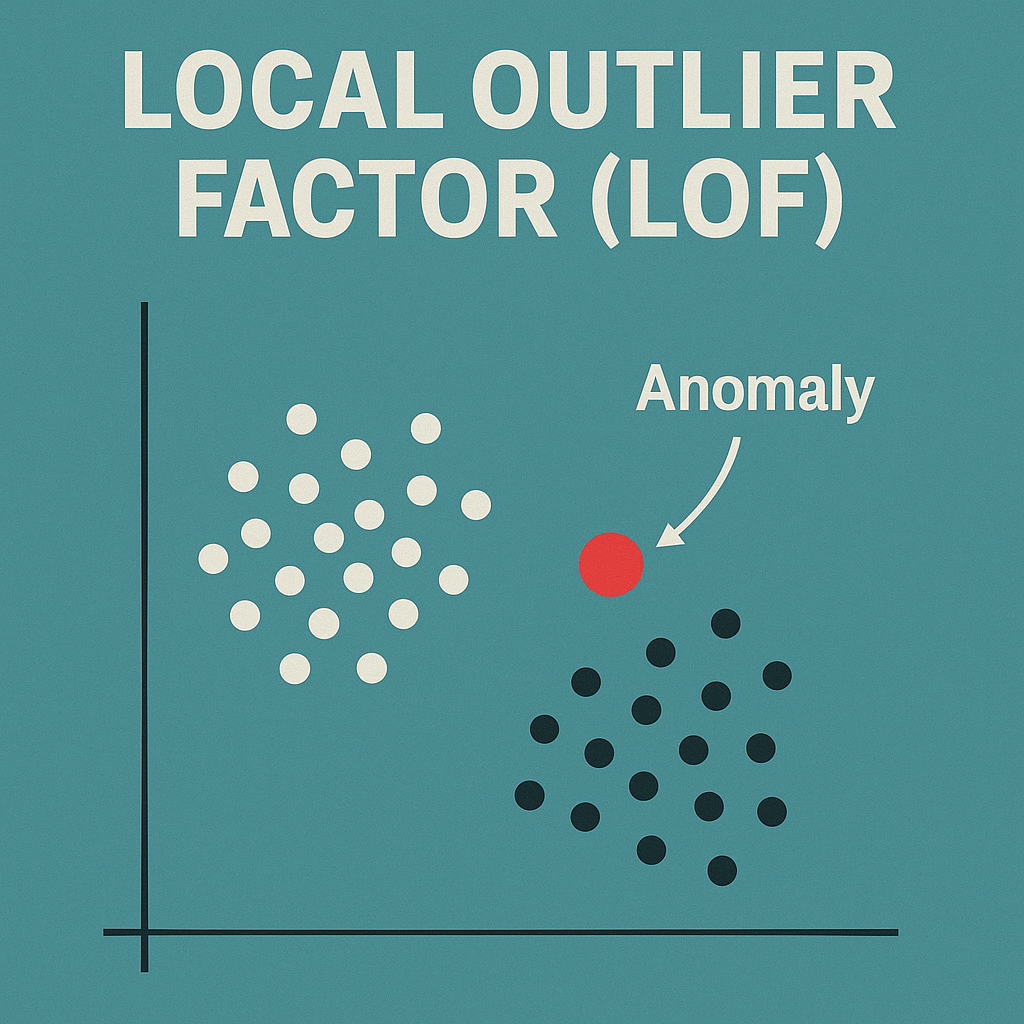
Imagine a dataset where most points form two tight clusters. A few points lie on the fringes — not far enough to be clearly separate, but not quite part of the clusters either.
Traditional detectors may miss these “borderline anomalies.”
LOF catches them because:
- Their neighbors are tightly packed
- They are looser → lower density → outliers
This local approach gives LOF an edge in non-uniform, multi-cluster datasets.
4. Pros and Cons of LOF
Strengths
- Excellent for datasets with varying densities
- Captures local anomalies missed by global methods
- Non-parametric, no distribution assumptions
- Works in high-dimensional spaces
Limitations
- Computationally expensive (requires nearest-neighbor searches)
- Sensitive to choice of k
- Not ideal for very large datasets without optimizations
5. When to Use LOF
LOF shines in scenarios where:
- clusters have different densities
- subtle anomalies need detecting
- you can afford nearest-neighbor computations
- you want explainability (LOF scores are interpretable)
Use cases include:
- fraud detection
- network intrusion detection
- manufacturing sensor deviations
- trade surveillance
- unusual pattern detection in behavioral analytics
6. LOF in Python
from sklearn.neighbors import LocalOutlierFactor
import numpy as np

# sample data
X = np.random.randn(500, 2)
X[495:] += 5  # inject outliers
lof = LocalOutlierFactor(n_neighbors=20, contamination=0.01)
y_pred = lof.fit_predict(X)
lof_scores = -lof.negative_outlier_factor_
print(lof_scores[:10])
Interpretation:
- scores > 1 = likely anomalies
- y_pred = -1 → outlier
- y_pred = 1 → normal point
7. Choosing the Right k
General rules:
- 20–50 neighbors work well for most datasets
- Smaller k → very sensitive, may flag noise
- Larger k → overly smooth, may miss local anomalies
Try multiple k values and choose the one that balances sensitivity and stability.
8. LOF vs Other Anomaly Detectors

Local Outlier Factor is one of the most powerful anomaly detection algorithms when working with complex, multi-cluster, and non-uniform datasets.
Its strength lies in looking at the world locally, not globally.
If your anomalies are subtle and hiding inside dense clusters, LOF is often the tool that will catch them.
메타데이터
- post_id
- 4b643a8da8ba
- slug
- local-outlier-factor-lof-a-simple-guide-to-density-based-anomaly-detection-4b643a8da8ba
- url
- https://medium.com/@roshmitadey/local-outlier-factor-lof-a-simple-guide-to-density-based-anomaly-detection-4b643a8da8ba
- canonical_url
- https://medium.com/@roshmitadey/local-outlier-factor-lof-a-simple-guide-to-density-based-anomaly-detection-4b643a8da8ba
- author_url
- https://medium.com/@roshmitadey
- status
- ok
- fetched_at
- 2026-07-15 01:02:51