Urbanization AP Human Geography: Causes, Effects, and Examples | APScore5
Urbanization is one of the biggest stories in human geography because it explains how humans changed the surface of the Earth by moving…
Urbanization AP Human Geography: Causes, Effects, and Examples | APScore5
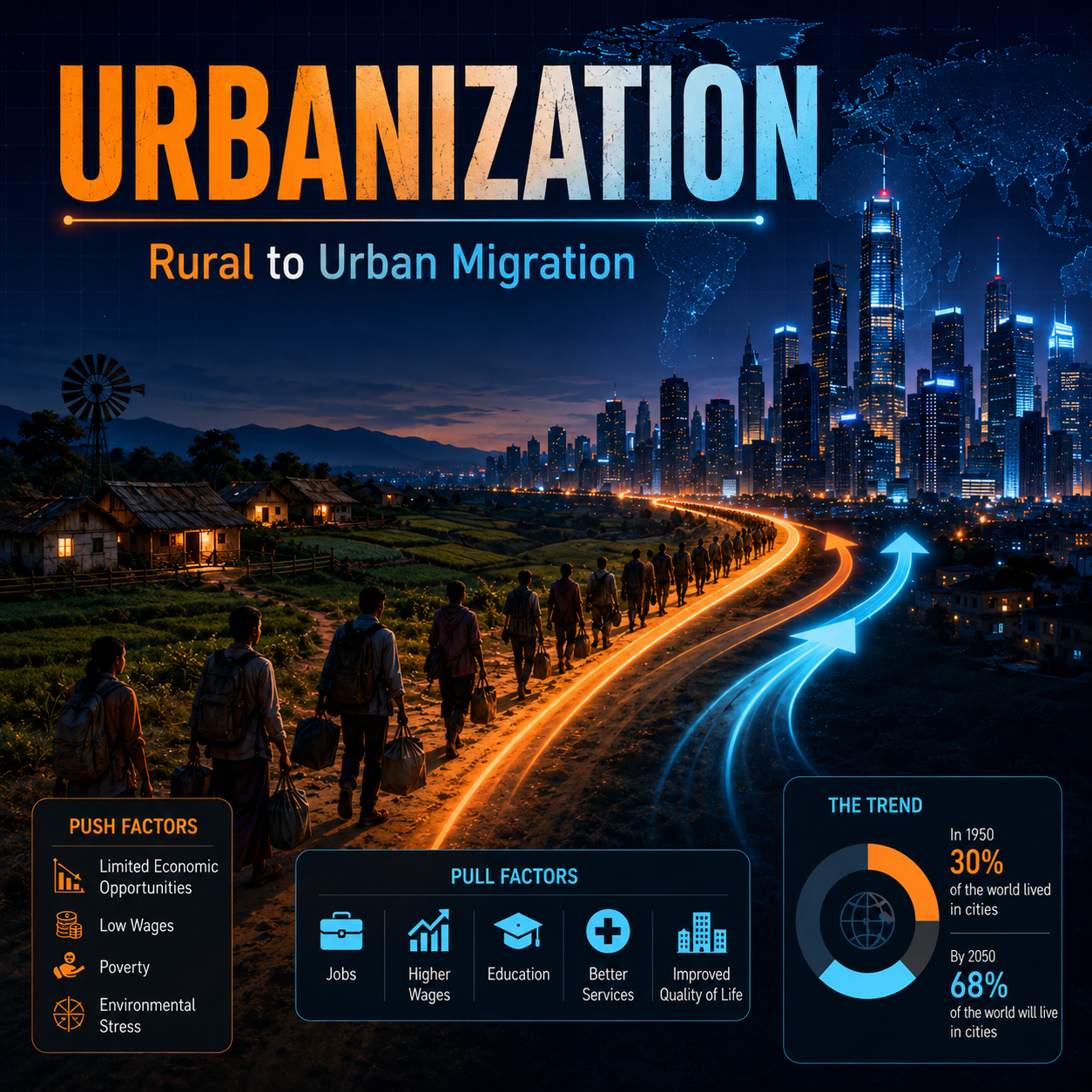
Urbanization explains how rural-to-urban migration reshapes population patterns, city growth, and land use in AP Human Geography Unit 6.
Urbanization is one of the biggest stories in human geography because it explains how humans changed the surface of the Earth by moving into cities. For most of human history, most people lived in rural areas.
They farmed, raised animals, lived close to land, and depended heavily on local resources. Cities existed, but they were smaller, fewer in number, and home to a much smaller share of the world’s population.
Today, that pattern has changed dramatically. More people now live in urban areas than rural areas, and cities have become the centers of jobs, culture, transportation, education, technology, politics, and economic power.
[embed]Urbanization — AP Human Geography Explained.
For AP Human Geography Unit 6, urbanization is not just the growth of cities. It is the movement of people, the transformation of land, the rise of urban systems, and the creation of new social and economic patterns. When you study urbanization, you are really studying how human beings organize space when population, industry, transportation, and opportunity concentrate in one place.
The simplest definition is this: urbanization is the process by which an increasing percentage of a population lives in cities. That sounds simple, but the idea is powerful. Urbanization changes where people live, how they work, how they travel, what they consume, and how societies are structured. It also creates major challenges, including traffic congestion, housing shortages, pollution, inequality, urban sprawl, and pressure on infrastructure.
If you want to understand AP Human Geography Unit 6, urbanization is one of the first concepts you need to master.
Why Urbanization Happens
Urbanization happens because people move toward opportunity. Cities often provide more jobs, better schools, hospitals, transportation networks, entertainment, government services, and access to markets. When people leave rural areas and move to cities, they are usually responding to push and pull factors.

Urbanization often begins when rural push factors and urban pull factors combine to drive migration toward cities.
Push factors are conditions that drive people away from a place. In rural areas, these may include poverty, lack of jobs, limited schools, poor health care, land shortages, natural disasters, political instability, or declining agricultural income. When farming becomes less profitable or when land can no longer support a growing population, people begin to look for new options.
Pull factors are conditions that attract people to a place. Cities may offer factory jobs, service jobs, universities, hospitals, housing, transportation, cultural life, and the possibility of upward mobility. Even when city life is difficult, people may still move because they believe the city offers more opportunity than the countryside.
This is why urbanization is closely connected to migration. In AP Human Geography, migration is the movement of people from one place to another, and urbanization is often powered by rural-to-urban migration. People leave farms, villages, and small towns and move into cities because they are searching for a better life.
Urbanization also happens through natural increase. This means that the urban population grows because births exceed deaths within cities. In many rapidly growing cities, especially in developing countries, both rural-to-urban migration and natural increase are happening at the same time. That makes urban growth extremely fast.
The Industrial Revolution and the Rise of Modern Cities
The Industrial Revolution was one of the major turning points in the history of urbanization. Before industrialization, most people were involved in agriculture, and cities were limited by transportation, food supply, and technology. When factories developed, jobs began to concentrate in urban areas. People moved from farms to cities to work in manufacturing.
This was especially important in places like Great Britain, Western Europe, and the northeastern United States. Industrial cities grew around factories, railroads, ports, coal fields, and transportation routes. Cities became centers of production, not just trade and government.
Industrialization created a powerful connection between economic development and urban growth. As countries industrialized, they usually urbanized. Workers moved to cities because that was where the jobs were. Businesses located in cities because they could access labor, transportation, capital, and markets. This pattern is one of the reasons AP Human Geography links urbanization with economic development.
However, early industrial cities were often harsh places to live. Many had overcrowded housing, poor sanitation, pollution, unsafe working conditions, and extreme class inequality. These problems are still important because they help explain why urban planning became necessary. Cities needed roads, sewers, zoning laws, public transportation, housing regulations, and services to manage rapid growth.
Urbanization in Developing Countries
Urbanization today looks different from the urbanization that happened during the Industrial Revolution. In many developing countries, cities are growing very quickly, sometimes faster than governments can provide housing, water, roads, schools, jobs, and sanitation. This creates a major AP Human Geography theme: urbanization can bring opportunity, but it can also create serious challenges when growth is too rapid.
Many cities in Africa, Asia, and Latin America have experienced explosive population growth. People move to cities because rural areas may not provide enough economic opportunity. At the same time, cities may not have enough formal jobs or affordable housing for everyone who arrives. This can lead to the growth of informal settlements.
Informal settlements are residential areas where people build housing without legal ownership of the land or full access to public services. These areas may be called squatter settlements, shantytowns, barrios, favelas, or slums, depending on the region. For AP Human Geography, the key idea is that informal settlements show the gap between rapid urban population growth and the ability of governments to provide planned housing and infrastructure.
It is important not to describe informal settlements only as places of poverty. They are also places where people create communities, informal economies, social networks, and survival strategies. Many residents work in informal jobs, run small businesses, or commute to other parts of the city. These areas reveal both the challenges and resilience of urban populations.
Megacities and World Cities
Urbanization has also created megacities. A megacity is usually defined as a city with more than 10 million people. Megacities are important because they show the massive scale of modern urban growth. Cities such as Tokyo, Delhi, Shanghai, São Paulo, Mexico City, Cairo, Lagos, and Jakarta represent how large urban areas can become when migration, natural increase, economic concentration, and globalization combine.

Megacities show the massive scale of modern urbanization as population, infrastructure, and economic activity concentrate in large cities.
Not all large cities have the same global importance. AP Human Geography also uses the term world city, or global city, to describe cities that play a major role in the global economy. A world city is influential because it contains financial institutions, corporate headquarters, advanced services, media centers, transportation hubs, universities, and international connections. New York, London, and Tokyo are classic examples.
The difference matters. A megacity is defined mainly by population size. A world city is defined mainly by economic and cultural influence. Some cities are both megacities and world cities, but not all megacities are global command centers. This is a common AP Human Geography distinction.
How Urban Land Use Changes Space
Urbanization does not only increase population. It also changes land use. Cities require housing, roads, businesses, schools, hospitals, parks, factories, warehouses, airports, rail lines, and government buildings. As cities grow, land is converted from rural to urban use.
Urban land tends to become more valuable near the center of the city because accessibility is higher. This connects to the bid-rent theory. Bid-rent theory explains that land prices are often highest near the central business district because many businesses want access to the most central and connected location. As distance from the city center increases, land values often decrease, although modern transportation and suburban growth can complicate the pattern.
The central business district, or CBD, is the commercial core of a city. It usually contains office towers, banks, government buildings, stores, hotels, and major transportation connections. In older cities, the CBD is often the historic downtown. In newer or more spread-out cities, economic activity may be more decentralized.
AP Human Geography often asks students to think spatially. That means you should ask where things are located and why they are there. Urbanization creates spatial patterns. Wealthy areas may cluster in certain districts. Industrial zones may locate near railroads or highways. Low-income housing may be pushed to less desirable land. Suburbs may grow along transportation corridors. These patterns reveal how money, power, transportation, and planning shape the city.
Suburbanization and Urban Sprawl
Urbanization does not always mean people are moving into the dense city center. In many developed countries, especially after World War II, suburbanization became a major pattern. Suburbanization is the movement of people, businesses, and services from the central city to areas on the urban fringe.

Urban growth can produce sprawl or sustainable development depending on transportation, land-use planning, density, and infrastructure choices.
Suburbs grew because of highways, automobiles, rising incomes, government housing policies, and the desire for larger homes and more space. Many families moved away from dense urban centers and into residential subdivisions outside the city. Shopping malls, office parks, schools, and hospitals followed them.
Suburbanization often leads to urban sprawl. Urban sprawl is the spread of low-density development over a large area. It usually depends on cars and highways. Sprawl can create problems such as traffic congestion, loss of farmland, longer commutes, increased air pollution, and higher infrastructure costs.
For AP Human Geography, urban sprawl is important because it shows how transportation technology shapes urban form. When people depend on cars, cities spread outward. When cities invest in public transportation, walkability, and mixed-use development, they can become more compact.
Gentrification and Changing Neighborhoods
Another important urban process is gentrification. Gentrification happens when wealthier residents and businesses move into a lower-income urban neighborhood, often raising property values and changing the character of the area. Buildings may be renovated, new restaurants and shops may open, crime may decline, and tax revenue may increase.
However, gentrification can also displace long-term residents who can no longer afford rising rents or property taxes. This makes gentrification a controversial process. Some people see it as neighborhood revitalization. Others see it as displacement and cultural loss.
For AP Human Geography, the most important thing is to understand both sides. Gentrification can bring investment, but it can also create inequality. It shows how urban space is not neutral. Space is shaped by economic power, housing markets, public policy, and social change.
Urban Challenges
Urbanization creates opportunities, but it also creates problems. Large cities need massive systems to function. They need clean water, sewage treatment, electricity, public transportation, waste collection, housing, schools, hospitals, policing, and emergency services. When urban growth happens faster than infrastructure development, cities struggle.
Traffic congestion is one common problem. As more people move into cities and suburbs, roads become crowded. Long commutes reduce quality of life and increase pollution. Housing affordability is another major issue. When demand for urban housing rises faster than supply, prices increase, and lower-income residents may be pushed out.
Environmental issues are also important. Cities consume large amounts of energy and resources. They produce waste, heat, pollution, and greenhouse gas emissions. Urban areas can create heat islands, where temperatures are higher than surrounding rural areas because of concrete, asphalt, buildings, and reduced vegetation.
Inequality is one of the most important themes in urban geography. Cities often contain extreme wealth and extreme poverty close together. Luxury apartments, financial districts, informal settlements, public housing, and gated communities can all exist within the same metropolitan area. This makes cities powerful examples of uneven development.
Sustainable Urbanization
Because urbanization is not stopping, the key question is not whether cities will grow. The key question is how cities will grow. Sustainable urbanization focuses on building cities that are more efficient, equitable, livable, and environmentally responsible.
Sustainable cities may invest in public transportation, bike lanes, walkable neighborhoods, green spaces, renewable energy, mixed-use development, affordable housing, and better waste management. The goal is to reduce environmental damage while improving quality of life.
Smart growth is one planning approach that tries to limit sprawl and create more compact, connected communities. Instead of spreading outward endlessly, smart growth encourages higher-density development, public transit, mixed land use, and preservation of open space.
For AP Human Geography, sustainable urbanization connects Unit 6 to larger themes across the course. It connects to population, migration, economic development, environmental impact, land use, and political decision-making. Cities are not just places where people live. They are systems that reveal how societies make choices.
Why Urbanization Matters for the AP Exam
Urbanization is likely to appear on the AP Human Geography exam because it connects vocabulary, models, real-world examples, and geographic reasoning. You may be asked to define urbanization, explain causes of rural-to-urban migration, compare megacities and world cities, analyze urban sprawl, describe informal settlements, or explain how transportation affects city growth.
The key is to avoid memorizing definitions without understanding the process. AP questions often ask why something happens, how it changes space, or what consequences it creates. If you see a question about people moving from rural villages to a city, think about push and pull factors. If you see a question about low-density development spreading along highways, think about suburbanization and sprawl. If you see a question about rising rents and changing neighborhoods, think about gentrification. If you see a question about a city with more than 10 million people, think megacity. If you see a question about a city with global financial influence, think world city.
Urbanization is powerful because it is visible. You can see it in skylines, highways, apartment towers, shopping centers, informal settlements, rail stations, suburbs, and downtown districts. Every city is a geography lesson.
Final Takeaway
Urbanization is the story of people moving into cities and transforming the world around them. It is one of the biggest migrations in human history because it marks a massive shift from rural life to urban life. For AP Human Geography Unit 6, you need to understand that urbanization is not just city growth. It is a process connected to migration, industrialization, economic opportunity, land use, inequality, infrastructure, transportation, and sustainability.
The easiest way to remember the concept is simple: urbanization means more people living in cities. The AP-level understanding goes deeper. You must know why people move, how cities expand, what problems rapid urban growth creates, and how planning can make cities more sustainable.
Cities are now the main stage of human life. They are where millions of people search for work, education, safety, identity, and opportunity. They are also where some of the biggest challenges of the future will be solved or made worse. That is why urbanization matters. It is not just an AP Human Geography vocabulary word. It is one of the most important changes in human history.
For more AP Human Geography review, practice questions, and quick explanations, visit APScore5.com and keep building the concepts that help you score higher.
A large developing-country metropolis has grown quickly over twenty years.
- A. Identify one positive effect of urbanization.
- B. Identify one negative effect of urbanization.
- C. Explain one planning response a city might use to address the negative effect.
Your draft (optional — saves in this browser)
Show scoring rubricReveal sample answer
Scoring rubric (3 points)
- 1 pt — Valid positive effect (jobs, services, innovation, etc.)
- 1 pt — Valid negative effect (housing, congestion, pollution, etc.)
- 1 pt — Planning response connected to the negative effect
Sample response
A: Urbanization can concentrate jobs and services, improving access to wages and healthcare.
B: Rapid growth can produce traffic congestion and air pollution from concentrated vehicles and industry.
C: The city might expand public transit and enforce emissions standards to reduce congestion and pollution.
Status: Draft your answer first-then open the rubric or sample.
Originally published at https://www.apscore5.com.
메타데이터
- post_id
- 4b74446d3f33
- slug
- urbanization-ap-human-geography-causes-effects-and-examples-apscore5-4b74446d3f33
- url
- https://medium.com/@ap_53163/urbanization-ap-human-geography-causes-effects-and-examples-apscore5-4b74446d3f33
- canonical_url
- https://medium.com/@ap_53163/urbanization-ap-human-geography-causes-effects-and-examples-apscore5-4b74446d3f33
- author_url
- https://medium.com/@ap_53163
- status
- ok
- fetched_at
- 2026-06-17 08:20:12