The Economic Crash Is Coming, Even to America
The damage wrought by the US and Israel’s war has not reached its crescendo yet, and won’t, even if the war ends tomorrow
The Economic Crash Is Coming, Even to America
The damage wrought by the US and Israel’s war has not reached its crescendo yet, and won’t, even if the war ends tomorrow
Greetings from one of the two countries at fault for the disaster unfolding in some places, and imminent in others. Americans have complained with greater fury lately over rapidly rising gas and commodity prices, but what they have endured so far is only a taste of what’s to come.
If you find this newsletter informative and care to offer a little something in support, feel free to buy me a coffee or become a subscriber. For those of you who prefer storytelling and art over this fictionalized reality we are living through, check out my other site, Inverted Umbrella.
Now, to the business at hand…

Credit: Eyestetix Studio on Unsplash
The oil problem
More than two months into the war in Iran, Western economies have not yet felt its true impact. Prices have risen in those places, yes, but not at a clip representative of reality. Historical numbers tell the real story of what is coming. Consider this chart, compiled by economist Steve Keen:
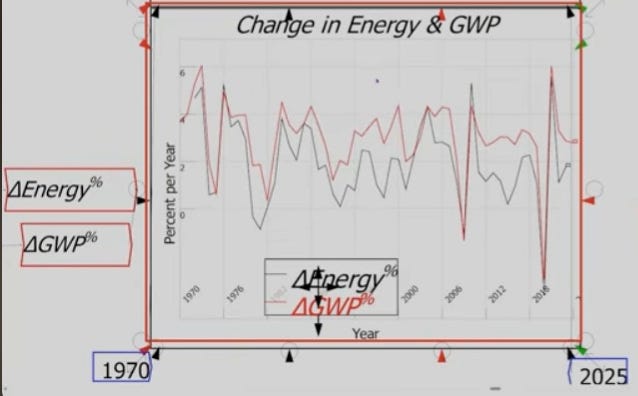
It shows a direct correlation between energy production and gross world product (GWP), which is basically the same thing as GDP, but measured across the entire planet. As energy production rises or falls, so too does GWP.
International Energy Agency (IEA) Executive Director Fatih Birol said the current loss of oil in the global market ranges around 12 million barrels per day. That amounts to about 12% of global production. If Keen’s numbers hold, they suggest we face a potential double-digit drop in GWP (the percentage drop in GWP virtually mirrors the percentage of energy lost or withheld from the world market). For comparison, during the height of the COVID lockdowns, global GDP or GWP dropped by 3%.
If energy production, particularly oil, is so important to the global economy, why hasn’t the price risen more dramatically yet? You might ask.
There are three prongs to this answer.
First, oil moves slowly. Those giant tankers sail at speeds similar to a fast mall-walker. For that reason, Saudi oil shipped to California takes as long as 50 days to arrive. The war started 76 days ago (at the time of this writing), so the last bit of oil from the Middle East landed in California just two weeks ago. Oil lost from the Middle East was only noticed after the last ships arrived. Depending upon your location in the world, that could have been shortly after the war’s beginning to almost two months later.
Second, 32 member countries of the IEA agreed back in mid-March to release 400 million barrels from their energy reserves over a specific time period. Such releases would stopgap the production shortfall and slow price escalation. Governments, under this plan, are essentially accommodating demand through reserve releases, thereby suppressing the true price.
But on May 12, the IEA warned that global reserves depleted faster in April than in March, apparently ahead of the schedule set forth in the March agreement. This is unsustainable. Jeff Currie, senior advisor at Carlyle Group, noted that even in the oil-rich United States, at the current rate of consumption and export, the country’s reserves will run dry by July. He ominously added he has “never seen anything like it before.”
When global reserves completely vanish, the price of oil will skyrocket with unprecedented speed; Western countries just haven’t gotten there yet. When they do, the question will become: at what price does demand destruction occur? (I explained what demand destruction is in a previous article, linked below).
Third, some countries have launched an initiative that is artificially propping up demand (aside from leaning on reserves) while simultaneously accelerating the depletion of supply: price caps on gasoline. Such caps have been instituted in South Korea, Poland, and Thailand. Others have taken the related step of reducing or fully pausing gasoline taxes; even the US is considering doing so.
About this, Rodrigo Valdes, the IMF’s fiscal affairs chief, said:
We don’t have oil. We don’t have energy. Energy needs to be more expensive for everybody, so that the adjustment happens and we consume less. You can pass through (higher energy prices) and then you can do other things to help. It’s a global shock and if countries suppress the price signal, the global price will be higher… It’s very important to give price signals so demand can adjust.
In other words, subsidizing a product of which there simply is not enough doesn’t make the effects of a shortage magically disappear, it instead hastens the shortage’s arrival and worsens those effects.
So, mark the date. If the Strait of Hormuz does not resume traffic soon, all countries worldwide will see fuel lines or rationing by July.
The food problem
Another issue we are facing is a massive increase in the price of food, followed by actual food shortages if the war continues for long. There are several reasons the world’s food supply is at risk.
First, as the price of gasoline — and especially diesel — climbs, so too does the cost to produce and ship food. People around the globe, including Americans, have already experienced rising food prices. In April in the United States, for instance, prices jumped more in a single month than they have in four years — when the Ukraine-Russia crisis began. Most food items in the United States are shipped by truck. Since January, diesel has climbed by $1.83 per gallon. That increase was (and will continue to be) passed onto consumers.
But the high cost of diesel creates problems before a single vegetable is loaded onto a truck. Tractors, combines, trucks, irrigation pumps, and the equipment that moves crops from the field to market all run on the stuff. Problematically, farmers cannot alter the timeline of operations to try and evade (what they hope are) temporary blips in the fuel market. They are forced to purchase it at whatever the rate happens to be, and if they lack the funds, must scale back operations. Put another way, if gas is too expensive, they will plant less.
Farms in the US faced a difficult year in 2025 in large part because of misguided tariffs. The two years before that were even worse, as natural disasters caused billions in losses. Then came 2026.
Tariffs still linger, certain important regions are currently suffering severe drought conditions, and the war-driven fuel crisis is landing right in the middle of the planting season. Many farmers face the prospect of bankruptcy, continuing a trend that was thought to have peaked in 2024–25. That year, bankruptcy filings climbed by 46%.
Just recently, a survey found 70% of farmers could not afford the amount of fertilizer they need to produce at normal levels. This is driven by the extraordinary loss of Middle Eastern liquified natural gas, the production of which creates byproducts used to make fertilizer. Debt held by farmers nationally is expected to smash records this year. In 2025, total farmer debt reached $478 billion. Projections for 2026 are over $600 billion. Those estimates were made before the war in Iran started, so expect far worse.
If more farmers go bankrupt this year, choose to plant significantly fewer plants, or lose crops to drought, grocery prices will not only continue to rise, exacerbated by the rising cost to produce and transport them, but some foods may become unavailable.
Unfortunately, while demand destruction might be possible for oil (people can drive less, for example), it is far less doable when it comes to food. Consumers will certainly pivot their habits, purchasing higher-calorie-to-dollar items (which will probably have adverse health effects), but they cannot forego food altogether or even dramatically decrease their consumption.
Demand destruction caused by higher food prices will occur in other sectors in the form of consumers dropping services or foregoing ‘convenience’ products to preserve money for food. This might include things like unsubscribing from streaming services, refusing to buy new items such as clothing, or delaying activities such as car or home maintenance. Of course, these kinds of demand destruction will contribute to growing unemployment, which will perpetuate the recessive environment.
Could we run out of oil?
It is impossible to predict with certainty, but I suspect we would run out of demand for oil long before we physically run out of the product. Obviously, we would never completely end demand — oil is used in nearly every sector. What I mean is demand would diminish to levels that are sustainable under the volume of production that excludes what is lost each day as a result of the war. This will happen when the price reaches such a height that people are forced to adopt less oil-reliant lifestyles.
Although such a shift in demand would be a good thing in the long-run (environmentally speaking), it would be very painful in the short-term. In America, much of the country lacks viable public transportation. People living in rural areas, where poverty is most abundant, would face complete ruin if the price of gasoline exceeds their financial thresholds.
Beyond transportation, however, demand would likely drop in various sectors because of rising prices associated with oil. As noted above, oil is used in practically every sector. The cost of items like clothing, electronics, food, and so forth are directly tied to the price of oil. When everything gets more expensive, non-necessities get sacrificed, and even some necessary expenses will be suspended for as long as possible (think, for example, of delaying doctor appointments to avoid the copay).
What if the war (truly) ends tomorrow?
The results of this, too, are hard to predict because it would depend upon the terms of the cessation. Even supposing we could somehow turn back the clock to the geopolitical conditions of February 27, many negative economic affects would persist for months. (It should go without saying that the geopolitical environment that existed before the war is finished, so what’s described below is a best-case scenario.)
Energy prices would come down a bit, if for no other reason than renewed optimism. Still, they would be quite a bit higher than they were before, and would remain so for the months — possibly the years — it will take to restore infrastructure that was destroyed.
Food prices, on the other hand, would probably keep rising. The reason is because it will take time to reinvigorate the fertilizer and diesel supply, time that farmers do not have. What hasn’t been planted by now is irrevocably lost from the market. Fall (harvest time) prices for food will be exorbitant, regardless of what might happen tomorrow.
Both of those problems will hurt global production. Oxford Economics predicts GWP to reach only 2.4% for 2026, and only if the Strait returns to 50% of its pre-war capacity by June at the latest. Inflation will remain a problem, driven by food and still-high oil prices. Persistent inflation or even a surge could “de-anchor[] inflation expectations [from interest rates], permanently raising long-term borrowing costs, and altering how monetary policy responds to future shocks.”
Wages and employment are also directly linked to inflation expectations. Normally, heightened inflation leads to increased wages (though not evenly), but as the economy contracts under the weight of higher commodity and energy prices, unemployment will rise. The Fed’s usual response to higher inflation is to raise interest rates to slow growth, but if growth is already slowed, this will not help. What we are left with is stagflation — inflation without growth.
The US will have an acute problem in its battle against stagflation. Typically, the best policy is to reduce government spending and the amount of money in circulation, the latter by selling government bonds. Unfortunately, the US government is severely limited in its ability to execute these measures. Moreover, most of the ancillary actions governments can take, such as investing more heavily in alternative energy and reforming the labor market, are in direct contradiction to the ruling party’s ideology. The current US government is not likely to look toward those options.
The war won’t end tomorrow, anyway
In order for the war to end tomorrow, the competing sides need to be negotiating today. The parties to this war are not doing that. What they actually are doing can only be described as nuts. As a student of history, I cannot recall reading about any situation that parallels the absurdity of the present circumstances. Sure, external-party countries have served as mediators when the sides refused to come to the table together. But this is different.
One of the three sides seems not to be involved in negotiations at all — Israel. Just in the past few days, Netanyahu flat-out declared the war is not over. His demands for what would end the war are exactly those Iran recently refused to discuss or outright rejected (such as dismantling its nuclear [refused to discuss] and missile programs [outright rejected]).
But Netanyahu’s demands are largely irrelevant. Under his rule, Israel has repeatedly violated ceasefires announced by the US and Iran. He has stated publicly his desire to destroy Iran. His troops regularly commit atrocities (i.e. war crimes) against Iran’s allies, the Lebanese and Palestinians. There is no value in negotiating with this person.
Another of the three sides, the Iranians, have laid out their conditions several times. In each instance, the demands became simpler by kicking specific issues down the road. Meanwhile, they continue to mock the US president on social media and with AI-generated videos. They’ve otherwise refused to engage with the Americans since the one and only meeting with Vice President JD Vance, declaring them untrustworthy and unserious. I explained in detail why the Iranians think this, here:
[embed]When Peace is Off the Table You're left with surrender or annihilationrobertvanwey.substack.com
Because of the Iranians’ refusal to deal with the Americans directly, they’ve turned to Pakistan to mediate. The Pakistanis’ motives in this are questionable, having recently “stabbed the US in the back” by opening six ground crossings to Iran to help sustain its economy, as one illustration. They do not seem to be entirely neutral or effective.
Finally, there are the Americans, who have cranked the absurdity dial to ten. To commence negotiations, Trump elected to send two of the most incompetent people he could have chosen — his son-in-law and a guy whose expertise, such as it is, is in real estate. They were not accompanied by Persian speakers or subject matter experts on Iran or nuclear programs. Indeed, the real estate guy openly admitted he knew nothing about nuclear enrichment or Iran’s efforts related to it.
Even if Trump wises up and selects a better team of negotiators and Iran agrees to meet them (two very improbable ifs), talks would be immediately undermined by Trump’s constant late-night rage posting on his social media app. He routinely calls for the annihilation of Iran and its people, threatens various violent actions, then immediately claws back such comments. Some of his threats and take-backs seem timed to make hundreds of millions of dollars in the prediction and stock markets.
In the midst of this circus, the world is enduring the greatest energy supply shock in history while the markets seem to be pretending nothing is wrong.
The whole situation is insane.
And for these reasons, the war seemingly can’t end anytime soon because there is no one to end it. No one is talking to each other. The mediator seems to have its own agenda. The proposals proffered so far appear wholly unacceptable to the opposing side. Worst of all, it’s not even clear what ‘end’ would mean, perhaps other than that the Strait is reopened. And what ‘reopened’ means is itself ambiguous. Does it mean Iran collects a toll or decides who is allowed to pass through?
Sadly, it appears only a true catastrophe will bring this conflict to a final halt. It could manifest as a global economic crash causing one side to capitulate or as a substantial escalation followed by a decisive military victory. The former could lead to levels of famine similar to China’s Great Famine in 1959, the Dutch famine of WWII, or the Soviet famine of the 1930s. The latter could see the detonation of a nuclear weapon or the destruction of infrastructure that forces millions to flee the Middle East (think desalination plants).
Nothing about 2026 looks good.
What can I do to protect myself?
Start by recognizing the American government will not help you. Trump explicitly said he does not “think about Americans’ financial situation.” For once, he was truthful.
[embed]
He has claimed the government cannot afford “Medicare, Medicaid and child care” because his warmongering is too expensive. This is also the guy who threw paper towels at Puerto Ricans after Hurricane Maria while his government only provided about 60% of the funds needed for reconstruction. So, aside from whatever states can do, expect no help coming from your own taxpayer dollars.
That said, there are a number of measures you can take to reduce your household’s pain:
- Fill your gas tanks regularly to reduce the impact of sudden price jumps (don’t wait until you are near empty);
- Avoid unnecessary driving;
- Avoid aggressive driving — it consumes more fuel;
- Check your records for unused subscription or other services you continue to pay for — a report in 2025 found Americans pay, on average, $205 per month on unused services;
- Lower monthly energy usage by cutting back on energy-hungry devices like AC;
- Buy more non-perishable food to use in the event of shortages or substantial price hikes;
- Shop at thrift stores — they are a great place to buy cheap work clothes, furniture, and appliances;
- Keep in regular touch with your family or friends — this will help in times of financial duress but, perhaps more importantly, it will also help keep you mentally well in these trying times.
We will make it through this and, with luck, the world will welcome a more moral and rational United States. For now, though, we must focus on preparation and survival.
메타데이터
- post_id
- 4b7e08d75804
- slug
- the-economic-crash-is-coming-even-to-america-4b7e08d75804
- url
- https://medium.com/policy-panorama/the-economic-crash-is-coming-even-to-america-4b7e08d75804
- canonical_url
- https://medium.com/policy-panorama/the-economic-crash-is-coming-even-to-america-4b7e08d75804
- author_url
- https://medium.com/@rlvanwey
- status
- ok
- fetched_at
- 2026-06-09 15:37:30