The Banyan Vs. The Sapling: What Climate Physics Teaches Us About Old Growth and New Hope
What a 550-year-old banyan in Andhra Pradesh, India teaches us about the real physics of climate restoration
The Banyan Vs. The Sapling: What Climate Physics Teaches Us About Old Growth and New Hope
What a 550-year-old banyan in Andhra Pradesh, India teaches us about the real physics of climate restoration
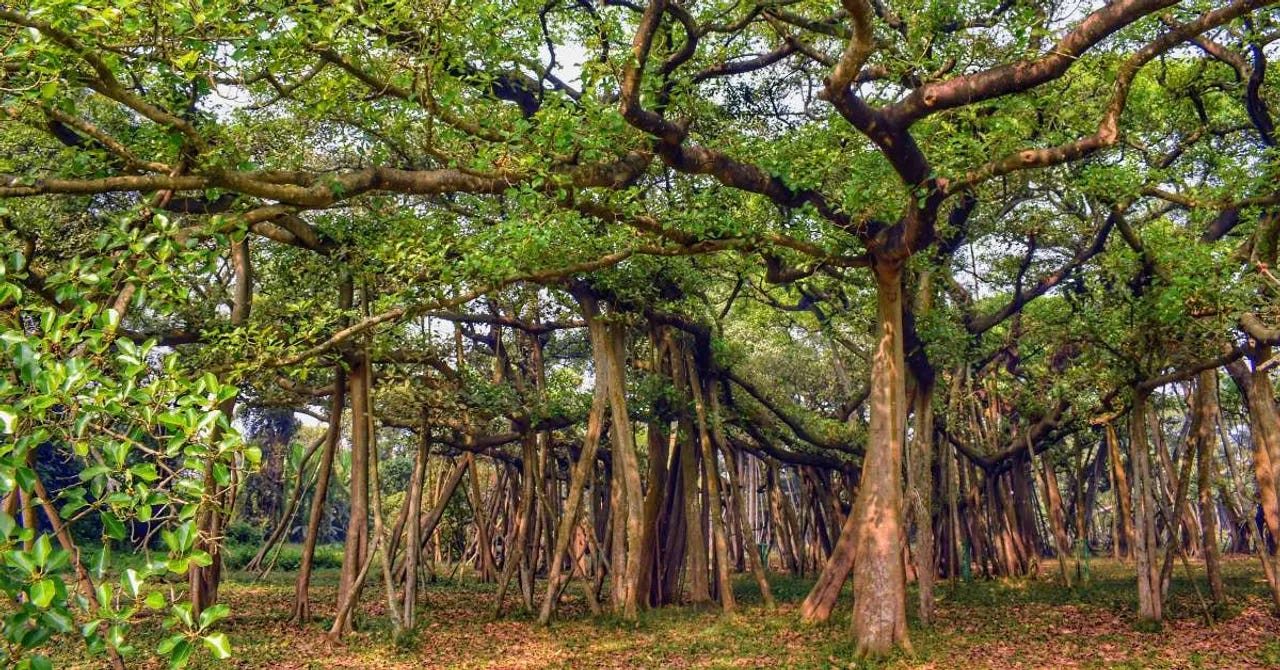
Thimmamma Marrimanu is a huge banyan tree located in the village of Gutibayalu in the Anantapur district of Andhra Pradesh; Picture source: Forbes
In the heart of Andhra Pradesh (India), lives a single organism so large it looks like a forest. Her name is Thimmamma Marrimanu.
At 550 years old, this banyan tree covers five acres, roughly the size of four football fields. She has over 4,400 aerial prop roots, each one a woody pillar supporting a canopy that breathes for an entire region.
Thimmamma isn’t just a local wonder; she is a carbon-sequestering powerhouse.
While the world is currently obsessed with the simple narrative of “planting a million trees,” Thimmamma reminds us that in the world of climate physics, age is much more than a number.
TL;DR
- Maturity Wins: A single mature banyan tree can absorb up to 20 tonnes of CO2 annually, while a sapling in its first decade captures just 5.5 kg in total.
- Protection First: Avoiding deforestation provides roughly twice the carbon benefit of planting new forests over a 45-year horizon.
- The Time Gap: New forests often take 10 to 20 years before they even become “net carbon sinks”, meaning they might release more carbon than they store in their early years.
- Data-Driven Action: Real impact comes from protecting old-growth giants and using verified field reporting to ensure new restoration projects actually survive.
The Great Carbon Mismatch
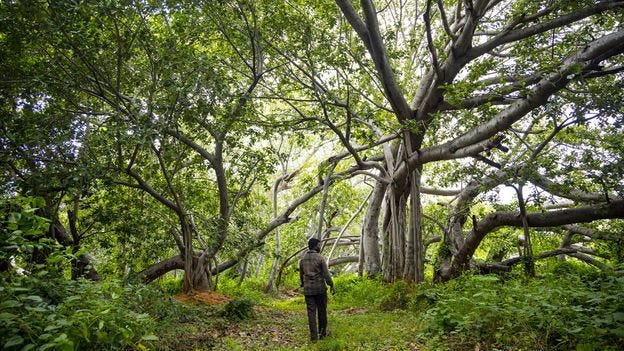
Source-BBC
We love the image of a child planting a sapling. It feels hopeful, active, and clean. But if we look at the physics, the math doesn’t quite add up.
According to a study by Superales (2015), a mahogany sapling captures roughly 34.29 grams of CO2 in its earliest stages, totalling about 5.5 kg over its first ten years.
In contrast, research by Ansari et al. (2026) on the banyan trees at Rajshahi University shows that a single mature specimen can sequester nearly 200,000 kg (200 tonnes) of CO2 over its lifetime, with some mature banyans pulling in 20 tonnes every single year.
To put that in perspective, you would need to plant and successfully grow nearly 4,000 saplings to match the annual carbon work of just one grandmother tree like Thimmamma.
Why Old Growth is the Gold Standard
Source-Unsplash
It’s tempting to think of forests like a factory: if you build more, you get more output. But forests are biological systems.
Recent research from Resources for the Future (RFF, 2023) highlights that old-growth forests store substantially more carbon than young forests.
Fischer, Wang, and Huth (2024) explain that mature trees have reached a structural complexity that young plantations simply cannot replicate.
They have deeper root systems, more complex fungal networks in the soil, and a massive amount of “standing carbon” in their trunks.
When we cut down an old forest and replace it with saplings, we aren’t “restarting” the clock.
We are actually creating a massive carbon debt.
Studies in *Nature Climate Change* (2025) suggest that secondary forests can take decades to become net carbon sinks.
In those first 10–20 years, the soil disturbance and the death of young saplings can actually result in a net release of CO2.
The Trap of the Million Tree Narrative
The “plant a million trees” slogan is a favourite for corporate greenwashing. It’s cheap, it looks good on a billboard, and it’s easy to count.
But it ignores the “leakage”, the high mortality rate of saplings that are planted without long-term care or data tracking.
At The Better Human™ Life Foundation, we see this as a call for climate justice. It isn’t enough to just put a stick in the ground. We have to ensure that the sticks we plant today become the giants of tomorrow.
From Law to Direct Action
I began my career in law. And spent years navigating the fine print of regulations and corporate promises.
But I noticed a recurring pattern: plenty of talk, plenty of “offset” credits, but very little measurable change on the ground.
I left the legal world to start The Better Human NGO because I realised that real impact isn’t about optics, it’s about accountability.
We don’t just want to plant trees; we want to protect what already works and restore what is broken with mission-based giving.
Verifiable Hope
The physics of climate change doesn’t care about our intentions; it only cares about the atoms of carbon moving in and out of the atmosphere.
That is why we use a Live Mission Tracker. Every project we undertake, from planting mangroves to supporting school transport, is geo-tagged and numbered.
We have moved away from the “black box” of traditional charity. With our model, 100% of funds go directly to the field.
We cover the admin costs so that your contribution goes straight to the front lines of ecological restoration.
How We Move Forward
Does this mean we should stop planting saplings? Of course not. Every ancient banyan started as a tiny seed.
But it does mean we need to change our strategy.
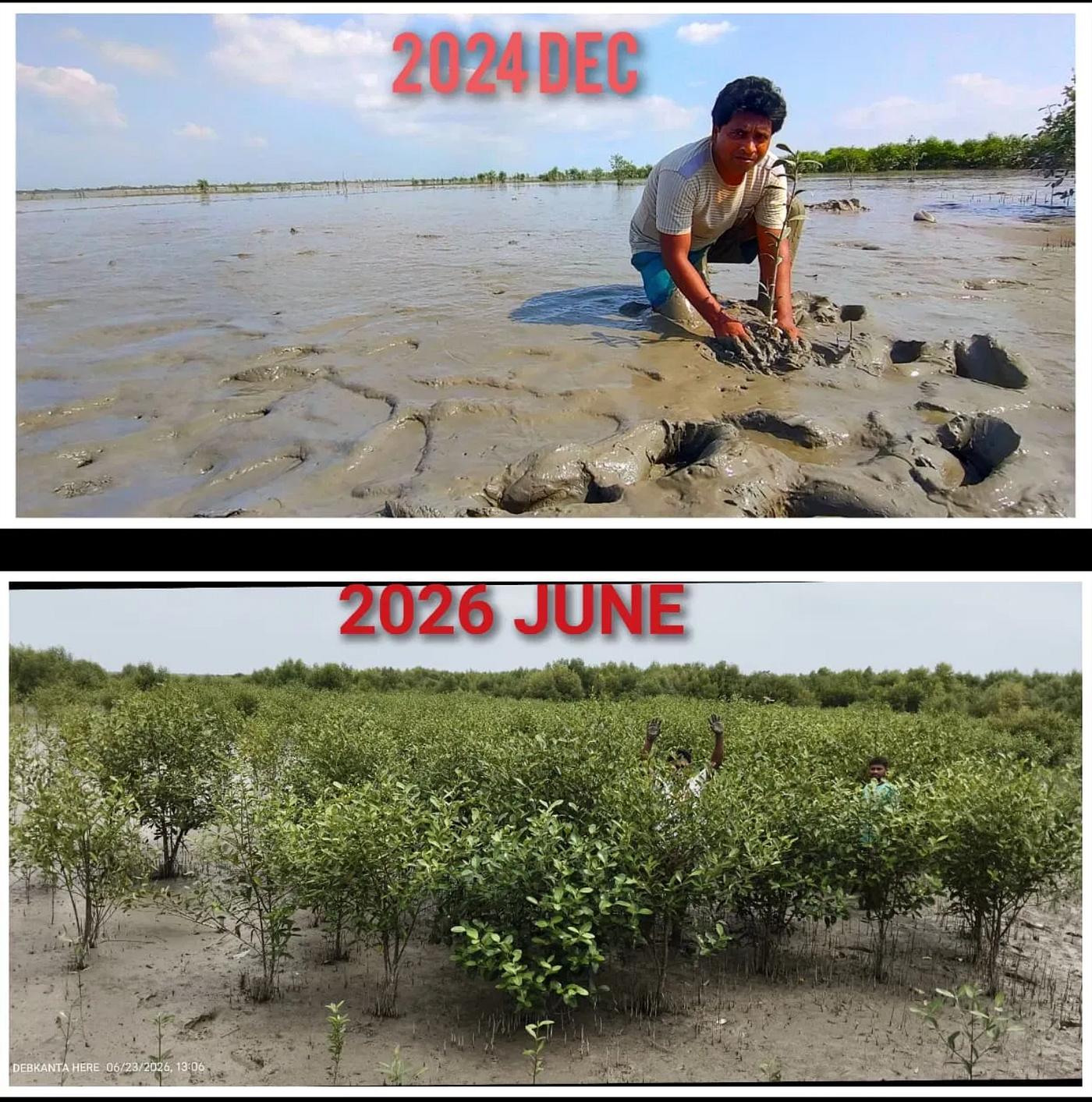
Mangrove Plantation Report by our partner NGO — Sukher Swarga Foundation
- Protect the Giants: Our first priority must be the absolute protection of old-growth forests. They are our primary “carbon batteries.”
- Verified Restoration: When we do plant, we must use data. Our **mangrove restoration projects** are a perfect example, showing rapid, waist-high growth in just two years because they were planted in the right place with the right care.
- Direct Action: We need to move beyond simple “donations” and toward direct accountability.
The banyan tree teaches us that resilience takes time, space, and deep roots.
By valuing the old and carefully nurturing the new, we can build a future that is as enduring as Thimmamma herself.
메타데이터
- post_id
- 4b864f16a05b
- slug
- the-banyan-vs-the-sapling-what-climate-physics-teaches-us-about-old-growth-and-new-hope-4b864f16a05b
- url
- https://medium.com/the-environment/the-banyan-vs-the-sapling-what-climate-physics-teaches-us-about-old-growth-and-new-hope-4b864f16a05b
- canonical_url
- https://medium.com/the-environment/the-banyan-vs-the-sapling-what-climate-physics-teaches-us-about-old-growth-and-new-hope-4b864f16a05b
- author_url
- https://medium.com/@saket-sambhav
- status
- ok
- fetched_at
- 2026-07-14 02:06:09