Occupational Hazards: Inaction is Promotion when Institutions Fail to Distinguish Liberty from…
Freedom and Speech
Occupational Hazards: Inaction is Promotion when Institutions Fail to Distinguish Liberty from License.

Freedom and Speech
Freedom of expression was never designed to elevate every act into a right. It shields thought and speech — the interior and communicative faculties that allow a person to reason, dissent, and participate in public life. Section 2(b) of the Charter secures that liberty precisely because words, symbols, and art speak without displacing the rights of others. The freedom is intellectual, not territorial. Its scope narrows when expression moves from the forum of dialogue into the arena of disruption.
The communicative core of this freedom is inviolable: it ensures every citizen the right to voice dissent, convey solidarity, and challenge the status quo through symbolic or verbal means. This protection is afforded to the message itself, establishing a high bar against censorship by the state. However, the right to speak is distinct from the right to impose. The strength of the freedom lies in its abstraction — its ability to exist without laying physical claim to property or space.
Once expression transitions from symbolic advocacy to physical imposition, its shield diminishes. This distinction is paramount to the Charter’s internal logic, which is designed to reconcile competing rights. Expression may be loud, controversial, or unpopular, but it must remain within the bounds where it does not constitute a de facto negation of another person’s rights to safety, movement, or property enjoyment. The moment expression demands territorial control, it ceases to be pure liberty and becomes a matter for public regulation.
Expression as Conduct and Assembly
Expression, however, often takes physical form. Demonstrations, pickets, and gatherings are conduct that expresses meaning — acts of assembly that convey solidarity, grievance, or opposition. The Charter recognizes assembly as inherently expressive. Yet protection depends on purpose and effect: an assembly is protected when it communicates; it loses protection when it obstructs or intimidates. Conduct may still be expressive, but it becomes subject to regulation when it imposes consequence beyond communication. Courts draw the line where independent harm appears — where conduct, even symbolic, inflicts injury, trespass, or fear that is not integral to its message.
This is why a march, a vigil, or a rally can remain within freedom’s sphere, while an occupation, blockade, or encampment may step beyond it. The former articulates meaning through presence; the latter asserts possession through duration. Assembly is protected; occupation is not guaranteed. Conduct that transforms space into claim becomes governance’s concern, not Charter protection.
Conduct, Occupation, and Consequence
Occupation sits at the center of the conflict between expression and conduct. It begins as a form of symbolic presence — a statement of endurance and belonging — but quickly transforms into something more tangible: control of space. If left unchecked, the state’s inaction tacitly legitimizes the seizure, allowing what began as speech to grow into governance by occupation. In that tolerance, permission becomes promotion.
This is why conduct must be addressed in conception, not as a reaction. Early, proportionate intervention prevents transformation without limiting genuine expression. Dealing with occupation at its birth — through established laws of trespass, nuisance, loitering, or unlawful camping — is not repression, but preservation. It ensures that freedom’s intent remains communicative, not possessive.
If left to expand, an occupation can evolve into two separate outcomes: it can become a riot, marked by intimidation and fear, or it can settle into a non‑expressive infraction such as trespass or public nuisance. In either case, the conduct has departed from protected expression. By acting early, the state prevents both extremes — maintaining peace without silencing dissent.
Misapplication and Reluctance: The Institutional Failure
Officials treat enforcement as constitutionally suspect, demanding judicial endorsement before acting on laws that already exist — trespass, mischief, obstruction, nuisance. This inversion of order makes courts the first responders and turns administration into an immobile entity. This is not constitutional prudence; it is paralysis. Proper application would address conduct early, preventing the illusion that an occupation or blockade enjoys constitutional immunity. Failing to act transforms expressive conduct into entrenched disorder, and lawful restraint into perceived weakness. We must call a spade a spade and utilize the mechanisms already at our disposal.
Further, an instinctive reliance on judicial intervention to resolve criminal activity allows such conduct to persist and prevail. When courts are already overburdened, these unnecessary referrals delay justice and encourage continued misconduct. The consequences are grave: the administrative failure to act forces a pathway toward higher criminal liability for participants, while the institution itself suffers the optics of promotion and complicity. Courts exist to remedy wrongs retrospectively; they are not designed to substitute for active governance or enforcement. To stunt enforcement out of misplaced caution is misguided, breeding confusion about what is truly permitted.
A parallel can be drawn to university administrations that hesitate to address campus occupations. Their reluctance reflects the same constitutional timidity, allowing expressive conduct to evolve into entrenched disorder under the guise of academic freedom. Recent examples at McGill University and the University of Toronto illustrate this tendency — where encampments and building occupations persisted for weeks under claims of expressive rights, while disruption, exclusion, and intimidation steadily escalated. These institutions, in delaying proportionate action, mirrored governmental hesitation and allowed expressive acts to harden into assertions of control and permanent breach. Canada’s recurring mistake is misapplication through hesitation, nowhere more evident than on campus.
Question of Bias: The Imposed Narrative
In reluctance to act, in favoring the unlawful act over the rights infringed, does this not lead to the illusion of a two‑tiered justice or narrative? The perception that one group’s defiance is tolerated while another’s dissent is suppressed breeds distrust in enforcement and erodes the equality of law. Bias here need not be explicit; it can arise through selective hesitation — where moral sympathy or political optics distort the neutral application of rules. When a supposedly neutral body, through inaction, permits certain conduct to persist while others are immediately sanctioned, it effectively co-authors and imposes a social narrative.
This silence is an active policy choice that grants de facto legitimacy to the transgression, fundamentally corrupting the body’s neutrality and dictating what is “permitted” in society. This structural imbalance reinforces a hierarchy of legitimacy, suggesting that some causes merit impunity while others invite sanction. Furthermore, this selective hesitation creates a profound chilling effect not on the protesters, but on those whose rights are infringed. The average citizen, facing the inconvenience and intimidation of an unregulated occupation, correctly perceives that the state has abandoned the enforcement of their basic rights.
The psychological consequence of this institutional abandonment is the subconscious application of justice by the public itself. If the instruments of order — the police, the administration, the government — demonstrate that the enforcement of clear law is negotiable based on the political popularity of the transgressor, the social contract is severely damaged. The law ceases to be an impartial standard and becomes a flexible tool of political will, leading to an environment where citizens internalize the lesson that disorder is permitted, provided the cause is deemed morally sympathetic by the governing body.
The Consequence of Tolerated Possession: Societal Demise
If the expressive nature of occupation is repeatedly tolerated, the core concept of public space regulation and, by extension, civil society itself, begins to erode. The institutional failure to intervene creates a dangerous precedent: the notion that any occupation, so long as it maintains a façade of peaceful or inclusive purpose, can be indefinite, thereby effectively allowing the circumvention of all established laws and regulatory guidelines governing public residence, safety, and hygiene.
The very sign of a civil society is its commitment to order, justice, and good governance; without enforcement, we enact our own demise. Enforcement is not merely an optional mechanism, but a fundamental function of a healthy democracy. When we permit chaos — visible in the squalor, the dereliction, and the incessant nuisance of long-term unauthorized shantytowns in public parks — we witness the symptoms of a dying society. Tents, individuals screaming, and the visible degradation of public infrastructure are not signs of expressive liberty, but evidence of a barbaric, lawless scourge.
This toleration allows unlawful residence to persist indefinitely, undermining regulatory control over residence guidelines. The result is that parks look disgusting, essential infrastructure is damaged, and places become permanently claimed and unusable by the general public. To deliberately want to permit this chaos contradicts the essence of a proper democratic society, which is built precisely upon the principle of shared, regulated order. This tolerance signals that possession by assertion supersedes governance by rule of law, undermining the shared, equal right to public resources and imposing physical and moral decay upon the community.
Counter Conduct: The Oakes Test and Delayed Enforcement
Conduct is never neutral. Once expression manifests physically, it generates consequence — traffic diverted, commerce impeded, safety challenged, property affected. These consequences justify proportionate regulation under general law.
Where a legislative limit on expression is necessary — as in the enforcement of trespass laws — it is weighed against the high standard set by Section 1 of the Charter, specifically the Oakes Test. Regulation is only proportional if it satisfies the pressing and substantial objective, is rationally connected to that objective, impairs the right as little as possible, and, critically, ensures that the deleterious effects of the measure are proportional to its salutary effects. The core argument is that early, proportionate enforcement under existing laws is the least intrusive means (minimal impairment) of protecting the rights of all citizens to shared public space and safety.
When governments or police hesitate to act at the initiation of those consequences, fearing accusations of repression, they allow manageable conduct to metastasize into crisis. Enforcement delayed becomes enforcement dramatized. A lawful limit deferred becomes a spectacle of rights. The Charter reviews action; it does not require paralysis until a court speaks.
Inaction is promotion. This can even extend into the institutional sphere, where delay or avoidance legitimizes disorder by silence. It is more logical — and more responsible — to intervene than to stand back and permit escalation. Permitting such conduct not only signals endorsement but almost constitutes authorship, as though the institution has co‑signed the act through its inaction. The longer the inaction, the greater the complicity, transforming oversight into a tacit form of participation.
Question of Obstruction
Obstruction is not a neutral expression; it is an act of physical coercion that edges into unlawfulness the instant it impedes another’s lawful movement or access. Freedom of expression does not and cannot extend to denying others their own Charter protections or civil use of public areas. When expressive conduct morphs into a physical barrier — be it a blockade, a human chain, or a physical structure — it moves from the realm of communication to that of infringement. The distinction is critical: the Charter protects the right to speak, but not the right to unilaterally dictate the movement or presence of others. Therefore, public spaces are shared, and expression conducted there must coexist with the public’s fundamental right to passage, safety, and enjoyment. The obstruction of these rights, even in protest, transforms expression into a non-protected wrong.
This interference strikes directly at the principle of equal public enjoyment. The moment one group’s expressive act prevents others from accessing, navigating, or utilizing a public thoroughfare, it creates a hierarchy of rights, subordinating the guaranteed mobility and use rights of the many to the expressive claim of the few. This is not the coexistence required by a pluralistic democracy, but an assertion of temporary dominion. Such conduct attempts to extract political or social compliance not through the power of its message, but through the leverage of physical inconvenience and effective trespass against the broader community. The democratic legitimacy of dissent rests on its ability to persuade, not its capacity to paralyze or punish the non-participants.
Consequently, intervention by officials faced with clear obstruction is not a constitutional option but a governance imperative. When a street is blockaded, or a doorway is physically held, the enforcement response is not predicated on a constitutional analysis of the protest’s message or content. Instead, it is based on the immediate, tangible violation of public order laws — trespass, public nuisance, or obstruction of traffic. The conversion point is clear and immediate: once the communicative element is supplanted by the coercive element of physical interference, the threshold has been crossed, demanding proportionate and timely action to restore the public right of way without further delay.
Interpretation and the Conversion Point
Freedom operates by presumption until authority declares enough. That declaration — the conversion point — marks the moment conduct ceases to be protected and becomes a breach. The change is interpretive, not legislative. Police and public officials translate circumstance into enforcement; courts later decide whether that interpretation was justified. Freedom thus ends not by repeal but by application. The instant the state acts, expression is redefined by consequence.
This interpretive power is essential yet perilous. Applied fairly, it maintains peace. Applied selectively, it redefines dissent as disorder. The integrity of freedom depends on consistency in that interpretation — the willingness to distinguish genuine expression from coercive conduct regardless of politics or popularity. The exercise of this power demands more than discretion; it requires uniformity of principle. When enforcement is consistent across all forms of conduct — whether the protestors are popular or reviled, their cause sympathetic or marginal — the application of the law remains constitutionally sound. Conversely, allowing political calculus to dictate when a law is invoked undermines the neutral promise of the Charter.
The inherent risk is that officials, by seeking to avoid controversy, politicize the rule of law. If the threshold for intervention is seen to rise and fall with the public mood, the public loses faith in the legal system’s capacity to protect them equally. This failure of consistent application provides grounds for future legal challenges, not on the basis that the law itself is bad, but that the selective enforcement was unconstitutional. Thus, the integrity of freedom rests not only on its philosophical definition but on the courageous and consistent application of its limits by those entrusted with maintaining public order.
Expression Without Immunity
Even rightful expression bears consequence. The Charter binds the state, not society. Individuals remain accountable for how their words are received and how their conduct affects others. Protection from censorship is not protection from response. The right to speak does not entail the right to escape criticism, discipline, or disassociation. Likewise, the state may lawfully enforce limits without forfeiting its legitimacy; proportional action can be unpopular and still constitutional.
Freedom guarantees voice, not victory. The irony lies in permitting expression while guaranteeing consequence: once conversion occurs, the same permission that shielded speech exposes the actor to criminal liability. The changing definition of the act alters the individual’s status from civilian to offender — by interpretation rather than transformation. The very nature of law recognizes that by Charter freedoms even the freedom to commit crime is protected — one is free to act unlawfully, but not immune from the consequence of that action.
Thus, intervention becomes a form of protection rather than repression; waiting for judicial interpretation nearly guarantees grounds for forfeiture of rights, apprehension, criminal liability, and forced remedies.
Riot Law and the Anticipatory Threshold
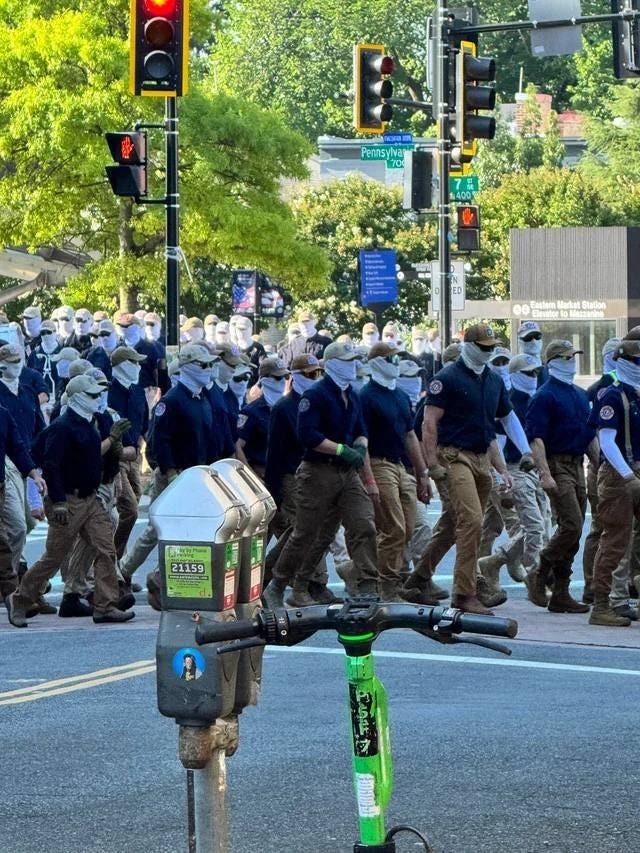
Riot law illustrates the anticipatory logic of enforcement. It also invites reflection on how anticipatory enforcement interacts with known expectations of force or violence — when public intervention is predictably met with force, that dynamic may itself mark a separate threshold worth acknowledging, even without resolution. Riot can thus arise through anticipation, threat, or expectation of tumultuous activity, and occupation itself can embody threat when it excludes others or demands physical protection. The visible perimeter militia, whether engaged or not, signals both anticipation and preparedness for violence, reinforcing the threshold between expression and coercion.
Therefore, even if no intervention occurs at the point of conception, once an occupation has formed, intervention on grounds of riot becomes justifiable when exclusion, protection, intimidation, or resistance are present. Sections 63–65 of the Criminal Code define unlawful assembly as conduct causing fear of tumultuous disturbance — fear alone is sufficient to justify dispersal. The law intervenes at the stage of potential violence, not aftermath, just as the threat of assault is assault. That same principle applies to occupations and blockades: once conduct creates fear, intimidation, or material obstruction, the grounds for lawful intervention exist. Waiting for physical violence misreads both statute and purpose. Early, measured action protects the very freedom it limits by preventing its descent into riot.
Closing Reflection
Freedom of expression protects the voice, but conduct reveals its limits. Assembly translates belief into presence; occupation transforms presence into power. When governments and institutions mistake hesitation for fairness, they blur the line between liberty and license, forcing courts to intervene in matters of pure administration. The mechanisms for intervention — trespass, nuisance, obstruction — are immediate, lawful, and exist precisely to maintain the line between dissent and disorder. Over-protection of conduct and reluctance to enforce law at its inception invite both misapplication and disorder, escalating manageable acts of expression into crises of criminal liability and institutional failure. The Charter was crafted to discipline power, not to disable it. Its strength lies in clarity: knowing when speech has ended and grave consequence has begun.
메타데이터
- post_id
- 4ba95a35af35
- slug
- occupational-hazards-inaction-is-promotion-when-institutions-fail-to-distinguish-liberty-from-4ba95a35af35
- url
- https://medium.com/@guy_valdez/occupational-hazards-inaction-is-promotion-when-institutions-fail-to-distinguish-liberty-from-4ba95a35af35
- canonical_url
- https://medium.com/@guy_valdez/occupational-hazards-inaction-is-promotion-when-institutions-fail-to-distinguish-liberty-from-4ba95a35af35
- author_url
- https://medium.com/@guy_valdez
- status
- ok
- fetched_at
- 2026-07-15 17:04:07