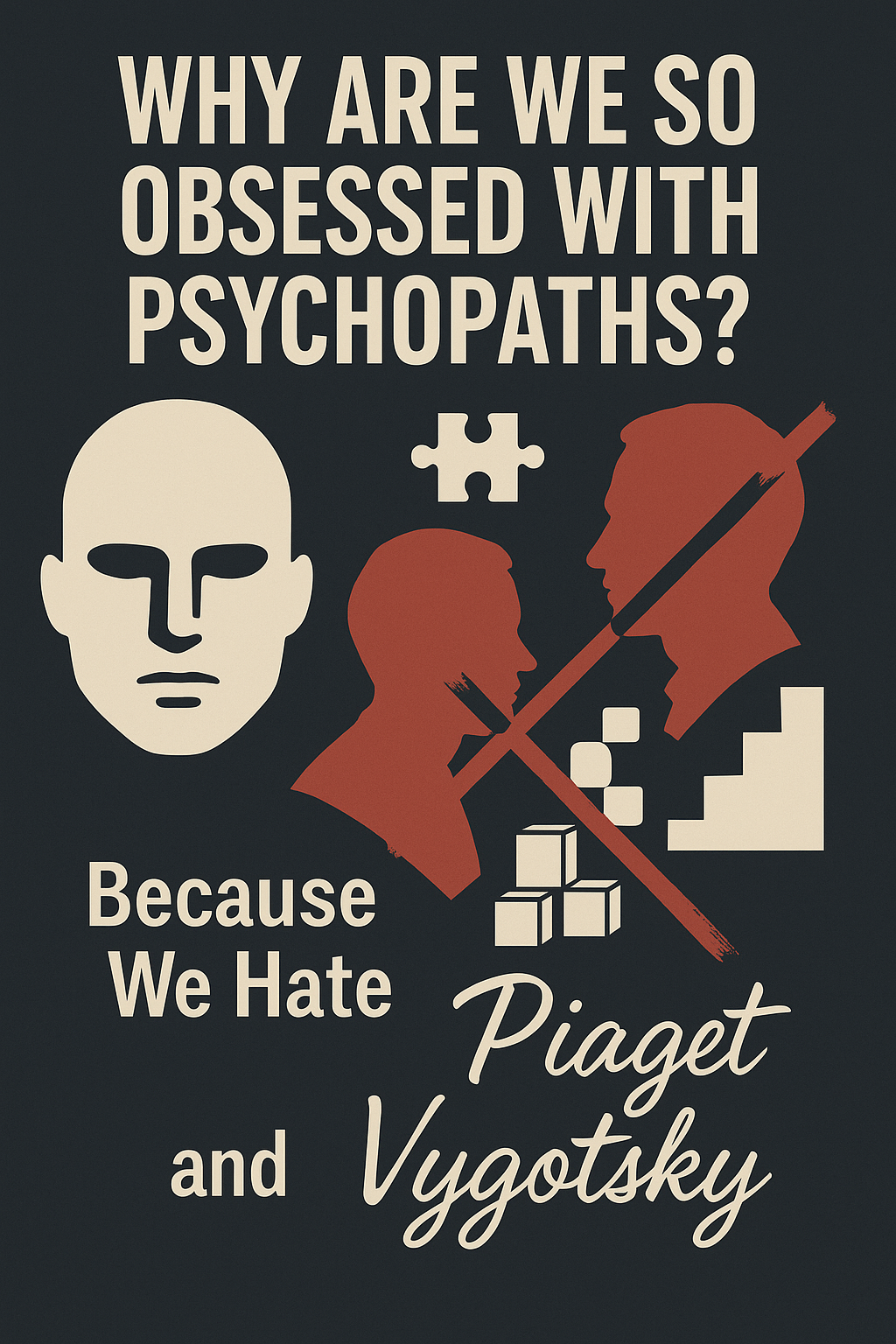
Why Are We So Obsessed with Psychopaths? Because We Hate Piaget and Vygotsky
The term “psychopath” has become the go-to insult of the 21st century. They don’t reply to your WhatsApp? Psychopath. They ghosted you…
Why Are We So Obsessed with Psychopaths? Because We Hate Piaget and Vygotsky
The term “psychopath” has become the go-to insult of the 21st century. They don’t reply to your WhatsApp? Psychopath. They ghosted you without explanation? Narcissist. They’re cold or distant? Antisocial traits. No matter the issue, there’s always a handy clinical diagnosis. Your boss? Psychopath. The neighbor who doesn’t greet you? Psychopath. Netanyahu? Psychopath. Trump? Narcissistic psychopath. These labels have become magic words to categorize our world and soothe our conscience. Because, of course, if they’re psychopaths… then we’re fine, right?
Well, it depends.
You might be building a thesis in your mind about how your ex hurt you, had emotional deficits, or was emotionally unavailable, finding perfect explanations in TikTok videos listing “red flags of emotionally avoidant narcissists.” But the truth is, neither you nor I can genuinely know. Because most people have no real clue what psychopathy means.
Here’s the kicker: if you’re questioning, doubting yourself, wondering what you might’ve done wrong, you’re not a psychopath.
Psychopaths don’t doubt. They don’t introspect. They feel no guilt. They might fake empathy because they understand social norms, but internally, they don’t feel it. Their narrative always keeps them looking good: the world is wrong, not them.
But you, reflecting, feeling guilty, and questioning yourself, you’re human. That’s empathy. It’s emotional health. It’s self-awareness.
Stop Measuring Skulls: Psychopathy Isn’t Obvious
Before diagnosing everyone based on TikTok, let’s clear some things up. Psychopathy is a personality disorder, yes, but it’s not diagnosed because someone is rude or hasn’t apologized. Nor is it solely environmental. The reality is complex, as boundaries between healthy and pathological aren’t always clear.
Psychology has shown there are biological factors predisposing people to specific emotional patterns (or lack thereof). Yet, numerous social and contextual variables shape us profoundly, from parental affection to family roles. A child lacking physical affection might desperately seek it or become emotionally frozen. Another, burdened with responsibilities from a young age, might spend adulthood seeking validation they never received.
This complexity includes genetic factors. Interestingly, one renowned psychologist studying psychopathy openly acknowledges he’s diagnosed as a psychopath. He doesn’t feel empathy naturally but learned to imitate socially acceptable behaviors cognitively.
Similarly, people with autism or Asperger’s often cognitively learn social cues that others intuitively grasp. This cognitive-behavioral approach emphasizes that our actions and learning from others matter, not just our innate feelings.
What Exactly Is a Disorder?
A mental disorder isn’t simply having a bad day or being quirky. It’s a persistent pattern significantly affecting someone’s life or their environment. For instance, alcoholism isn’t about occasional drinking; it’s a compulsive, repetitive, damaging behavior.
Yet, labeling isn’t straightforward. Take child soldiers or ruthless executives; their behaviors, while destructive, are adaptive strategies rather than clear-cut disorders. Humans often struggle with ambiguity, craving clear morality. But reality thrives in the gray areas.
Psychopath vs. Sociopath: What’s the Difference?
Traditionally:
- A psychopath is believed to have biological predispositions: emotional detachment, lack of guilt, minimal empathy.
- A sociopath develops through trauma or environmental neglect, gradually losing emotional connectivity as a survival mechanism.
However, these definitions are increasingly blurred. Instead of using these terms carelessly as insults, we should recognize them as complex human adaptations — sometimes destructive, sometimes adaptive.
Let’s Talk Sadism, BDSM, and Boundaries
We enjoy discussing psychopaths partly because they let us feel emotionally superior. Yet, beneath our righteousness lies hidden aggression. Consider the death penalty: it’s not justice; it’s ritualized sadism, a moral purge enacted through pain.
Many seemingly good people harbor vengeful fantasies. Society channels these feelings through symbolic violence: sports, debates, violent games. Psychopaths become screens onto which we project our repressed desires without guilt.
What separates functional from dangerous individuals are boundaries, consent, and context. Enjoying horror films or BDSM safely within agreed boundaries isn’t psychopathic; it’s healthy exploration.
Marxism, Evolution, and Corporate Psychopaths
Capitalism rewards psychopathic traits like emotional detachment, cold calculation, and ruthless ambition. Success in this system often mirrors clinical dysfunctions. This isn’t accidental; it’s systemic.
Philosophers like Hobbes described nature as brutal competition, influencing modern hyper-individualistic philosophies. Yet history shows humanity thrives through cooperation and mutual aid far longer than hierarchical, competitive structures.
Today, corporate giants exemplify psychopathic behaviors but eventually collapse under mistrust and internal instability. Capitalism isn’t sustained purely by markets or spreadsheets but by trust, cooperation, and social stability.
We Hate Piaget and Vygotsky: Education and Psychopathic Structures
Our educational system isn’t intentionally producing psychopaths but fosters behaviors functionally similar to psychopathy: competitiveness, lack of empathy, detachment. Schools today mimic industrial factories, prioritizing efficiency and conformity.
Piaget and Vygotsky observed children within industrialized education systems, inadvertently reinforcing production-line models of education. Montessori, in contrast, recognized autonomy and movement as crucial learning factors.
Schools still promote competitiveness, individualism, and emotional detachment, normalizing psychopathic behaviors. Student representatives become powerless bureaucrats rather than community leaders, reinforcing apathy and cynicism.
Education should foster mutual aid, diverse abilities, and collective growth — not inflate individual egos. We must reclaim education to develop empathy, solidarity, and emotional intelligence, breaking free from the obsolete industrial model.
Understanding psychopathy means recognizing our social and economic systems’ role in nurturing such traits. It’s time to rethink not just psychopath labels but the environments creating them.
Conclusion
Labeling everyone as psychopaths or narcissists might feel good, but it oversimplifies complex human behavior. To truly understand psychopathy, we must examine our systems, education, and social norms critically. Only then can we foster genuine empathy, cooperation, and emotional intelligence, building healthier societies where human connections matter more than competitive victories.
메타데이터
- post_id
- 4bb130035151
- slug
- why-are-we-so-obsessed-with-psychopaths-because-we-hate-piaget-and-vygotsky-4bb130035151
- url
- https://medium.com/@laguardillapodcast/why-are-we-so-obsessed-with-psychopaths-because-we-hate-piaget-and-vygotsky-4bb130035151
- canonical_url
- https://medium.com/@laguardillapodcast/why-are-we-so-obsessed-with-psychopaths-because-we-hate-piaget-and-vygotsky-4bb130035151
- author_url
- https://medium.com/@laguardillapodcast
- status
- ok
- fetched_at
- 2026-06-09 15:37:30