LiFePO₄ vs AGM: Which is the Smarter Choice for Nordic Winters?
For those who live in or explore Scandinavia, winter is more than a season; it’s the ultimate test of your gear. When temperatures plunge…
LiFePO₄ vs AGM: Which is the Smarter Choice for Nordic Winters?
For those who live in or explore Scandinavia, winter is more than a season; it’s the ultimate test of your gear. When temperatures plunge below -15°C and daylight dwindles to mere hours, one question becomes paramount for every cabin owner, vanlifer, and off-grid adventurer: “Will my power last?”
For years, AGM (Absorbent Glass Mat) batteries were the go-to, maintenance-free answer. They seemed reliable on paper. Yet, as countless winter users have discovered, theory often crumbles in the face of a true Arctic night.
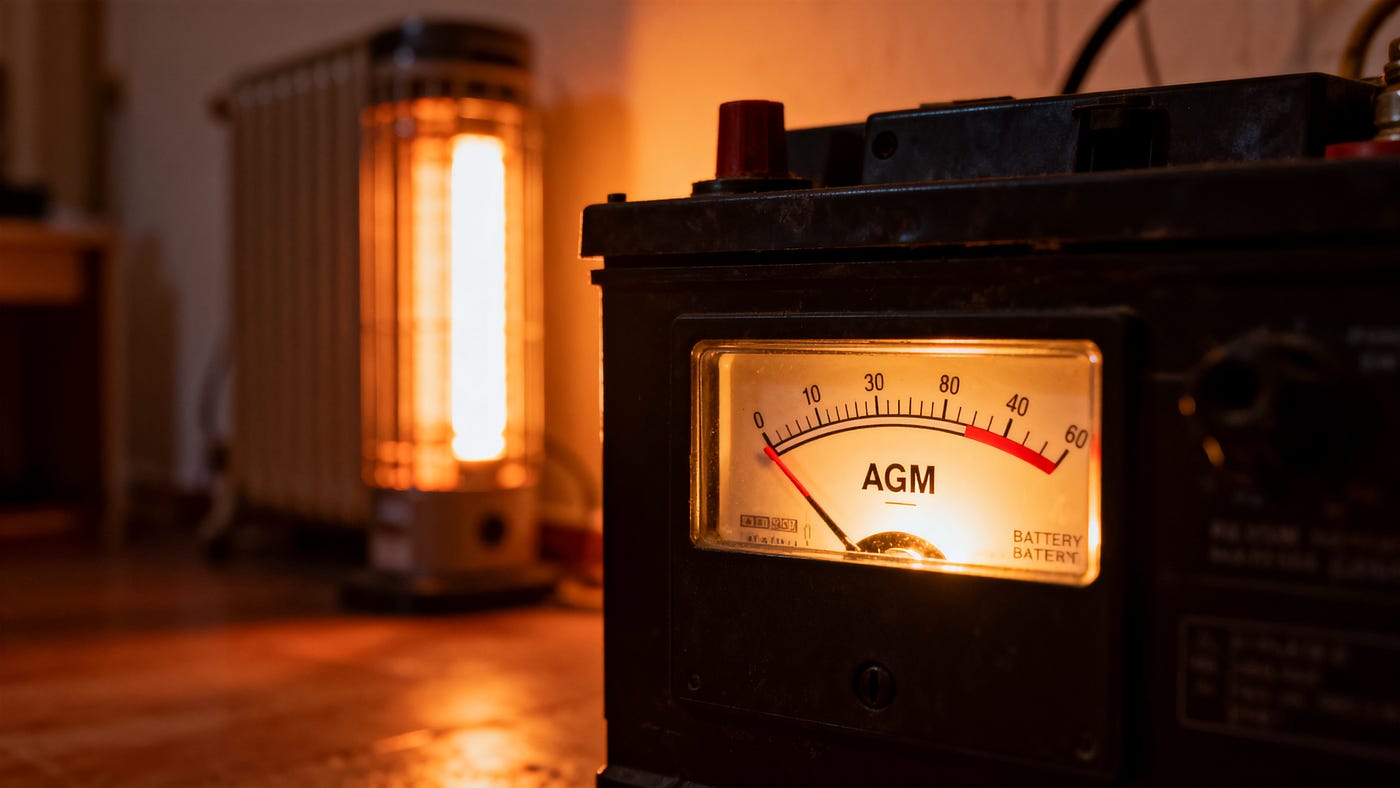
AGM in the Arctic: When Theory Meets Reality
Take Johan, who lives full-time in his van in Kiruna, northern Sweden. During a December trip above the Arctic Circle, his 100Ah AGM battery struggled to cope with basic loads: a fridge, diesel heater, lights, and a laptop.
After just one day, the issues were undeniable. His usable capacity had nearly halved. The voltage would sag noticeably every time the heater cycled on, dimming the lights. The weak winter sun did little to replenish what was used.
As Johan put it: “Winter camping is magical, but with the AGM battery, I was always doing the maths. It turns a relaxing trip into a constant calculation.”
This experience is not unique. In the cold, AGM batteries face inherent limits: a drastic reduction in usable capacity, slow and inefficient charging, and a cycle life often limited to 300–800 cycles, which can mean replacements every 2–3 years with regular winter use.

The LiFePO₄ Upgrade: From Calculation to Confidence
Before the next winter, Johan upgraded to a Hoolike 12.8V 100Ah LiFePO₄ battery. The change was immediate and profound.
The constant voltage sag vanished. He could run all his devices simultaneously without worry. Crucially, even at -10°C, the battery delivered over 90% of its usable capacity. The built-in Battery Management System (BMS) intelligently managed charging, blocking it if temperatures were unsafe to prevent permanent damage — a critical feature for lithium chemistries.
The biggest change was psychological. The stressful “battery math” was replaced by predictable, reliable power.
Real-World Performance: A Side-by-Side Look
The difference is clear in direct comparison. Under identical winter conditions (-10°C) with typical loads (fridge, heater, lights, laptop), the results speak for themselves:

These numbers translate to real freedom across the Nordics: a LiFePO₄ battery powering a Lapland cabin for days, enabling induction cooking in a Norwegian campervan, or efficiently capturing brief midday sun in Finland.

Beyond Winter: The Long-Term Value Proposition
While the upfront cost of LiFePO₄ is higher, the long-term perspective reveals a different story. This is where cycle life — the true measure of a battery’s lifespan — becomes decisive.
A quality LiFePO₄ battery is engineered for 3,000 to over 6,000 cycles, and with proper care, can reliably serve for 8–10 years or more. In stark contrast, an AGM battery in regular deep-cycle winter use typically offers 300–800 cycles.

This translates to more than just savings. It’s an investment in dependability — avoiding the gradual performance drop and mid-winter failure of aging AGM batteries, season after season.
Prepared for the Extreme: Built for Nordic Demands
Modern LiFePO₄ batteries are designed with harsh climates in mind. For instance, the **Hoolike 12.8V 100Ah model, tested by European users, delivers its full rated capacity and features a robust BMS that handles high-surge appliances like induction cookers with stable voltage. In cold-start tests at -11°C**, its BMS correctly and safely blocked charging to protect the cells, demonstrating essential protection for long-term health.
This engineering makes LiFePO₄ the ideal companion for: · Off-grid cabins (stugor): Reliable power for lighting, pumps, and communication. · Winter vanlife & camping: Safe, lightweight power for heating and appliances. · Marine applications: Resistance to humidity and salt air. · Solar storage: High cycle life maximizes the use of limited winter sunlight.

The Final Verdict: Reliability Over Compromise
AGM batteries served a purpose, but the demands of a true Nordic winter expose their limitations. For those whose comfort, safety, and peace of mind depend on stable power — whether in a remote cabin, a winter-ready campervan, or a coastal boat — the choice is increasingly clear.
LiFePO₄ technology offers more than just power; it delivers the reliability, stability, and enduring confidence that turns harsh winter conditions into moments of pure enjoyment. It answers that pressing winter question not with a hope, but with a guarantee.
As Johan summarized after his first full winter with LiFePO₄: “I finally stopped worrying about power. I could just enjoy the silence and the northern lights. My focus shifted from managing the battery to enjoying the journey.”
In the Nordics, where winter is both a challenge and a spectacle, your energy storage shouldn’t hold you back. It should empower your adventure.
메타데이터
- post_id
- 4bbc7b4972b2
- slug
- lifepo₄-vs-agm-which-is-the-smarter-choice-for-nordic-winters-4bbc7b4972b2
- url
- https://medium.com/@berryli6768/lifepo%E2%82%84-vs-agm-which-is-the-smarter-choice-for-nordic-winters-4bbc7b4972b2
- canonical_url
- https://medium.com/@berryli6768/lifepo%E2%82%84-vs-agm-which-is-the-smarter-choice-for-nordic-winters-4bbc7b4972b2
- author_url
- https://medium.com/@berryli6768
- status
- ok
- fetched_at
- 2026-06-10 08:17:25