How to Setup a Backyard Sanctuary for Bird Photography
Tips for creating award winning images in your backyard
How to Setup a Backyard Sanctuary for Bird Photography
Tips for creating award winning images in your backyard
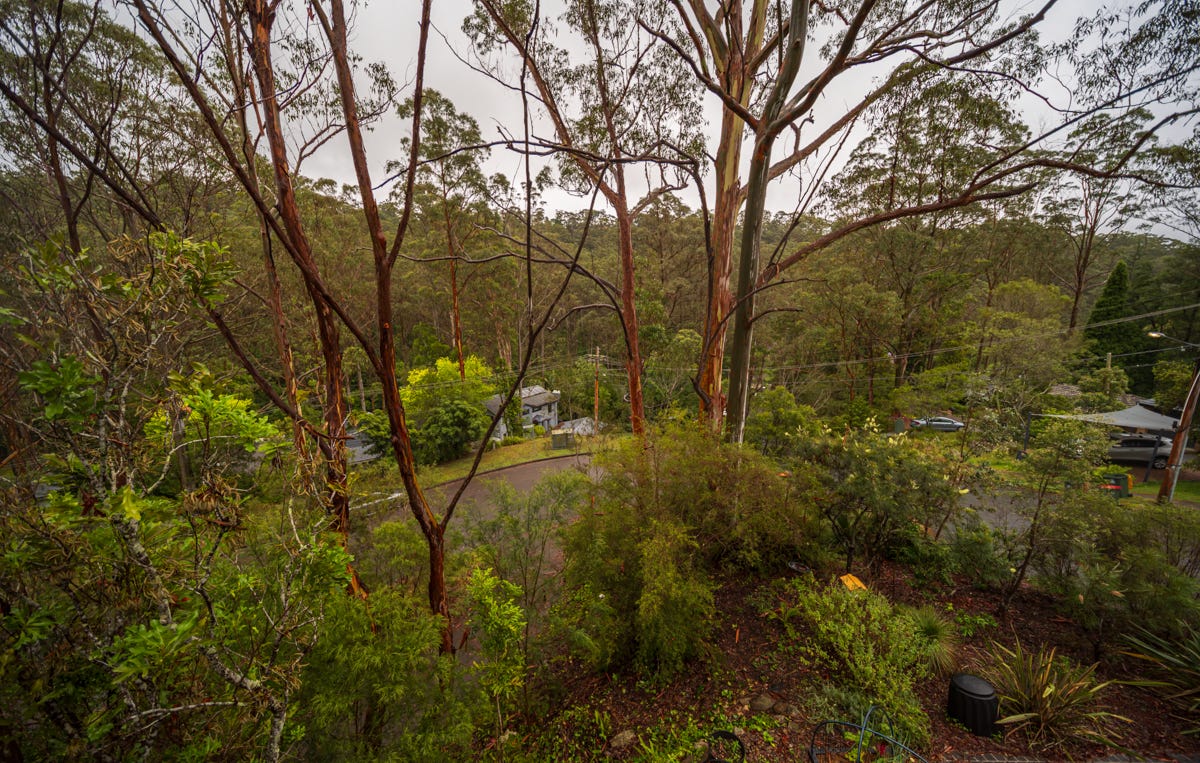
My garden at the edge of Berowra National Park. Image Credit: Nilmini De Silva
Introduction
The first thing that struck me when I migrated to Australia 26 years ago, was the diversity of bird life in the suburbs. But I would never have imagined then that I would be capturing award winning images from the deck overlooking my garden. To be honest, I didn’t even know how to operate my camera on manual settings back then. But this year, an image I took in my backyard was a finalist in the Australian Geographic Nature Photographer of the Year competition (AG NPOTY 2024) competing with images that were taken in far more exotic surroundings in the region.

Spider and the Dew, Finalist in Australian Geographic Nature Photographer of the Year, 2024, Image Credit: Nilmini De Silva
But it wasn’t photography that inspired me and my partner to start creating a sanctuary for our native birds and wildlife at home. I love the natural environment and feel a deep connection to the Australian bush. I feel privileged and lucky to live adjacent to Berowra Valley National Park, located at the northern edge of Sydney. In the local indigenous language, the word “Berowra’ means ‘a place of many winds.’ Our garden is almost an extension of the park, with towering gum trees and native species endemic to the area. We also grow some food using our own compost and host native bees, which do a fabulous job of pollinating the native plants around the neighbourhood.


King parrot feasting on wattle seed and a rainbow lorikeet dining on the grevillea. Image Credit: Nilmini De Silva
How to Setup a Bird Sanctuary in your Backyard
As a civil engineer who has worked in catchment management for decades, I understand the importance of conservation and biodiversity. The number of threatened species across our continent and around the world is increasing just as fast as their habitat is disappearing. The threat of climate change will only further exacerbate this risk as global temperatures rise at a rate that is too fast for many species to adapt too. Photography is a means by which we can bring more awareness to these issues as much as it a tool to inspire a love for the natural environment.

A kookaburra on a gum tree is about as iconic as you can get in Australia. Image Credit: Nilmini De Silva. This image was taken with a Canon 200–800mm lens I was testing earlier this year.
One of the first things we did after moving to our home in the bush, was to pull up the lawn, install mulch and plant native grasses and plants. This automatically increased the species that frequented our garden, bringing with that plenty of opportunities to practice my bird photography.
Doing our bit at home from having a bird bath for those hot summer days to creating habitat was the best way to set up a sanctuary where birds could be encouraged to nest, feed and find shelter. One of the gum trees in our garden has a nesting hollow that is also a magnet for a variety of species ranging from the kookaburras and rainbow lorikeets to the galahs and the noisy miner. The plants have different cycles of flowering and seeding, attracting species like the king parrot which we see less often.

An inquisitive galah connects with me as I photograph it. Image Credit: Nilmini De Silva
It is important that our gardens are structurally diverse, with an upper canopy, mid-story, and ground cover. Assorted native plants also encourage a diversity of bird life. We are fortunate to live in an area where our local Council has free native plant giveaways with lots of educational material that helps us to keep adding to the diversity of plants in our garden.

Rainbow lorikeets frolic in our bird bath. Image Credit: Nilmini De Silva
There are lots of shrubs planted around our birdbath which gives the smaller birds a place of refuge and helps them feel safe from neighbourhood predators like domesticated cats. The little stepping stones in the bath also help the smaller birds navigate the space and scramble out after having a dip. I have a clear view of the bird bath from my deck, but it is a good distance away, enabling me to safely focus on them with my long lens without intruding on their space. My garden has become an endless source of inspiration and creativity.


The cockatoos are prolific where we live but they are not the most loved birds here due to their destructive tendencies. Image Credit: Nilmini De Silva

The cockatoos are prolific where we live but they are not the most loved birds here due to their destructive tendencies. Image Credit: Nilmini De Silva
Many Australians are fond of feeding the wild native birds but there are many risks associated with this practice including unbalanced populations, the spread of decease and dependence on humans. Growing a native garden is a wonderful way to increase and improve biodiversity with a wonderful byproduct for a photographer — an incredible canvass to practice bird photography.
Camera Gear & Settings for Bird Photography
We often say the best camera is the one you have with you, but this is not typically true when it comes to bird photography. Without a good telephoto lens, it is almost impossible to get award winning images of wildlife in general and birds in particular. I use the combination of my Canon EOS R6 camera (a full frame mirrorless) and an EF 100–400mm f/4.5–5.6L IS USM telephoto lens for my wildlife images. For my macro photography I use the Canon EF 100mm f/2.8mm Macro IS USM lens which I find ideal for extreme close-ups of spiders and insects that are also prolific in my garden.
I use the EF lenses with a mount adaptor on my mirrorless camera and it works a treat. In a perfect world, I would say a 600mm telephoto would be ideal, but I am not shooting at great distances from the deck in my garden.


A king parrot feasting on green tomatoes and produce from our garden. Image Credit: Nilmini De Silva
One of the biggest challenges with bird photography will be that the smaller birds are especially skittish. I don’t have a hide in my garden but if I am already setup on my deck and don’t make too many sudden movements, I have a much better chance of not scaring them. One of my techniques for quickly recalling my settings when something is afoot in my garden, is to save some standard settings as a custom function (C1) on my camera. I find that these settings are a good starting point from which I can adjust both my aperture, depending on the size of the birds and shutter speed depending on if they are stationary or in flight.
The Auto Focus feature in the lenses works perfectly most of the time, but in those instances where a bird is obscured by branches or leaves, you may wish to switch to manual focusing. I have turned on the focus guide and manual peaking settings for when I may need to switch my focusing method.


The Xanthorrhoea is endemic to Australia. There is a lot of feasting when it blooms. Image Credit: Nilmini De Silva
Programming your camera dials for back button focusing is a game changer for wildlife photography. So is your Auto Focus (AF) method. My starting point is to turn on the eye tracking feature, which includes choosing the subject to detect (animals) and turning on eye detection. I have gone an extra step and setup dual back button focusing on my camera. The AF-On button and the * button (which fixes exposure on the Canon R6) have been programmed to switch between spot focus and eye tracking. There are times when distractions get in the way of finding the bird’s eye, so this enables me to quickly switch between the two methods when needed.


This year we split our native bee hive. Australian native bees don’t produce much honey to share with us humans but they do a wonderful job of pollinating our native plants. Image Credit: Nilmini De Silva
The other important setting is Auto Focus (AF) Operation. My starting point is set to enable the camera to track moving subjects — ‘Servo’ on my Canon camera. However, I have also customized my depth of field dial button — which I never use — to switch between One Shot and Servo for those instances when my subject is stationery.
On my custom setting for wildlife, my Aperture is set to f/8 and my shutter speed to 1/2000secs. The size of my subject, the depth of field required, and the degree of movement will decide the ultimate values for these settings. I keep my ISO on AUTO but limit the range to 100–12800. While 12800 is quite high, I would rather have a sharp image, than a blurry one when it comes to wildlife. The software these days is incredibly powerful at removing noise and will only get better. If I am shooting in low light, I will also adjust either my shutter speed or my aperture to constrain my ISO.
My camera is programmed to shoot in RAW to make sure I can extract as much information from my image file during post-production. My drive mode is ‘high speed continuous’ for wildlife because there are many instances where you may just have to spray and pray! Shooting fast increases your chances of getting lucky.

It’s not everyday that you catch the kookaburras mating. Image Credit: Nilmini De Silva
The metering mode is the other setting that may change depending on the ambient light available. While some photographers might advocate shooting in the evaluative (matrix) mode, enabling the camera to average the light across the scene, my starting point is spot metering due to the fact my birds are often back lit. If you are shooting in RAW, then you can keep your White Balance at Auto, or set the Kelvin temperature at 5,500 (daylight) so you can adjust for any color casts in post-production and synchronize these setting easily across your images during postproduction.
I have turned off other features in my camera such as long exposure noise reduction and all lens correction features because I shoot in RAW. I also prefer to turn off the continuous auto focusing feature. I set my picture style to ‘Standard’ as this style determines the JPEG I see on my Live View screen. I have an eye on my histogram while shooting to make sure that I am not clipping the shadows or the highlights while exposing the image to the right (ETTR) to capture maximum information.

Berowra Valley National Park is a favourite bush walking destination right on our doorstep. Image Credit Nilmini De Silva
Reflection
Growing a native garden with plants that are endemic to your area has many benefits both for your mental health and well-being as well as increasing the biodiversity in your region. The pleasure we get from watching the native birds and bees thrive in a garden that we have grown and tend is immeasurable. When I am away from Australia it is this connection to the Australian bush that I yearn for and miss the most. The photography has been a wonderful byproduct and the opportunity to create an award-winning image is just the icing on the cake!

Our valley is reverberating with the sounds of the cicadas this year. Image Credit: Nilmini De Silva
All images in this article were taken by the author Nilmini De Silva in her garden except for the image of Berowra Valley National Park.
You can follow her on Instagram @nilmini_de_silva_photography or visit her website narratives4change.com.au.
메타데이터
- post_id
- 4bbd6d0b3e2e
- slug
- how-to-setup-a-backyard-sanctuary-for-bird-photography-4bbd6d0b3e2e
- url
- https://medium.com/live-view/how-to-setup-a-backyard-sanctuary-for-bird-photography-4bbd6d0b3e2e
- canonical_url
- https://medium.com/live-view/how-to-setup-a-backyard-sanctuary-for-bird-photography-4bbd6d0b3e2e
- author_url
- https://medium.com/@narratives4change
- status
- ok
- fetched_at
- 2026-06-09 15:37:30