The Hidden Layers of Reality: A Guide Through the Higher Dimensions of M-Theory
Author’s Note:
The Hidden Layers of Reality: A Guide Through the Higher Dimensions of M-Theory

A conceptual visualization of 11-dimensional spacetime: Branes of varied shapes and geometries float within the higher-dimensional bulk, each with its own physical laws. Hidden, compactified Calabi-Yau manifolds twist through hidden dimensions, encoding the unique mathematical structure of each universe.
Author’s Note:
This analysis offers an in-depth look at the foundational elements of string theory and its potential to reshape our understanding of space, time, and reality. In this exploration, we delve into the complexities of string theory, higher dimensions, and the speculative frontiers of M-theory and the multiverse. While these ideas remain largely theoretical and unproven, their implications are profound, suggesting radical shifts in how we view the universe and our place within it.
“My goal is simple. It is a complete understanding of the universe, why it is as it is and why it exists at all.” — Stephen Hawking
Chapter 1 — Why Hidden Dimensions Matter: Unlocking the Secrets of Our Universe
Hidden dimensions are a staple of science fiction. Parallel universes, alternate realities, and unseen realms fill our books and screens. But, in physics, these “hidden” dimensions are far more than fantasy. They’re central to some of the most ambitious and profound theories about how the universe truly works.
At the heart of this idea lies M-theory, a framework that unifies all versions of string theory by proposing that our universe may consist of up to 11 dimensions, most of which are curled so tightly they elude our perception. These extra dimensions may shape everything from quantum behavior to the structure of the cosmos.
As our understanding of the universe has evolved, from early Newton’s mechanics to the complexity of Einstein’s spacetime, each leap has uncovered deeper layers of reality. M-theory represents the next frontier: a vision of the universe built on 11 dimensions, and woven together in ways we’re just beginning to understand.
One of the most compelling implications of higher dimensions is their potential to explain dark matter and dark energy — mysterious forces that account for 95% of the universe’s mass-energy, yet remain invisible to us. Extra dimensions may offer the key to understanding these elusive components, suggesting that what we perceive as “missing” matter and energy could be the gravitational fingerprints of phenomena unfolding in dimensions beyond our perception.

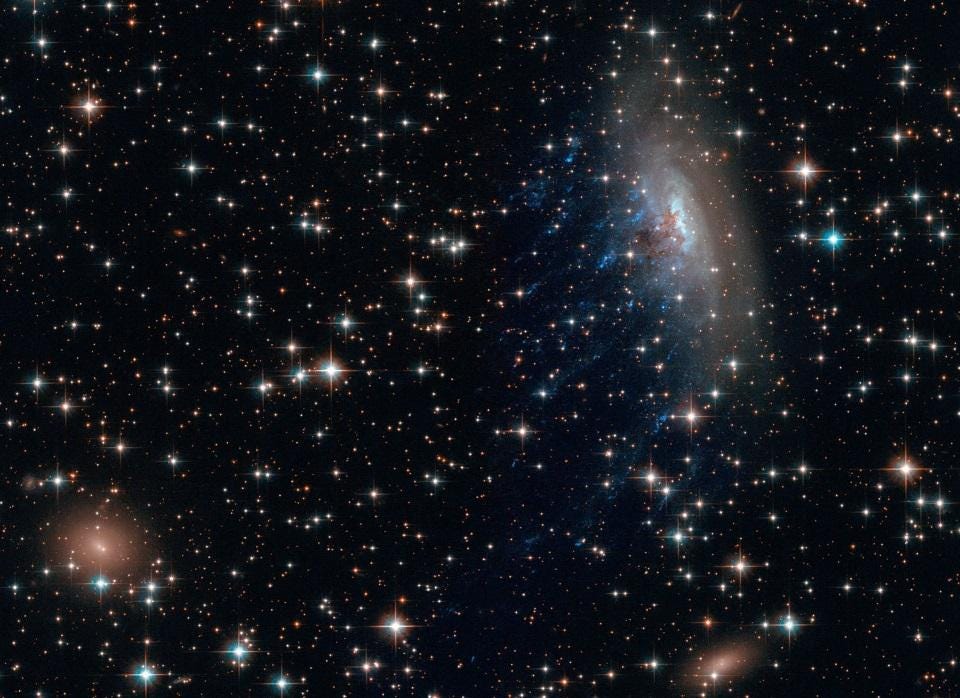
Hubble visualization of the dark matter distribution within the galaxy cluster Abell 901/902. The presence and structure of dark matter are inferred through weak gravitational lensing — subtle distortions in the light from over 60,000 background galaxies — revealing the invisible scaffolding that shapes the cluster’s mass. Image credit: NASA, ESA, ESO, and the STAGES/COMBO-17 collaborations.
Dark matter might consist of particles that exist in higher dimensions, interacting with our 3D world only through gravity. Picture them as shadows — present, but untouchable. Similarly, some theorists suggest dark energy could be a higher-dimensional force spilling into our universe, stretching space and accelerating cosmic expansion.
If these ideas hold true, the discovery of higher dimensions could revolutionize more than just our understanding of the universe; it could pave the way for technologies we’ve only dreamed of. Take quantum computing, for example. By tapping into these extra dimensions, we could unlock the potential for computers to process information in ways far beyond the capabilities of traditional, 3D-based systems. Imagine machines that operate simultaneously in multiple dimensions, harnessing this new space to perform calculations at speeds unimaginable today. This breakthrough might not just redefine computing; it could inspire entirely new technologies in energy, transportation, and even space exploration, transforming industries and societies in ways we can’t fully predict.
So, let’s take a closer look at these higher dimensions. Why do they matter, not just for physicists, but for anyone interested in understanding the deep truths about the universe — its origins, its structure, and the very essence of existence?
To grasp the true significance of these hidden dimensions, we must first ground ourselves in what we already understand — starting with the familiar framework of space and time.
Chapter 2 — The First Four Dimensions: Grounding Our Understanding of Space and Time
Before venturing into abstract dimensions, let’s ground ourselves in the four we already know. These dimensions form the framework of our daily experience, and the launching pad for deeper theories.
1st Dimension: The Line
The first dimension is pure length. Imagine a straight line — no width, no depth. Just one direction. Movement is limited to forward or backward along this axis. It’s simple, but essential: every higher dimension builds on this.
2nd Dimension: The Sheet
Add width, and you get a flat, two-dimensional world — like a sheet of paper. Shapes like circles, squares, and triangles live here, but there’s no sense of height. A 2D being could move left-right or forward-back, but the idea of “up” simply wouldn’t exist in their reality.
3rd Dimension: The Cube
Add depth, and we arrive at the familiar three-dimensional world. Objects have volume. We can move in all directions — up-down, left-right, forward-back. Our physical reality, from houses to humans to planets, exists in this space.
4th Dimension: The Frames
Time is often called the fourth dimension because it adds a necessary axis to our understanding of the universe. Just as the third dimension extends the flat 2D shapes into volumetric 3D space, time also extends spatial reality into a dynamic, evolving continuum. Each moment can be thought of as a frame in film reel, static on its own, but when arranged in sequence and played at a constant rate, creating the motion and change we observe. In physics, especially in Einstein’s theory of relativity, space and time are woven together into a single fabric: spacetime. Movement through space is inseparable from movement through time. To describe an event completely, we must specify not only where it happens, but when.
Massive objects like stars bend this spacetime, creating what we perceive as gravity. Instead of pulling on things directly, gravity arises from the way objects move along the curves of this four-dimensional fabric. This relationship between matter, energy, and the curvature of spacetime is captured by Einstein’s field equations₁ — a set of elegant yet powerful formulas at the heart of general relativity.
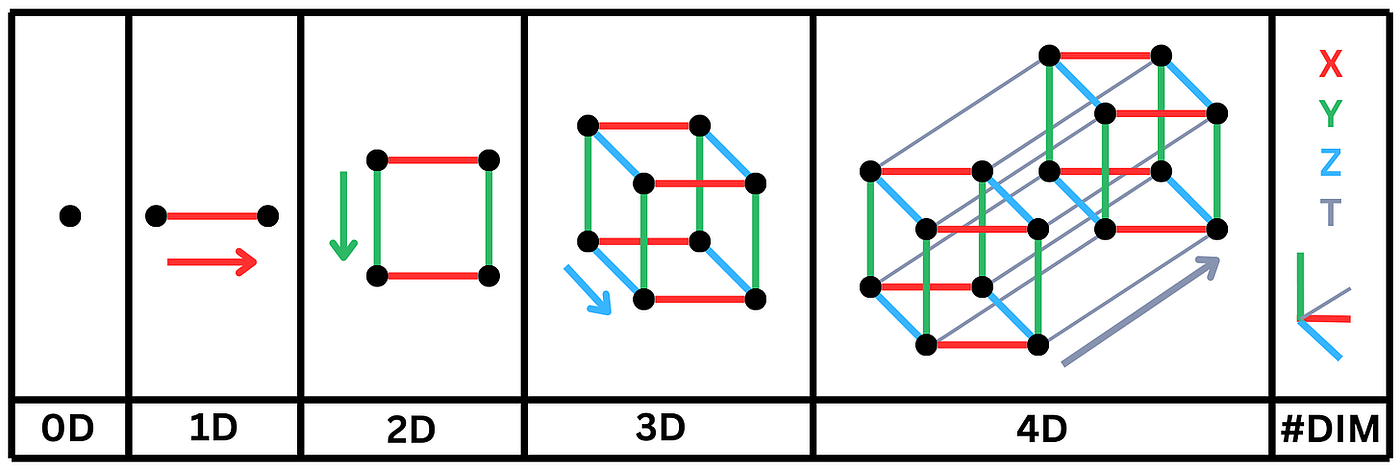
An illustration of geometric objects across dimensions: from a 0D point to a 4D tesseract, showing how each higher dimension builds on the structure of the previous one.
Together, these four dimensions — length, width, depth, and time — form the foundation on which all known physics plays out. They allow us to move through space, interact with objects, and perceive the passage of time.
Now that we’ve established the framework of these four familiar dimensions, we’re ready to venture into the uncharted territory beyond. In the realm of string theory, these additional dimensions offer a bold new vision — one that could revolutionize our understanding of the universe.
Chapter 3 — Into the Unknown: String Theory’s Vision of Extra Dimensions
At this point, you might wonder: Why go beyond four dimensions? Isn’t that enough to explain the universe? For many phenomena, yes. Our current models, especially Einstein’s relativity, work brilliantly on large scales. But as we dive deeper, down to the tiniest particles, the rules begin to change, and our familiar models start to break.
In the 20th century, physicists faced a critical challenge: unifying the fundamental forces of nature. Gravity, electromagnetism, and the nuclear forces could not be reconciled within the confines of the four-dimensional framework. This led to the birth of string theory, which proposed not just four dimensions, but ten, to provide a unified description of the universe.
The idea of extra dimensions isn’t a recent development. In the 1920s, Theodor Kaluza and Oskar Klein proposed a 5th dimension to unite gravity and electromagnetism — an idea that laid the groundwork for later, more complex advancements. Fast forward to the 1980s, and string theory underwent a resurgence with the “First Superstring Revolution,” revealing its potential to unify all fundamental forces. By the 1990s, M-theory emerged as the next step, uniting all five versions of string theory through 11 dimensions and mysterious “branes.”
Building on these ideas, scientists began to see that the four dimensions we experience daily are just the visible tip of a much larger structure. At the smallest scales, where quantum mechanics reigns, our familiar laws of physics begin to unravel. To make sense of this, physicists turned to hidden dimensions — compact, curled-up spaces that might hold the key to a deeper, more unified order.
This progression, from Kaluza and Klein’s early theory to M-theory’s promise of a unified framework, shows how what once seemed like speculative ideas have evolved into one of the most promising avenues for understanding the universe. As we stand on the brink of uncovering these hidden dimensions, the potential for transformative breakthroughs — both technological and conceptual — is closer than ever.
These dimensions are not just abstract mathematical constructs; they are essential to completing the picture of how reality functions. Exploring them could allow us to finally bridge the gaps between the seemingly disconnected forces of nature and open our eyes to a far more intricate, interconnected reality than we’ve ever imagined.
Chapter 4 — Where Physics Breaks Down: The Search for a Unified Theory
On the quantum scale, things get strange. Here, three fundamental forces — electromagnetism, the strong nuclear force, and the weak nuclear force — govern particle behavior and are successfully described by quantum field theory. Gravity, however, is not. When applied at or near the Planck scale, general relativity breaks down, predicting singularities such as infinite curvature or density. These outcomes are mathematical red flags, indicating the theory’s failure to describe gravity at quantum scales. Reconciling gravity with quantum mechanics is one of the deepest unresolved problems in modern physics. Despite their success individually, the fundamental forces refuse to fit neatly into a single, unified framework.
String Theory’s Big Idea String theory offers us a solution. Instead of thinking of particles as tiny dots, imagine them as tiny, vibrating strings. Just like plucking a guitar string can make different sounds, the way these strings vibrate determines things like mass, charge, and spin. Each vibration is like a note played on a cosmic instrument, with each note creating a different particle. If string theory is right, everything in the universe, from light to matter to gravity, arises from these strings.
Picture it like a spring door stopper: you can flick it and watch it vibrate back and forth, but its movement changes dramatically when you twist or bend it in more directions. In the same way, these extra dimensions give the strings the freedom to vibrate in more complex ways, unlocking the behaviors we observe in the physical world.
But there’s a catch: the math only works if the universe has more than four dimensions. Specifically, string theory requires ten dimensions — nine of space, one of time. Without these extra dimensions, the equations fall apart.

From points to strings: Classical physics models particles as zero-dimensional points moving through four-dimensional spacetime (left). String theory reimagines them as tiny, vibrating strings (right), with each vibration mode corresponding to a different particle. These strings propagate through familiar spacetime while interacting with six hidden, compactified dimensions, visualized here as a swirling vortex connecting the axes.
Why Don’t We See Them? If extra dimensions exist, why can’t we see them? The answer lies in compactification. These dimensions are thought to be “curled up” so tightly they’re undetectable at human scales. Imagine a garden hose viewed from afar — it looks like a line. Up close, you can see that it’s actually hollow, with space inside the hose for water to pass through. Similarly, higher dimensions may be tightly wound at subatomic scales and hidden within the lower dimensions we already perceive.
To physicists, these compactified dimensions aren’t just curled at random — they follow precise, stable geometric patterns, embedded deep into the fabric of space itself. In string theory, they’re thought to take the form of intricate, folded shapes — tiny, multidimensional structures that determine how strings vibrate and what kinds of particles and forces arise. It’s as if the garden hose contains a hidden inner mechanism — a rolled-up complexity that silently governs the visible world.

From simplicity to complexity: What appears as a one-dimensional line at the macroscopic scale (left) reveals a hidden structure under magnification (right) — a tubular space with six compactified dimensions arranged in a hexagonal pattern. Motion flows linearly in the extended dimension while curving through the tightly curled internal geometry, illustrating how extra dimensions can be hidden yet influence physical behavior.
Why Does This Matter? While we don’t directly perceive these hidden dimensions, they are fundamental to the fabric of reality. They are the very structure upon which the universe is built, and they play a crucial role in how the universe operates on both the microscopic and macroscopic scales. These hidden dimensions may help to unify the fundamental forces of nature, from gravity to the strong nuclear force, into a single, comprehensive framework. By embracing the existence of these additional dimensions, string theory has the potential to provide a deeper understanding of everything from the behavior of particles at the quantum level to the large-scale structure of the cosmos.
One way string theory makes room for these hidden dimensions is through Calabi–Yau manifolds — complex, multi-dimensional shapes that are curled up so tightly we can’t detect them directly. While imperceptible, their geometry profoundly influences the physics we observe. The way strings vibrate within these compactified dimensions determines fundamental particle properties like mass and charge. In essence, Calabi–Yau manifolds are not just mathematical curiosities — they’re the invisible scaffolding shaping the visible universe.

A Calabi–Yau manifold is a complex, multi-dimensional shape used in string theory to describe compactified extra dimensions. It is Ricci-flat — meaning it has no net curvature in certain directions — and it supports special symmetries (holonomy) that influence the physical properties of particles, such as mass and charge. The Kähler volume₂, calculated using the 2-form ω, measures the size of these hidden dimensions and determines how strings vibrate within them — shaping the observable universe from beneath the surface.
Chapter 5 — Beyond the 4D World: The 5th to 10th Dimensions of String Theory
As we move beyond the familiar four dimensions of space and time, string theory proposes six additional spatial dimensions — compactified, hidden, but vital for explaining the universe’s inner workings. These higher dimensions aren’t “directions” we can move in, but rather unseen degrees of freedom that influence how strings vibrate, how particles behave, and how the forces of nature interact.
Each dimension builds on the last, adding new layers of symmetry and complexity that shape the laws of physics. Instead of visualizing them as spatial extensions, imagine them as increasingly refined parameters in the cosmic blueprint.
5th Dimension — Extra Configuration Freedom:
The 5th dimension provides additional flexibility in how the compactified dimensions (those beyond 3D space) are “folded.” This impacts the vibrational patterns of strings, altering the properties of fundamental forces (like gravity and electromagnetism) and particle masses. Small changes in these shapes affect quantum interactions, potentially altering everything from particle behavior to gravity at tiny scales.
6th Dimension — Expanding Possibilities:
The 6th dimension introduces further variations in the shape and configuration of these compactified dimensions. This influences the fundamental constants of nature and the specific laws of physics. It offers a framework for how geometry variations of the compact dimensions could affect particle interactions.
7th Dimension — Complex Interactions:
The 7th dimension brings a greater variety of compactification schemes, enabling different interactions between forces and particles. This complexity helps explain how the forces in our universe — gravity, electromagnetism, nuclear forces — might emerge from unified interactions at higher energy scales.
8th Dimension — The Landscape of Realities:
The 8th dimension represents all the possible solutions to string theory’s equations. Every distinct arrangement of the compactified dimensions could generate a different physical reality. It’s a framework for understanding why our universe has the specific laws it does, as it is the result of the particular configuration chosen from a vast landscape of possibilities.
9th Dimension — Symmetry and Unification:
The 9th dimension explores the role of symmetry in higher dimensions, connecting forces and particles through symmetrical transformations. It plays a key role in unifying the forces of nature at very high energy levels, hinting at a unified theory where gravity, electromagnetism, and nuclear forces are linked in a higher-dimensional framework.
10th Dimension — The Unified Field Theory:
The 10th dimension is where all the extra dimensions converge, providing the ultimate unified theory of the universe. It represents the final boundary of physical reality, where all possible configurations of dimensions, symmetries, and forces merge into a single field theory. This framework ties together all physical laws and interactions, offering a comprehensive understanding of the universe.
Still with me? These concepts are highly abstract, making them difficult to visualize…
Let’s think of the dimensions as the different levels of a pyramid. The base represents our 3D universe (+ time), and each new level going up from the base describes a new dimension, until we hit the cap (10th dimension) at the top of the pyramid.

The Cosmic Pyramid: A metaphorical pyramid that illustrates the compactified nature of higher dimensions. Each ascending layer of the pyramid represents a new dimension — an unfolding of space, time, and possibility. From the tangible fabric of space-time to the abstract unity of all existence, this structure illustrates the architecture of a multi-dimensional universe.
The narrowing of the pyramid symbolizes moving from observable physics (the wide 4D base) up through increasingly hidden, abstract, or unified dimensions — not their physical scale. In M-theory, all dimensions beyond the familiar four are compactified at similar scales near the Planck length, and thus, are no smaller or more compact than any of the other higher dimensions. In this respect, the top of the pyramid isn’t “smaller” spatially; it’s just more refined, or higher-order.
Dimensions 5 through 10 offer a deeper understanding of the universe’s fundamental structure, building upon the first four dimensions in ways that are both subtle and profound. While these dimensions are abstract and not directly observable, their influence is felt throughout the cosmos, shaping the behavior of particles, the forces of nature, and the very constants that define reality. Each dimension introduces a new layer of complexity, revealing how the universe is not just a collection of space and time, but a dynamic, multi-dimensional architecture governed by intricate symmetries and configurations. Together, these higher dimensions provide the framework for everything we observe and experience, contributing to the unified theory of physics that could one day explain the mysteries of the universe.
While string theory paints a vast, multidimensional picture, it’s M-theory that ultimately brings these strands together — offering a deeper, potentially unifying vision in its mysterious eleventh dimension.
Chapter 6 — M-Theory and the 11th Dimension: The Key to Unifying Forces, Parallel Universes, and the Structure of Reality
The 11th dimension in M-theory is unique because it serves as a unifying element, linking the five different versions of string theory that existed before M-theory was proposed. While the other 10 dimensions in string theory involve different types of vibrational patterns for strings (which can manifest as particles), the 11th dimension plays a fundamentally different role.
In the 10-dimensional models of string theory, the extra dimensions are compactified, meaning they are curled up so small that they are undetectable at our scale. These dimensions extend and contract in ways that determine properties of particles, such as charge and mass. However, these dimensions don’t directly influence our experience of the universe on a large scale.
The 11th dimension, in contrast, is not compactified in the same way. It acts as a higher-dimensional “space” in which our entire 3-dimensional universe (the brane) is embedded. This higher-dimensional space, called the bulk, can be thought of as an environment that contains and interacts with our universe. The 11th dimension allows for the possibility that other branes could exist within the bulk, potentially creating parallel universes. It’s also theorized to help explain the relationship between gravity and the other fundamental forces, and why gravity is so much weaker than the other forces.
Introducing the 11th dimension also helps reconcile quantum mechanics and general relativity — two areas of physics that have traditionally been difficult to unify. It’s essentially a framework for connecting the dots between the many forces and dimensions that string theory has proposed, offering a deeper understanding of the universe’s structure. Unlike the other dimensions, which relate to specific properties of particles, the 11th dimension provides the “stage” on which the physics of our universe unfolds.
Imagine the bulk as a vast, higher-dimensional space with membranes floating within it (like a giant, cosmic loaf of bread, filled with floating “slices” of bread — each slice representing a brane, or universe). These branes are separated by (and contained within) the bulk. And while we are confined to the specific brane our universe resides on, it’s possible that interactions could occur between our brane and others across this higher-dimensional space. These interactions could have significant effects, including the potential for gravity (or even other fundamental forces) to leak between branes, offering new explanations for cosmic phenomena that are otherwise unexplained by traditional models.

The Cosmic Loaf: A metaphorical loaf of bread that illustrates the multiverse, where each slice represents a distinct brane — self-contained universes with their own space and time axes. The bulk (the rest of the loaf) houses these branes and allows for phenomena like gravity to leak between them.
Branes are multi-dimensional objects predicted by string theory. A 0-brane is a point, a 1-brane is a string, a 2-brane is a 2D membrane, and so on — up to 9-branes in some models. These branes can vibrate, collide, and stretch across higher dimensions, serving as potential universes or fundamental components of them. The behavior of a specific class called Dp-branes (where “p” indicates the number of spatial dimensions) is governed by the Dirac–Born–Infeld (DBI) action₃. This mathematical framework describes how these branes move and respond to forces, incorporating both their geometric shape and internal fields like electromagnetism. In essence, it tells us how a brane flexes, bends, and carries energy as it evolves through the fabric of higher-dimensional space.
The extra dimensions proposed by M-theory are not merely theoretical curiosities; they could hold the key to understanding the very nature of matter and space-time itself. In this framework, everything from the behavior of subatomic particles to the grand structure of the cosmos could be determined by how our brane interacts with higher-dimensional space and other branes. Thus, M-theory doesn’t just offer a potential “Theory of Everything” that unites quantum mechanics and general relativity — it opens entirely new ways of thinking about how the universe is connected across all scales.
More than just a unifying framework, M-theory reimagines the entire scaffolding of reality. It invites us to consider a cosmos where our universe is just one of many branes drifting through a higher-dimensional bulk, where space and time are dynamic, and where the multiverse emerges not as science fiction, but as a natural consequence of deeper hidden dimensions. In doing so, M-theory doesn’t merely reconcile quantum mechanics and general relativity — it opens the door to entirely new ways of thinking about existence, connection, and the fundamental nature of the cosmos.
Chapter 7 — Branes, the Bulk, and the Multiverse: Exploring the Cosmic Origins and Hidden Forces of Our Universe
Now that we understand branes and the bulk, let’s explore what these concepts mean for the universe we live in.
The idea of branes in a multidimensional bulk opens up radical possibilities for understanding the universe. For example, gravity may not be confined to our brane, unlike other fundamental forces. It might “leak” into the bulk or interact with neighboring branes, possibly explaining why gravity appears weak compared to electromagnetism. This could help resolve the so-called hierarchy problem in physics.
One of the most compelling features of this framework is the possibility of interactions between branes. For instance, some physicists propose that the Big Bang might have been caused by a collision between two branes, unleashing a burst of energy that formed all of the matter in our universe. In this view, what we see as a singular cosmic origin could actually be the result of a higher-dimensional event.

Brane Collision: Two branes collide at a single point in higher-dimensional space, triggering a cosmic singularity. This impact releases an outburst of light, energy, and fundamental forces into both branes — an event theorized in some models, such as the Ekpyrotic Potential₄, as a possible origin of the Big Bang and the birth of our universe.
Brane collisions also offer an alternative explanation for cosmic phenomena like the distribution of dark matter and the presence of dark energy. Dark matter might actually be the gravitational influence of nearby, parallel branes. What appears as invisible mass in our universe could be the pull of unseen dimensions acting on us. Similarly, dark energy — the mysterious force driving cosmic acceleration — might result from motion or pressure in the bulk pushing on our brane.
Testing Higher Dimensions: The Large Hadron Collider (LHC) As we consider the potential for higher dimensions, it’s important to note that these theories aren’t confined to the realm of abstract speculation. The Large Hadron Collider (LHC), the world’s largest particle accelerator, is at the cutting edge of experiments that could offer empirical evidence of extra dimensions. Models like Randall-Sundrum suggest that extra dimensions might affect how gravity behaves, allowing it to “leak” into these higher dimensions and alter its strength at small scales.
If such extra dimensions exist, gravity could appear weaker at subatomic distances, because the force would be spread out across more dimensions than we experience in our familiar three-dimensional world. Experiments at the LHC, particularly those studying high-energy particle collisions, could reveal anomalies in gravity or particle behavior that might point to the existence of these hidden dimensions. Deviations from the predictions of traditional physics, such as unexpected gravity effects at tiny distances, could offer the first direct evidence of extra dimensions in our universe.
Why It Matters These higher-dimensional concepts aren’t just theoretical curiosities; they offer powerful new frameworks for solving some of the universe’s most persistent puzzles. M-theory’s brane-world perspective reframes how we think about space, time, and gravity, providing new explanations for phenomena like dark matter, dark energy, and even the origin of the cosmos.
If these ideas prove correct, they could unify gravity with the other fundamental forces, resolve long-standing paradoxes in cosmology, and show that our universe is just one piece of a much larger, multidimensional reality. In that sense, brane dynamics don’t just add complexity; they may bring us closer to a truly unified understanding of the cosmos.
The brane-world framework offers profound insights into cosmic phenomena like dark matter, dark energy, and the very origin of the universe. These ideas not only challenge our current understanding but also hold the potential to unify gravity with the other forces. As we move forward, we’ll explore how experiments at the frontier of science could provide crucial evidence, bringing us closer to understanding higher dimensions.
Chapter 8 — At the Edge of Science: Where Physics Ends and Speculation Begins
While rooted in advanced mathematics, M-theory remains highly speculative. We have no direct evidence for extra dimensions or the bulk, and current technology is far from capable of testing these ideas.
M-theory’s elegance lies in its unifying power, but it operates at energy scales that are simply beyond our experimental reach. The extra dimensions it proposes are thought to be compactified — curled up at scales near the Planck length (about 10⁻³⁵ meters) — making them undetectable with today’s particle accelerators or instruments.
This highlights a central challenge in modern theoretical physics: many ideas are mathematically sound but not empirically testable. That raises a deeper philosophical question: can a theory be considered scientific if it can’t be tested? Or is it better viewed as a conceptual framework, guiding our search for deeper truths even without current proof?
M-theory’s speculative nature invites both excitement and skepticism. Are we uncovering the universe’s true architecture, or just spinning beautiful abstractions? Until new methods emerge, M-theory sits at the frontier — where science meets imagination. But many breakthroughs began at that very edge. Concepts like black holes and quantum mechanics were once purely theoretical too. M-theory, despite its uncertainties, may yet reshape our understanding of reality.
In considering this tension between what we can predict through mathematics and what we can verify through experimentation, we encounter the heart of modern theoretical physics — where abstract elegance often collides with the hard constraints of empirical validation. This friction is not only a challenge but a critical driver of progress, propelling science forward into new realms of possibility, even when the path is unclear.

Venn diagram showing the difference between what is purely mathematically predictable about the universe, what we can quantify in a lab through experimentation, and where the two are beginning to overlap.
While M-theory remains speculative, its bold vision pushes the boundaries of our understanding, offering the possibility of profound breakthroughs that could revolutionize both science and technology. As we explore the intersection of theory and experiment, it becomes clear that even in the absence of direct evidence, these ideas are shaping the future of physics, leading us toward new realms of discovery.
Chapter 9 — Unlocking the Hidden Realms: How M-Theory Could Reshape Reality and Drive the Next Frontier of Innovation
The universe is stranger and more layered than we ever imagined. M-theory offers a radical glimpse into a reality beyond our senses, where our three-dimensional world may float on a “3-brane” within a vast, multidimensional bulk.
These ideas might seem abstract, but the search for a unified theory isn’t just philosophical — it’s practical. Understanding the deepest laws of nature has historically sparked transformative advances. Electromagnetism gave us electricity and the internet. Quantum theory led to semiconductors and MRI machines. What might higher-dimensional physics unlock?
A better grasp of these hidden dimensions could reshape fields like energy, materials science, quantum computing, and even space travel. It may help us answer some of the biggest questions in cosmology — or rewrite what we think is possible.
In a world where gravity may leak into unseen dimensions, we could someday manipulate spacetime itself — harnessing gravitational forces in ways that seem like science fiction today. Energy systems could be built not just on the particle interactions we know, but on fields extended through higher-dimensional topologies. Materials designed with brane-inspired architectures might exhibit behaviors that defy classical constraints — self-healing, shape-shifting, or even tuning their physical properties in real-time.
Quantum computers might evolve into dimensional computers, capable of threading calculations through geometries we’ve only glimpsed in equations. And if space itself is a membrane, perhaps interstellar travel won’t mean pushing through space, but slipping between it — finding shortcuts through the bulk, stepping off our brane for just long enough to reappear somewhere new.
These aren’t just wild dreams — they are the kinds of futures that emerge when physics meets imagination, when fundamental understanding leads to fundamental change. As we push further into the fabric of reality, M-theory may not just explain the universe. It may invite us to remake it.
The implications here aren’t just technological — they’re philosophical. If the architecture of reality includes unseen dimensions, then our place in the cosmos must be reimagined. We are no longer simply inhabitants of space and time, but explorers of a hidden structure far more vast and strange that we even know. M-theory doesn’t just offer us a new scientific framework, it invites an entirely new worldview. One in which our curiosity becomes a compass, and the horizon isn’t just out there in the stars, but woven into the very fabric of reality beneath our feet.
Chapter 10 — Dimensions of Possibility: The Next Frontier of Physics
M-theory stretches the boundaries of both physics and imagination. Are we living in a multiverse? Do unseen dimensions shape the universe we know? These questions are no longer confined to science fiction — they now belong to science itself.
Yet, for all we’ve uncovered, most of the cosmos remains a mystery. Each discovery opens the door to deeper questions. But with every step forward, we draw closer to understanding the true nature of reality.
The potential isn’t just theoretical. A deeper grasp of higher dimensions could unlock radical innovations — from energy and computing breakthroughs to reimagined notions of space, time, and even consciousness itself. What kind of civilization might we become if we learned to harness the fabric of the cosmos?
Standing at the threshold of this new frontier, we’re challenged to rethink our most basic assumptions. If M-theory is right, our universe is only one layer in a grand, multidimensional structure — where the rules we’ve known are only part of the story. Peering into these hidden dimensions could not only transform physics but open entirely new chapters of human potential.
As Stephen Hawking once warned,
“The greatest enemy of knowledge is not ignorance, it is the illusion of knowledge.”
In the quest to understand the universe, we must remain humble — and relentless. The journey into higher dimensions is more than a scientific endeavor. It is a testament to the human spirit: curious, imaginative, and forever reaching into the unknown.
While we may not yet know where this path leads, the questions we ask today will undoubtedly shape the realities of tomorrow.

Artistic rendition of cosmic branes in the 11D bulk.
“Somewhere, something incredible is waiting to be known.” — Carl Sagan
Thank you for reading! If you enjoyed this work, please consider sharing it so others can read it too, or follow me for more deep-dives into thought-provoking topics in science.
Appendix: Physics Terms
11 Dimensions In M-theory, the universe is composed of 11 dimensions: 10 spatial and 1 time dimension. These extra spatial dimensions may be compactified (curled up and hidden), and they play a crucial role in the behavior of fundamental particles and forces.
3 Brane A three-dimensional brane, or membrane, in string theory. Our universe is proposed to exist on a 3 brane, which is a three-dimensional object floating in a higher-dimensional bulk. The concept of branes helps explain the potential existence of parallel universes.
Brane Collisions (Ekpyrotic Potential) A model that suggests the universe was created through the collision of two branes in a higher-dimensional space. This collision released energy, resulting in the Big Bang and the formation of our universe. The “Ekpyrotic Potential” refers to the potential energy from such brane collisions that could explain cosmic phenomena.
Bulk The bulk is the higher-dimensional space in which branes (like our universe) exist. While we are confined to our own brane, gravity and possibly other effects may extend into or interact across the bulk.
Calabi–Yau Manifold A complex, compact, and highly symmetrical shape used in string theory to describe how extra spatial dimensions might be folded or “compactified.” These shapes help determine the properties of particles and forces in our universe.
Compactification The process by which extra spatial dimensions in string theory are “curled up” into small, unobservable sizes. This explains why we do not observe more than the familiar three spatial dimensions in everyday life.
Configurations In physics, configurations refer to the possible arrangements or states of a system, often used in the context of string theory to describe how the extra dimensions or strings might be organized.
Dark Energy A mysterious force causing the accelerated expansion of the universe. Some theories propose it originates from interactions between dimensions or energy seeping into our universe from the bulk.
Dark Matter A type of matter that doesn’t emit light and cannot be directly seen, but reveals itself through gravitational effects. In some theories, it may involve particles that interact with our universe only through gravity, possibly from higher dimensions.
Depth The third spatial dimension, representing the extent of an object or space in a direction perpendicular to both length and width. Together, length, width, and depth describe the physical space around us.
Dimension A direction or axis in space or time. We live in a universe with three spatial dimensions (length, width, height) and one time dimension. Higher-dimensional theories propose additional, hidden dimensions.
Einstein’s Theory of Relativity A set of two theories proposed by Albert Einstein: special relativity and general relativity. Special relativity addresses the physics of objects moving at high speeds and introduces the concept that space and time are relative and interconnected. General relativity extends this by describing gravity as the curvature of spacetime caused by mass and energy.
Electromagnetism One of the four fundamental forces, electromagnetism governs the interactions between charged particles. It is responsible for electric fields, magnetic fields, and the interaction of light with matter. It operates through the exchange of photons.
Extra Dimensions Dimensions beyond the four we experience. These may be spatial dimensions that are compactified or abstract dimensions that describe alternate physical laws, realities, or potential outcomes in multiverse theories.
Geometries of Space-Time The shapes or structures of spacetime, which are influenced by the distribution of mass and energy. In general relativity, mass curves spacetime, and this curvature dictates how objects move through space and time.
Gravity The force of attraction that pulls masses toward one another. In Einstein’s theory of general relativity, gravity is not seen as a force but as the curvature of spacetime caused by mass and energy. Massive objects warp the fabric of spacetime, causing other objects to move along curved paths.
Hierarchy Problem A major issue in particle physics that questions why gravity is so much weaker than the other fundamental forces (like electromagnetism). One proposed solution involves the idea that gravity might spread across extra dimensions, leading to its apparent weakness in our four-dimensional universe.
Length The one-dimensional measurement of the distance between two points in space. It is one of the fundamental spatial dimensions we experience.
M-theory A theoretical framework in physics that unifies the five different versions of string theory. It proposes that the fundamental building blocks of the universe are one-dimensional strings, and that the universe has 11 dimensions (10 spatial dimensions and 1 time dimension). M-theory incorporates the concept of branes, which are multi-dimensional objects, and provides a potential framework for understanding gravity at the quantum level.
Multiverse The idea that multiple universes may exist, each with different initial conditions, physical laws, or even numbers of dimensions. These universes may be realized in higher-dimensional space or alternate branches of quantum outcomes.
Paradox A paradox in physics is a situation or thought experiment that reveals an apparent contradiction or conflict within established theories, observations, or assumptions. These paradoxes often highlight the limits of current understanding and can lead to breakthroughs by challenging physicists to resolve the inconsistency.
Planck Length The Planck length is the smallest possible unit of length with physical meaning, approximately 1.616 × 10⁻³⁵ meters. It represents the scale at which classical ideas of gravity and space-time cease to be valid, and quantum gravitational effects dominate. Often considered the “pixel size” of the universe, nothing smaller can be meaningfully measured or observed.
Planck Scale The Planck scale refers to the realm of physics where quantum mechanics and general relativity converge. It defines the smallest meaningful units of measurement in the universe, beyond which our known physical laws break down and a theory of quantum gravity is required. At this scale, space-time is thought to be quantized — meaning it’s not smooth and continuous, but composed of singular units, like the individual pixels on a screen that together form a coherent image.
Point-like Objects In particle physics, point-like objects refer to particles that are treated as having no spatial extension (i.e., they are considered to be zero-dimensional). In string theory, these point-like particles are replaced by one-dimensional strings.
Quantum: Refers to the smallest building blocks of the universe — tiny, discrete units of energy or matter. Quantum physics deals with how things behave at this incredibly small scale, where particles can act like waves, exist in more than one place at once, and seem to be connected over vast distances. These strange but real behaviors are at the heart of how the universe works at its most fundamental level.
Quantum Computing: A new kind of computing based on the weird rules of quantum physics. Instead of using regular bits like 0s and 1s, it uses qubits, which can be 0 and 1 at the same time. This allows quantum computers to process information in a way that’s totally different from normal computers — faster for some problems and better at handling really complex systems, like those that come up in high-dimensional theories like M-theory.
Quantum Field Theory A theoretical framework that combines quantum mechanics and special relativity to describe the behavior of fields (such as electromagnetic fields) and the particles that arise as excitations in those fields. It forms the basis of the Standard Model of particle physics.
Quantum Mechanics The branch of physics that describes the behavior of particles at the smallest scales. It’s probabilistic, not deterministic, and forms the basis of modern particle physics.
Randall-Sundrum Model: The Randall-Sundrum model is a theoretical framework in particle physics that addresses the hierarchy problem. It proposes that our universe has extra dimensions beyond the familiar three of space and one of time. Specifically, it suggests that gravity can spread through these extra dimensions, while the other forces are confined to a 3-dimensional brane. This model provides a potential explanation for the weakness of gravity compared to other forces and offers insights into phenomena like dark matter and the nature of black holes.
Singularity A point in space-time where density becomes infinite, such as at the center of a black hole. The laws of physics break down at a singularity, and a theory of quantum gravity is needed to describe this region.
Spacetime A four-dimensional continuum that combines three spatial dimensions (length, width, depth) and one time dimension. Spacetime forms the “fabric” in which all physical events occur, and its curvature dictates gravitational effects.
Strings/ String Theory A theoretical framework in which the fundamental building blocks of the universe are not point particles, but tiny vibrating strings. The vibrations determine the properties of particles, and the theory requires extra dimensions to work.
Symmetry A property of a system that remains unchanged under specific transformations. Symmetries in physics lead to conservation laws (such as conservation of energy) and play a key role in formulating theories of fundamental forces.
Tesseract A four-dimensional analog of a cube. Just as a cube is a 3D extension of a square, a tesseract is a 4D extension of a cube. It is used in theoretical physics and mathematics to help visualize higher-dimensional objects and spaces.
The Strong Nuclear Force The fundamental force that holds the nuclei of atoms together, binding protons and neutrons. It is the strongest of the four fundamental forces but operates only over very short distances (on the order of atomic nuclei).
The Weak Nuclear Force A fundamental force responsible for processes like radioactive decay and the interactions of subatomic particles such as neutrinos. It is weaker than the strong nuclear force and electromagnetic force but is crucial for nuclear reactions, such as those in the Sun.
Theory of Everything (TOE) A theoretical framework that attempts to unify all fundamental forces of nature (gravity, electromagnetism, the weak nuclear force, and the strong nuclear force) into a single, consistent theory. A TOE would reconcile quantum mechanics with general relativity.
Time The fourth dimension, measured in seconds, minutes, hours, etc. Time represents the progression of events and changes in the state of systems, and it is integrated with space to form spacetime in Einstein’s theory of relativity.
Vibration/Vibrational Patterns (of Strings) In string theory, different particles are thought to correspond to different vibrational modes of strings. The vibration pattern (or frequency) of a string determines the particle’s properties, such as its mass, charge, and spin.
Weak Gravitational Lensing A method to detect dark matter by observing how it subtly distorts light from distant galaxies. It reveals the invisible mass distribution that can’t be seen directly.
Width The two-dimensional measurement of the extent of an object or space in a direction perpendicular to length. It is one of the fundamental spatial dimensions.
Appendix: Mathematical Equations
These equations describe the fabric of reality in modern theoretical physics — and echo the deeper philosophical questions we’ve explored: what lies beneath the surface of what we see, feel, and know? How do invisible structures shape lived experience? How do collisions — emotional, spatial, cosmic — give rise to something new?
1. Einstein Field Equations

Einstein’s iconic equation relates the curvature of spacetime (left side) to the distribution of matter and energy (right side). In simple terms: the presence of matter tells space how to curve, and the curvature of space tells matter how to move. This equation is the foundation of general relativity and underpins our understanding of gravity.
Philosophical Reflection: Reality is relational. Existence creates shape, and shape guides motion. This interplay between matter and space can be viewed as a metaphor for our social and emotional lives. Just as gravity shapes the paths of celestial bodies, emotional gravity shapes our connections, creating invisible forces that influence our interactions. Empathy, for instance, is a subtle warping of our paths around each other — an invisible force that directs our behaviors and feelings. The equation captures the idea that our relationships, like the forces of gravity, are built on mutual influence and interconnectedness.
2. Kähler Volume of a Calabi–Yau Manifold

This elegant integral calculates the volume of the hidden dimensions in string theory. The Calabi–Yau manifold is the invisible geometry that shapes the observable universe. The 2-form ω represents how space is curved and curled in ways we cannot directly perceive.
Philosophical Reflection: The visible world is shaped by hidden dimensions. Just as we cannot directly observe the intricate structures of the Calabi–Yau manifold, much of the reality we experience is shaped by forces and dimensions that are invisible to us — both physically and emotionally. This equation represents the unseen influences that shape our world. It can be thought of as a metaphor for the unconscious: the emotional undercurrents, the impulses and biases that guide us without our conscious awareness. Empathy operates much like the hidden dimensions of the manifold — it is the invisible architecture that shapes our interactions and experiences, lying beneath the surface of language and logic, often going unnoticed but deeply affecting the structure of our relationships and society
3. Dirac–Born–Infeld Action for Dp-Branes

This equation describes a Dp-brane — a multidimensional object moving through higher-dimensional space. The brane bends and stretches in response to internal forces (denoted as F{ab}) and the external geometry (g{ab}) of the universe around it.
Philosophical Reflection: A brane is like a consciousness — shaped by both internal desires and external pressures, embedded in a universe it cannot fully perceive. It vibrates with tension, reacting to both internal needs and the surrounding environment, evolving as it moves through space. This metaphor mirrors how we, as individuals, navigate the complexities of life. Our emotional responses (internal forces) interact with the social and cultural structures (external forces) we find ourselves in, constantly shifting, stretching, and adapting. The brane’s motion is a perfect analogy for empathy: the way we are sensitive to the “curvature” of others — how we adjust our emotional and behavioral trajectories in response to the people around us.
4. Ekpyrotic Potential (Brane Collision & the Cyclic Universe)

This simplified action describes the Ekpyrotic universe — a theory proposing that our Big Bang wasn’t the beginning but the result of a collision between higher-dimensional branes. The scalar field ϕ represents the distance between these branes, and the potential V(ϕ) draws them together over cosmic time.
Philosophical Reflection: From separation, attraction. From collision, creation. This is the mathematics of encounter — two realms, or two consciousnesses, crashing into each other, forging something new. The Ekpyrotic theory mirrors emotional and societal dynamics: moments of intense clash or confrontation often lead to transformation. Just as the collision of two branes creates a new universe, the collision of ideas, emotions, or cultures can give rise to new understandings and new realities. This is a metaphor for growth and change — how conflict or tension can propel us toward greater unity or insight, much like two minds opening to each other, or two societies colliding and generating fresh meaning. The cycle of separation, attraction, and collision reflects the cyclical nature of human experience — where each moment of rupture creates the potential for renewal, just as each emotional struggle can lead to personal evolution.
References and Recommended Reading
String Theory and Extra Dimensions:
Greene, B. (1999). The Elegant Universe: Superstrings, Hidden Dimensions, and the Quest for the Ultimate Theory. W.W. Norton & Company.
Greene’s work provides a foundational exploration of string theory, introducing the concept of extra dimensions and the M-theory framework, offering a compelling vision of a multi-dimensional universe that challenges our perception of space and reality.
Becker, K., Becker, M., & Schwarz, J. H. (2007). String Theory and M-Theory: A Modern Introduction. Cambridge University Press.
This textbook delves into the mathematical structure of string theory, explaining how the theory extends beyond the familiar 4-dimensional spacetime to encompass higher dimensions, which may hold the key to understanding fundamental physics.
Greene, B. (2004). The Fabric of the Cosmos: Space, Time, and the Texture of Reality. Vintage Books.
Greene takes us through the implications of space-time, showing how string theory could reshape our understanding of the universe, particularly through the lens of hidden dimensions.
Polchinski, J. (1998). String Theory Volumes 1 & 2. Cambridge University Press.
Polchinski’s authoritative work provides a rigorous, in-depth look at string theory’s core concepts and its mathematical underpinnings, offering insights into the theory’s potential to describe the universe at a fundamental level.
Dark Matter and Dark Energy
Brown, P. M. (1997). The dark matter problem: A historical perspective. The Astrophysical Journal, 477(1), 1–15.
Brown’s article offers a historical overview of the dark matter hypothesis, charting its evolution from a theoretical curiosity to a central component in our understanding of the cosmos.
Randall, L. (2015). Dark Matter and the Dinosaurs: The Astounding Interplay Between the Universe and the Evolution of Life on Earth. HarperCollins.
Randall explores the interplay between dark matter and cosmic evolution, proposing that dark matter might have influenced the formation of galaxies and potentially played a role in the extinction of the dinosaurs.
NASA. (n.d.). Dark matter. NASA. Retrieved from https://www.nasa.gov/
NASA’s site provides accessible explanations and visualizations, highlighting the key role of dark matter in shaping galaxy clusters and the larger cosmic structure.
Riess, A. G. (2004). The discovery of dark energy. Nature, 416(6881), 19–28.
Riess’s groundbreaking paper details the discovery of dark energy, which has transformed our understanding of the universe’s accelerating expansion and the forces driving its evolution.
Hawking, S. (1988). A Brief History of Time. Bantam Books.
Hawking’s classic work offers a deep dive into the mysteries of the universe, including dark energy and its role in shaping the cosmos, particularly through its impact on the balance of forces.
Frieman, J. A., Turner, M. S., & Huterer, D. (2008). Dark energy and the accelerating universe. Annual Review of Astronomy and Astrophysics, 46, 385–432.
This comprehensive review by Frieman and colleagues synthesizes the current understanding of dark energy, exploring its influence on the accelerating expansion of the universe and its potential origins.
Quantum Mechanics and String Theory’s Potential for Quantum Computing
Aaronson, S. (2013). Quantum Computing Since Democritus. Cambridge University Press.
Aaronson’s work explores the philosophical and practical aspects of quantum computing, grounded in the principles of quantum mechanics, and discusses the potential breakthroughs in computational power through quantum systems.
LaFlamme, R., & Schreiber, D. (2009). Introduction to Quantum Computing. Cambridge University Press.
This textbook provides a structured introduction to quantum computing, outlining the fundamental principles of quantum mechanics and their applications in the emerging field of quantum computation.
Preskill, J. (2018). Quantum computing in the NISQ era and beyond. Quantum, 2, 79.
Preskill discusses the current state of quantum computing, focusing on the NISQ (Noisy Intermediate-Scale Quantum) era, and outlines the potential advancements that could be achieved with quantum technologies in the near future.
Weinberg, S. (1992). String Theory and the Quest for the Ultimate Theory. Pantheon Books.
Weinberg’s work investigates the potential of string theory to offer a unified framework for physics, and how this could lead to revolutionary technological advancements, including in the realm of quantum computing.
Fock, V. (1965). The Mathematical Structure of Quantum Mechanics. Springer-Verlag.
Fock’s foundational text on quantum mechanics offers the mathematical underpinnings of quantum theory, providing the necessary framework for understanding how quantum mechanics and string theory could converge in quantum computing.
Time as the Fourth Dimension and General Relativity
Einstein, A. (1915). The field equations of gravitation. Annalen der Physik, 49(7), 769–822.
Einstein’s groundbreaking paper introduced general relativity, revolutionizing our understanding of gravity as the curvature of spacetime caused by mass and energy.
Einstein, A. (1920). Relativity: The Special and the General Theory. Henry Holt & Co.
In this accessible work, Einstein elaborates on his theory of relativity, explaining how time and space are interwoven and how their curvature leads to the phenomenon of gravity.
Hawking, S. (1988). A Brief History of Time. Bantam Books.
Hawking discusses the unification of space and time in his exploration of general relativity, detailing how Einstein’s work continues to influence modern cosmology.
Calabi-Yau Manifolds and Compactification
Greene, B. R., & Plesser, M. R. (1990). Duality in Calabi-Yau moduli space. Nuclear Physics B, 338(1), 15–37.
This seminal paper introduces mirror symmetry and its role in string theory, explaining how Calabi-Yau manifolds help define the compactified extra dimensions that govern the behavior of elementary particles.
Frankel, T. (1997). The Geometry of Physics: An Introduction. Cambridge University Press.
Frankel provides an accessible overview of Calabi-Yau geometry and its critical role in string theory, particularly in understanding the compactification process.
Becker, K., Becker, M., & Schwarz, J. H. (2007). String Theory and M-Theory: A Modern Introduction. Cambridge University Press.
This textbook gives a thorough treatment of Calabi-Yau spaces in the context of string theory, detailing their function in defining the compactified dimensions that influence particle physics.
Why We Can’t See Hidden Dimensions
Polchinski, J. (1998). String Theory Volumes 1 & 2. Cambridge University Press.
Polchinski explains the compactification process in string theory, describing how extra dimensions are “curled up” and hidden from our perception, effectively eluding direct detection.
Kaku, M. (1999). Introduction to Superstring Theory. Springer-Verlag.
Kaku’s book provides a more accessible explanation of compactification, discussing how higher dimensions are compactified and why they remain invisible to us.
M-Theory and Its Vision of the Universe
Witten, E. (1995). M-theory: The mother of all superstrings. Nuclear Physics B, 443(1), 3–46.
Witten’s landmark paper introduces M-theory, proposing an 11-dimensional framework that unifies all five superstring theories into a single, cohesive theory of the universe.
Greene, B. (1999). The Elegant Universe: Superstrings, Hidden Dimensions, and the Quest for the Ultimate Theory. W.W. Norton & Company.
Greene discusses M-theory as a unifying framework for string theories, showing how it extends string theory into a broader 11-dimensional context, offering a deeper understanding of the universe.
Disclaimer: This work explores advanced topics in contemporary theoretical physics, including string theory, M-theory, and higher-dimensional models. While the discussion is informed by peer-reviewed literature and established mathematical frameworks, many of the concepts addressed — such as extra spatial dimensions, D-branes, and the multiverse — remain speculative and are not empirically verified. These models are active areas of theoretical research and are subject to ongoing refinement and debate within the scientific community. As such, the interpretations and perspectives presented herein are intended for conceptual exploration and intellectual engagement, and should not be regarded as settled scientific fact.
메타데이터
- post_id
- 4bce5fbfde29
- slug
- the-hidden-layers-of-reality-a-guide-through-the-higher-dimensions-of-m-theory-4bce5fbfde29
- url
- https://medium.com/@johnrwilder149/the-hidden-layers-of-reality-a-guide-through-the-higher-dimensions-of-m-theory-4bce5fbfde29
- canonical_url
- https://medium.com/@johnrwilder149/the-hidden-layers-of-reality-a-guide-through-the-higher-dimensions-of-m-theory-4bce5fbfde29
- author_url
- https://medium.com/@johnrwilder149
- status
- ok
- fetched_at
- 2026-06-10 12:26:30