Linda Bradford Raschke: She Started Her Career $30,000 in Debt
Okay, so nobody was hiring a 21-year-old girl to manage money in 1980. Obviously.
Linda Bradford Raschke: She Started Her Career $30,000 in Debt
Okay, so nobody was hiring a 21-year-old girl to manage money in 1980. Obviously.
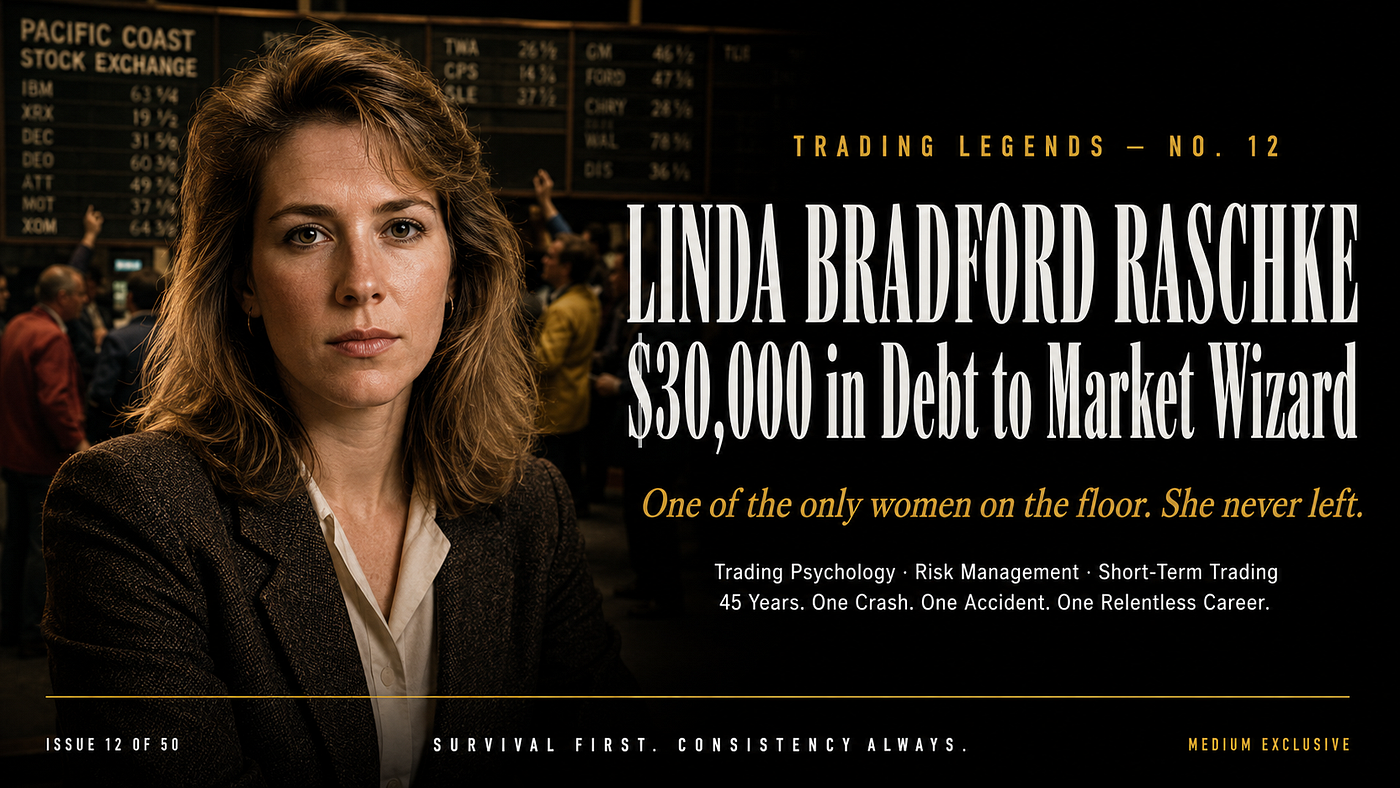
So what does she do? She takes some random job across the street from the Pacific Coast Stock Exchange in San Francisco and just… starts hanging around before her shift. Every morning. Watching people. Asking dumb questions probably, at first.
Somebody noticed eventually.
That’s it. That’s how one of the best short-term traders in history got her start. Not a degree. Not connections. A woman who wouldn’t stop showing up outside a building.
$25,000 and Then a Hole She Didn’t See Coming
A trader ends up staking her. Twenty-five grand. Split the profits fifty-fifty, that was the deal.
She’s in. On the floor now. Basically the only woman there most days, probably.
Then she loses almost all of it.
There’s this trade — Cities Service, a stock — and it just goes bad. Really bad. She later called it the most expensive lesson she ever paid for, and I believe her, honestly, because by the time the dust settled, she was thirty thousand dollars in debt.
Twenty-one years old. On a floor where she already stood out just by existing there. And now buried in debt before she’d even really started.
She said something once that I keep coming back to — she had to learn survival before she could even think about profits.
Read that again, actually. Survival before profits. Not survival and profits. Before.
Most people starting — in Pakistan, wherever, doesn’t matter — they’re thinking about the win on day one. She wasn’t thinking about winning. She was thinking about whether she’d even be allowed to keep trying tomorrow.
The Floor Didn’t Care Who She Was
She said this thing about the floor that stuck with me weirdly.
If you didn’t have thick skin already, you weren’t lasting long there. And once you were on the floor, you grew even thicker skin than that.
Try to picture it. Early 80s trading pit. Loud. Aggressive. Mostly men who’d been doing this forever, some of them probably not thrilled a young woman was standing there at all.
She stayed anyway.
In the pits, she said, if a bad trade got in your head it would follow you into the next one and eat you alive. You needed — her words — a short memory for pain.
A short memory for pain. I think about that phrase a lot, honestly.
Not forgetting the lesson. She never forgot Cities Service; she talked about it for decades after. Just… not letting the emotional weight of one bad trade poison the next decision. Which sounds simple. It’s genuinely one of the hardest things in trading, and most people never actually get there.
An Accident Took the Floor. Might Have Saved Her Career Though.
- Horse riding accident.
Bad enough that she physically couldn’t stand on a trading floor anymore. And her whole career up to that point was built around exactly that — standing in a loud, crowded pit for hours, shouting orders, reading body language.
Gone. Just like that.
She moves to what they used to call “upstairs” — basically a home office. One big Quotron monitor. Some machine called a Monchik-Weber. No real charts existed yet in any usable form, so she’s literally plotting the market by hand. Drawing it herself. Tracking numbers on paper.
You’d think this ends her career, honestly. Everything she’d built ran on floor instincts.
Instead, her first year doing this alone, by hand, turned into one of her most profitable years ever. Something like forty-five straight profitable weeks, from what I’ve read.
The thing that should’ve wrecked her career forced her into something slower. More careful. All that floor chaos and adrenaline she’d thrived on for years — suddenly just gone, replaced by quiet observation.
That’s basically the foundation her whole later career sat on.
She Got Lonely. Nobody Talks About This Part.
After maybe four years trading alone from home, she starts feeling something most trading stories just skip right past.
Lonely.
Missed the floor. Missed other traders around her, who shared that energy, people who actually got what a rough week felt like without you having to explain it. Tried hiring an assistant at one point. Tried working next to other people again.
Never quite worked the same as the floor did.
Honestly, I think this part matters more than people give it credit for. Everyone talks about discipline, risk management, setups. Almost nobody mentions the actual human cost of building a career that isolates you completely.
If you’re trading alone right now, staring at charts by yourself all day, feeling like nobody around you gets what a losing week actually feels like — she felt that too. At the peak of her success, even. Doesn’t mean something’s wrong with you.
The Day She Bought a Crash and Was Down $100,000 by Lunch
October 1987. Market crashes harder in one day than almost anyone alive had seen.
She’d actually been out of the market that week. But on the crash day itself, she looks at the S&P futures falling apart and just… buys. Ten contracts. Right into the middle of the chaos.
By the end of the day, she’s down a hundred thousand dollars.
Didn’t close it though.
She believed, based on everything she understood about markets after violent moves like that, a bounce was coming. Sat there watching that number the whole time. Unrealized. Enormous. Just sitting on her screen.
Next day the market bounces. She was right.
But she only closed part of it for profit. Held the rest a few more days, trying to squeeze even more out of the move. And in doing that — gave some of it back that she probably shouldn’t have.
She’s been honest about this being an actual mistake on her part. Not the buying decision, that took real conviction. The mistake was not having a clear plan for when enough was enough on the way out.
I want you to notice something here. Most trading stories end with the hero being right and just… stop there. She includes the part where being right still cost her money because her exit wasn’t planned properly. That’s rare. Most legends leave that part out.
The 20 Percent Rule That Protects Her From Herself
One thing she’s said consistently across decades, deceptively simple-sounding.
Never let a real winner turn into a loser. If something moves twenty percent against you from its peak, the trade isn’t behaving right anymore. Doesn’t matter what your original reason for the trade was.
Think about how different this is from what most people actually do.
Most retail traders set a stop when they enter and then completely forget about protecting profit once a trade starts working. Ride the winner up, watch it give some back, keep holding because they remember how good it felt at the top, and eventually a real winner becomes a real loser right in front of them.
Her stop loss logic — a stop isn’t just a price. It’s the point where your original thesis got proven wrong. Same logic applies after you’re winning too, apparently. If the market’s behavior shifts enough, your thesis for that specific move already expired, win or lose.
Consistency Over Drama, Every Time
She said something I think about constantly.
A steady two percent a month beats a fifty percent gain followed by a forty percent loss.
Do that math for a second. Fifty percent up sounds amazing. Forty percent down after sounds like just a normal pullback, right? Except a forty percent loss on the bigger account wipes out most of that fifty percent gain. Maybe more.
Meanwhile, two percent a month, done honestly, consistently, quietly compounds into something that survives decades. Which is exactly what her career actually did. Four decades of trading. Her fund ranked seventeenth out of forty-five hundred for five-year performance. Not one spectacular year. Decades of boring, repeatable, unglamorous consistency.
I see traders in Pakistan chasing the massive win constantly. The one trade that fixes everything. Her whole forty-five-year career argues against that instinct completely.
What This Actually Means If You’re Starting From Nothing Right Now
I want to say this plainly.
She started her career thirty thousand dollars in debt. One of the only women on a floor that wasn’t exactly welcoming. Lost her entire initial stake on one trade before she’d even found her footing.
Built a forty-five-year career anyway. Survived 1987. Adapted after an accident took away the only trading environment she’d ever known. Pushed through actual loneliness working alone for years. Kept refining a system built on discipline instead of drama.
If you’re reading this after a loss that’s made you question whether you even belong in this — you’re not behind where she started. You might genuinely be ahead of it already.
She didn’t succeed because the odds favored her. She succeeded because every setback — the debt, the crash, the accident, the isolation — got treated as something to work around, not something that decided whether she deserved to keep going.
Survival first. Then consistency. Then, four and a half decades later, whatever you want to call what she has now.
That order matters a lot, honestly. Most people try to skip straight to the end part.
메타데이터
- post_id
- 4bcfe5e84f4e
- slug
- linda-bradford-raschke-she-started-her-career-30-000-in-debt-4bcfe5e84f4e
- url
- https://medium.com/@mahambitget9807/linda-bradford-raschke-she-started-her-career-30-000-in-debt-4bcfe5e84f4e
- canonical_url
- https://medium.com/@mahambitget9807/linda-bradford-raschke-she-started-her-career-30-000-in-debt-4bcfe5e84f4e
- author_url
- https://medium.com/@mahambitget9807
- status
- ok
- fetched_at
- 2026-07-09 20:10:33