The Impact of Confirmed Contact with Aliens on Public Finances
Political elites may justify concealing the existence of extraterrestrial civilizations by claiming that their intentions toward humanity…
The Impact of Confirmed Contact with Aliens on Public Finances

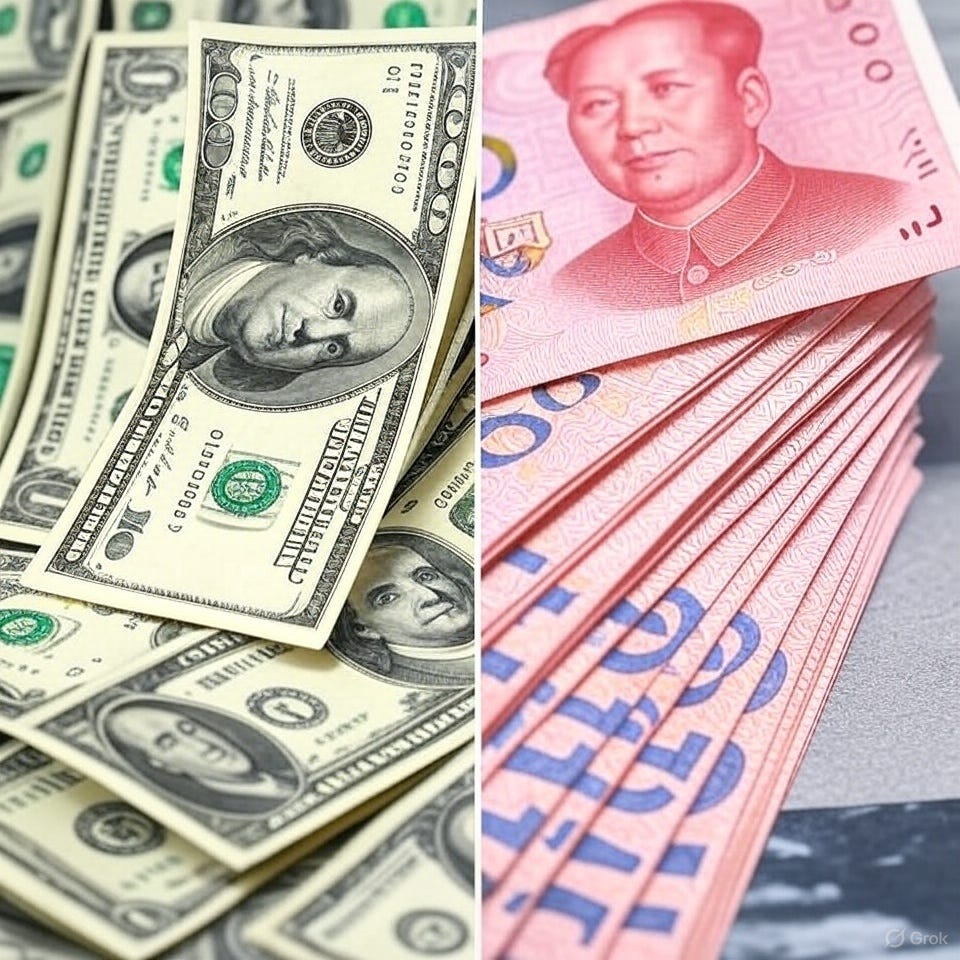
(Illustration based on the author’s concept)
Political elites may justify concealing the existence of extraterrestrial civilizations by claiming that their intentions toward humanity are hostile. It sounds noble — like a cosmic version of the phrase: “We’re keeping this secret for your own good.” That is the charm of paternalism: it always finds a moral justification, even when its primary purpose is preserving the existing structure of power.
Not only politicians, but also some scientists, have expressed concerns about the potential risks associated with contact with an extraterrestrial civilization. This is not paranoia, but a cold assessment of the consequences that may arise from an extreme disparity in levels of development. When two civilizations meet at radically different stages of technological and social maturity, Earth’s history offers only one outcome.
In 2010, the late physicist and mathematician Stephen Hawking issued a warning that was as concise as it was characteristic of him — and, as always, disturbingly sober:
“If aliens ever visit us, I think the outcome would be much as when Christopher Columbus first landed in America, which didn’t turn out well for the Native Americans. Advanced alien civilizations might become nomads, looking to conquer and colonize whatever planets they can reach. The resources of each conquered planet could be necessary for their continued growth.”
Professor Hawking — a realist to the very end, bold in his views yet relentlessly rational — apparently did not believe that such contact had already taken place. Why? Because, in his view, the evidence would have been undeniable. A civilization capable of reaching Earth would have no need to hide.
According to what was likely the most respected physicist of his era, an encounter with a hostile extraterrestrial civilization could have catastrophic consequences for humanity. Human civilization would disappear — leaving no one behind to remember it. Not even Professor Hawking himself. Thus, if forced to choose between stories about cosmic friends and the statistical record of encounters between civilizations, he chose statistics.
Hollywood’s Distorted Mirror
Fear of hostile extraterrestrials — often cited by political elites as justification for secrecy — found fertile ground in Hollywood, which, so to speak, transformed fear into art… and simultaneously into business.
Nearly every science fiction film presents the familiar scenario: a centralized planetary government, total control over the population, and a small group of rebels resisting tyranny. The archetype repeats so frequently that one could almost believe it has become a modern social myth.
In other versions, we face a direct invasion — as in War of the Worlds — where a handful of heroes save humanity from annihilation. Leaving the cinema, viewers may feel a wave of relief: “Perhaps we are not quite so defenseless after all.”
A beautiful illusion… and an even more beautiful box-office return.
Was Stephen Hawking right? Perhaps. Yet it is worth remembering that nothing sells quite as well as apocalypse. Love is beautiful, but the end of the world performs better at the box office.
The author, who has written several screenplays — including the award-winning film More Than Eternity — can confirm that the recipe for cinematic success remains disarmingly simple: good versus evil, light versus darkness, rebels versus empire, humans versus… something else. And if, in the background, a city burns while the protagonist delivers a final rebellious monologue, success is practically guaranteed.
By contrast, a film about genuine harmony — complete understanding between government and citizens, or peaceful cooperation between Earth and extraterrestrials — would almost certainly be a financial disaster.
After all, audiences prefer their popcorn with conflict.
Consequences for National Economies and Public Finances
If contact with an extraterrestrial civilization were to result in the introduction of free and inexhaustible energy, the impact on elites and ordinary citizens would be radically different.
The first casualties would, of course, be energy corporations. But immediately after them would fall… state finances.
In most Western economies, the price of energy is heavily burdened with taxes and surcharges. In addition to corporate income tax and sales tax in the United States — or VAT in Europe — governments derive additional revenue from excise duties and “green” fees: a fiscal euphemism as elegant as it is profitable.
For many countries, this system functions like a kind of financial serum: stable, predictable, and remarkably effective at disconnecting citizens from awareness of how deeply public finances are intertwined with their own lives.
The moment energy becomes free and unlimited, this entire revenue stream would evaporate overnight.
Governments, stripped of traditional sources of income, would begin nervously searching for new tax bases — likely with a creativity that would surprise even the most seasoned tax collectors.
If clean air can now be taxed, there will be no shortage of people willing to draft the legislation. Legislative imagination knows no limits.
Rising Debt in the Wealthiest Countries
Meanwhile, the world’s most industrialized economies increasingly sustain their growth through debt.
Governments finance present comfort with future taxation, issuing bonds with maturities so distant they might as well be promises made to the unborn. Investors — apparently resistant to arithmetic — continue lending enthusiastically, sometimes even for a hundred years. They believe in future taxpayers with a faith bordering on mysticism.
It creates the impression that the future itself is their only remaining asset… even though no one has yet officially priced it.
Public debt is usually expressed as a percentage of gross domestic product (GDP), presumably to spare citizens the pain of learning its actual value — and the realization of how close their leaders may be to exhausting both financial and moral resources simultaneously. The average voter may still believe the accounts will magically balance; accountants know the truth and remain silent — perhaps out of professional compassion.
The debt figures of the largest economies are staggering:
- Japan: approximately 234% of GDP,
- Italy: over 135%,
- United States: nearly 122%,
- France: 115%,
- Canada: 111%,
- United Kingdom: 101%.
And all of this before the arrival of free energy, which — like a stone thrown into the web of fiscal comfort — could sever the final threads of apparent budgetary stability.
Now imagine what happens when free energy causes the prices of nearly all goods and services to collapse. Deflation would follow, and the tax base would automatically shrink. Governments would be forced to chase investors through ever darker corridors of financial credibility.
In a world where interest rates become negative, capital erodes by itself, and the passage of time becomes a fiscal predator, investing transforms into an act of slow self-destruction.
Fiscal Catastrophe and the Limits of Credibility
Governments would find it increasingly difficult to attract investors because trust in financial markets would collapse. Under negative interest rates, investment itself loses meaning. It is a paradox: saving becomes a process of impoverishment. Portfolios would not grow; they would erode, like rock worn smooth by the winds of deflation. Financial institutions, for whom time had long been an ally, would suddenly discover that it had become their greatest enemy.
The risk of sovereign default would cease to be an abstraction. Many countries would be unable not only to honor their obligations to creditors, but even to finance the most basic functions of the state: healthcare, security, education, and administration. Funds would be lacking for everything now considered self-evident — and the rationalization of collapse would be presented as “difficult but necessary reforms.”
Nothing ennobles bankruptcy quite like a good narrative.
Ironically, the countries most threatened with bankruptcy would be the wealthiest ones. They have the most to lose — and most of their prosperity rests upon debt, fictional valuations, and faith in infinite growth. Wealth — like a flame deprived of oxygen — burns brightest just before turning to ash.
The taller the financial pyramid of prosperity, the more spectacular its collapse.
Meanwhile, the poorest countries — those with virtually no debt — might suddenly discover that they are solvent. Their stability could improve, their currencies strengthen, and their citizens’ standard of living rise — not because of reforms or genius, but simply because they have nothing to lose.
In a world where giants drown, small boats may remain afloat — mainly because no one attempted to build palaces upon them.
A Brief History of Fiscal Amnesia
To understand this trajectory, one need only examine the two greatest financial shocks of the early twenty-first century: the 2007–2008 crisis and the 2020 pandemic.
How were they “resolved”? Through money printing and expanding debt — distributed, as Milton Friedman once put it, “straight from the helicopter.” In any other era, the mass printing of dollars and euros would have been called shameless devaluation; in ours, it was labeled “rescue policy.”
The semantics of finance are often more flexible than state budgets.
The system caught its breath. But every miracle in the world of finance comes with a bill.
At the end of 2007, U.S. debt stood at approximately $7 trillion; by 2009, it had exceeded $10 trillion; in 2020, it reached $26 trillion; and by the end of 2025, it had risen to $37 trillion.
In less than two decades, the world’s largest economy increased its debt more than fourfold.
Were these crises solved? A more accurate description would be: postponed. It was not recovery — it was palliative medicine, keeping the system alive at the cost of even greater future suffering.
Borrowing Time — Literally
How much time have today’s political elites purchased for future generations? And what collateral will those generations use if the future itself has already been mortgaged without security? The question of the “creditworthiness of future citizens” may begin to sound metaphysical: does reality possess enough dimensions to contain all these obligations?
In a world of extraterrestrial technology, free energy, and the collapse of the debt-based model of state financing, the next fiscal crisis would not merely be a recession. It would constitute the collapse of the global economic structure. This time, there would be no easy remedy. No quantitative easing would save the system; money printing would no longer help, because there would be no future taxpayers left to guarantee the fantasies of the present.
Who would lend money to the world’s largest debtors once faith in their solvency disappears?
Would any country still possess sufficient surpluses to rescue the bankrupt giants of the “developed world”?
And if so, why would they rescue them, when the fall of old hegemons would signal the birth of new ones?
This, then, may be the first — and perhaps the most tangible — reason why political elites in the wealthiest nations might prefer silence regarding contact with extraterrestrial beings.
It would not be fear of cosmic invaders that haunts them.
It would be fear of earthly accountants — the only professional group that truly knows no mercy.
메타데이터
- post_id
- 4bd22fcb499a
- slug
- the-impact-of-confirmed-contact-with-aliens-on-public-finances-4bd22fcb499a
- url
- https://medium.com/the-geopolitical-economist/the-impact-of-confirmed-contact-with-aliens-on-public-finances-4bd22fcb499a
- canonical_url
- https://medium.com/the-geopolitical-economist/the-impact-of-confirmed-contact-with-aliens-on-public-finances-4bd22fcb499a
- author_url
- https://medium.com/@marlolipow
- status
- ok
- fetched_at
- 2026-08-21 02:41:33