AI Does Not Create Copper. But It Can Show Earlier Where to Look for It
MetalCore is interesting not because of the AI word in the headline, but because it is trying to speed up the slowest part of copper…
AI Does Not Create Copper. But It Can Show Earlier Where to Look for It
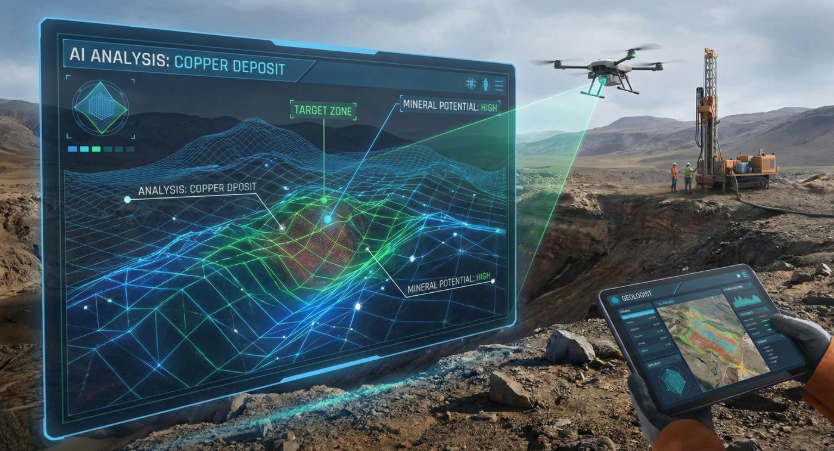
MetalCore is interesting not because of the AI word in the headline, but because it is trying to speed up the slowest part of copper supply.
That is not as loud as an AI campus measured at 300 MW or a new battery storage deal measured in several GWh. But in mining, these dry numbers are often where future copper begins. First, there is no cable. No transformer. No substation. First come old geological reports, geochemical samples, mineral tenure records, deposit data, magnetic anomalies, and the attempt to understand where it actually makes sense to go into the field.
Copper has one inconvenient trait: it cannot be added quickly for a new wave of demand. If AI data centers, EV charging, battery storage, robotics, defense electronics, and grid upgrades want more cable tomorrow, that does not mean a new deposit appears the day after. Everything starts much earlier — with data, sampling, geophysics, permits, and drilling.
That is where MetalCore starts to look interesting. NovaRed describes the platform as an AI-assisted mineral exploration tool that brings public-source geological, geochemical, and mineral tenure data into a prioritized target-generation environment. The dataset includes roughly 1.5 million geochemistry records and 1.4 million oil and gas well records. Together, that is about 70% of the total database. Alongside them are more than 800,000 deposit records, roughly 200,000 geothermal records, mine records, BC mineral title data, BC MINFILE, magnetic anomaly data, mineral property records, satellite scenes, and geophysical survey data.
Yes, the list sounds dry. But the idea is simple enough: if you can filter out noise faster, geologists can understand earlier which areas deserve real fieldwork. Not “AI found a deposit with one click.” That is a silly story. A better way to say it is this: AI can help avoid wasting time where the signal is weaker.
For NovaRed, this matters because MetalCore is not floating in the air as a separate software project. The company is working on the Wilmac Copper-Gold Project in British Columbia, where it has an option to earn a 70% interest. Wilmac covers roughly 16,078 hectares in the Quesnel porphyry belt, about 10 km west of Hudbay’s producing Copper Mountain Mine. So beneath the AI tool, there is real copper-gold ground, not just a polished presentation.

What I like here is not the label “AI for mining” by itself. I like the connection. The AI economy is increasing the need for copper in electricity, cables, transformers, substations, cooling systems, and power electronics. At the same time, AI tools are starting to help search for the very copper needed for that buildout.
This is not magic. A dataset does not replace a drill rig. MetalCore does not create metal supply by itself. But if it helps move faster from old reports to better targets, then it becomes part of the physical story, not just a software headline.
The market often remembers copper when the price is already moving. Infrastructure needs it much earlier. Before megawatts become a data center, they pass through a cable. And before a cable gets its metal, someone has to find the place where that metal might be.
So this news is not only about 920 users and 4.1 million records. It is about the search for future copper starting to accelerate too. The AI boom looks digital only from the top. Beneath that layer, it quickly brings everyone back to land, geology, permits, drilling, and metal that may be needed in larger amounts than the market is calmly imagining right now.
메타데이터
- post_id
- 4bd4d0451582
- slug
- ai-does-not-create-copper-but-it-can-show-earlier-where-to-look-for-it-4bd4d0451582
- url
- https://medium.com/@paris.himmelberg/ai-does-not-create-copper-but-it-can-show-earlier-where-to-look-for-it-4bd4d0451582
- canonical_url
- https://medium.com/@paris.himmelberg/ai-does-not-create-copper-but-it-can-show-earlier-where-to-look-for-it-4bd4d0451582
- author_url
- https://medium.com/@paris.himmelberg
- status
- ok
- fetched_at
- 2026-07-08 16:17:31





