Your Dialer Is Hanging Up on Real People — And You Don’t Even Know It
The $10 Billion Problem Hidden Inside Every Call Center
Your Dialer Is Hanging Up on Real People — And You Don’t Even Know It
The $10 Billion Problem Hidden Inside Every Call Center
How broken Answering Machine Detection is silently killing your campaigns — and why AI is the only way out
Somewhere in a call center right now, an agent just got connected to a call.
They said “Hello?” into their headset.
No one answered.
The agent waited two seconds. Three seconds. Then hung up and moved on.
Try VM Hunter’s AI answering machine detection.
What they didn’t know — what their dialer software didn’t know — is that on the other end of that line, a real human being had just picked up their phone. They said “Hello?” too. And they heard nothing but silence. So they hung up, mildly annoyed, wondering if it was another robocall.
That prospect is gone. Forever.
This happens millions of times a day across call centers worldwide. It is not a training problem. It is not a script problem. It is not a lead problem.
It is an Answering Machine Detection problem. And the technology most call centers are still using to solve it was written when flip phones were considered advanced.
What Is Answering Machine Detection — And Why Should You Care?
If you run outbound call campaigns, you already know the math is brutal.
When your dialers call a list of numbers, somewhere between 40% and 70% of answered calls will hit a voicemail, an IVR, a carrier recording, or a disconnected number message. Without AMD, your agents spend half their shift listening to “please leave your message after the beep” and hanging up. That is expensive, demoralizing, and completely avoidable.
Answering Machine Detection (AMD) is the software layer that listens to the first few seconds of a call and decides: is this a real human or a machine? If it’s a machine, drop the call. If it’s a human, connect the agent.
Simple in theory. Catastrophically broken in practice.
The Dirty Secret of Traditional AMD
Here is something the telephony vendors do not advertise prominently in their sales decks:
The AMD built into most dialers — including the most widely deployed open-source dialer platforms — is based on code and logic that has not fundamentally changed in close to two decades.
It works like this. When a call is answered, the system listens to the audio, counts syllables, measures silence gaps, tracks how long speech continues, and looks for a beep. Based on those measurements, it makes a guess: human or machine.
That’s it. That’s the whole algorithm. Syllable counting and silence timing.
# This is roughly how traditional AMD thinks:
if silence_after_answer > threshold:
    return "MACHINE"
elif word_count < 3:
    return "HUMAN"
elif speech_duration > long_greeting_threshold:
    return "MACHINE"
else:
    return "HUMAN"  # Best guess
In 2006, when cell phones were less common and voicemail greetings were short and predictable, this worked reasonably well on clean landline audio. You could tune the parameters and get decent results.
In 2026, it is a disaster.
Five Ways Traditional AMD Is Destroying Your Campaigns Right Now
1. It Hangs Up on Real People
This is the most painful failure, and it happens constantly.
A real human picks up the phone. They answer with a slightly longer greeting — “Hello, this is Sarah, who’s calling?” — and the AMD system counts the syllables, decides it sounds too long, and labels it a machine. The call drops. Your agent never spoke to Sarah. Your CID just made a terrible first impression.
Industry data from real production campaigns consistently shows that traditional AMD misclassifies real humans somewhere between 5% and 15% of the time, depending on the call population. On a campaign running 10,000 calls a day, that is potentially 1,500 real prospects being hung up on by a machine that was supposed to help you reach them.
2. It Has No Concept of Call Screening
This is the fastest-growing problem in outbound calling, and traditional AMD is completely blind to it.
iOS Call Screen. Google Call Screen. Samsung Bixby is answering. Carrier-level filters from T-Mobile, AT&T, and Verizon.
When one of these screening systems answers your call, here is what happens: a synthetic AI voice picks up and says something like “calls to this number are being screened” or “who is calling and what is this about?” The real human is watching their phone screen, fully aware of the call, ready to accept it if you identify yourself.
Traditional AMD hears a machine voice. It says MACHINE. It drops the call.
The prospect — who was right there, watching their screen — sees the call end. They assume it was a robocall. You lost them.
In 2026, with iOS screening alone active on tens of millions of phones, this is not an edge case. It is a significant and growing portion of your answered calls, and your traditional AMD is silently destroying every single one of them.
3. Carrier Noise and Codec Compression Break Everything
Traditional AMD was designed for clean audio over copper wire. Modern telephony is nothing like that.
Your audio travels through VoIP networks, gets compressed by G.711 or G.729 codecs, hops across carrier interconnects, and arrives at the answering phone with artifacts that the old heuristic rules were never designed to handle. Silence thresholds that worked perfectly on landlines misfire constantly on cell calls. Energy measurements get thrown off by codec compression artifacts. A perfectly normal human pickup gets misread because the audio path added 40ms of background noise.
The result: accuracy that varies wildly depending on your carrier mix, your codec configuration, whether you’re hitting cell phones or landlines, and even the time of day. One campaign might hit 90% accuracy. Another identical campaign on a different list hits 65%. The algorithm is the same. The world changed around it.
4. It Cannot Hear What Is Being Said
Perhaps the most fundamental limitation of traditional AMD is the one that seems most obvious once you say it out loud:
It does not understand language.
It does not know the difference between a human saying “Hey, how are you?” and a voicemail saying “Hey, you’ve reached my voicemail, please leave a message.” Both start with “Hey.” Both have similar energy profiles. The AMD system counts syllables and measures silence. It is not reading the words.
Voicemail greetings are incredibly predictable. They almost always contain phrases like “leave a message,” “you’ve reached,” “not available,” “after the tone,” “please leave your name and number.” These phrases are essentially a signature that screams MACHINE to anyone who speaks English.
But traditional AMD cannot read. It cannot hear the meaning. It is deaf to the actual content of what is being said.
5. Disconnected Numbers Are Invisible Honeypots
Here is a problem that goes beyond accuracy and into compliance territory.
When you call a disconnected number, you expect to get a SIP error code back from the carrier — a clean signal that the number is out of service. But that is not always what happens. Carriers, especially for recently disconnected or recycled numbers, often let the call connect and play a recorded intercept message instead of returning an error.
Traditional AMD hears audio, cannot identify the intercept message for what it is, and often routes the call to an agent or simply hangs up. Either way, your caller ID just pinged a number that carriers are increasingly using as a honeypot to identify aggressive autodialers. Repeat hits from the same CID to disconnected numbers is one of the fastest ways to get your numbers flagged as SPAM or SCAM by carrier analytics systems.
Traditional AMD does not distinguish between a voicemail and a carrier disconnect intercept. It treats them the same. The compliance and reputation consequences are not the same at all.
The New Reality: What AMD Actually Needs to Classify in 2026
The old binary — HUMAN or MACHINE — is not enough anymore. Here is what a modern AMD system actually needs to handle:
- Live Human — real person who picked up and is ready to talk
- Voicemail / Answering Machine — personal or business voicemail greeting
- IVR / Automated System — press 1 for sales, press 2 for support
- Call Screening (CALLGUARD) — iOS, Google, Samsung, or carrier screening active
- Carrier Intercept / Disconnect — number not in service, changed, or blocked
- Fax Tone — fax machine answered
- Static / Dead Air — noise line, failed connection, pre-recorded audio
That is seven distinct categories. Traditional AMD gives you two. And even at two, it gets it wrong more than 1 in 10 times on real humans.
Enter SpeechLLM: AMD That Actually Understands Audio
VM Hunter is built on a fundamentally different approach to answering machine detection — a proprietary AI model called SpeechLLM that was designed from the ground up to solve the problems that have made traditional AMD unreliable.
The core difference is this: SpeechLLM does not just measure audio. It understands it.
Instead of counting syllables and timing silences, SpeechLLM analyzes the audio stream across multiple dimensions simultaneously the moment a call is answered:
It listens for signal characteristics in real-time. Beep tones, carrier tones, static, silence patterns, fax signals — these are detected from the raw audio at the signal level, running continuously throughout the call, not as a one-shot measurement at the start.
It transcribes and understands what is actually being said. When speech is detected, SpeechLLM processes the spoken content in real-time. Voicemail greetings identify themselves in plain English. “Please leave your message after the tone” is not ambiguous. SpeechLLM reads those words and knows immediately what they mean.
It classifies across all seven call types. Including CALLGUARD — the category that traditional AMD cannot see at all. When SpeechLLM detects call screening phrases, it returns a CALLGUARD classification rather than dropping the call as a machine, giving your dialplan the information it needs to route the call to an agent who can identify themselves and get the prospect to accept.
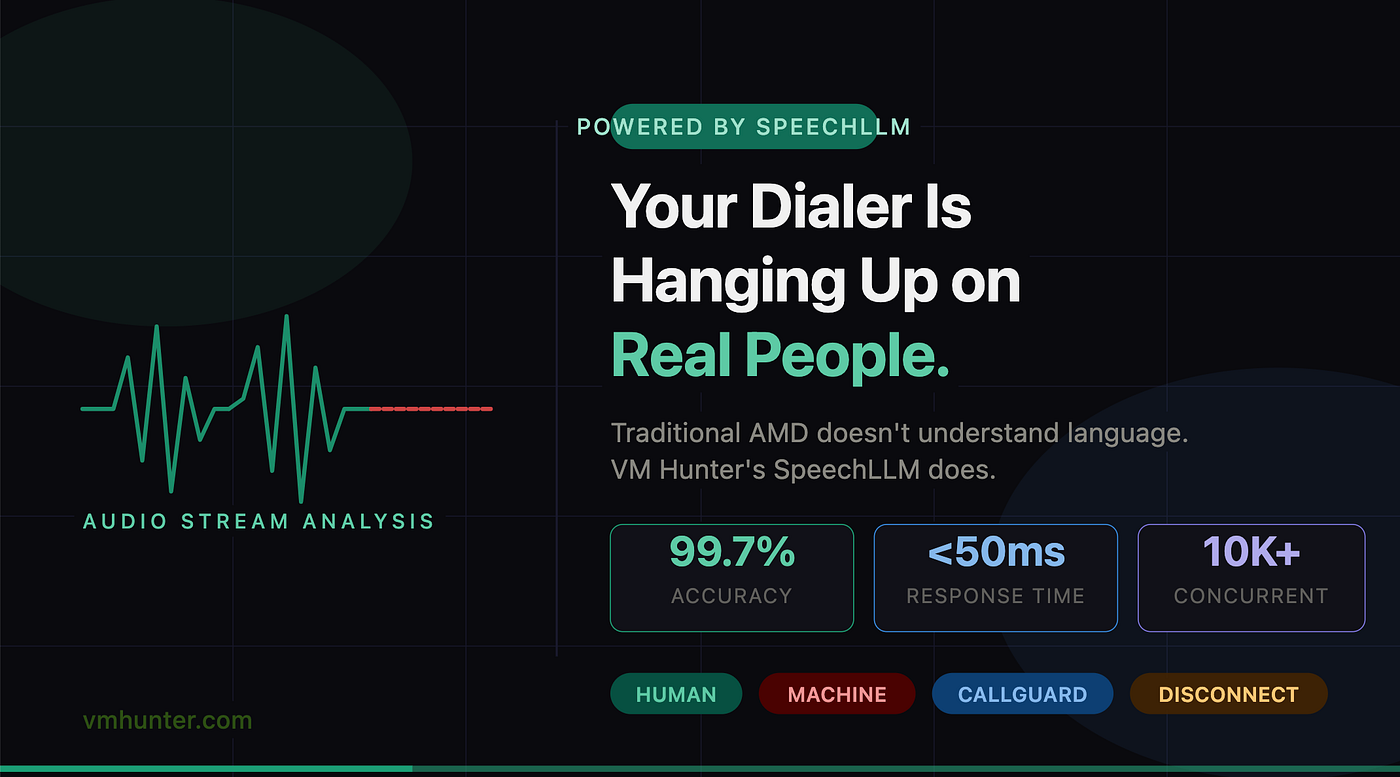
It makes decisions in under 50ms. Not after two or three seconds of silence. Not after waiting for a beep. As soon as the audio content provides enough information for a confident decision, SpeechLLM fires. For the vast majority of calls, that is well under two seconds. Dead air — that awkward gap that tells every prospect they’re being autodialed — is minimized to the point where it no longer costs you conversions.
Here is what a SpeechLLM response looks like through the VM Hunter API:
{
  "AMDSTATUS": "MACHINE",
  "AMDCAUSE": "MACHINE_BEEP",
  "confidence": 0.991,
  "elapsed_ms": 1840
}
{
"AMDSTATUS": "CALLGUARD",
"AMDCAUSE": "CALLGUARD_PHRASE:calls to this number are being screened",
"confidence": 0.988,
"elapsed_ms": 1230
}{
"AMDSTATUS": "HUMAN",
"AMDCAUSE": "HUMAN",
"confidence": 0.976,
"elapsed_ms": 980
}Your dialplan gets AMDSTATUS, AMDCAUSE, and a confidence score. You can act on each case differently. Route CALLGUARD calls to an agent. Drop MACHINE calls. Flag DISCONNECT numbers for list hygiene. The information is there. You just need a system smart enough to produce it.
99.7% Accuracy: What That Number Actually Means
VM Hunter claims 99.7% detection accuracy. In an industry where 95% is considered good, and most real-world deployments are sitting somewhere between 65% and 85%, that number might sound like marketing.
It is not.
Here is what 99.7% means in practice on a campaign running 10,000 calls per day:
AMD System Accuracy Misclassified Calls/Day Real Humans Dropped Traditional AMD (tuned) 90% 1,000 ~150 Traditional AMD (default) 70% 3,000 ~450 VM Hunter SpeechLLM 99.7% 30 ~4
The difference between 70% accuracy and 99.7% accuracy is 2,970 calls per day that get correctly classified instead of misclassified. If even 10% of those are real humans your agents never got to speak to, that is 297 missed conversations every single day.
Over a month, that is nearly 9,000 prospects. Over a year, that is more than 100,000 real people your agents should have spoken to but didn’t, because the AMD system you trusted to help you was silently failing.
The 99.7% figure is sustained accuracy — across mixed cell and landline populations, across codec variations, across carriers, and across the full range of call types, including the edge cases that break traditional AMD. Not “up to 99.7%” under ideal conditions. Sustained, in production, at scale.
How VM Hunter Integrates With Your Existing Dialer
One of the biggest barriers to adopting better AMD technology is the fear of a complicated integration. VM Hunter was designed to remove that barrier entirely.
The integration uses a standard WebSocket connection. Your dialer streams PCM audio to VM Hunter the moment a call is answered. VM Hunter returns the classification decision in real-time. No ripping out your existing infrastructure. No changing your dialplan architecture.
For VICIdial, Asterisk, and FreeSwitch users, the integration looks something like this:
Call Answered
     ↓
Audio streams to VM Hunter via WebSocket
     ↓
SpeechLLM analyzes in real-time (<50ms)
     ↓
Decision returned: HUMAN / MACHINE / CALLGUARD / DISCONNECT
     ↓
AMDSTATUS + AMDCAUSE + CONFIDENCE set
     ↓
Your dialplan routes accordingly
The result that comes back is fully compatible with how VICIdial and Asterisk expect AMD results — AMDSTATUS and AMDCAUSE variables set before the connection closes, ready for your existing GotoIf logic to handle without any changes to your campaign configuration.
For campaigns at scale, VM Hunter handles 10,000+ concurrent calls. You do not need to worry about the AMD layer becoming your bottleneck at peak dialing hours. The architecture scales horizontally, and the per-call latency stays flat regardless of concurrent load.
The ROI Case for Better AMD
Let’s make this concrete.
Suppose your campaign runs 500 agent hours per month. With traditional AMD at 75% accuracy, your agents spend roughly 15–20% of their time handling misrouted calls — listening to machines that got through, or waiting through dead air on dropped human calls that made the prospect uncomfortable.
Fixing AMD accuracy to 99.7% gives those hours back. It is not a small improvement at the margins. It is a structural change in how efficiently your agents operate.
Beyond agent efficiency, there is the CID reputation angle. Every disconnected number your dialer hits without proper DISCONNECT classification is a potential carrier flag. CID reputation damage is expensive and slow to repair. A SPAM label on your numbers can tank an entire campaign overnight. The cost of proper classification is a fraction of the cost of rebuilding poisoned caller ID numbers.
And there is the CALLGUARD opportunity. Every call screening interaction that traditional AMD drops is a prospect who was literally there, watching their screen, ready to engage if your agent had spoken. VM Hunter routes those calls to agents. Even a modest call volume with 5% CALLGUARD interactions means hundreds or thousands of recaptured conversations per month.
The Future of Outbound Calling Is AI-Native
The dial-by-heuristic era is ending. It lasted longer than it should have, mostly because the switching cost of moving away from built-in AMD felt too high and the failures were invisible — nobody was going back and listening to every call the AMD dropped to find out how many were real humans.
But the math has changed. Cell phones dominate call lists now. Call screening is widespread and growing. Carrier anti-spam enforcement is becoming more aggressive. And the tools to do AMD properly — with real AI, real language understanding, real signal analysis — exist and are accessible.
VM Hunter is not a patch on top of old AMD logic. It is a ground-up replacement built for how telephony actually works today, not how it worked fifteen years ago.
The call centers that figure this out first will run campaigns that are dramatically more efficient, reach more real prospects, and protect their CID reputation as carrier enforcement tightens. The ones that stick with traditional AMD will keep hanging up on real people and wondering why their connect rates keep declining.
The future of outbound calling belongs to AI-native AMD. And right now, that means VM Hunter.
Get Started With VM Hunter
VM Hunter is live and available today at vmhunter.com
- Free trial — no credit card required, start testing against your live traffic immediately
- WebSocket API — integrates with VICIdial, Asterisk, FreeSwitch, GoAutoDial, and any dialer that supports WebSocket audio streaming
- Sub-50ms response time — decisions arrive before your agents feel the delay
- 99.7% sustained accuracy — across all call types, all carriers, all codecs
- 10,000+ concurrent calls — scales to your peak without becoming a bottleneck
- Full analytics dashboard — see your HUMAN / MACHINE / CALLGUARD / DISCONNECT breakdown in real-time
If you are running outbound campaigns at any meaningful scale and you have not audited what your current AMD is actually doing to your real human connect rate, start there. Run the numbers. Find out how many real people your dialer hung up on last month.
Then try VM Hunter.
메타데이터
- post_id
- 4bdbe580982a
- slug
- your-dialer-is-hanging-up-on-real-people-and-you-dont-even-know-it-4bdbe580982a
- url
- https://medium.com/@akhanriz/your-dialer-is-hanging-up-on-real-people-and-you-dont-even-know-it-4bdbe580982a
- canonical_url
- https://medium.com/@akhanriz/your-dialer-is-hanging-up-on-real-people-and-you-dont-even-know-it-4bdbe580982a
- author_url
- https://medium.com/@akhanriz
- status
- ok
- fetched_at
- 2026-06-10 08:17:25


