SpaceX Just Became a $2 Trillion Company. The Real Story Isn’t the Rocket.
Everyone’s talking about the number. Almost no one’s talking about what it actually represents.
SpaceX Just Became a $2 Trillion Company. The Real Story Isn’t the Rocket.
Everyone’s talking about the number. Almost no one’s talking about what it actually represents.
On Friday, June 12th, 2026, SpaceX went public.
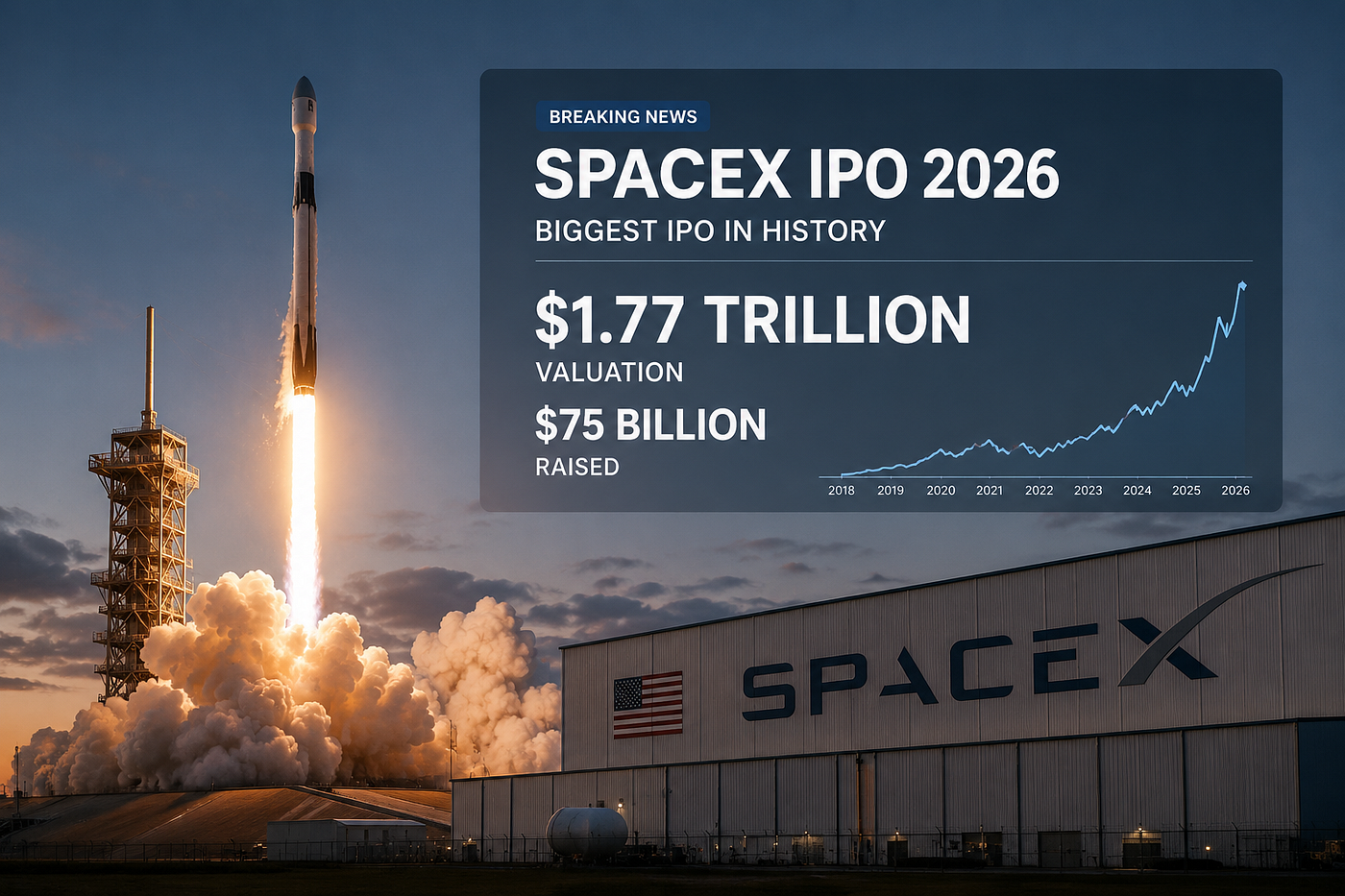
Within hours, the numbers stopped sounding real. Shares priced at $135 opened around $150, climbed as high as $176 during the day, and settled at $160.95 — up roughly 19% on debut. That single day pushed the company’s market cap close to $2.3 trillion. The raise itself — about $75 billion from selling more than 555 million shares — made it the largest IPO in history.
Somewhere in there, Elon Musk became the kind of wealthy that doesn’t really have a comparison point anymore.
And almost every headline led with that. The number. The record. The spectacle.
But the number isn’t the story. The number is just the symptom. The real story is what kind of company just became the most valuable thing on Earth — and what that says about where everyone with serious money thinks the future is headed.
This Wasn’t Really a “Space Company” Going Public
Here’s the part that’s easy to miss if you only skim the headlines: SpaceX, as it exists today, isn’t just a rocket company anymore.
In early 2026, SpaceX acquired xAI and folded it into the space giant’s AI division — after xAI itself had acquired X (formerly Twitter) the year before. So the company that just went public for $2 trillion isn’t “we launch rockets and sell satellite internet.” It’s rockets, satellite internet, a social media platform, and an AI company, all stacked inside one entity.
Starlink alone is estimated to represent around 58% of SpaceX’s total revenue — which means the company Wall Street just valued like a space empire is, financially, mostly an internet provider with a rocket division attached.
That’s not a criticism. It’s actually the most interesting part of the whole story: the most valuable company on the planet right now is a bet on infrastructure — satellites, compute, connectivity — not on any single flashy product. Nobody is paying $2 trillion because they think Falcon 9 is cool. They’re paying it because they think whoever owns the pipes of the next era — orbital internet, space-based compute, AI infrastructure — owns something close to irreplaceable.
“Trading Not on Fundamentals” — And That’s the Real Headline
Here’s a quote that should have gotten more attention than it did. A former Nasdaq chief described SpaceX as “a stock that’s trading not on fundamentals,” noting the company is performing “on the aspiration of what’s possible with human spirit going forward in time.”
Read that again. The person who used to run the Nasdaq is saying, on the day of the largest IPO in history, that the valuation isn’t really about the numbers in the spreadsheet. It’s about belief.
That’s worth sitting with. The same commentary pointed out that this was, in some ways, a harder sell than a company like OpenAI or Anthropic going public — because those companies actually have clearer, more conventional business models. SpaceX’s pitch is bigger and vaguer at the same time: the future is going to be built around what we’re building, trust us.
And the market said: we trust you. Here’s $75 billion.
That’s not really a financial story anymore. That’s a story about what an entire generation of capital has decided to bet on — collectively, almost instinctively — without fully being able to explain why.
The Door SpaceX Just Opened
A former Nasdaq executive said he’d “definitely bet” that OpenAI and Anthropic follow SpaceX to the public market this year, adding: “I think the window is open, SpaceX has opened it, and you’ll see other companies certainly flying through.”
This is the part that actually matters for the next 12 months. SpaceX wasn’t just a company going public — analysts described it as a signal for the broader AI market, with one noting that if these mega-IPOs are well-received, many more companies are likely to ride the same wave of investor enthusiasm.
In plain terms: SpaceX just proved that public markets will absorb a trillion-dollar-plus AI-adjacent IPO with enthusiasm, not skepticism. That changes the calculus for every other AI giant sitting on enormous private valuations and wondering whether now is the moment.
One CEO of an investment advisory firm raised a more cautious note — questioning whether there’s enough demand to absorb multiple massive capital raises back to back, pointing to historical data showing many high-profile IPOs, including Alibaba, Meta, and Shopify, struggled within their first year.
So the optimistic read is: the floodgates are open. The cautious read is: floodgates opening fast is exactly how you get a flood — and floods don’t ask which companies deserve to stay afloat.
Why This Matters Beyond Wall Street
It’s easy to read all this as “rich people get richer, line goes up, who cares.” But there’s a more grounded reason this matters even if you’ll never own a single share of SPCX.
When a company this large, this fast, becomes this valuable — it doesn’t just sit there. IPO proceeds for companies like this typically flow directly into expansion — more satellites, more compute, more infrastructure. That infrastructure is the same infrastructure increasingly showing up in local news: data centers competing with neighborhoods for power and water, satellite constellations reshaping how internet access works in rural and developing regions, AI compute demands reshaping entire power grids.
A $2 trillion valuation isn’t just a number on a ticker. It’s a green light for a specific version of the future — more orbital infrastructure, more AI compute, more consolidation of internet, social media, and AI capability inside fewer and fewer entities — to get funded at a scale that was, until Friday, theoretical.
The Real Story
The headline number — $2 trillion, biggest IPO ever, new richest person threshold — is the part that’s easy to write and easy to read. It’s also, in a way, the least important part.
The actual story is this: the market just told us, in the loudest possible way, what it believes the next decade of technology looks like. Not chatbots. Not apps. Infrastructure — satellites, compute, energy, connectivity — owned increasingly by a handful of companies that don’t fit neatly into one category anymore.
Whether that future arrives on schedule, whether the “aspiration” justifies the price tag, and whether the rest of the market can absorb what comes next — nobody actually knows yet.
But for one Friday in June, the world placed its bet. And it placed it big.
Do you think this IPO wave is a sign of real progress, or a bubble waiting to pop? Curious what you think — drop a comment.
메타데이터
- post_id
- 4bde175c5fb7
- slug
- spacex-just-became-a-2-trillion-company-the-real-story-isnt-the-rocket-4bde175c5fb7
- url
- https://medium.com/@shreeramkulat/spacex-just-became-a-2-trillion-company-the-real-story-isnt-the-rocket-4bde175c5fb7
- canonical_url
- https://medium.com/@shreeramkulat/spacex-just-became-a-2-trillion-company-the-real-story-isnt-the-rocket-4bde175c5fb7
- author_url
- https://medium.com/@shreeramkulat
- status
- ok
- fetched_at
- 2026-06-15 20:49:13