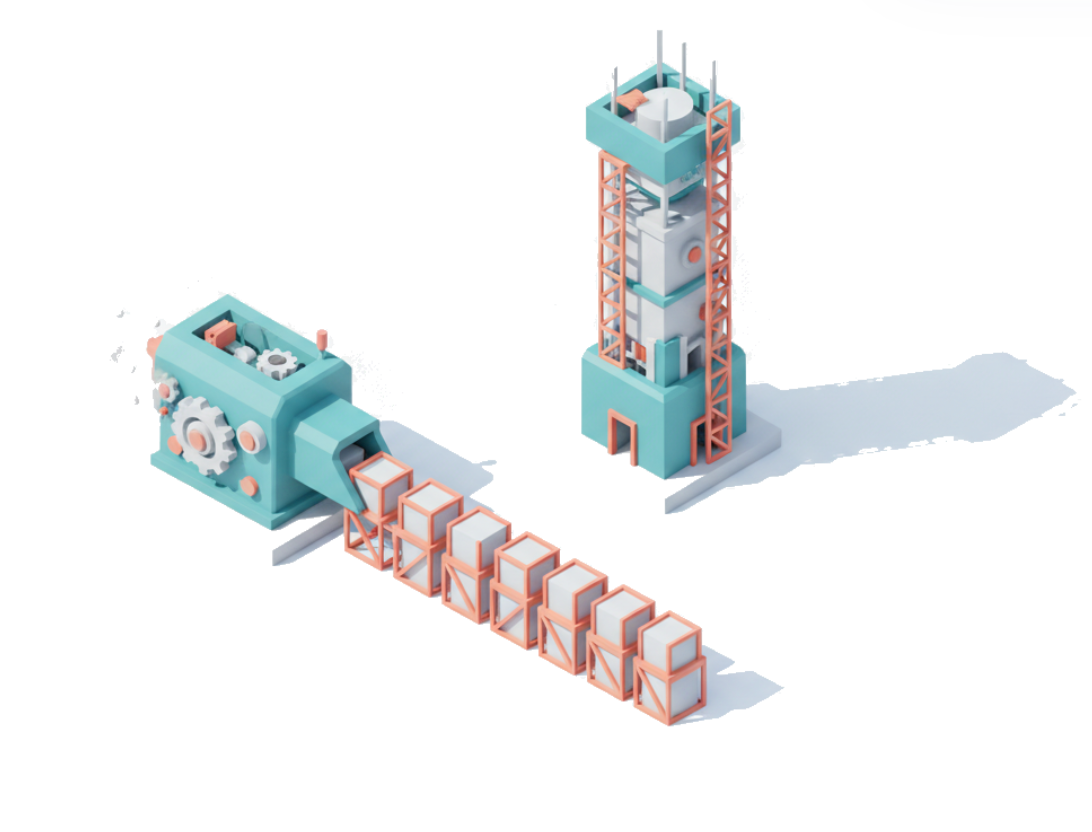
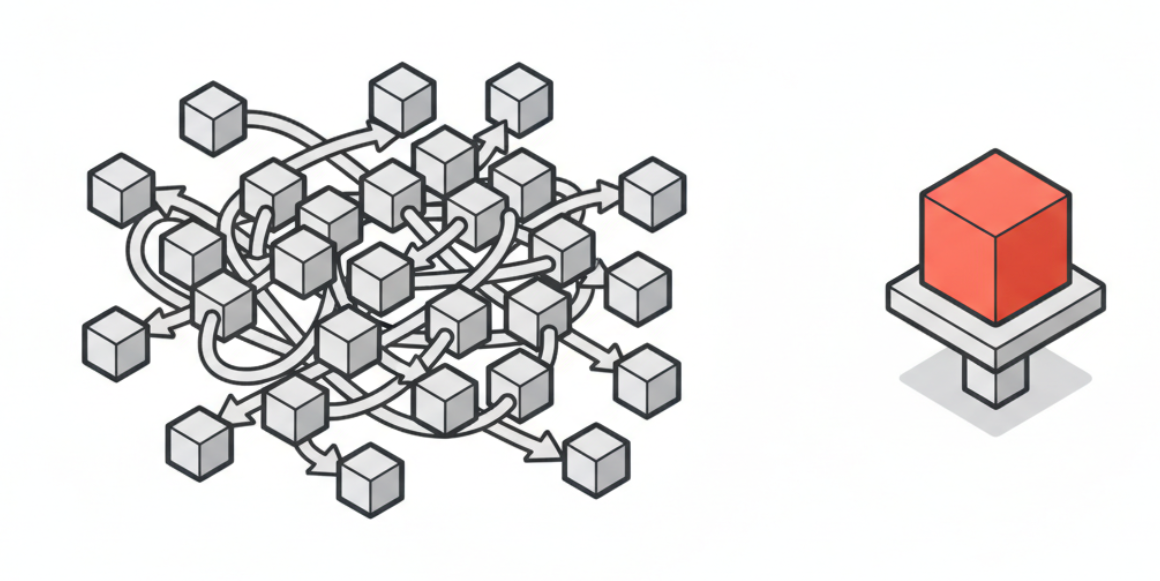
Apple Killed the App Store. By Moving the Front Door.
Dramatic title aside, the real story here is the introduction of the second-surface.
Apple Killed the App Store. By Moving the Front Door.
Dramatic title aside, the real story here is the introduction of the second-surface.
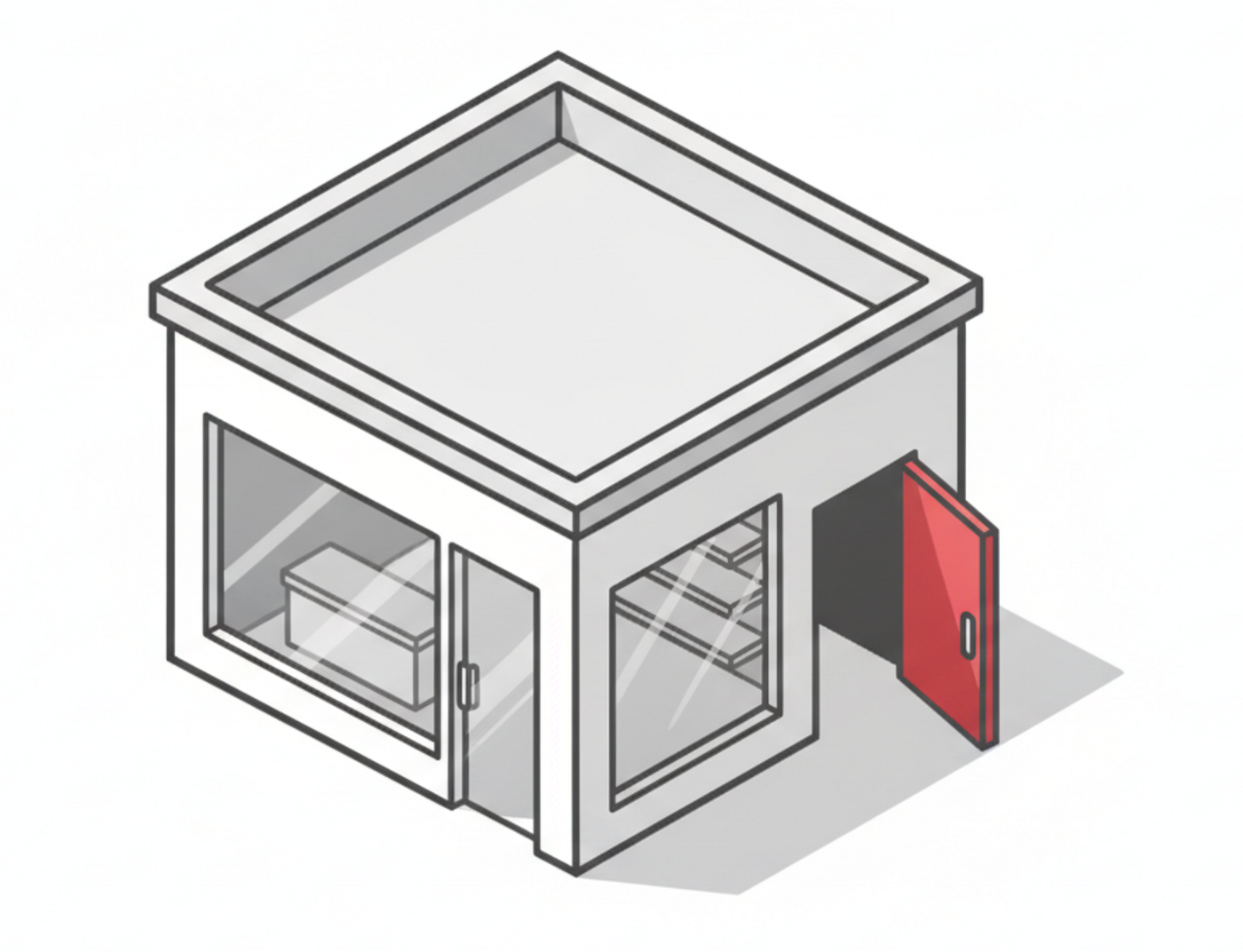
A viral post claimed WWDC 2026 ended the app era and replaced your home screen with an omniscient Super-Siri. It did not happen, and some of the post’s sources are invented. The real change is quieter, and it has a deadline.
A post went around this week claiming that at WWDC 2026, Apple “killed the App Store.” The story was dramatic. Apple had supposedly phased out applications entirely, replaced the grid of icons with a background-running “Super-Siri” agent, and turned every app into a headless API that users would never see. UI designers were panicking, ASO was dead, in-app ads were finished, all of it overnight.
It is a great story. It is also wrong in most of its specifics, and a few of the references it leans on, a “Silicon Valley Product Design Guild” whitepaper, an “Amodei and Altman historical thesis,” an Apple doc with a title Apple never published, do not appear to exist. I went and checked what Apple actually announced, because the gap between the viral version and the real one is exactly the kind of thing that gets a team to make a bad decision.
Here is the honest version. The app era did not end. But the front door to your app moved, and the old door is now on a clock.
Three things to take away:
- Apple did not kill the App Store, phase out apps, or replace the home screen with an autonomous agent. Apps, the store, and the icon grid are all intact. The “post-app, zero-UI” framing is hype, and parts of the viral writeup are fabricated.
- What Apple did do is real and consequential. App Intents is now the only way Siri can call into a third-party app, the older SiriKit path got a formal deprecation notice, and an app that does not expose App Intents is invisible to the rebuilt, Gemini-powered Siri.
- This is not the death of the interface. It is a second surface. Your app’s actions, not its screens, are now what the assistant talks to. You keep your UI, and you expose your actions, or you get left out of a channel that is about to matter.
What the viral version got wrong
Start with the corrections, because they matter for anyone about to forward that post to their team.
There is no “Super-Siri” that replaces your home screen and runs everything from the background. Siri got rebuilt, but it arrived as a rebuilt assistant, a standalone app, and a “Search or Ask” prompt in the Dynamic Island, not as an omniscient operating layer that dissolves the rest of the OS. The grid of icons is still there. The App Store is still there, still taking its cut, still the place apps are distributed and discovered.
Apps did not become headless-only. App Intents lets Siri call specific actions inside your app. It does not strip your app of its interface, hide your screens, or turn your product into a pipe with no face. People still open apps and tap things. What changed is that the assistant gained a structured way to invoke some of your actions without the user navigating there by hand.
And the sweeping economic claims, ASO is dead, in-app ads are over, UI design is extinct, are the writer’s extrapolation, not Apple’s announcement. None of that shipped. Those are predictions dressed up as facts, which is the tell of a piece optimized for sharing rather than for being right.
What Apple actually shipped
Now the real list, which is more interesting than the fake one.
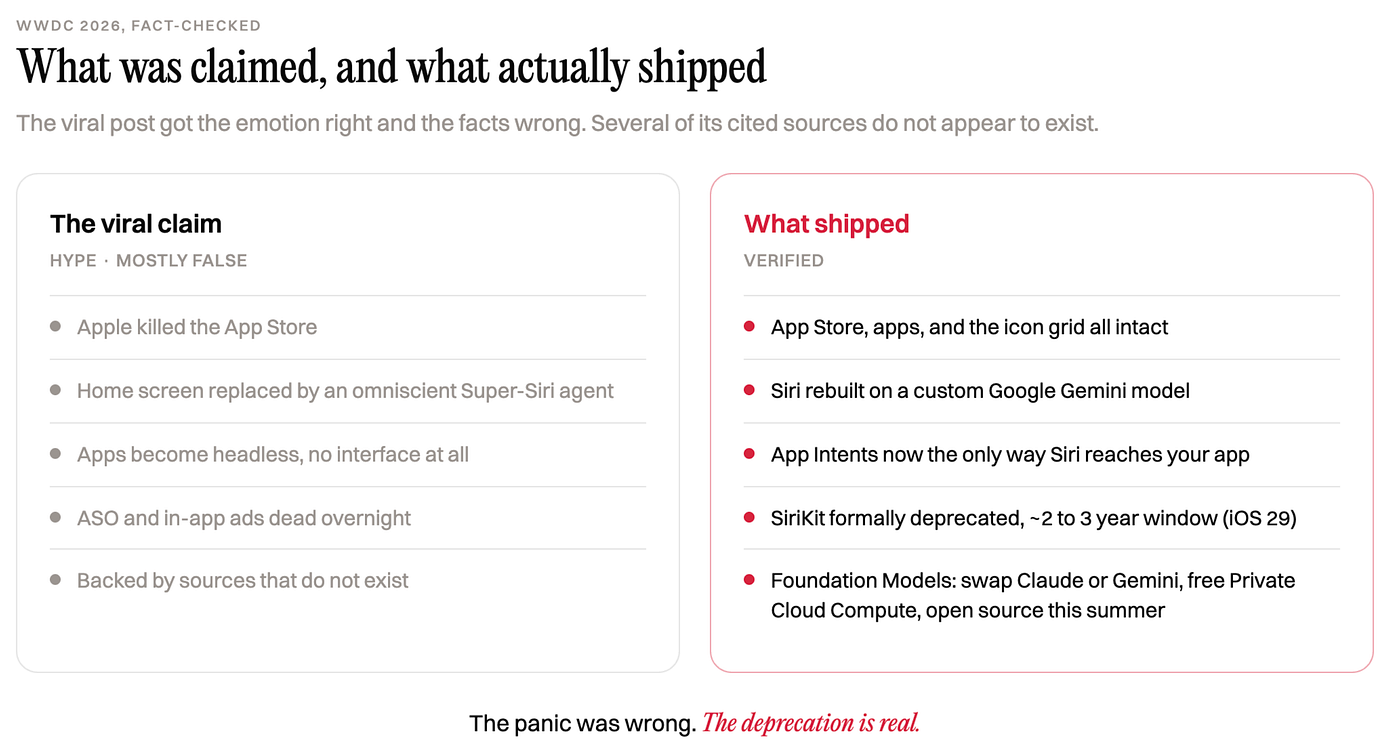
Siri was rebuilt on a custom Google Gemini model. That alone is a remarkable admission from a company that prefers to own its stack, and it is the genuine headline of the keynote.
App Intents became the mandatory integration surface. This is the part that matters most to builders. The expanded App Intents framework is now the only way the new Siri can reach into a third-party app. The older SiriKit framework, which has powered voice features since 2016, received a formal deprecation notice. SiriKit apps still compile under iOS 27, with deprecation warnings, but they will not surface in the rebuilt Siri at all. The support window before removal is roughly two to three years, landing around the iOS 29 cycle in late 2028.
For developers there is a new layer underneath this too. The Foundation Models framework now offers free Private Cloud Compute access to smaller developers, image input, and server-side model support, meaning you can route to Claude or Gemini and swap providers without code changes. Apple said it will open source the framework later this summer. A separate Core AI framework handles running custom on-device models, with tooling to convert PyTorch models to Apple silicon.
The front door moved, it did not vanish
Here is the thesis the viral post fumbled. The interface is not disappearing. A second entrance to your software is being built next to the first one.
For two decades the only way a user reached your app’s functionality was through your screens. They found your icon, opened it, and navigated your interface to the action they wanted. That door is still open and still important. What WWDC 2026 added is a side door, the assistant, that reaches a specific set of your actions directly, expressed as App Intents.
The reason this feels bigger than a Siri update is the exclusivity. Apple did not add App Intents as one option among several. It made App Intents the only path the new Siri will use, and put the old path on a removal schedule. So the side door is not optional decoration. If you do not build it, the assistant simply cannot see your app, and as the assistant becomes a more common way people start tasks, an app the assistant cannot see is an app that quietly loses a slice of its usage.
That is the real story. Not “apps are dead.” More like “apps now need two faces, the one humans navigate and the one the assistant calls, and the second one just became mandatory if you want to be in the assistant’s world at all.”
What an App Intent actually is
The viral piece talked about “semantic tools” and “headless clients” in the abstract. In practice it is concrete and not exotic. You describe an action your app can perform, with typed parameters and a natural-language phrase, and the system can invoke it.
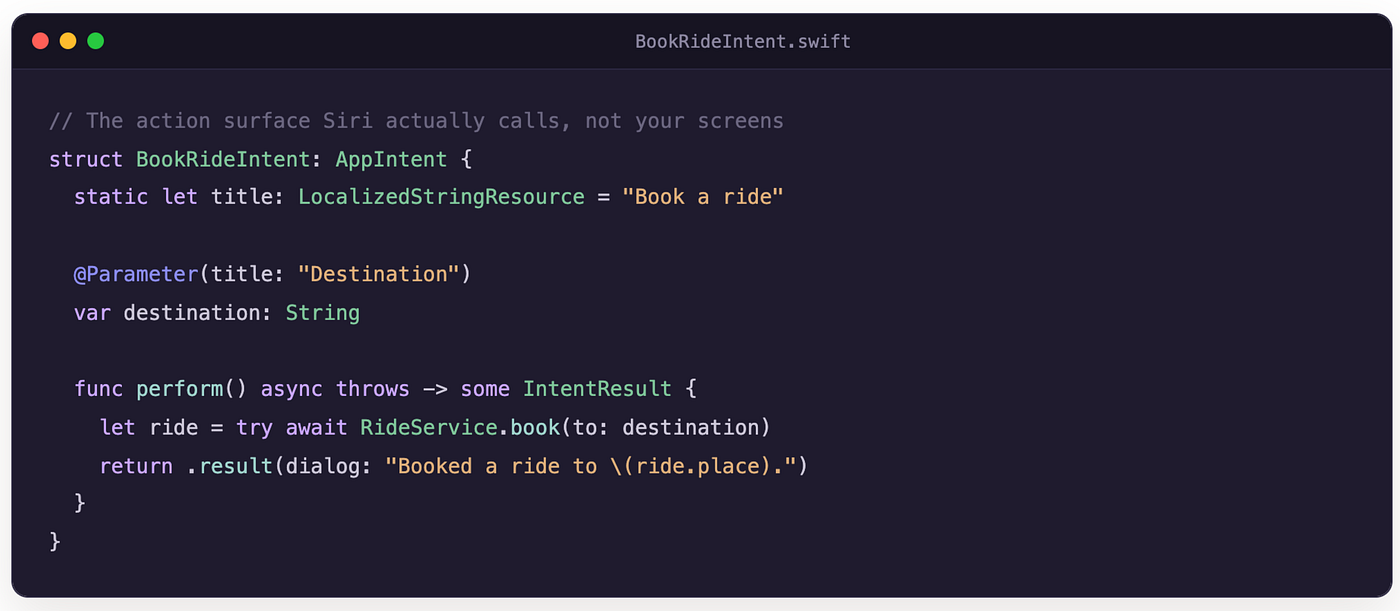
If you have ever exposed a function for an LLM to call, this will feel familiar, because it is the same shape. You are giving the assistant a tool: a name, the arguments it takes, and what it does. The skill that matters is writing these so an assistant can pick the right one and fill the parameters without guessing. Ambiguous intents get mis-invoked, the same way a vague tool definition trips up any agent. This is App Intents, but it is also just good tool design, and the teams that already think in terms of clean, callable actions will find this easy.
What to do before 2028
The deadline is soft, but soft deadlines on platform shifts have a way of arriving early in practice, because the new behavior becomes the expected one long before the old one is removed.
The move is not dramatic. Keep your app and its interface exactly as they are. Then go implement App Intents for your core actions, the three to five things people most often come to your app to do, and treat them as first-class product surface rather than a Siri afterthought. Write the intent descriptions and parameters so they are unambiguous to a model. Do it this year, not in 2028, because the value is not avoiding a removal warning, it is being visible in the assistant while most of your competitors are still ignoring it.
And ignore the advice to stop building interfaces. People still navigate apps, and they will for a long time. The instruction is additive, not subtractive. Build the screens, and also expose the actions.
The panic is wrong, the deadline is real
The viral framing got the emotion right and the facts wrong. There is a genuine shift here, and it is worth preparing for, but it is not the apocalypse the headline promised. Apple did not end the app era at WWDC 2026. It added a second way in, made that way mandatory for the new Siri, and started a clock on the old one.
So do not panic, and do not forward the version that says the App Store is dead. Do the boring, correct thing instead. Keep your interface, expose your actions through App Intents this year, and write them well enough that an assistant can call them without guessing. The front door moved. It did not disappear, and the people who calmly build the second door now will own the channel while everyone else is still arguing about whether the first one is gone.
Sources I actually checked, since the original’s were invented: Apple’s WWDC 2026 Platforms State of the Union (via MacRumors), the App Intents and SiriKit deprecation reporting from TechTimes and Mac O’Clock, and the Foundation Models coverage from TechTimes. If a claim is not in one of those, treat it as someone’s prediction, not Apple’s announcement.
Marco Kotrotsos, specializing in practical AI implementation for organizations ready to close the gap between AI hype and AI value. With 30 years of IT experience now focused purely on AI deployment, he works hands-on with companies to turn AI potential into measurable business outcomes.
This article is published in Autocomplete, a Medium publication about real-world AI for practitioners and decision-makers. We’re always looking for writers. If you’re building with AI and have something worth sharing, reach out.
My free Substack newsletter, also called Autocomplete, can be found here: https://acdigest.substack.com.
My books on Amazon: Claude Code for Everyone Else and From Vibe to Production.
I also take on a small number of mentees one-on-one on MentorCruise.
메타데이터
- post_id
- 4be28c821069
- slug
- apple-killed-the-app-store-by-moving-the-front-door-4be28c821069
- url
- https://medium.com/autocomplete-real-world-ai/apple-killed-the-app-store-by-moving-the-front-door-4be28c821069
- canonical_url
- https://medium.com/autocomplete-real-world-ai/apple-killed-the-app-store-by-moving-the-front-door-4be28c821069
- author_url
- https://medium.com/@kotrotsos
- status
- ok
- fetched_at
- 2026-06-21 23:24:37