War at Sea and Russian Tactics
Today, I want to point out how the war is expanding beyond Eastern Europe. We knew the Ursa Major was sunk off Spain in neutral waters…
War at Sea and Russian Tactics
Today, I want to point out how the war is expanding beyond Eastern Europe. We knew the Ursa Major was sunk off Spain in neutral waters. Volyanedia has a few theories on this. However, one thing runs through all of them. The sinking was not an accident. So with no further this:
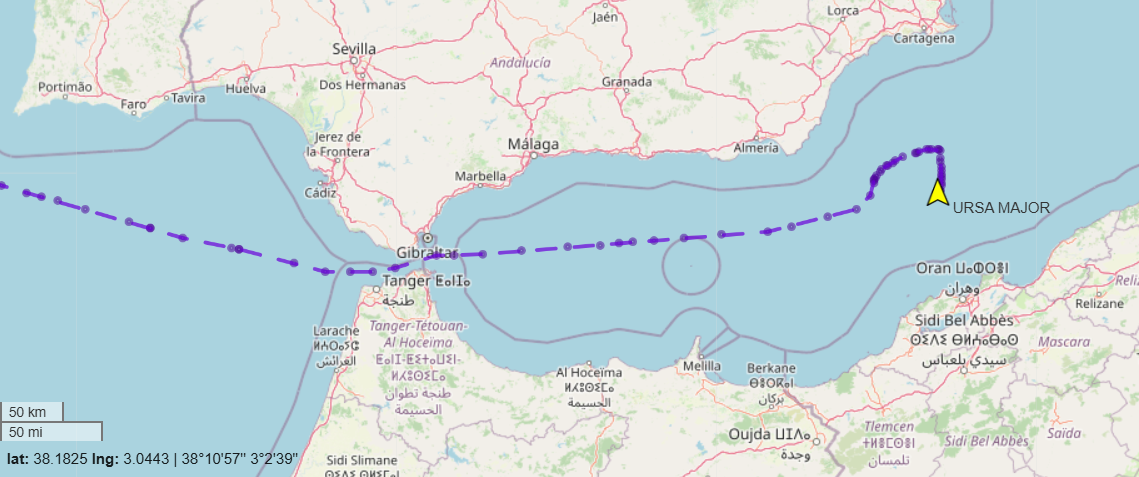
An OSINT analyst working under the pseudonym HI Sutton in the article Overview Of Maritime Drones (USVs) Of The Russo-Ukrainian War, 2022–24 in December 2024 showed the development of Ukraine’s capabilities in the use of maritime drones of various types. The sinking of URSA MAJOR could have been organized by using the promising Ukrainian underwater drone Toloka TLK-150 or another similar type. “Toloka” is only 2.5 meters long. It has two engines mounted on small wing-shaped stabilizers and a large keel. In combination with a separate rudder and dive planes mounted in front, providing good maneuverability, the drone can quickly and stealthily approach a target, actively maneuvering if necessary. The drone has a high mast with cameras and communication devices, allowing it to navigate, hold and change course, and aim for attacks.
Several such drones, possibly three (based on the number of explosions, according to the crew), could have been launched at URSA MAJOR from any of the fishing vessels located near the ship.
This is a sophisticated attack — the kind you expect from a country that has been changing the game’s rules. Per the article, Russians are saying the explosives were planted in St Petersburg and remotely detonated, still, from a fishing ship.
According to Volyamedia, there are Ukrainian traces of this, but not how the Russians usually mean it. It is more evident that hurting Russia requires a war at sea, going after the shadow fleet. The Ursa Major was a good choice due to the ship’s class. It’s a heavy lift ship; this hurts logistics. It was also en route to Vladivostok.
This last paragraph in the piece matters a lot. I recommend reading and putting the whole article on Chrome; it will translate. It is chockfull of critical details:
Ukraine, having secured an advantage and security for its maritime traffic in the northwest of the Black Sea, having forced the Russian Black Sea Fleet to Novorossiysk, is ready to move on to the next stage of military action — a blockade of Russian shipping in the Black and Mediterranean Seas. This will lead to significant economic losses for Russia and will become an important factor in its final expulsion from Syria and African countries. It can also become an additional trump card for forcing the Putin regime to peace on Ukraine’s terms.
So, Ukraine will now impose a sea boycott without a navy. Consider the implications for the future of war.
Now, from a new channel I was directed to from Volyamedia, there is this commentary on the land war:
Total degradation of the Russian army or even mobilization will not help to win
👉👉👉 During a war , each side strives to embellish its position and present the enemy’s condition as hopeless and almost dying. Therefore, it is impossible to objectively describe the state of the Armed Forces of Ukraine and the Armed Forces of the Russian Federation in specific figures with references to authoritative sources. However, trends are tracked quite reliably and it is their analysis that allows us to assess the current resources of the parties.
The Russian army has been advancing for the past year, although its successes have been purely nominal. Not once has it managed to achieve breakthroughs of even operational significance; all of them are purely tactical. Yes, Russia still has more tanks and other armored vehicles, more artillery and shells, more missiles, planes and ships. And, as pro-Kremlin experts pointedly note, Russia, unlike Ukraine, has impressive industrial potential for producing weapons of murder.
➡️ However, we dare to say that superiority in military equipment , which was the key to victory in a conventional war half a century ago, does not play a special role today!!! The digitalization of war has made the cumbersome and unwieldy equipment of the past almost useless. This was especially evident at sea, where Ukraine, having no warships or submarines at all, wiped out a third of the combat strength of the Russian Black Sea Fleet, including the flagship, the missile cruiser Moskva, and drove the remaining vessels afloat to bases in Novorossiysk and Abkhazia. This was done with the help of cruise missiles and sea drones (unmanned boats).
🪖 On land, a new reality has also emerged, in which FPV drones are the MAIN THREAT to armored vehicles. For a tank, this is like a mosquito. But a mosquito, one bite of which is fatal. The most unpleasant thing is that the distance at which micro-UAVs can destroy armored vehicles is up to 10 km, and when using other drones as repeaters, it increases to 17 km , while a tank, in order to shoot at the enemy, must get closer to him at least 1.5–2 km. It turns out that its arms are too short for modern warfare.
As for massive tank strikes, they become fundamentally impossible, because tank columns will be destroyed on the march to the concentration areas. Drones have revolutionized not only the fight against armored vehicles, but also reconnaissance! Drones allow you to scan the enemy’s rear to a depth of 50 km in real time. Night and fog are not a problem, since the sky scouts are equipped with thermal imagers. The only obstacle to their uninterrupted operation is a squall wind, but in the Ukrainian steppes, hurricanes are a rarity.
⚠️ Technical innovations make the polished tactics of the last century completely useless. Today it is impossible to secretly concentrate hundreds of tanks on a small section of the front, suppress the enemy’s anti-tank defense with massive artillery fire, and then break through the enemy’s defense with a powerful blow of an armored fist. Therefore, the superiority of the Russian Armed Forces in armored vehicles and the ability of Russian industry to stamp out tanks are of no importance. While in Nizhny Tagil they are churning out one formidable T-90M worth $4 million, Ukrainian schoolchildren manage to assemble a couple of hundred attack drones, which cost $500 apiece , and this amount is enough to burn down an entire tank division .
This means one thing: the attacking infantry ends up naked on the battlefield!!! Lately we have often seen some crazy experiments: Russian assault groups storm Ukrainian positions using MT-LBs (their main purpose is to transport artillery guns and crews), UAZ-Bukhankas, Zhigulis and even motorcycles as transport (yeah, the word “motorized riflemen” immediately took on new colors!). Often commentators, especially in the West, laugh: they say that the Russians must have completely run out of tanks and armored personnel carriers if they are going into the attack on whatever they can get their hands on.
The next to last paragraph is very telling. You used to concentrate columns and groups before launching an attack. See the battle of Kursk during the Second World War. These days, any significant concentration leads to HIMARS or other systems landing among your troops.
So, the Russians are using whatever they can to launch attacks using small numbers of troops. These constant attacks prevent Ukrainian defenders from resting. It’s a battle of wills and endurance.
Anecdotally, Russians are also seeing more troops surrendering to Ukraine or deserting. And the advances they have made have cost them. At this point, they admitted 600,000 injured troops. It’s the most significant admission so far.
This brings me to the hybrid war against the West:
The European Union intends to introduce additional sanctions against the “shadow fleet” of Russian tankers in connection with the damage to the Estlink 2 telecommunications cable in the Baltic Sea.
Finland suspects the Cook Islands-registered Eagle S of involvement in the incident.
Not only was this ship involved, but it’s a merchantman, right? Well, not quite:
According to information obtained by journalists from Finnish authorities, the detained Russian shadow tanker Eagle S had on board advanced spy equipment used to monitor the activities of other countries’ fleets. Moreover, the equipment was so powerful that it often overloaded the ship’s generator, causing power outages on the vessel. Thus, the tanker is now simultaneously accused of three crimes: breaking an energy cable, transporting oil in violation of sanctions, and an act of espionage.
Under the laws of armed conflict, this supposed merchantman is a valid target. It’s been detained by the Finnish Coast Guard. And it increasingly looks as if Russia is preparing to attack the Baltic countries or Finland, maybe both. So keep your eye on that front as well. But we are graduating to both kinetic and hybrid war at sea.
메타데이터
- post_id
- 4be7ec6fed89
- slug
- war-at-sea-and-russian-tactics-4be7ec6fed89
- url
- https://medium.com/@nadinbrzezinski/war-at-sea-and-russian-tactics-4be7ec6fed89
- canonical_url
- https://medium.com/@nadinbrzezinski/war-at-sea-and-russian-tactics-4be7ec6fed89
- author_url
- https://medium.com/@nadinbrzezinski
- status
- ok
- fetched_at
- 2026-06-21 07:44:09