Why Today’s Music Sounds Lame If You Lived in the ’70s
Yeah, it’s about people playing instruments.
Why Today’s Music Sounds Lame If You Lived in the ’70s
Yeah, it’s about people playing instruments.
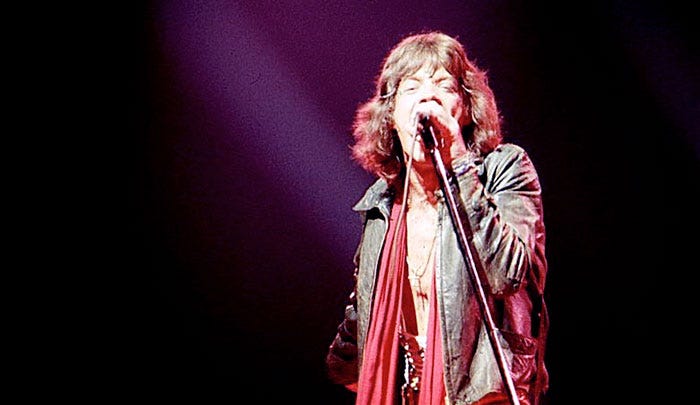
Mick Jagger, City of New York, 1970 (Wikimedia Commons)
I know, I know… everybody thinks everything was better back in their day, right?
Actually, in a lot of ways, life has improved since the seventies. (I mean, until recently.) But the music? Well….
Now, yes, of course there’s excellent music to be found right now, no argument there. But you have to look so much harder for it.
What I’m talking about is being able to noodle around on the radio and discover something that jumps out at you and you just gotta know who it is, or to browse the new releases or take a chance on an odd cutout at the record shop and stand a good chance of finding a band that’s doing something really interesting. I’m talking about variety, creativity, and technical prowess in abundance, not as the exception — that’s what the seventies had!
Today, it’s really hard for anything to grab me because, frankly, it all sounds the same. And that’s on purpose, which we’ll get to in a sec. The seventies were just the opposite, and that’s because of these guys:
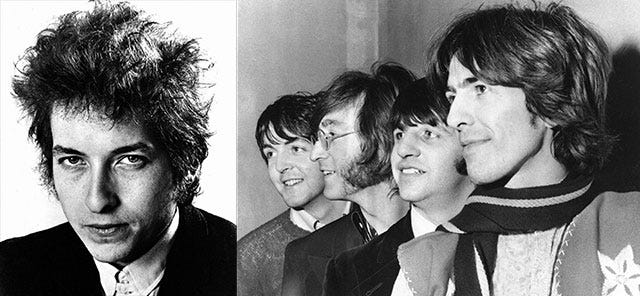
Bob Dylan and The Beatles, 1960s (Wikimedia Commons)
Musically, the fifties were very much about following trends. (With notable exceptions, of course.) Then Bob Dylan came along and started putting unique twists on folk standards, emphasizing believability over technical prowess in the vocals, then writing his own material, then famously going electric in ’65 on Bringing It All Back Home. Whatever people wanted Dylan to do, he seemed determined to do anything but. And it sold millions of records!
On his heels were The Beatles, who not only started putting out albums entirely of their own material, but in the span of 7 years completely transformed the landscape of popular music. The Fab Four intentionally made every album sound different from all the others. The industry took note, and by the dawn of the seventies it was expected that if an artist wanted to break through, they had to find their own sound. (And if they couldn’t, well, Beth would just have to wait up til they did.)
All that would change in the 1980s with the advent of digital production and data-tracking. Rather than putting seed money into a variety of acts and supporting those that found an audience, labels and producers used data to define what “worked” and sought to tailor their acts toward that template.
[embed]Frank Zappa reflects on changes in the music industry, 1987
So what did we lose in the process? Pretty much everything that made the decade great.
First off, data-driven modeling stifles innovation, which is what makes music fun and interesting and keeps it moving forward. And it’s not just the bands that get cut out, it’s everybody else who will never be influenced by those bands.
I mean, seriously, can you imagine a group like Focus getting a shot these days? C’mon…
[embed]Yeah, that’s Gladys Knight introducing these guys. That’s how eclectic the decade was.
Now keep in mind, all the music I’m sampling in this article was on mainstream radio. Of course, not everything on the airwaves was worth the time it took to hear it. For every “Bohemian Rhapsody” there was a “Muscrat Love,” no doubt.
But the tapestry was so much richer back then. Maybe you’d hear The Carpenters, maybe you’d hear “Rubberband Man,” who knew what would be playing? But can you honestly imagine anyone today producing and releasing a song with a minute-long piano introduction, lyrics snatched from film noir, and a solo that bounces from violin to Spanish guitar to electric guitar to saxophone, all completely original? If so, you’ve got a more vivid imagination than I do.
[embed]This one never gets old.
One of the reasons this kind of thing is so much rarer these days is that contemporary production standards for popular music veer heavily toward a “bricked” waveform. In other words, volume should remain relatively constant throughout the track. Just look at the difference between these tracks from 1975 and 1999:
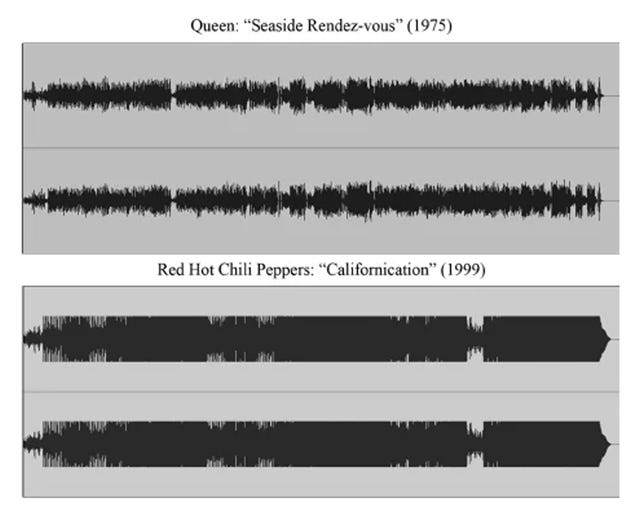
“From 1967 to 1984, mainstream music production tended toward high-fidelity and transparency, as a result of technological innovations. From 1984 to 2004, on the contrary, music tended toward low-fidelity and transient degradation.” Emmanuel Deruty, Journal of the Audio Engineering Society 62(1/2):42–55; PDF publicly available.
Now I’m not saying that bricking is always bad. Hell, Blackfoot intentionally recorded their albums “hot” in order to generate distortion. But that was do-able in the analog days. Try that on a digital board and you’ll “clip” the wave, flattening it on either end, which sounds like crap on burnt toast.
What you get with a more dynamic waveform is greater “headroom,” the gap between average and peak volumes where the song gets to explore. Just listen to how Heart uses headroom in “Crazy on You” to give the song depth, interest, and texture:
[embed]In the seventies, a song could be beautiful and delicate and badass at the same time.
Another consequence of modern production trends is that songs are much more repetitive than they were in the seventies, because so much of the music is based on loops. Rather than being roller coaster rides, modern songs are more like merry-go-rounds, covering the same ground over and over and over, which frankly sounds boring to ears trained on seventies music.
One of the first pop tunes to use a loop, which at that time was a literal loop of analog tape, was Bee Gees’ “Stayin’ Alive,” and that was only done because one of the drummers couldn’t make the session. Even so, non-looped drumming was used to mask the loop so it wasn’t noticeable, and live musicians on electric and acoustic instruments were arranged in ways that are hard to appreciate if you’re just grooving to the music. Check out Jon Mattox’s breakdown of the tracks:
[embed]Disco takes a lot of heat, but it was some of the most intricately produced music of the decade.
Another problem with heavy reliance on sampling rather than creating is that it becomes a crutch. If an artist is spending their time looking for good samples, that’s time they’re not spending trying to create something more original themselves. And when everybody’s doing it, the whole scene just gets samier and samier. In today’s environment, that’s considered a good thing. The downside is, it dulls our ears, training listeners to hear difference as dissonance.
Consider Outkast’s “Hey Ya” (2003) which is actually studied in marketing classes. Originally the song was rejected because it sounded so distinct from anything on the radio. The label didn’t “get it.” But they also couldn’t get it out of their heads after hearing it, so they decided to promote it by “sandwiching,” i.e. playing the song on radio between top hits and hoping the audience would stick around for it. The song had to be force-fed to twenty-first century listeners in order to get traction.
Back in the seventies, artists wanted to be different. And fans expected originality. Without that attitude, we’d never have masterpieces like“Mr. Blue Sky” from ELO.* And while you’re listening, I want you to notice how the track swings, precisely because the instruments are being played by humans and left that way, without being “snapped” to the beat by digital software. On the hard rock size, Led Zeppelin famously played loose as all get-out and produced some of the most compelling music of the era.
[embed]Supposedly, science has determined that this is the happiest song ever written.
I cannot overemphasize the importance of the human element in seventies music of all stripes. Those were real orchestras you were hearing, often permanently employed by the labels. And a lot of tracks were laid down live in the studio with musicians feeding off each other and making decisions in real time depending on the vibe in the room.
I remember watching the Grateful Dead on stage from the third row in Atlanta, noticing their faces and gestures as they steered that ship together. Maybe Phil would start pulling in one direction with the bass and Jerry would turn to him with a quizzical look, and Phil would look back and grin that big toothy grin of his and give Jerry a little lick like a nod down the road he wanted to take. Then Jerry would toss his head back a bit, like “Oh, all right, I see now,” and off they would go in a new direction. It was magical!
That kind of magic happened in the studio, too. Like when the tape kept rolling at the end of the Stones’ “Can’t You Hear Me Knocking” and without even knowing it the band cranked out an all-time classic coda:
[embed]
And listen, there was no auto-tuning. I see videos sometimes online, of some singer or other, and the fact that the vocals aren’t auto-tuned is trumpeted as something astounding. Back in the day, you had to have chops, which could be the pitch-perfect pipes of Freddy Mercury, or the heartbreaking honesty of Bonnie Tyler , or the jazzy playfulness of Ricky Lee Jones, or the sultriness of Kim Carnes. Or hey, the whole ball of wax, like Roberta Flack for instance:
[embed]
A lot of seventies music is bare-bones like Flack is here. Nick Drake’s album Pink Moon, for example, is a stripped-down classic that’s absolutely timeless. Now granted, Drake didn’t get the credit he deserved in his brief lifetime. But the radio didn’t shy away from sparse simplicity, either. You can get away with it when you actually know how to play and sing.
[embed]In case you’ve never heard it, Still Crazy After All These Years is one of the best albums of the era. If you have heard it, you already know that.
And see, back then we didn’t need so much distraction, like today when concerts are all choreography and pyrotechnics and jumbo screens, a relentless wall of sensory overload to make up for what the music lacks. In those days, a little flash and glitter sufficed to spiff things up a bit for the stage, because we were there for the music, for the moment, to get together and hear something that would never be played exactly that way again.
[embed]
We had no cell phones, of course. Hardly anyone carried a camera around unless they were on vacation or paid to do it. If you went to a show, chances were, once those notes dissolved in the air they were gone forever, and we knew it. We weren’t there to document anything, like so many people are today. We were there to get into it, and the musicians had to be right there with us.
And while everyone took pride in their record collection, no matter how small, it just wasn’t possible to create your own rut and stay in it. There was no streaming, so we were exposed to all sorts of artists and styles and tunes just going through our day. No one was gathering our data and generating heuristics that fed us only what was predictable. The landscape was so much wilder!
You see, it’s not that we’re a bunch of grumpy old farts pining for some imagined golden age. We really did have it too good. We suckled on Dom Pérignon, so we just can’t stomach this Thunderbird they’re trying to sell us today.
Now like I said, I know there’s great music being made right now. Just recently I was able to catch Dead & Co with John Mayer, first time I’ve seen any kind of Dead show since Jerry died, and even with a broken finger, Mayer was awesome!
Next month, I’m seeing Gillian Welch and David Rawling for the first time since they literally played in a barn down the road from my house. They don’t get down this way all that often, and I’m super psyched about the show. Josh Ritter’s concerts are an absolute must. Sturgill Simpson is doing amazing work, and just released his new album on physical media only. Artists like Billy Strings, Jason Isbell, and Peggy Honeywell are producing great stuff, and that’s just my tiny corner of the music world.
But man, I’m telling you, if you weren’t there, if you didn’t live it, it’s going to be hard to understand why most of today’s music seems so bland to older ears. Even if it’s high-energy, it tends to lack humanity. Everything’s strait-jacketed to the grid, unnaturally polished, repetitive and derivative, and made to please like a grocery store sheet cake.
Which is why they had to invent the “classic rock” radio format in the early eighties. Yeah, music had moved on, but the seventies stuff was so well written, performed, and recorded that it couldn’t be discarded. Think about it — in 1976 nobody but music geeks were listening to popular tunes from the 1920s, even as covers. (Taco being the exception that proves the rule.) But today, you can still hear tracks from ’76 being played all over, and many of them are just as popular now as they were then.
Will people be listening to today’s music in 2076? Maybe. But I kinda doubt it; and even if so, not with the scope that we still listen to those “classic” tracks from half a century ago in 2026.
Now if you’ll excuse me, it’s time to go play “Echoes.”
Epilog
After watching Rick Beato’s excellent video on the lack of “wait for it” moments in today’s music (which I think Sony has since shot down) I decided to find the top ranked song on Billboard right now and compare it to the tunes above. Turns out, 9 of the top 10 songs are brand new releases by one artist. And if that doesn’t convince you that music is now almost entirely controlled by industry “push” rather than what people want to hear, I don’t know what will.
Here’s today’s #1. It is a bad song? Nope. But notice how repetitive it is, how robotic it sounds compared to the ’70s tunes, and how indistinguishable it is from everything else of its type playing right now. Not only would I be willing to bet good money at bad odds that no one will be listening to this tune 50 years from now, I doubt many people will even remember it. Because how could they?
[embed]
We should also look at the only top 10 tune not by Drake, a twang-pop number in the mold of Urban-Cowboy-era country. Again, is it a bad song? Nope. But just like the #1, compared to music of the 1970s it lacks originality, has very little variation, and exhibits practically no human feel in the musical performance. Even the vocals have the mechanical texture of auto-tune.
[embed]
So like I said, if your ears were trained on ’70s music, listening to this stuff feels like eating plain saltines, without the salt. Not even the machine-gun vulgarities of the first track or the cry-in-your-beer schmaltz of the second can make up for the sterility of the sound.
For comparison, here’s the #1 from 50 years ago — notice the swing, the texture, and the human feel of the tune:
[embed]
And yes, people are still listening to top 10 songs from that week half a century ago, like this classic country-pop crossover from Elvin Bishop:
[embed]
Or this blue-eyed soul standard from Hall & Oates:
[embed]
You can still hear these tunes on the radio any day of the week, and rightly so. So you’ll have to forgive me, folks, but what’s popular today just can’t measure up. And that’s a damn shame.
**Bonus Trivia: While ELO’s full name is often pronounced like Electric-Light Orchestra, it’s actually the Electric Light-Orchestra.*
메타데이터
- post_id
- 4be9adfe1492
- slug
- why-todays-music-sounds-lame-if-you-lived-in-the-70s-4be9adfe1492
- url
- https://medium.com/thinkpiece-magazine/why-todays-music-sounds-lame-if-you-lived-in-the-70s-4be9adfe1492
- canonical_url
- https://medium.com/thinkpiece-magazine/why-todays-music-sounds-lame-if-you-lived-in-the-70s-4be9adfe1492
- author_url
- https://medium.com/@ptzenki
- status
- ok
- fetched_at
- 2026-06-14 11:28:49