Statelessness and the Chameleon Identity of Zainichi Koreans
In my previous post, I wrote about names — how they change, split, and adapt depending on context. Now, I want to stay with that idea of…
Statelessness and the Chameleon Identity of Zainichi Koreans
In my previous post, I wrote about names — how they change, split, and adapt depending on context. Now, I want to stay with that idea of change but examine it from a legal and historical perspective.
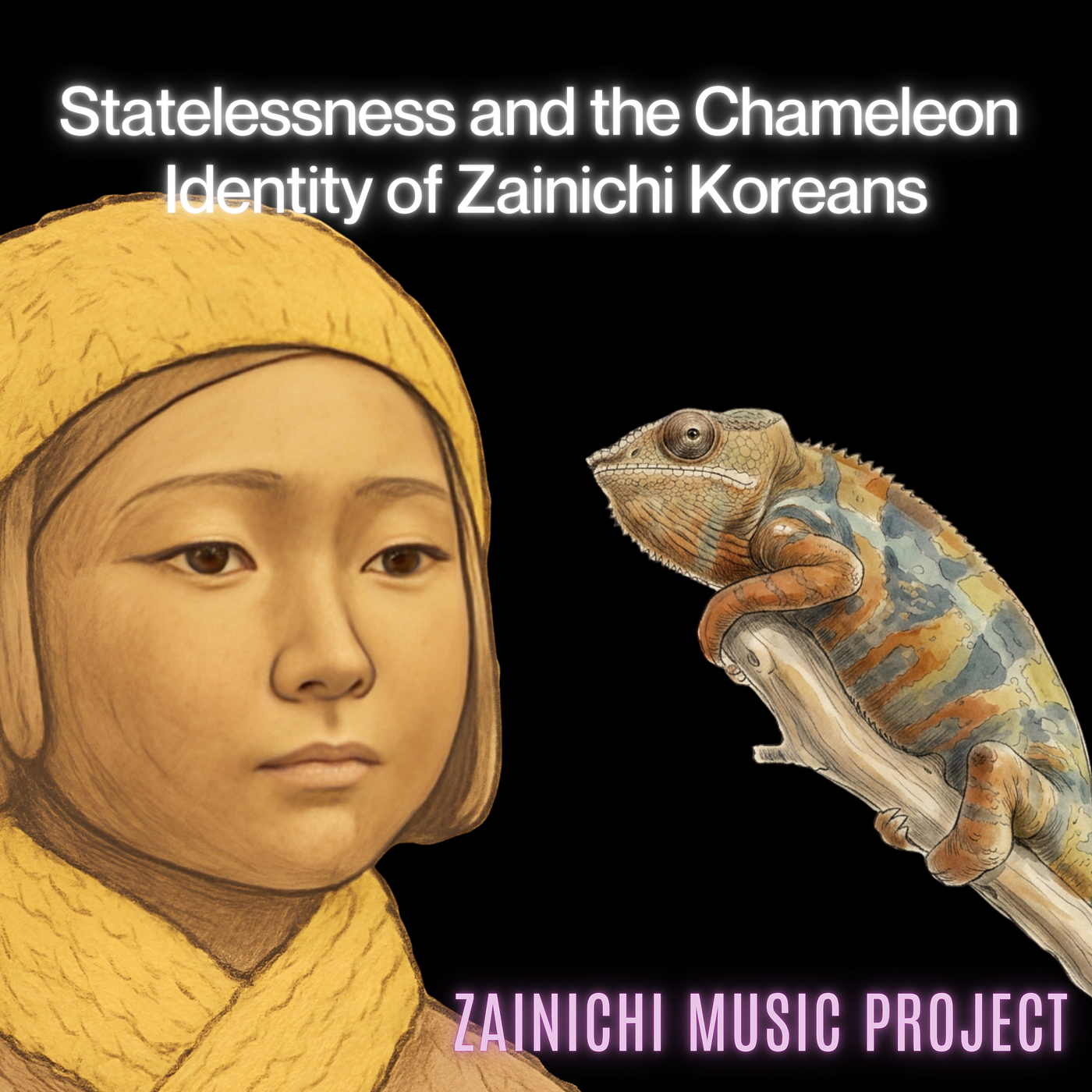
This post focuses on statelessness — and, more specifically, how the legal status of Zainichi Koreans kept shifting over time, almost like a chameleon.
Not stable. Not fixed. Constantly adjusting to political circumstances.
Were Zainichi Koreans Stateless?
After Japan’s defeat in 1945, the legal position of Koreans in Japan changed abruptly.
Under colonial rule, Koreans had been classified as Japanese imperial subjects. This did not mean equality, but it did mean formal legal inclusion within the empire.
When the empire collapsed, that legal framework disappeared. Koreans in Japan were no longer treated as Japanese at a moment when Japan was struggling to reconstruct its postwar identity and increasingly promoting homogeneity as a national ideal. Korea itself had also not yet been recognized as a unified, independent state.
For several years, many Koreans in Japan existed in a legal gray zone without a clear nationality.
In 1952, following the implementation of the San Francisco Peace Treaty, Koreans in Japan formally lost their Japanese nationality and were classified as foreign nationals.
For many families, this created effective statelessness — not always in the narrow sense defined by international law, but in daily life. No state fully represented them, protected them, or claimed them as citizens.
A Status That Crossed Generations
Japan does not grant citizenship automatically based on place of birth. As a result, statelessness — or near-statelessness — did not end with the first generation.
Children born in Japan to Zainichi parents inherited their parents’ legal status. Even if a family had lived in Japan for decades or generations, that fact alone did not change their nationality.
I was born in Japan. My parents were also born there. Yet I was not born a Japanese citizen.
This is one of the central realities of Zainichi statelessness: it was not confined to the immediate postwar period. It extended into the lives of second- and third-generation children who had never lived anywhere else.
The 1950s: Dignity, Politics, and North Korean Influence
During the 1950s, the situation became even more complex.
With the collapse of the Japanese Empire, Zainichi Koreans lost not only their former legal status but also any clear source of political or moral recognition. Many sought a sense of dignity and belonging that had been systematically denied to them in postwar Japan, where discrimination in employment, housing, and education was especially severe.
That discrimination did not stop at the level of law. It was deeply embedded in everyday social life.
During this period, organizations affiliated with North Korea became highly visible within the Zainichi community. These groups established schools, cultural institutions, and support networks. They promoted an ideology centered on ethnic pride, resistance to the legacies of Japanese colonialism, and national dignity.
It is important to be clear: describing this historical moment does not constitute an endorsement of the North Korean state or its actions. The North Korean regime has committed severe human-rights abuses against its own citizens. Those realities should be neither minimized nor excused.
As scholars such as John Lie have documented, the attraction to North Korea under its founding leader, Kim Il-sung, during the 1950s and 1960s cannot be reduced to propaganda alone. For many Zainichi Koreans — both educated and uneducated — this ideology offered something that postwar Japan did not: recognition, structure, and a sense of dignity at a time when they were being systematically devalued.
Korean schools in Japan, many supported by North Korea–aligned organizations, became places where children learned Korean language, history, and collective identity. These schools provided education and affirmation, but they also operated within a broader Cold War political framework.
At the same time, this engagement carried grave consequences.
Beginning in the late 1950s, a large-scale repatriation program encouraged Zainichi Koreans to migrate to North Korea, often presenting the journey as a return “home.” Tens of thousands left Japan through this program. Many were never heard from again, and returning to Japan was not possible.
This chapter of Zainichi history reveals how statelessness, social exclusion, and the deprivation of dignity influenced political alignment — often under conditions of limited information and constrained choice.
Explaining this context is not propaganda. It is historical responsibility.
The 1970s and 1980s: South Korean Nationality — and Its Limits
From the 1970s through the 1980s, increasing numbers of Zainichi Koreans registered as South Korean nationals.
After Japan normalized diplomatic relations with South Korea in 1965, South Korean citizenship became the most practical route to more secure residency and travel documentation in Japan, especially while other paths remained legally restricted or politically blocked.
On paper, this meant acquiring a recognized nationality and passport. In practice, its meaning was more limited.
Many Zainichi Koreans who registered as South Korean citizens had never lived in South Korea. They were not represented politically, did not participate in elections, and often had little practical connection to the South Korean state beyond their documentation.
Legal recognition resolved certain problems involving travel, paperwork, and administrative classification. But it did not fully resolve questions of identity or belonging.
Zainichi Koreans were not Japanese, yet many were not fully South Korean in their lived experience either.
Everyday Life Under the Alien Registration System
Regardless of their nationality, the daily lives of Zainichi Koreans in Japan were governed by the Alien Registration system.
They were required to register as foreigners, carry identification at all times, and submit to fingerprinting. Traveling abroad required special permission, and the right to re-enter Japan was conditional.
Even those born and raised in Japan were subject to these controls.
When I turned sixteen, I was fingerprinted and issued an Alien Registration Card, as required by law.
One childhood memory illustrates how this system operated in everyday life.
When I was around nine years old, my mother was pulled over in Tokyo for a minor traffic issue. She had her driver’s license and vehicle registration with her, but she had left her Alien Registration Card at home.
Because her license identified her as a foreign resident, that single omission was enough for the police to detain her until someone brought proof of her alien registration.
I remember answering the telephone in our kitchen. My grandmother was panicking. At nine years old, I hailed a taxi by myself and brought my mother’s registration card to the police station.
It was traumatic and overwhelming — something no child should have had to manage.
Only much later did I understand that this was not simply an isolated incident. It reflected how the system functioned.
I will return to this memory in a future post.
The 1990s: Special Permanent Residency
In the early 1990s, Japan introduced Special Permanent Resident status for Zainichi Koreans.
This status provided greater stability than earlier forms of residency. It acknowledged Zainichi Koreans’ historical ties to Japan and reduced some administrative burdens.
At the same time, it remained conditional.
Special Permanent Residents were still required to obtain permission to leave Japan and return within a specified period. Failure to do so could result in the loss of that status — even for people who had been born, raised, and educated in Japan.
Legal belonging remained fragile.
I lost my own Special Permanent Resident status after my mother’s death, while I was attending college in the United States and unable to return to Japan within the required period.
The law did not account for my personal circumstances, the disruption caused by my mother’s death, or the fact that Japan was the only country I had ever known as home.
Despite having been born, raised, and educated there, my legal right to remain was conditional — and it could quietly disappear.
I do not share this to elicit sympathy. I share it to demonstrate how conditional even the most secure-sounding status could be.
A Chameleon-Like Legal Identity
Across these decades, Zainichi legal identity repeatedly changed shape:
- effectively stateless
- classified as foreign nationals
- registered as South Korean citizens on paper
- recognized as Special Permanent Residents
Each shift addressed a particular legal problem. None provided a complete resolution.
Legal status adapted to political circumstances, but identity and belonging did not move in the same way.
This is why Zainichi identity can feel chameleon-like — constantly adjusting to external systems, but never fully anchored by them.
Why I Am Telling This Story
The Zainichi Music Project began as a way for me to learn my own history — a history that was not taught in school and was rarely discussed at home. Much of it existed in fragments, silences, and unanswered questions.
This is not about blaming individuals. The systems I am describing were historical and structural. Naming them helps us understand how they operated and how they shaped people’s lives.
The Zainichi Music Project came first as a long-term vision for exploring identity, history, and culture. The podcast and these essays became ways for that vision to begin taking shape publicly.
As I shared these stories through the podcast and my Behind the Mic writing for The Piano Pod, I began hearing from listeners and readers. Many were not Zainichi Korean, yet they recognized parts of their own histories in these stories.
Those exchanges — thoughtful, complex, and human — are the point.
By sharing my story, I hope to bring attention to a history that has long been overlooked. More than that, I hope that speaking openly about uncertainty, adaptation, and survival allows others to recognize parts of themselves — and to know that they are not alone.
Statelessness was not merely a single legal category. It was a historical process that changed over time while continuing to shape people’s lives.
Understanding this helps explain why questions of identity, silence, and caution persist across generations.
In the next post, I will move from legal status to social behavior and explore silence: how it was learned, inherited, and normalized.
Please support the Zainichi Music Project through my NYFA project page.
메타데이터
- post_id
- 4bead4febe2e
- slug
- statelessness-and-the-chameleon-identity-of-zainichi-koreans-4bead4febe2e
- url
- https://medium.com/@yukimisong/statelessness-and-the-chameleon-identity-of-zainichi-koreans-4bead4febe2e
- canonical_url
- https://medium.com/@yukimisong/statelessness-and-the-chameleon-identity-of-zainichi-koreans-4bead4febe2e
- author_url
- https://medium.com/@yukimisong
- status
- ok
- fetched_at
- 2026-08-11 21:47:26