From Estes Rockets to Artemis II 🚀
What 30 Years Taught Me About Building the Future
From Estes Rockets to Artemis II 🚀
What 30 Years Taught Me About Building the Future
Non-members can read here. Also subscribe to stay updated whenever I publish…
I remember the smell of glue. Mid 90s. High school. A small group of us in a city park in Istanbul. Two nerdy kids and a few teachers who backed us.
We built rockets from kits with cardboard tubes, plastic nose cones. We used Estes Industries solid rocket engines and launched them, sometimes far too close to people, in the nearby park.
No permits. No simulations. No safety briefings.
Just curiosity.
We were not “learning aerospace engineering.” But in a very real way, we were doing it. Every launch was a loop:
- Build
- Countdown and launch
- Observe and recover chutes (sometimes from rooftops)
- Fix
- Then relaunch
Sometimes the parachute opened and sometimes it didn’t. Sometimes the rocket came back gently. A few times it turned into a missile :)
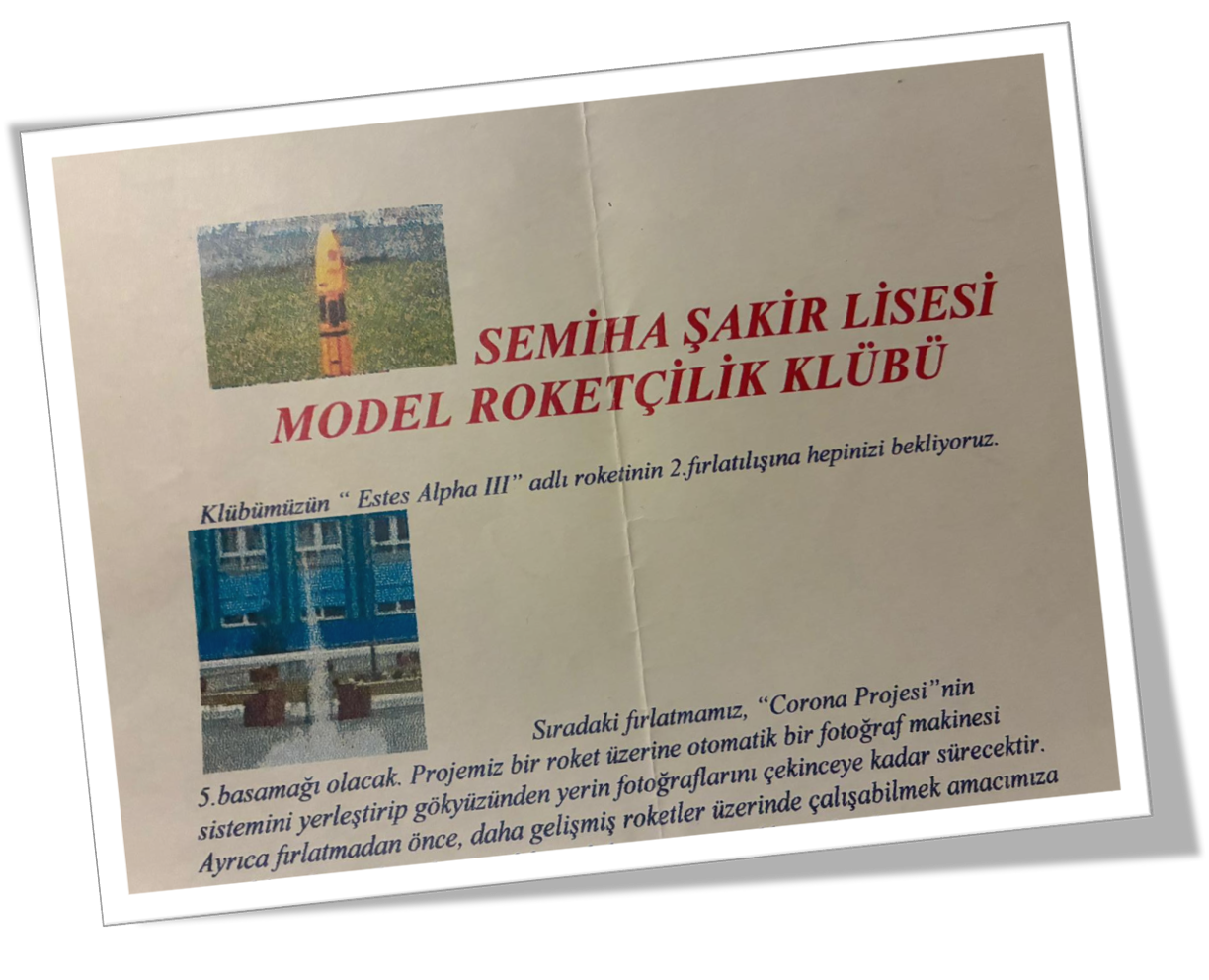
SEMIHA ŞAKİR HIGH SCHOOL MODEL ROCKETRY CLUB We invite all of you to the 2nd launch of our rocket named “Estes Alpha III.” Next, we will place an automatic camera system on a rocket to capture photographs of the Earth from the sky.

We didn’t call it iteration but that’s exactly what it was. At the same time, something bigger was shaping us. We were obsessed with the story of the Space Race in the 1960s and 70s.
We played “Buzz Aldrin’s Race Into Space” PC game

https://en.wikipedia.org/wiki/Buzz_Aldrin%27s_Race_Into_Space
Read about Buzz Aldrin and the Moon missions. We were not just playing a game, we were learning:
- Very hard trade-offs
- Careful mission planning
- Risk management
Without realizing it…
Now Fast Forward
30 years later and 50+ years after Apollo 11 Moon Landing humans are again flying around the Moon.
This time under the Artemis Program. Four astronauts. Inside Orion. As of this writing on their way from a flyby of the Moon, back to Earth.

https://www.nasa.gov/mission/artemis-ii/
Pause For A Second. What are they actually doing?
Launch → fly to Moon → swing around → come back → splashdown
That’s it. That’s the same loop we ran in a park. Just scaled.
Back then we had, cardboard, plastics, glue, ignition wires, maybe a very basic old school photograph attached to the body and lots of trial and error.
Today:
- deep space navigation
- life support systems
- thermal shields
- orbital mechanics
But the logic is identical. There is a deeper shift though. Apollo was simple to understand. One goal! Land people on the Moon. Win “the” race. It was emotional, visible and pulled everyone in.
Artemis Is Different
- Stay on the Moon
- Build infrastructure
- Prepare for Mars
This is not a race, it’s a system. Systems may not inspire the same way races do. And yet… the foundation is stronger.

What Artemis II proves is simple:
- Humans can go there
- Systems can hold
- Missions can repeat
This is the “test flight phase.” Exactly like early rockets. Here is the part most people miss. There is no hero moment. No flag. No footprint, just yet!
Precision, trajectory control, extreme heat management, precise thruster timing, re-entry accuracy. This is engineering maturity. And still, something feels familiar.
Technology → Narrative → Participation
Humanity saw it in the 60s. I’ve felt it in the 90s. We are seeing early signs again. But weaker. More fragmented. No single story that pulls everyone in, yet!
That’s the missing piece.
Back then: The Moon meant progress against the Soviets.
Of course, it was also about national prestige, science, military edge, and a mass cultural symbol of progress too…
Today: The Moon means space infrastructure.
Less emotional. More technical. But if Artemis succeeds… we’ll see:
- permanent bases
- frequent missions
- human stories again
New Obsessions
Then the loop restarts:
- kids building rockets this time landing backwards like Falcon 9
- hobby clubs
- new and much better simulations
Because inspiration is not about technology, it’s about visibility. I didn’t become an astronaut. But I learned something more important.
How to build, test, fail fast, try again.
And today, watching Artemis II return… It feels very clear. We are still doing the same thing. Just at a different scale. 🚀
All the best
Altan
P.S.
While writing this, I found that Race Into Space now has an open-source home on GitHub. That felt oddly fitting. ->
메타데이터
- post_id
- 4befcb9e739b
- slug
- from-estes-rockets-to-artemis-ii-4befcb9e739b
- url
- https://medium.com/@atabarezz/from-estes-rockets-to-artemis-ii-4befcb9e739b
- canonical_url
- https://medium.com/@atabarezz/from-estes-rockets-to-artemis-ii-4befcb9e739b
- author_url
- https://medium.com/@atabarezz
- status
- ok
- fetched_at
- 2026-06-20 20:29:01