The Sigmoid Function: The Elegant Curve That Powered a Revolution
In the world of mathematics and computer science, some functions stand out not just for their utility, but for their elegance. The sigmoid…
The Sigmoid Function: The Elegant Curve That Powered a Revolution
In the world of mathematics and computer science, some functions stand out not just for their utility, but for their elegance. The sigmoid function is a prime example. With its characteristic “S” shape, this simple-looking curve has been a foundational pillar in fields ranging from statistics to biology, and most notably, in the development of artificial intelligence.
This article will take a deep dive into the sigmoid function, exploring what it is, why its properties are so unique, its historical significance in neural networks, its modern applications, and why, despite its age, it’s still a function every data scientist and AI enthusiast must understand.
What is the Sigmoid Function? The Basics
At its core, a sigmoid function is any mathematical function that has an “S”-shaped (sigmoidal) curve. While several functions fit this description, when people in machine learning and statistics say “the sigmoid function,” they are almost always referring to the logistic function.
The formula for the logistic sigmoid function is:
σ(x)=1+e−x1
Let’s break this down:
- x : This is the input to the function. It can be any real number, from negative infinity to positive infinity.
- e : This is the base of the natural logarithm, a fundamental mathematical constant approximately equal to 2.71828.
- σ(x) : This is the output, or the result of applying the function to the input x.
When you plot this function, you get the iconic S-curve.
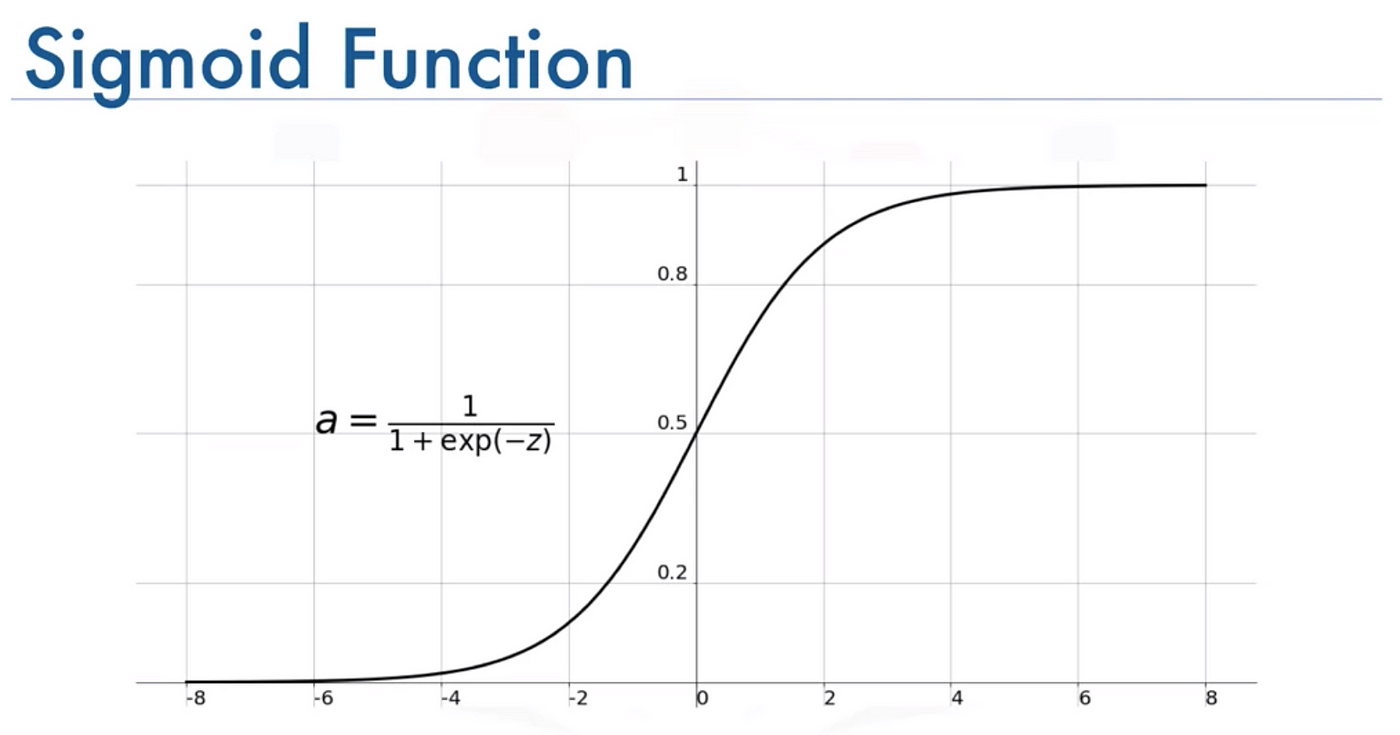
Key characteristics of this curve are immediately visible:
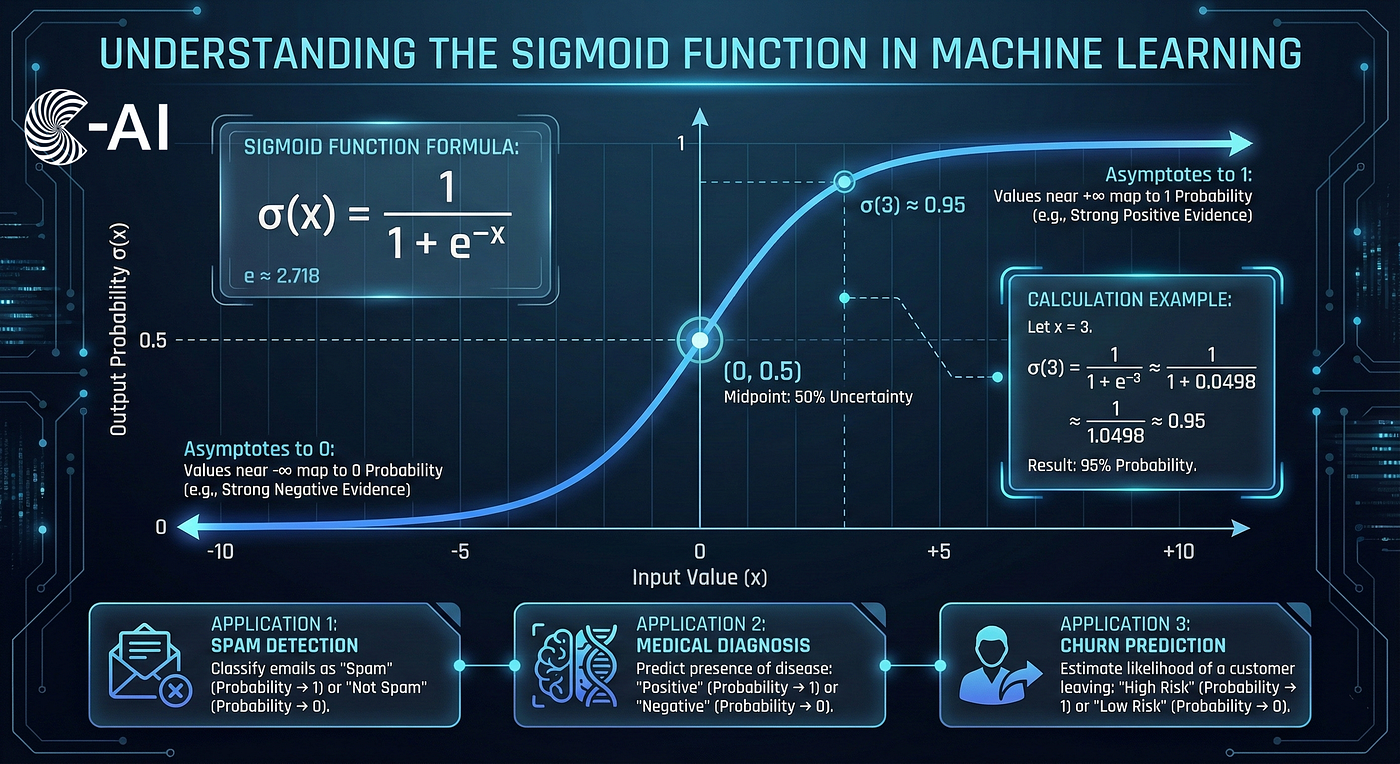
- Asymptotes: The curve approaches but never quite reaches 0 on the left and 1 on the right. These are its horizontal asymptotes.
- Midpoint: The function passes through the point (0, 0.5). When the input is 0, the output is exactly 0.5.
- Range: The output of the function is always between 0 and 1 (exclusive).
Key Properties: Why the Sigmoid is Special
The simple formula of the sigmoid function hides a set of powerful properties that make it incredibly useful, especially in the context of machine learning.
1. Bounded Output (Range of 0 to 1)
This is perhaps its most celebrated feature. The sigmoid function takes any real-valued number and “squashes” it into a range between 0 and 1. This makes it a perfect tool for representing probabilities. An output of 0.9 can be interpreted as a 90% probability, while 0.1 can be seen as a 10% probability.
2. Smooth and Differentiable
For a function to be used in optimizing a neural network (a process called backpropagation), it must be differentiable — meaning we must be able to calculate its derivative (the slope of the curve at any given point). The sigmoid is smooth and has a derivative everywhere.
What’s truly remarkable is the form of its derivative. If
σ(x) is the sigmoid function, its derivative,
σ′(x) is: = σ(x)⋅(1−σ(x))
This is computationally elegant. It means that if you’ve already calculated the output of the sigmoid function σ(x), you can calculate its derivative with just one more multiplication and subtraction. This efficiency was a massive advantage in the early days of computing.
3. Monotonic Function
The sigmoid function is strictly increasing. This means that as the input
x increases, the output σ(x) will always increase. This predictable behavior is desirable in many modeling scenarios.
The Role of the Sigmoid in Neural Networks: A Historical Pillar
The sigmoid function was one of the first and most widely used activation functions in artificial neural networks. An activation function’s job is to introduce non-linearity into the network, allowing it to learn complex patterns beyond simple linear relationships.
Here’s how it worked in a classic neuron:
- A neuron receives a set of inputs, multiplies them by weights, and sums them up.
- This sum is then passed through an activation function to produce the neuron’s final output.
- The sigmoid function would take this sum and “squash” it into a value between 0 and 1.
This output could be interpreted as the neuron’s “activation level” or “firing rate.” An output close to 0 meant the neuron was largely inactive, while an output close to 1 meant it was firing strongly. This graded, probabilistic response was far more powerful than a simple on/off switch.
The elegant derivative, σ′(x) = σ(x)(1−σ(x)) was crucial for the backpropagation algorithm. This algorithm works by calculating the gradient of the network’s error with respect to its weights and adjusting the weights to minimize that error. The chain rule of calculus is used extensively here, and the simple form of the sigmoid’s derivative made these calculations computationally feasible, enabling the training of multi-layer networks.
Beyond Neural Networks: Other Applications
The utility of the sigmoid function extends far beyond deep learning.
- Logistic Regression: This is one of the most fundamental algorithms in statistics and machine learning for binary classification (e.g., predicting if an email is spam or not spam). A linear model is trained, and its output is then passed through a sigmoid function to map the result to a probability between 0 and 1.
- Cumulative Distribution Functions (CDFs): The sigmoid curve is very similar to the CDF of the normal distribution, which describes the probability that a random variable will be less than or equal to a certain value.
- Modeling Growth: The S-shape is ideal for modeling processes that start slow, then accelerate rapidly, and finally slow down as they approach a maximum capacity. This includes things like population growth, the spread of diseases, and the adoption of new technologies.
The Downside: Limitations of the Sigmoid Function
Despite its historical importance and elegance, the sigmoid function has two major drawbacks that have led to its decline as a default choice for hidden layers in deep neural networks.
1. The Vanishing Gradient Problem
This is the most critical issue. Look at the derivative of the sigmoid function:
σ′(x)=σ(x)(1−σ(x))
- The maximum value of this derivative is 0.25, which occurs when x=0
- For large positive or negative inputs (where the sigmoid is saturated, close to 0 or 1), the derivative is very close to 0.
In a deep network during backpropagation, gradients are multiplied together as they are passed backward through the layers. If several of these gradients are tiny (less than 0.25), the product becomes vanishingly small. This means the gradients for the early layers of the network become almost zero, and these layers learn extremely slowly, if at all. This severely limits the depth of networks that can be effectively trained.
2. Not Zero-Centered
The output of the sigmoid function is always positive (between 0 and 1). This can lead to inefficient learning. During gradient descent, weight updates depend on the gradient and the input. If the inputs are always positive, the gradients for a neuron’s weights will either all be positive or all be negative during an update step. This can lead to a “zig-zag” path of convergence, which is much slower than the direct path possible with a zero-centered function.
Modern Alternatives: What Replaced Sigmoid?
Because of these limitations, the sigmoid function has been largely replaced in the hidden layers of deep networks by more effective alternatives.
- ReLU (Rectified Linear Unit): The most popular activation function today. Its formula is simple: f(x)=max(0,x)
- It is computationally cheap and does not suffer from the vanishing gradient problem for positive inputs (its derivative is 1 for x>0).
- Tanh (Hyperbolic Tangent): The tanh function is a scaled version of the sigmoid: tanh(x) = 2σ(2x)−1
- Its main advantage is that it is zero-centered (its output ranges from -1 to 1), which helps with the gradient descent zig-zag problem. However, it still suffers from the vanishing gradient problem.
Conclusion: The Enduring Legacy of the Sigmoid
So, is the sigmoid function obsolete? Far from it. While it’s no longer the go-to choice for hidden layers in deep networks, it remains an essential tool.
- It is still the perfect choice for the output layer of a binary classification problem, where a single probability between 0 and 1 is required.
- It is the core of logistic regression, a workhorse algorithm in statistics and data science.
- Understanding the sigmoid function and its limitations is a rite of passage for anyone learning about neural networks. The story of its rise and fall provides deep insight into the practical challenges of building and training deep learning models.
The sigmoid function is more than just a mathematical equation; it’s a piece of AI history. Its elegant S-curve paved the way for the neural networks that power modern technology, and its lessons continue to guide the design of the next generation of artificial intelligence.
메타데이터
- post_id
- 4c0101b23ebf
- slug
- the-sigmoid-function-the-elegant-curve-that-powered-a-revolution-4c0101b23ebf
- url
- https://medium.com/@koshurai/the-sigmoid-function-the-elegant-curve-that-powered-a-revolution-4c0101b23ebf
- canonical_url
- https://medium.com/@koshurai/the-sigmoid-function-the-elegant-curve-that-powered-a-revolution-4c0101b23ebf
- author_url
- https://medium.com/@koshurai
- status
- ok
- fetched_at
- 2026-06-21 07:44:09