Our Columbia Island in Washington, DC, Deserves Better Than a Triumphal Arch
Proposing the U.S. Franklin–Dewey–Citizenry Civic Data Observatory
Our Columbia Island in Washington, DC, Deserves Better Than a Triumphal Arch
Proposing the U.S. Franklin–Dewey–Citizenry Civic Data Observatory
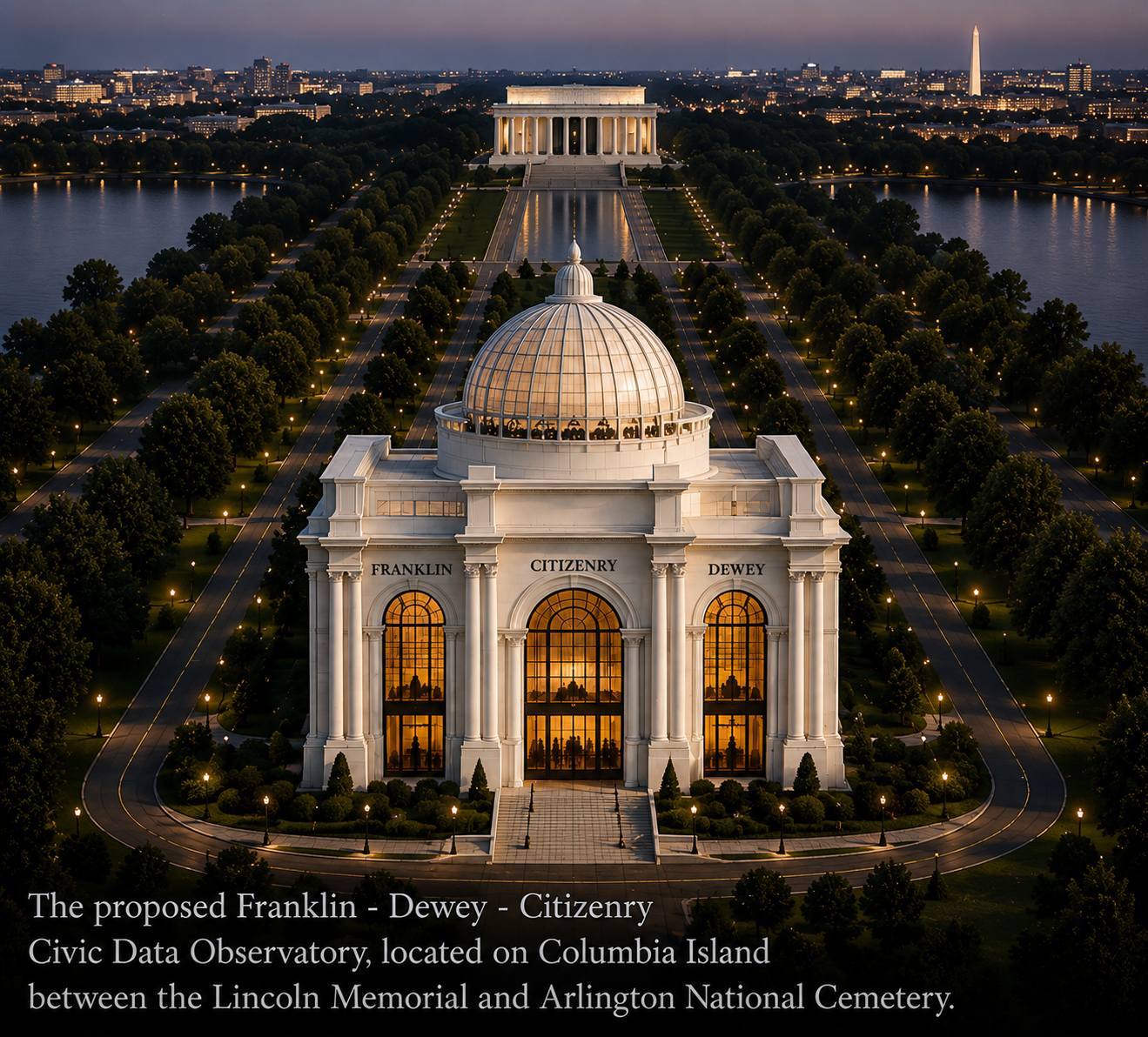
Proposal by Christopher Hunt Robertson, M.Ed. (Image by ChatGPT)
As both a historian and a Civic AI visibility theorist, I believe the land between the Lincoln Memorial and Arlington National Cemetery is among the most symbolically important civic corridors in the United States. That is why the proposal to build a 250-foot triumphal arch on Columbia Island deserves a much wider public discussion than it has yet received.
Critics have already raised serious concerns regarding the project’s scale, traffic impacts, aviation complications, disruption of historic sightlines, and uncertain legal footing under the Commemorative Works Act. Veterans and preservation groups rightly argue that the open axis between the Lincoln Memorial and the Arlington National Cemetery was intentionally preserved as a visual expression of national reconciliation after the Civil War. They are right to treat that landscape with great caution.
But beyond the practical objections lies a deeper question:
What story should this sacred corridor tell for future generations?
The Lincoln Memorial honors constitutional preservation and moral struggle. Arlington honors sacrifice. Together, they form not a triumphalist landscape, but a democratic one — a place reminding Americans that self-government requires both sacrifice and civic responsibility.
Washington already contains many monuments to presidents, founding generations, wars, and national triumphs. Those memorials matter. Yet what America increasingly lacks is visible civic infrastructure devoted to sustaining democratic self-government under modern technological conditions.
For that reason, I believe Columbia Island should not become the site of another monumental arch associated with any single political era or personality. Instead, this rare symbolic ground should serve the continuing democratic future of the American people themselves.
I would therefore propose a different vision for Columbia Island: a civic data observatory operated as a national constitutional public-works institution under the Library of Congress.
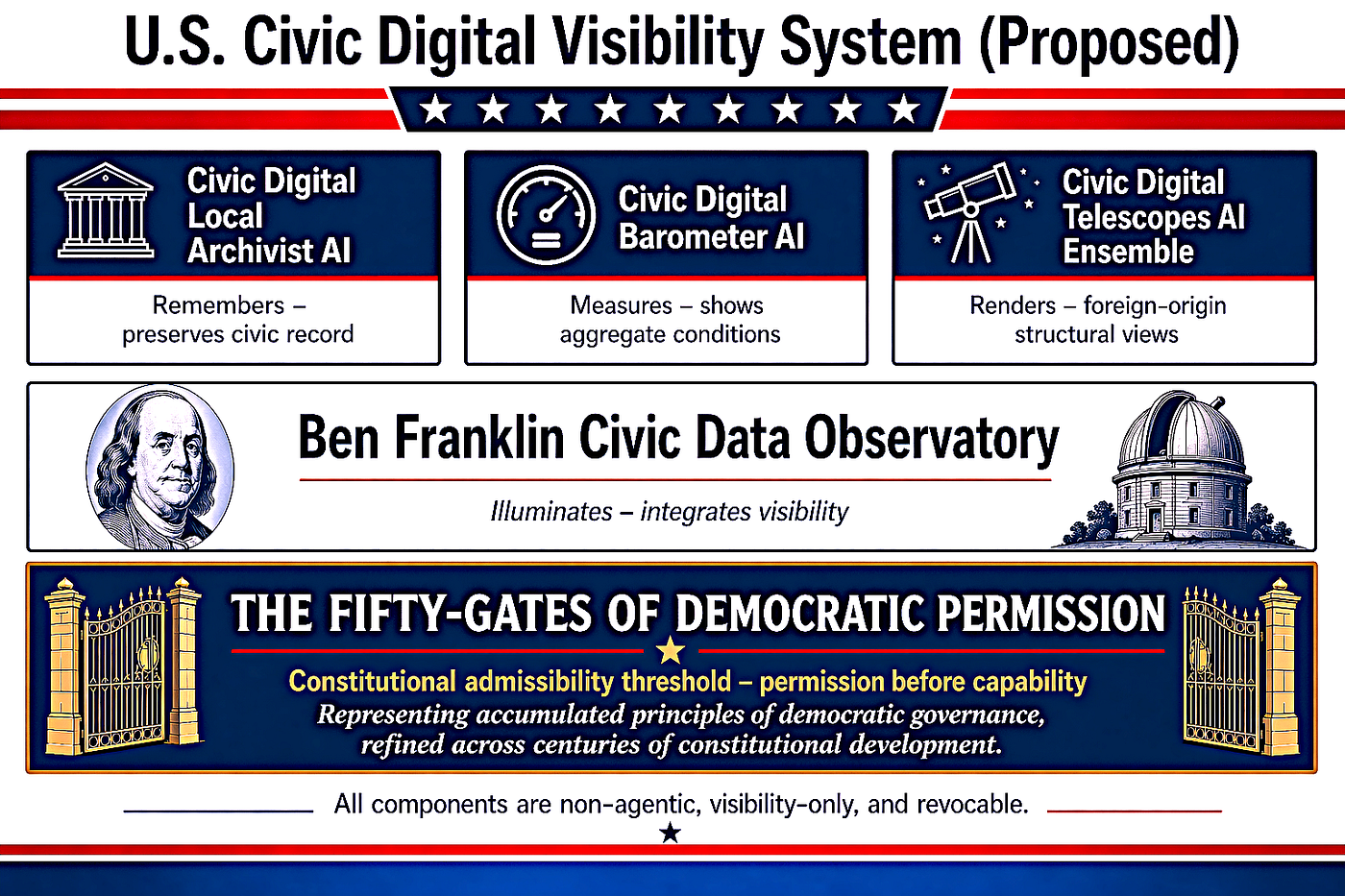
A civic data observatory is not a command center and not a surveillance tower. It is a public observatory for the machine age: a place where advanced, non-agentic Civic AI helps us see the large-scale digital conditions shaping public life, while leaving all judgment and authority with human citizens and their representatives. Its role would be to illuminate, not to rule.
In practical terms, such an observatory would help map the “civic weather” of the digital age: foreign information operations, synthetic-media campaigns, coordinated manipulation networks, and other systemic distortions that now operate largely beneath ordinary public awareness. Its systems would analyze patterns, identify emerging civic risks, and provide structured democratic visibility to Congress, journalists, scholars, public servants, and citizen representatives — while remaining constitutionally barred from making or enforcing policy itself.
The observatory would neither replace nor restrict the functions of existing military, intelligence, or law-enforcement institutions. Its purpose would instead be civic and constitutional: extending democratic visibility into large-scale digital conditions shaping public life.
Columbia Island is a symbolically fitting location for such an institution. It sits between a memorial to a president who preserved the Union and a cemetery that bears the human cost of that preservation. Placing a civic observatory there would affirm, in stone and glass, that protecting the republic now also requires protecting the clarity of the civic information environment upon which democratic self-government depends.
The Library of Congress is the natural steward for such a project. It already serves as the nation’s constitutional archive and research library, trusted across administrations and political parties. Housing the observatory under the Library’s institutional umbrella would align its mission with public knowledge, constitutional continuity, and democratic learning — not with executive power or technological control. Its proximity to Congress would also ensure that the people’s representatives remain directly connected to the same civic visibility systems informing public understanding.
The architecture itself would reflect this civic purpose. Instead of a single triumphal arch, the observatory would feature three civic arches recognizing Benjamin Franklin, John Dewey, and — most importantly — the Citizenry itself, with the largest arch dedicated to the American people as the enduring source of democratic legitimacy. Its neoclassical stone and transparent glass would place it within the American tradition of libraries, observatories, archives, and other public institutions designed not to dominate citizens, but to help free citizens navigate a complex world together.
Above its entrance could appear a single constitutional principle:
“DEMOCRACIES CANNOT GOVERN WHAT THEY CANNOT SEE.”
Benjamin Franklin understood that republics require civic infrastructure devoted to public knowledge and democratic maintenance. John Dewey later warned that modern technological societies could gradually eclipse the public’s ability to perceive the forces shaping their own civic life. Both traditions point toward the same democratic insight: self-government cannot survive indefinitely without shared civic visibility.
This is why the choice for Columbia Island matters.
A triumphal arch looks backward toward victory and political legacy. A civic observatory looks forward toward stewardship, democratic continuity, and the ongoing responsibility of citizens to govern themselves wisely under changing historical conditions.
Columbia Island will not be available twice. Once that symbolic space is filled, we will have chosen — for generations — what story that corridor tells about the American republic and its future.
Let us instead use Columbia Island, one of the nation’s rarest symbolic civic spaces, for a higher democratic purpose. Let us not use this space merely for another backward-looking Revolutionary War monument, but instead create a forward-looking piece of civic infrastructure that our founders would have appreciated — one that helps current and future generations preserve the self-governance they fought to attain for us.
Christopher Hunt Robertson, M.Ed. Historian and Civic AI Visibility Theorist Toledo, OH, and Charlotte, NC
메타데이터
- post_id
- 4c172ea5b8ea
- slug
- our-columbia-island-in-washington-dc-deserves-better-than-a-triumphal-arch-4c172ea5b8ea
- url
- https://medium.com/@crob2011/our-columbia-island-in-washington-dc-deserves-better-than-a-triumphal-arch-4c172ea5b8ea
- canonical_url
- https://medium.com/@crob2011/our-columbia-island-in-washington-dc-deserves-better-than-a-triumphal-arch-4c172ea5b8ea
- author_url
- https://medium.com/@crob2011
- status
- ok
- fetched_at
- 2026-06-09 15:37:30