Seq2Seq Models And Their Development Over Time
Deep Neural Networks work well whenever large labeled training sets are available, but they cannot map sequences to sequences.
Seq2Seq Models And Their Development Over Time
Deep Neural Networks work well whenever large labeled training sets are available, but they cannot map sequences to sequences.
If we talk about Artificial Intelligence (AI) and Machine Learning (ML), the domain of Natural Language Processing (NLP) stands as a cornerstone. It enables machines to understand, interpret, and generate human languages or, simply, words. Time has witnessed groundbreaking advancements of NLP, totally reshaping how we interact with digital systems.
Seq2Seq models, short for sequence-to-sequence models, have emerged as a pivotal force in NLP, revolutionizing the handling of sequential data. These models, also known as many-to-many models, are deep learning architectures designed to handle situations where both the input and output are in sequential form, such as machine translation, text summarization, question-answering systems, conversational AI, chatbots, and speech-to-text generators.
Source: created by me
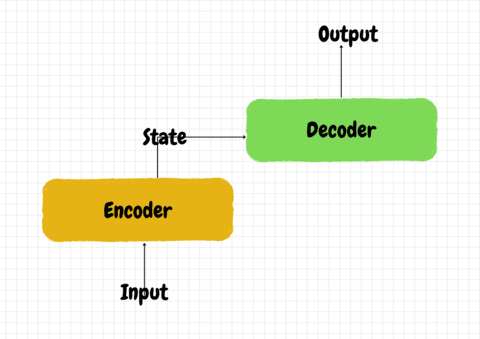
A typical Seq2Seq model consists of two main components: an encoder and a decoder.
- Encoder: The encoder takes the input sequence and processes it into a fixed-size context vector, also known as the encoder hidden state. This context vector contains all the information from the input sequence in a compressed form.
- Decoder: The decoder takes the context vector generated by the encoder as one of its inputs and uses it to generate the output sequence step by step. At each step, the decoder produces an output token based on the context vector and the previously generated tokens in the output sequence.
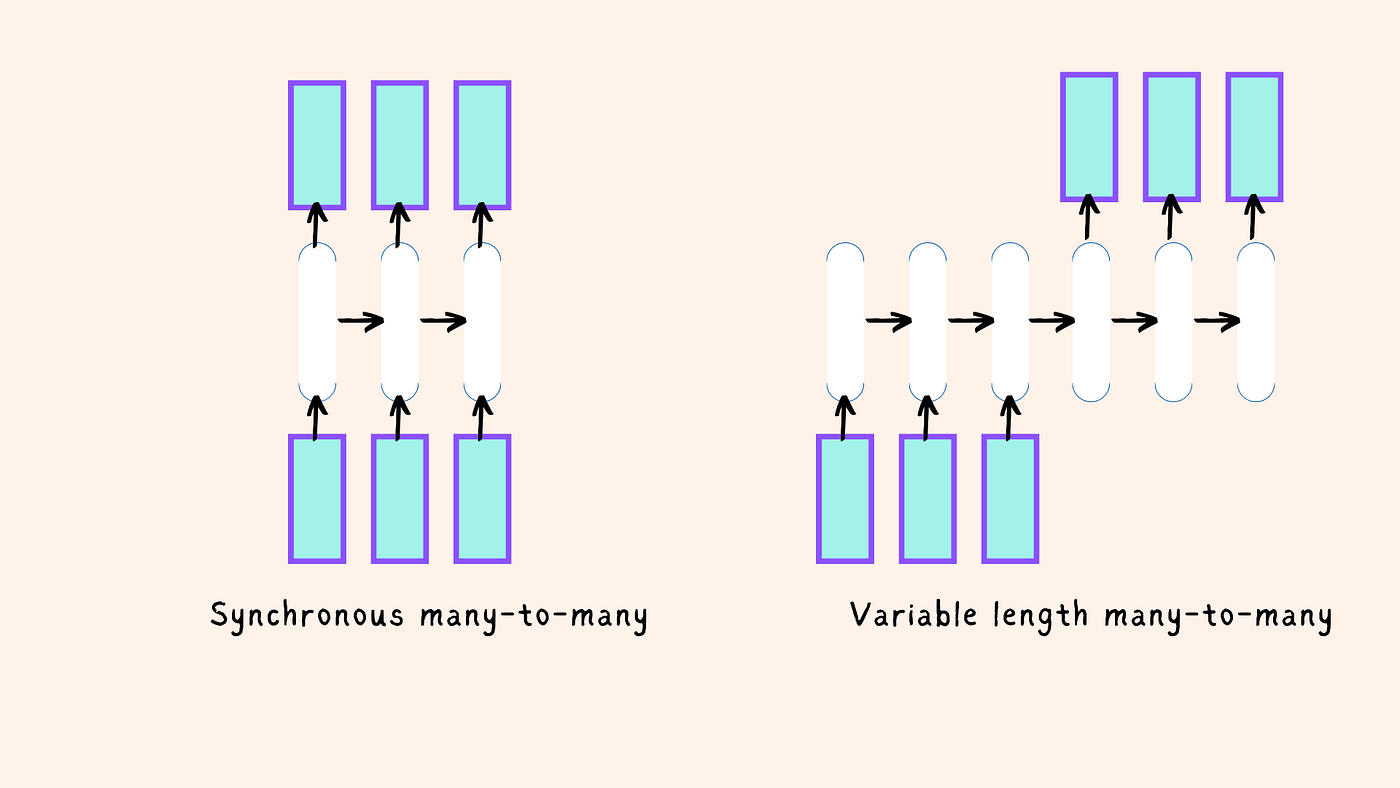
Many-to-many models can be of 2 types, one where the input and output sequences have the same length (synchronous many-to-many models) and the other one being variable-length many-to-many models.
- Synchronous many-to-many models include tasks like parts of speech tagging and named entity recognition in text, where each input element corresponds to an output element.
- On the other hand, variable length many-to-many models are crucial for tasks like machine translation, text summarization, question-answering systems, conversational AI, chatbots, and speech-to-text generators.
Source: created by me
Seq2seq models are required for tasks where the input and output are sequences of arbitrary lengths and may not have a one-to-one correspondence between elements. These models allow for flexible handling of input and output sequences of varying lengths and capture complex relationships between elements in the sequences. They have become essential in natural language processing and other domains where sequential data processing is required.
**MAJOR DEVELOPMENTS FOR Seq2Seq TASKS : **(click on the links to get to the respective articles)
- STAGE 1 : LSTM cell-based encoder-decoder
- STAGE 2 : Attention mechanism
- STAGE 3 : Transformers
- STAGE 4 : Transfer learning in NLP
- STAGE 5 : LLMs
With this blog, I am beginning a SERIES, on the 5 crucial stages of the development of Seq2Seq models. Stay tuned!!!
메타데이터
- post_id
- 4c4a97d3c243
- slug
- seq2seq-models-and-their-development-over-time-4c4a97d3c243
- url
- https://medium.com/@ak.t.kree/seq2seq-models-and-their-development-over-time-4c4a97d3c243
- canonical_url
- https://medium.com/@ak.t.kree/seq2seq-models-and-their-development-over-time-4c4a97d3c243
- author_url
- https://medium.com/@ak.t.kree
- status
- ok
- fetched_at
- 2026-07-24 05:01:32