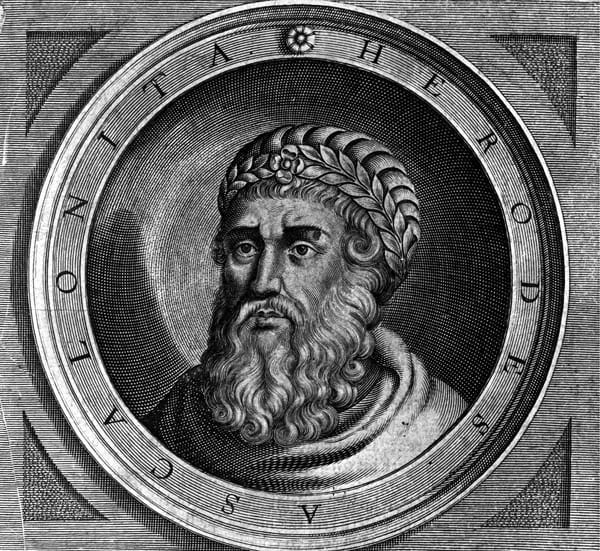
History of Christmas: King Herod
Why was he called Great?
Christmas Series: King Herod
History of Christmas: King Herod
Why was he called Great?
Herod the Great
King Herod was King of the Jews in the first century at the time of the birth of Christ. He was known for his wisdom and power, especially in his youth.
Why would the Wise Men ask the King of the Jews where the newborn king of the Jews was?
It might seem strange to ask a client king of the Roman Empire, but there were rumors about a Jewish king who would rule the world.
Historical Context of Herod’s Era
The Wise Men’s question might have been rather audacious, and Herod probably thought they were saying he wasn’t the real king.
Herod was quite paranoid at the time and didn’t trust anyone around him. He thought they were all trying to take his throne.
King Herod and the Magi
Instead of locking up the Wise Men, Herod figured out a way to get information from them. He learned from them the timing of the **Star** that had led them there, and asked his scholars what they found in the Hebrew scriptures about a prophecy of a king.
Herod learned that this “king of the Jews” was just a baby and lived in Bethlehem, the “City of David,” which was only 6 miles away.
There were also Roman writings from the first century that described this anticipation — works by historian Suetonius, historian and senator Tacitus, and Jewish historian Flavius Josephus — all of whom described a ruler coming from Judea to rule the world.
By this time, Herod had been ruling for over 30 years. He first became governor of Galilee in his twenties. Subsequently, he became a tetrarch under the Roman leader Marc Antony. But Herod had a disagreement with his uncle and had to flee to Rome.
What’s the Big Deal with Judea?
Some people might think Judea was a small province on the edge of the Roman Empire, but it was essential to Roman politics because General Pompey had conquered Jerusalem in 63 B.C.
King Herod’s Rise to Power
Syria in New Testament times
While in Rome, Herod was crowned “King of the Jews” by the Roman Senate. But Judea wasn’t a Senatorial province or an Imperial province ruled by the Emperor. It was like a satellite of nearby Syria, a more crucial Roman province at the time, governed by a prefect. This difference would play a significant role in the Easter story and the fate of **Pontius Pilate**.
When Emperor **Augustus came to power, young Herod had been a good ruler as a vassal king over Israel. His family was great at figuring out what the Roman politicians wanted in his territory and making shrewd decisions. For example, his father helped [Julius Caesar](https://billpetro.com/history-of-july)** in Egypt when his supplies were cut off, and Caesar rewarded his father handsomely, giving him charge of the public affairs of Judea.
Years later, when **Mark Antony went to see Cleopatra**, young Herod himself told him to make peace with the rest of the Roman Triumvirate he was in (with Augustus and Lepidus) — advice Antony ignored to his doom.
Herod knew Cleopatra well; they had a business together that got asphalt from the Dead Sea. Later, when Augustus became Emperor and won the civil wars, he made Herod one of his closest friends.
King Herod’s Architectural Legacy
Masada Fortress
Masada
In his book The Jewish War, Flavius Josephus tells us that Herod, who ruled Israel for 33 years, spent heavily building temples, aqueducts, cities, and palaces for himself and his people.
One of his most famous projects was Masada, a fortress north of the Dead Sea.
Second Temple
Second Temple in Jerusalem
Herod the Great’s most impressive feat was the construction of the Second Temple in Jerusalem, replacing the old Temple of Solomon, which Nebuchadnezzar of Babylon destroyed in 586 BC.
You can still see part of it today, especially the Western (“Wailing”) Wall on the Temple Mount. He also built a theater in Jerusalem and another, bigger one in the plain outside the city.
Caesarea Maritima, Port City
Herod built a port called Caesarea Maritima in honor of Augustus. He also built an arena, a hippodrome, and a theater there.
Ancient Caesarea Maritima
He supported culture in many cities in the eastern Mediterranean and even sponsored the 12 B.C. **Olympics**.
He was so involved in the games that he was called “President of the Olympic Games” for life.
Older King Herod
Taxes
Later, when Herod was an older man, the Sadducees and Pharisees, two Jewish sects, didn’t care for him. Even though Herod was a Nabatean and Edomite by birth who converted to Judaism, they still thought he was only half-Jewish because he was “too Roman” for his people. He made them pay high taxes to Rome. He also introduced foreign forms of entertainment and games and built pagan cities.
Herod’s Family
Herod’s own family didn’t like him either. He killed three of his sons, his favorite wife, her grandfather, mother, and brother-in-law. He even killed some of his own subjects. He often wrote to Rome asking for permission to kill one or more of his sons for suspected treason. Even his friend and patron, Augustus, said,
“I’d rather be Herod’s pig than his son.”
This was a play on the Greek words for son and pig, but it was also a joke because the Jews don’t eat pork.
Death of King Herod
Herod’s Illness
Death of Herod the Great
As he got closer to the end of his life, Josephus says that Herod’s illnesses caused him intense itching and convulsions all over his body. He suffered from chronic kidney disease and a rare form of gangrene that ran in his family. This made him want to take his life, but his cousin stopped him. Herod was worried that no one would mourn his death, which was a good guess.
Palace Intrigue
To ensure universal mourning for his death, Herod ordered a large crowd to fill the hippodrome in Jericho. When they announced his death, they were supposed to shoot them all and follow his wish for a funeral.
But Herod’s son, Archelaus, and his sister, Salome, didn’t want to do that. So, Herod’s plan failed, as did his plan for the Massacre of the Innocents, to kill the baby in Bethlehem, “who has been born king of the Jews.”
Bill Petro, your friendly neighborhood historian billpetro.com
Podcast version:
[embed]
*Subscribe* to have future articles delivered to your email.
메타데이터
- post_id
- 4ca5397ea466
- slug
- history-of-christmas-king-herod-4ca5397ea466
- url
- https://medium.com/@billpetro/history-of-christmas-king-herod-4ca5397ea466
- canonical_url
- https://medium.com/@billpetro/history-of-christmas-king-herod-4ca5397ea466
- author_url
- https://medium.com/@billpetro
- status
- ok
- fetched_at
- 2026-07-23 02:20:58