Database Sharding in Automation: Scale Without Limits
How splitting your database into shards powers the automation pipelines behind the world’s most data-intensive systems — with real…
Database Sharding in Automation: Scale Without Limits
How splitting your database into shards powers the automation pipelines behind the world’s most data-intensive systems — with real architecture blueprints.
Every automation system eventually hits the same wall: the database becomes the bottleneck. Sharding is the engineering answer — and understanding it is now non-negotiable for anyone building at scale.
What is database sharding?
Imagine a library with 10 million books crammed into a single room. Finding a book takes forever; adding new ones is chaos. Now imagine splitting that library across 10 buildings — each holding 1 million books, organized by author’s last name. Suddenly, every lookup is 10× faster, and you can add new buildings as needed.
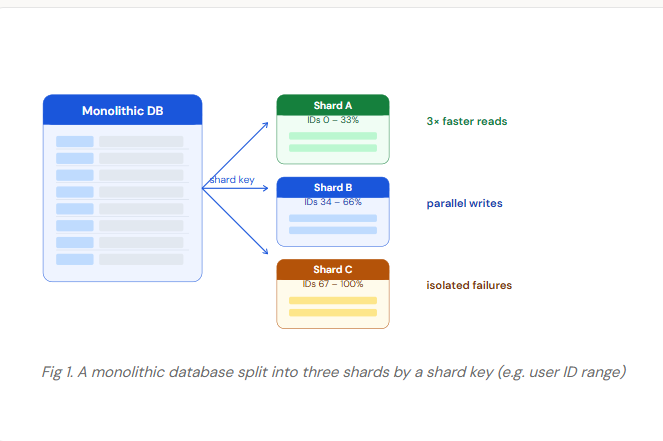
That’s sharding. A shard is a horizontal partition of your database — a self-contained slice holding a subset of the total data. The full dataset lives across all shards combined, but each shard is its own independent database instance.
Key definition : Sharding is a horizontal scaling strategy. Unlike vertical scaling (bigger hardware), horizontal scaling means more machines working in parallel. Each shard is a peer, not a replica.
How sharding works — the mechanics
The heart of sharding is the shard key: a column or set of columns whose value determines which shard a row lives on. Choose it wisely — it’s the most consequential architectural decision you’ll make.
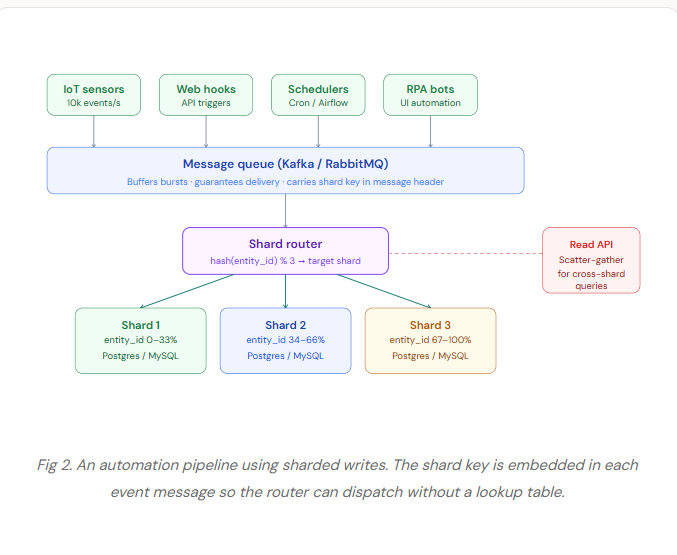
A shard router (also called a query router or middleware layer) sits between your application and the shards. Every query passes through it; the router reads the shard key, computes the target shard, and forwards the query accordingly.
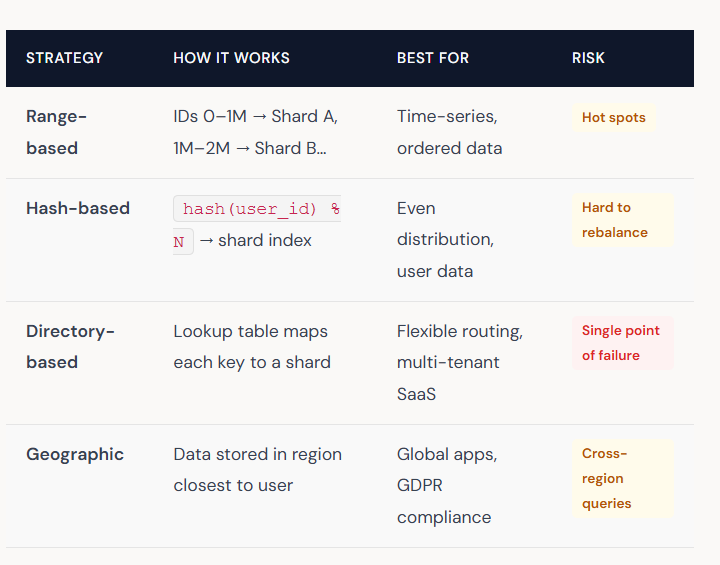
The three core sharding strategies
Sharding in automation pipelines
This is where things get genuinely powerful. Automation systems — ETL pipelines, event-driven workflows, robotic process automation (RPA), scheduled job orchestrators — are characterized by three properties that make them a natural fit for sharding:
High write throughput. Automation generates events constantly: job status updates, audit logs, sensor readings, scraped records. A single database chokes; sharded writes scale linearly.
Predictable access patterns. Automation jobs typically operate on a known entity — a tenant, a device ID, an order. That makes shard keys obvious and routing deterministic.
Isolated workloads. One automation job crashing or generating a spike should not degrade another. Sharding gives you fault isolation by design.
“The shard key in an automation system is almost always the entity being automated — not the job itself.”
Real-world use cases
📊E-commerce order processing
Shard by customer_id. Each customer's order history, cart, and events live on one shard — no cross-shard joins for the common case.
📱IoT telemetry ingestion
Shard by device_id. Millions of devices write sensor readings independently. A dead shard doesn't take down the whole fleet.
💬Social media / messaging
Shard by user_id. WhatsApp and Discord use this pattern. One user's messages, contacts, and media stay co-located.
🏦Multi-tenant SaaS
Shard by tenant_id. Each customer org lives on a dedicated shard — perfect for compliance, data residency, and noisy-neighbour isolation.
⚡CI/CD pipeline logs
Shard by repo_id or org_id. Build logs, test results, and deployment records scale with the number of repositories, not the size of a monolith.
💳Financial transactions
Shard by account_id. Stripe-style ledgers keep all transactions for an account on one shard, enabling strong consistency within an account.
Architecture blueprints
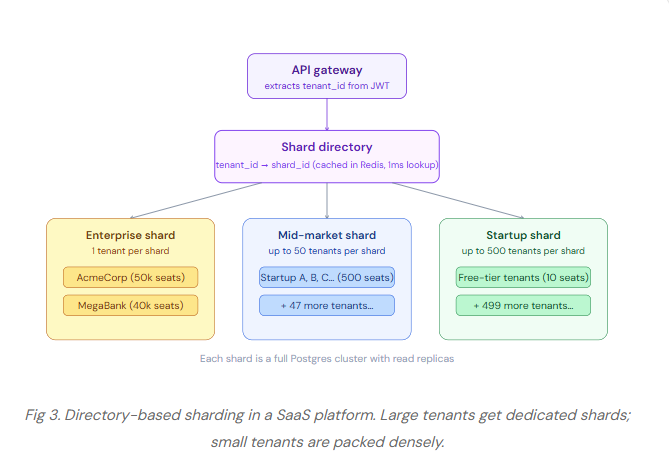
Blueprint A — Multi-tenant SaaS with directory sharding
The lookup-table pattern
When tenants have wildly different sizes (a 10-person startup vs a 50,000-seat enterprise), hash-based sharding creates imbalance. Directory-based sharding solves this: a central mapping table routes each tenant_id to a specific shard. Large tenants get their own dedicated shard; small tenants are co-located.
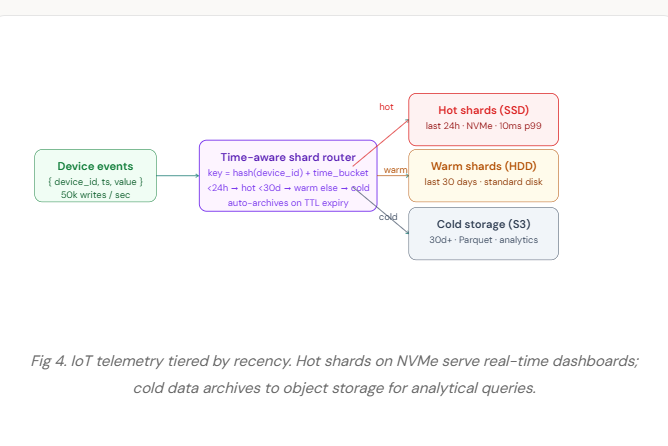
Blueprint B — IoT telemetry pipeline
Time-aware hash sharding
IoT systems face a double challenge: massive write throughput and time-series query patterns. A common solution is compound shard keys — combining device_id (for write distribution) with a time bucket (for efficient time-range scans). Older data is automatically archived to cold storage as buckets age out.
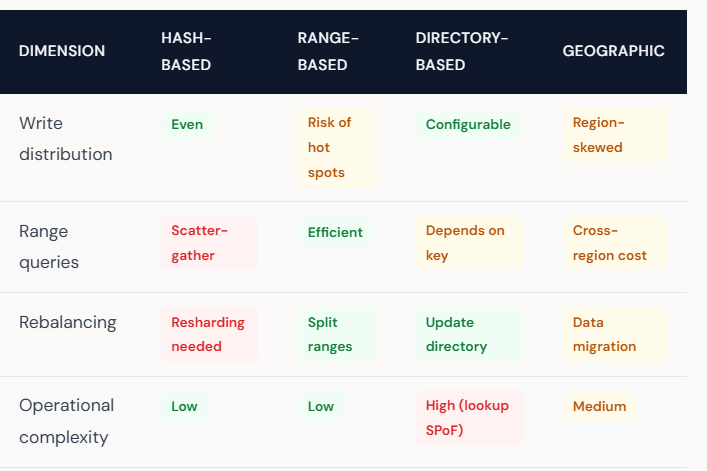
Sharding strategies compared
Rule of thumb for automation systems, hash-based sharding is the right default. It distributes writes evenly and makes your shard key obvious. Only reach for directory-based sharding when tenant sizes vary enormously (10× or more between your smallest and largest tenant).
Tradeoffs and when NOT to shard
Warning Sharding is a last resort, not a first move. It adds significant operational complexity. Before sharding, exhaust: read replicas, connection pooling, caching (Redis), query optimisation, vertical scaling, and table partitioning.
Cross-shard queries become expensive. A simple SELECT * FROM orders WHERE status = 'pending' that spans all shards requires fanning out to every shard and merging results — a "scatter-gather" query. In a monolith this is a millisecond operation; sharded, it's N milliseconds plus merge overhead.
Transactions are the hardest problem. ACID transactions across shards require distributed transaction protocols (2PC, Saga pattern) that are complex, slow, and failure-prone. Design your sharding so that the vast majority of transactions touch only a single shard.
Don’t shard if: your data is under ~1TB; your write rate is under ~5,000/sec; your team doesn’t have operational sharding experience; or your access patterns require frequent cross-shard joins.
Code example: shard routing in Python
Here’s a minimal but production-realistic shard router. It uses consistent hashing (via the hashlib stdlib) so that adding a new shard only remaps ~1/N of keys rather than reshuffling everything.
import hashlib
from dataclasses import dataclass
from typing import List
@dataclass
class ShardConfig:
shard_id: int
host: str
port: int
db_name: strclass ShardRouter:
"""
Consistent hash-based shard router.
Adding shards only remaps ~1/N of existing keys.
"""
VIRTUAL_NODES = 150 # more = better distribution def __init__(self, shards: List[ShardConfig]):
self.ring: dict = {}
self.sorted_keys: list = []
for shard in shards:
self._add_to_ring(shard) def _hash(self, key: str) -> int:
return int(hashlib.md5(key.encode()).hexdigest(), 16) def _add_to_ring(self, shard: ShardConfig):
for i in range(self.VIRTUAL_NODES):
vnode_key = self._hash(f"shard-{shard.shard_id}-vnode-{i}")
self.ring[vnode_key] = shard
self.sorted_keys = sorted(self.ring.keys()) def get_shard(self, entity_id: str) -> ShardConfig:
"""
Given an entity_id (user_id, tenant_id, device_id…),
returns the ShardConfig that owns this entity.
"""
key_hash = self._hash(entity_id)
for ring_key in self.sorted_keys:
if key_hash <= ring_key:
return self.ring[ring_key]
# wrap around the ring
return self.ring[self.sorted_keys[0]]
# Usage in an automation job
shards = [
    ShardConfig(shard_id=1, host="db1.internal", port=5432, db_name="app"),
    ShardConfig(shard_id=2, host="db2.internal", port=5432, db_name="app"),
    ShardConfig(shard_id=3, host="db3.internal", port=5432, db_name="app"),
]
router = ShardRouter(shards)
# In your automation handler:
def process_event(event: dict):
shard = router.get_shard(event["tenant_id"])
conn = get_connection(shard.host, shard.port, shard.db_name)
with conn.cursor() as cur:
cur.execute(
"INSERT INTO events (tenant_id, payload) VALUES (%s, %s)",
(event["tenant_id"], event["payload"])
)Consistent hashing advantageWith 3 shards → 4 shards, only ~25% of keys move. With simple modulo hashing (id % 3 → id % 4), ~75% of keys would need to move. At petabyte scale, that difference is weeks of migration vs hours.
Conclusion
Database sharding is not a silver bullet — it’s a trade-off you accept when the alternatives run out. But for automation systems operating at scale, it’s often the only path to linear horizontal growth.
The key decisions, in order of importance: pick the right shard key (almost always the primary entity being automated), choose your sharding strategy (hash for even distribution, directory for variable tenant sizes), and design transactions to be shard-local. Everything else — router implementation, rebalancing strategy, cross-shard query handling — follows from those three choices.
Start with a monolith. Add read replicas. Add a cache. Optimize queries. Vertically scale once. Then, when all else fails — shard.
메타데이터
- post_id
- 4cb194fdf985
- slug
- database-sharding-in-automation-scale-without-limits-4cb194fdf985
- url
- https://medium.com/@shweta.shrivastava/database-sharding-in-automation-scale-without-limits-4cb194fdf985
- canonical_url
- https://medium.com/@shweta.shrivastava/database-sharding-in-automation-scale-without-limits-4cb194fdf985
- author_url
- https://medium.com/@shweta.shrivastava
- status
- ok
- fetched_at
- 2026-06-09 15:37:30