Smarter Cushioning: Why the Future of Footwear Goes Beyond Foam
For decades, footwear cushioning has largely followed the same formula:
Smarter Cushioning: Why the Future of Footwear Goes Beyond Foam
For decades, footwear cushioning has largely followed the same formula:

Add more foam. Increase stack height. Soften the landing.
The entire performance footwear industry has spent years competing around variations of these same concepts:
- thicker midsoles
- softer compounds
- higher energy return
- bigger cushioning platforms
But the human body doesn’t move in a uniform way.
Pressure constantly shifts as we:
- walk
- run
- pivot
- accelerate
- stand
- change direction
Every step creates changing force patterns across different parts of the foot.
Yet most footwear cushioning systems remain relatively static.
That raises an important question:
What if cushioning systems could become more adaptive to human movement itself?
The Problem With Traditional Foam Cushioning
Most modern sneakers rely on a continuous foam-based midsole.
The approach works well for impact absorption, but it also creates limitations.
A single uniform cushioning layer often responds similarly across the entire foot, even though pressure distribution changes dynamically during movement.
The body does not load the foot evenly.
Different zones experience different forces depending on:
- gait
- posture
- stride
- weight transfer
- running mechanics
- surface interaction
- and individual anatomy
Traditional footwear systems attempt to solve this primarily by adjusting:
- foam density
- stack height
- carbon plates
- or outsole geometry
But the fundamental structure remains largely unchanged.
That’s where adaptive cushioning systems become interesting.
What Is Adaptive Cushioning?
Adaptive cushioning refers to footwear systems designed to respond differently across different areas of the foot during movement.
Instead of functioning as one continuous cushioning platform, adaptive systems can potentially:
- redistribute pressure
- compress independently
- alter force distribution
- improve airflow
- and create more dynamic interaction with movement
At Syntilay, we’ve been building on this concept through PulsePodz.
What Are PulsePodz?
PulsePodz is an advanced cushioning system built around independently engineered pod structures.
Rather than relying entirely on one continuous foam layer, the design uses separated geometric pod elements intended to redistribute pressure dynamically as movement occurs.
The core idea is simple:
Movement is adaptive. So cushioning should be too.
As pressure shifts across the foot, different pod zones can respond independently.
This creates a fundamentally different cushioning philosophy compared to traditional static foam systems.
Not just softer cushioning.
Smarter cushioning.
How AI and 3D Printing Change Footwear Cushioning
Historically, footwear design has been constrained by manufacturing limitations.
Traditional tooling methods often restrict how complex a cushioning system can become.
But 3D printing changes those constraints.
Additive manufacturing allows designers to explore:
- hollow structures
- airflow channels
- geometric compression systems
- variable-density architectures
- and independently engineered pod configurations
Artificial intelligence introduces another layer.
AI-assisted design tools can help generate and optimize structures that would be extremely difficult to design manually at scale.
This combination of:
- AI-assisted footwear design
- geometric engineering
- additive manufacturing
- and biomechanical thinking
…opens the door to an entirely new category of footwear systems.
Instead of designing cushioning purely around material softness, the structure itself becomes part of the performance system.
Pressure Redistribution vs Traditional Impact Absorption
Most footwear marketing focuses on absorbing impact.
But pressure redistribution may become equally important.
When force repeatedly concentrates in the same areas of the foot, discomfort and fatigue can increase over time.
A more adaptive structure has the potential to:
- distribute load differently
- reduce peak pressure buildup
- improve movement flow
- and create a more responsive underfoot experience
PulsePodz explores this through independently behaving pod geometries designed to interact dynamically with movement.
The goal is not simply to create softer footwear.
The goal is to rethink how cushioning systems behave altogether.
The Shift From Static Products to Responsive Systems
The broader footwear industry is entering a larger transformation.
For decades, shoes were treated as static products:
- fixed sizes
- fixed cushioning
- fixed manufacturing
- fixed inventory
But the future may look very different.
We are beginning to move from: mass production → intelligent personalization static products → responsive systems
Future footwear systems may increasingly integrate:
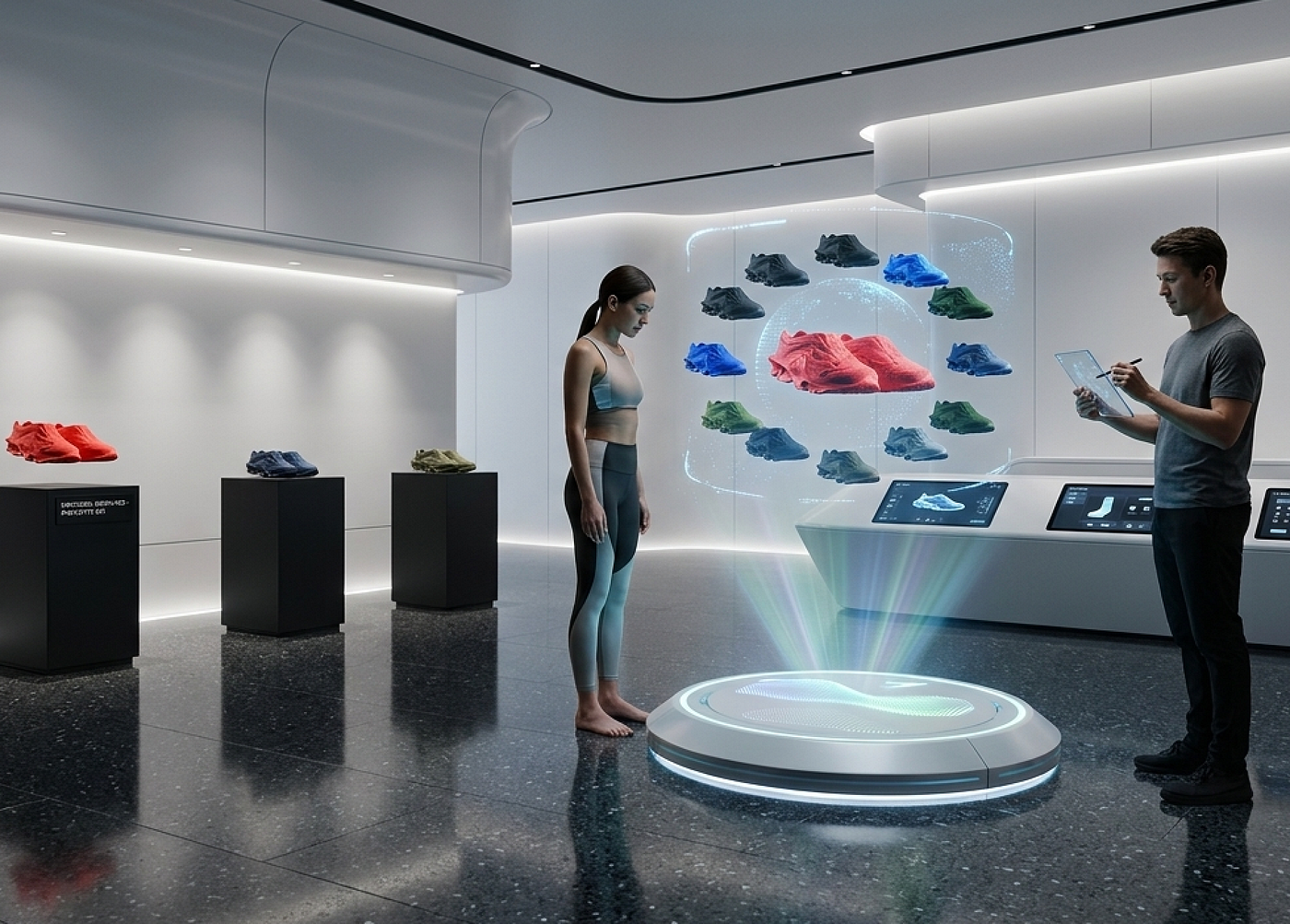
- foot scanning
- AI-generated geometry
- adaptive cushioning
- on-demand manufacturing
- and biomechanical personalization
This shift changes how footwear is designed, manufactured, and experienced.
Why the Future of Footwear Is Still Early
Many of these technologies are still in the early stages.
But the direction is becoming increasingly clear.
Footwear is evolving from: a mass-manufactured object
…into a responsive technology system built around human movement.
At Syntilay, we believe the future of footwear will not be defined solely by:
- higher foam stacks
- softer compounds
- or incremental cushioning updates
It will increasingly be defined by:
- intelligent structures
- adaptive systems
- pressure redistribution
- AI-assisted geometry
- and personalized movement experiences
The next era of footwear may not simply cushion movement.
It may adapt to it.
FootwearInnovation #3DPrinting #AI #SneakerTech #FutureOfFootwear #Biomechanics #ProductDesign #Innovation #Syntilay #PulsePodz
메타데이터
- post_id
- 4cc0f6b362f4
- slug
- smarter-cushioning-why-the-future-of-footwear-goes-beyond-foam-4cc0f6b362f4
- url
- https://medium.com/@syntilay/smarter-cushioning-why-the-future-of-footwear-goes-beyond-foam-4cc0f6b362f4
- canonical_url
- https://medium.com/@syntilay/smarter-cushioning-why-the-future-of-footwear-goes-beyond-foam-4cc0f6b362f4
- author_url
- https://medium.com/@syntilay
- status
- ok
- fetched_at
- 2026-06-16 20:05:23