In Arizona, a rift over the nation’s broadest school choice program may be headed to the ballot box
A universal school voucher program has been transformative for some families in the Grand Canyon State. But are voters wondering if it’s…
In Arizona, a rift over the nation’s broadest school choice program may be headed to the ballot box
A universal school voucher program has been transformative for some families in the Grand Canyon State. But are voters wondering if it’s gone too far?
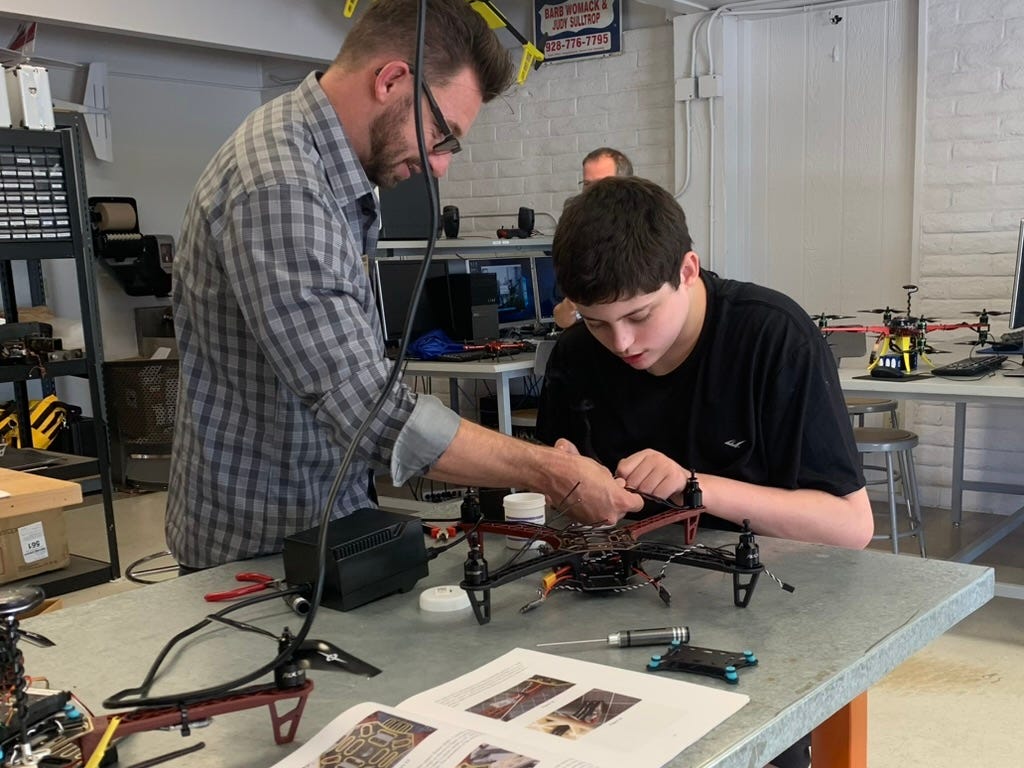
Titus Eichelberger, a student on Arizona’s Empowerment Scholarship Accounts, attended a summer program at Embry-Riddle Aeronautical University in Prescott, AZ in 2019. Courtesy of Tonya Reiner
For Tonya Reiner and her two sons, Arizona’s public schools just weren’t working out.
When Titus and Judah Eichelberger were in first grade and kindergarten respectively at their rural Prescott Valley school, the eldest was already seeing a multidisciplinary Individualized Education Program (IEP) team, a panel of specialists, educators, and administrators working to accommodate his disabilities, later diagnosed as a seizure disorder, an autism disorder, double vision and nonverbal communication.
They were “as creative as possible,” Reiner said, but the complexity of her son’s accommodation needs reached a level that forced Reiner to look elsewhere for help.
“It’s unfair to expect everyone to know everything about how to intervene or work with a child who has very, very complex needs,” she said, at the same time acknowledging the school’s recommendation to place her older son in a “self-contained autism classroom” was disappointing. That’s when Reiner heard about another path forward — a newly-passed scholarship program for students like her sons.
Just a few days ahead of the deadline in the summer of 2011, Reiner applied to have her sons join the first-ever batch of students on the state’s novel Empowerment Scholarship Account (ESA) program.
The program was designed to provide families with funds to spend on educational expenses equal to up to 90% of the per-pupil dollars that would be earmarked for their students in traditional publics, differing slightly from true voucher programs which fund non-public schools directly, which the state’s top court ruled unconstitutional in 2009.
The flexibility in receiving the funds directly enabled Reiner to cater to Titus and Judah’s individual needs herself, she said. With the voucher funds, she could bring in tutors, purchase supplies and curriculum and enroll them in specialized programs.
A few years after they joined ESA, Reiner signed Titus up to join a summer program at Embry-Riddle Aeronautical University’s Prescott campus. “They graciously allowed us to accommodate it for him,” Reiner said. “The first year he really learned the cafeteria — he had a one-to-one [aide] the whole time — and he learned the flow of how things worked, he tracked with the professors.” In the year that followed, Titus continued to improve, participating in a balloon launch class.
In his last year of attendance, Titus was taking courses on drones and rocket propulsion and thriving. Building a working, flying drone, even the professor — an “old-school military guy, someone who doesn’t dole out a compliment,” Reiner said — praised Titus’s work, she recalled.
“ESA allowed my son to go from a recommendation of a self-contained autism classroom with children who were working on toileting to, he’s doing fantastic now,” Reiner said. “He does college level in this particular area of engineering and science, and has learned coping skills and is verbal.”
But year after year, as her sons found more effective education options on the program, Reiner noticed something else, too. The group of eligible students — and permitted expenses — got wider and wider as the state legislature gradually expanded the program, eventually culminating in the most sweeping expansion in the country: the ESA program went universal in 2022, enabling any student in the state to exit the public schooling system and take thousands of dollars with them on the way out.
The model has gained attention beyond the Grand Canyon State: since 2022, Arkansas, Iowa and Utah have adopted their own universal ESA program. Arizona’s ESAs are cited as a national model in the Heritage Foundation’s Project 2025 guidebook for the second Trump term, too.
Since then, Reiner said the program has strayed too far from its roots — and hurt the very students it was designed to protect.
“The bigger the program grew, the more challenging it was for the parents of the students with disabilities to access,” Reiner said.
Since legislators voted to take the program universal, the very DNA of the program has changed. The program — created to serve students with disabilities — is now comprised less than 20% of students with disabilities, per the Arizona Education Department’s latest quarterly report. In the months following universalization, the amount of applications shattered anticipated figures, and the budget for the ESA program has surged to a billion dollars.
The expansion has been rocked with bad headlines for school choice advocates: media reports on the alleged tens of thousands of dollars spent on trips to ski resorts and Disneyland vacations have infuriated public school advocates, while the hundreds of millions spent on private school tuition have led those institutions to raise prices at rates far outpacing inflation, according to a 2023 analysis from Hetchinger Report. On Facebook groups for parents with children in ESA programs, members can be seen exchanging tips on how to get horseback riding lessons, top-of-the-line DSLR cameras and 3D printers approved for purchase.
But for the more than a million kids in Arizona’s public schools, it’s a vastly different story. Districts throughout the state are experiencing budget cuts, staff reductions and school closures that advocates say are a direct result of ESA expansion. Critics of the program argue that downstream budget concerns for public schools in the state, coupled with waste and fraud allegations, make the program’s unfettered expansion an untenable situation for Arizonan students and taxpayers.
Over 150,000 Arizonans have already signed onto a ballot initiative backed by the state’s teachers’ union and public school advocacy groups to implement spending reforms, introduce an income threshold and further incorporate accountability mechanisms over the ESA program. Meanwhile, the ESA program’s biggest boosters are closing ranks, speaking increasingly dogmatically in parent forums and aggressively mobilizing against would-be reformers, even those in their own party.
As soon as November, the deep purple state’s voters could serve as a bellwether for the nation: either voting to halt the school choice movement’s decade and a half of perpetual expansion in the state of Arizona and reject what’s become known on the far-right as a national model for education privatization, or keep the state marching on a path critics say could reshape public education as we know it.
✎✎✎
The promise of a free, universal public education is a central tenet of American life. But it’s also a relatively recent development.
It wasn’t until the 20th century that the majority of states made schooling compulsory and available to most, and schools were heavily segregated for the first half of the century. By the onset of the 1950s, the overwhelming majority of Americans were enrolled in public schools, and alternatives were far from mainstream.
The landmark Supreme Court ruling in Brown v. Board of Education and subsequent desegregation effort should have marked a major victory for those who champion universal public schooling — but instead, it unleashed a white “exodus from public schools,” according to the Southern Education Foundation. ‘Segregation Academies,’ as they came to be known, spread throughout the South and enrolled hundreds of thousands of white students.
By 1961, the state of Georgia enacted one of the earliest school voucher programs, enabling white students who were fleeing recently-desegregated schools to claim “a grant of state and local funds to be expended for the purpose of attending a non-sectarian private school.” The law and many like it would become obsolete following the 1976 Supreme Court ruling in Runyon v. McCrary, which held that private schools must desegregate too, though at least one Georgia lawmaker tried to argue that the ’61 voucher plan was technically still on the books during a resurgence in interest for school choice policies in 1993.
These highly racialized migrations making up the early school choice movement were happening concurrently with another important development. In 1955, economist Milton Friedman published an essay that’s become foundational to the modern school choice movement, imagining a free-market solution to education, enabling non-public schools to compete with public ones by introducing a voucher that could be spent on their tuition. It was Friedman’s work, not the ‘Segregation Academies’ or state laws that support them, that seemed to catch on with the general public. But it took several decades for the idea to really take off.
School choice programs gained renewed traction in the 1990s,, when clusters of voucher schemes in the Midwest, kickstarted by Milwaukee’s voucher program for low-and-middle income students often inaccurately dubbed the nation’s first voucher program, took off. The Brookings Institution, a center-left think tank, describes the waves of voucher expansion in the wake of a pair of Supreme Court cases, which expanded the ways in which taxpayer dollars could be used on causes like religious education.
In 2011, Arizona passed the earliest form of its Empowerment Scholarship Account law. For parents at the time, it was a novelty, but a welcome one.
“I had our application on the very first day it was ever open,” Kathy Visser, then the parent of a developmentally disabled 8-year-old, recalled. In fact, her 8-year-old was one of the first 75 students to participate statewide in the fall semester of 2011. “They [legislators] built this solution for me before I realized that I had a problem to solve.”
The program was small-scale, but Visser, a certified teacher herself, found the flexibility to be transformative. It was through the ESA program that she was able to afford to contract a vision teacher to tutor her son, who suffers from a sight disorder, and on his own schedule.
“His best learning hours were from 6am to 9am in the morning… she would come, she usually would come around 7am and work with him for two or three hours, two to, you know, three days a week. And that was what he needed to get going with learning,” Visser said. The program, still in its infancy, continued to grow.
“Applications were paper. You mailed your application in, we had this really convoluted expense report that just did not work very well,” Visser recalled. Even the process for paying for qualified expenses — today handled through an online platform called ClassWallet — was different. “There was no debit card, there was no ClassWallet.” But as more students enrolled, and eligibility was gradually widened, the program developed. Handbooks, specialized software and debit cards were all deployed. And by the mid-2010s, pro-school choice Arizonans were already plotting to make the program more widespread.
Groups like the Heritage Foundation, the right-wing think tank behind Project 2025, and the American Federation for Children (AFC), once chaired by President Trump’s former Education Secretary Betsy DeVos, championed the program and urged expansion. Republican state legislators, in the majority in both chambers, jumped on board.
But for some families of students with disabilities — the program’s original intended audience — the expansions beyond the program’s initial vision weren’t always welcome. “Special education students were used to grab what the school choice agenda really wanted,” Reiner argued.

Former Arizona Governor Doug Ducey and Former Secretary of Education Betsy DeVos attended a school choice roundtable event in Scottsdale, Arizona in 2019. Courtesy of the U.S. Department of Education
In 2018, legislators voted to strengthen the ESA program in a package backed by the state’s Republican Governor Doug Ducey to gradually expand program eligibility to all students statewide.
That November, Arizonans rejected the at the ballot box via veto referendum by a two-to-one margin, a lopsided defeat that one public school advocate called a “loud and clear message” in support of public education in an interview with local radio outlet KJZZ at the time.
But the lack of a mandate didn’t bother Arizona Republicans. Less than four years later, state lawmakers passed a bill making the ESA program universal along party lines, with every Republican in both chambers voting in favor, with support from no Democrats.
Former State Representative Kelli Butler, a Scottsdale-area Democrat in the chamber from 2017 to 2023, said the state GOP’s decision to overturn the voters’ will was hardly surprising.
“Every year I was in the legislature, the Republicans tried to pass their universal vouchers. And every year we had a Republican or two that would side with us… every year they would try it, and then every year we would find a stopper somehow, until finally we didn’t have a stopper anymore,” Butler recalled.
By the fall of 2022, all Arizonan students became eligible to withdraw from public schools and effectively take their funds with them. Then-Governor Ducey, a lame duck due to the state’s term limit laws, said upon signing that the passage of the law “cements [Arizona] as the top state for school choice.”
Following universalization, the program has experienced a groundswell of interest. Per the state Department of Education’s latest report, roughly 72% of ESA recipients receive funds under “universal” eligibility — and the DOE touts that roughly 60% of these universal students came immediately from a public school into the program.
The number of students on ESAs has steadily increased each semester from the over 11,000 enrollees taking part just before universalization, as has the cost of the program. The annualized cost of the program is well over $1 billion in the report, a figure that advocates say doesn’t even cover the total trickle-down budget shocks to public schools.
Since universalization, state Democrats have pushed for numerous ESA reforms — fingerprinting and background check requirements for instructors, safeguards on the rights of disabled students in private schools or creating more stringent eligibility requirements — but they’ve failed to find a foothold in the Republican-majority legislature. Despite the program’s massive cost, reports of potentially widespread misuse, and a lack of guardrails on spending and vendors, a will for reform has failed to materialize.
“[The 2022 ESA vote] was one of the darkest days in the legislature for me, because we’re now seeing what we knew would happen. We’re just seeing that public schools have declining enrollment for a lot of reasons, but one of them is the ESAs,” Butler said. “We’re seeing this lack of accountability for our tax dollars. We knew that it was just going to be a destructive, off-the-rails program.”
✎✎✎
At a board meeting in Kyrene School District, a K-8 public school district encompassing students in southern Phoenix, parent Catherine Peters was one of more than 80 parents and community members to address the board in an emotional hearing in September of last year. Her cause? Speaking out against the proposed closures of several Kyrene schools important to her family.
The local school board initially recommended the closure of nine schools in that September meeting. Throughout the fall, proceedings got contentious, with students, educators and parents packing the stands donning matching t-shirts in support of their campuses on the chopping block, delivering emotional remarks and urging a minimally disruptive solution to the district’s budget crisis.
“In 1998 and 1999, two mothers made the decision to uproot their families and move them into Kyrene School District. One started at Kyrene del Norte and one started at Millenio. The Milenio student was my husband, and I was the Norte student,” she said in a public comment, adding that her daughter was now in Kyrene schools, too.
Peters addressed the board at least a half-dozen subsequent meetings throughout the semester, according to publicly-available meeting minutes, advocating for her kindergarten-aged daughter’s Kyrene del Milenio, on the shortlist for closure, to remain open. In an interview with [outlet] in February, Peters recalled bringing a photo of her daughter during a board meeting.
“I brought those pictures and said, ‘Just remember that you guys are dealing with kids and not just dots and numbers on a chart or a grid or a board. These are living, breathing, little humans.’”

Catherine Peters spoke at Kyrene Governing Board meetings more than a half dozen times advocating against closure at her daughter’s school. Screenshot from Nov. 18, 2025 Meeting
“The kids are super close. They go to all their friends’ birthday parties. We go to their sporting events, a couple of them showed up to my daughter’s dance competition. We’re kind of like a little family, a little community, and so the thought of us being separated was kind of heartbreaking,” Peters said.
But the sheer scale of the shortfall meant that the school board’s alternatives were limited. Save Our Schools (SOS), the pro-public schooling group behind the ballot initiative to reform the ESA program, estimates that the program has already vacuumed more than $12 million away from Kyrene schools, with further declining enrollment projected. The board voted to close six of the district’s 25 campuses in December. And though Peters’ daughter’s school wasn’t ultimately one of those slated to close, she said the loss is still felt across the district. “We are in mourning because we’re still losing schools in Kyrene,” she said. “I went to Kyrene, my husband went to Kyrene. Kyrene is just a big part of what shaped us.”
The experience ultimately led Peters to run for the Kyrene Governing Board, where she hopes that, even if crises like the ESA program’s budget shocks remain unavoidable for public school districts, she can help school boards like Kyrene’s sound the alarm and better communicate with parents about the existential threats they face.
“We didn’t know that the budget was in deficit. We didn’t know that we were losing enrollment for five years since Covid. We didn’t know about these ESA vouchers, how many families these ESA vouchers were taking away from our public school system. And we didn’t know that the ESA vouchers don’t have any requirements, and that parents are buying lavish gifts and big screen TVs and trips,” Peters said of Kyrene parents standing against school closures.
Across the state, families are facing the same crisis. Less than 15 miles away, governing board members for the nearby Roosevelt School District were forced to make a similar decision in December of 2024, voting to shutter five of its 18 campuses, all elementary schools. It’s not just school closures, either — other districts have been forced to impose other costcutting measures as funds dry up.
In the East Valley, Chandler Unified School District’s Governing Board voted in January to eliminate 123 positions, including librarians, special education staffers and media specialists, “to address a $12 million budget reduction and a projected 3% enrollment decline.” Similar reduction-in-force decisions were made by Mesa Public Schools in February, Phoenix Union High School District last December, and Peoria Unified School Board in April, which eliminated each of its social worker positions.
Katie Nash, a representative with the Arizona Education Association (AEA), the state’s public school teachers’ union which is backing the reform ballot initiative, likened the explosive growth and consequences to a fable straight out of Dr. Seuss: “It’s literally like The Lorax,” Nash said. “[Lawmakers] took one puff from the tree…you look out and see the forest gone,” Nash said.
And these decisions are likely to keep coming as ESA enrollment continues to climb, and its cost to taxpayers balloons. Tyler Kowch, communications director for SOS, said the budget crisis is becoming existential for educators and families with students in public schools.
“We’re facing drastic financial decisions. Do we close schools? Do we lay off teachers? Do we cut programs? There are no districts in our state that are unaffected by this massive drain of funding,” Kowch said. “The Arizona state legislature could decide tomorrow to stop all of these school closures by stopping the drain of the funding to the voucher program, but they simply don’t have the will to do that.”
It’s unclear the exact amount of money that SOS’s reform initiative would recoup for the public school system each year, but the measure would also mitigate an increasingly large portion of ESA expenditures: those going towards fraudulent or unallowable purchases.
In the first school year in which universal ESAs were in effect, Arizonan families on the program spent more than $300 million on educational expenses. That included the expected expenses, private and specialized school tuition, equipment and curriculum supporting homeschooling and school supplies and books. But a 2023 report from local station ABC 15 raised eyebrows around the state when it revealed countless less-than-expected purchases: more than a hundred ski resort passes, $5 million spent on Apple products, even a $3,400 transaction at a golf shop, to name a few.
The report prompted investigators and reporters to dig into the hundreds of millions of dollars of approved purchases, unveiling several other controversial tickets. The following year, Arizona’s 12 News reported that taxpayers footed the bill for the purchase of more than $1 million worth of Legos by mid-2024, including “at least 84 Lego sets at a price tag of $500 or more,” per the report.
In February of this year, 12 News reported that close to 20% of all ESA accounts had made unallowable purchases, singling out state dollars spent on condoms, diamond rings and gift cards.
It’s stories like those which made Tonya Reiner start to question ESAs over a decade after her sons joined the program.
“There are parents out there who are using these funds to supplement vacations … there are parents who are using the funds for enrichment for very expensive hobbies … parents whose children were already attending private schools who are now using the funding to pay for that same private school,” Reiner said. “That was never the intention for the program.”
For critics, the widespread publicity surrounding such misuse has proved an opportune angle of attack on the voucher program as a whole. Marketing and social media posts from SOS have often focused on the most egregious and high-profile purchases, juxtaposed against the everyday reality of underfunded public schools.
But ESA parents don’t see the purchases as a serious concern.
“I don’t know anybody that isn’t just absolutely outraged about the misspending purchases that have been blown up in the media… We want to see that prosecuted. But the reality is, it’s a minority of stuff,” Visser said. She offered a possible explanation for how one in five parents could purchase items that the state Department of Education considers unallowable, a list that fits onto just three pages: “Last year, backpacks and water bottles were allowable expenses, so parents don’t know if they didn’t go in and reread the handbook that those are now disallowed… a lot of it really is unintentional,” Visser said.
As for the 20% figure, it itself has attracted some controversy. Arizona’s Superintendent of Education Tom Horne commissioned his own report in March in an attempt to debunk 12 News’s findings, and the statistical analysis his office touted was “recently conducted by a Stanford PhD” found that “2.0% of dollars spent” in the program were spent on unallowable purchases, and claimed the rate of fraudulent purchases was much lower.
The state’s Department of Education didn’t respond to a request for comment on reports of specific allegations of misspending, instead pointing to a statement from Horne dismissing the misspending claims in a statement on the department’s website, but its website’s home page combats accusations of a lack of ESA accountability by citing “millions of dollars’ worth of fraudulent activity in some districts and charters.”
“A ridiculous figure of 20% fraud has been circulating concerning ESA purchases which resulted from a total misinterpretation of data that we provided to Channel 12. The 20% figure represented program participants that ADE had selected for risk-based auditing. It had nothing to do with fraud,” Horne said in the statement. “Continued use of the 20% fraud allegation is an outrageous misrepresentation to the public that must stop.”
Parents of ESA students say that critics’ claims of widespread misspending don’t take into account the rigorous expense accounting they’re already asked to do. “The biggest misconception is that we can weld this money however we want, which is not true at all,” Vanessa said. “There are times that it can feel like ESAs are a second job… making sure that we are spending properly, that I have the proper documentation.”
✎✎✎
Roughly 100,000 students are currently enrolled to receive ESA funds this year, per the state Department of Education, representing about a tenth of the approximately 1.1 million who reside in the public K-12 system. But parents of the former cohort are becoming an increasingly vocal minority.
ESA parents are a diverse and growing group — among them, you have private school parents, the homeschoolers, the “microschoolers,” those just dipping their toes in the privatized schooling universe and those who are ardent defenders of the program and harsh critics of public classrooms. In Facebook groups, like the 26,000-member-strong “Arizona ESA Networking” launched a decade ago by Kathy Visser and other ESA parents to crowdsource tips and tricks, parents are finding a digital square to gather.
The groups are hardly monolithic — the spectrum from newbie parents looking to have their FAQs answered to those who refer to reformers as a “hateful group” in comments is wide — but they have increasingly become a forum for organizing against efforts to reform or restrain school choice in Arizona.

Visser and her son, who is at risk of losing rollover funds if the SOS-backed ballot initiative passes, encouraged voters to decline to sign the petition last month. Courtesy of Kathy Visser
Visser is one such parent. She’s made resource guides, shared tips on engaging with signature-gatherers for the ballot initiative outside libraries, public parks and other spaces, and actively encouraged people to document their experiences with petitioners, all in an effort to preserve the ESA program. But for Visser, there’s also a personal aspect to her opposition to the ballot initiative and its backers.
“The AEA did not support our disabled kids. SOS personally attacked disabled kids, parents trying to gaslight us on social media. They did not care about our kids. They’ve done all sorts of really insidious stuff,” Visser said. “Beth Lewis [the director of Save our Schools] puts her little sweater on and tries to look all cute and teachery, and the nasty stuff that she has done to parents is just disgusting.”
Vanessa, a Litchfield Park parent of thirteen who asked that her last name be withheld, is an active commenter in the group. She expressed similar animosity towards what she views as groups set on dismantling her educational rights.
“We’ve been throwing money at the school system for so long, with only very little changes in academic scores,” she said, adding that reforms like standardized testing requirements would undo the kind of progress school choice advocates had made to make distance with traditional educational models. “All they’re trying to do is throw us back into the system.”
Vanessa explained that she doesn’t hold ill will towards the public schools — she noted that several of her children spent years in public schools. But she is frustrated with the groups “putting the blame on ESAs” for underlying educational issues, and has grown more upset over what she said are threats to her children’s education. “These children are mine, at the end of the day,” she said.
Visser and Vanessa are just some of the parents willing to get directly involved in the fight against reforms. Others are physically mobilizing to sites where volunteers are collecting signatures for the SOS-backed ballot initiative, obstructing canvassers and attempting to convince passers-by to avoid signing petitions.
In one example, footage shared to pro-voucher Facebook groups, an ESA supporter can be heard accusing signature-gatherers affiliated with Save Our Schools of “lying to people to get signatures” in a confrontation.
In other videos, ESA supporters can be seen confronting volunteers in strip malls, outside of libraries, during rallies and other venues and pressing them to make mistakes, with commenters insinuating that evidence of such slips could be used to invalidate sheets of signatures. “So you’re going to be saying stuff that’s not true?’” one parent asked a canvasser who asked not to be filmed in a video shared in April.
[embed]
These everyday moments of encounter between public school supporters and school choice advocates are putting the increased polarization surrounding the education funding sea change on display. The development is isolating for parents like Reiner, who brought her kids into the program for the sake of flexibility, rather than dogma.
“We have a much higher percentage of people participating who have chosen ESA due to their own ideology or political stance, and that’s where it’s become very difficult to watch,” Reiner said.
Meanwhile, many parents participating in the program, some argue, appear to hold beliefs about the public school system that are increasingly divorced from reality. Former Rep. Butler, for instance, recalled speaking to voters during canvassing efforts in Arizona’s 28th legislative district, and learning that conspiracy theories surrounding educators and the classroom were concerningly commonplace.
“I cannot tell you how many people really believed that public schools had litter boxes in the classroom,” Butler said, a popular hoax promoted by the far-right claiming schools were making such accommodations for students who identified as furries. “These groups are using tons of resources to scare people and to vilify public teachers.”
One such group, the AFC, the school choice advocacy group which has heavily supported ESAs, has poured in millions of dollars in advertising and lobbying efforts to boost school choice, criticize teachers’ unions and deride public schools.
But the AFC’s record is also coming under intense scrutiny amongst ESA parents. In interviews, Vanessa and Visser also expressed a feeling of betrayal towards the AFC, which is collecting signatures for its own ballot initiative to bring reforms and restrictions to the program, separate from the SOS effort. Its smaller-scale proposal doesn’t include an income cap or a requirement that unspent ESA funds be remitted to public schools, but it would encompass similar standardized testing and fingerprinting requirements.
The AFC did not return a request for an interview to explain its sudden push for reform, but in a March statement explained that it stood by the measure, which was “aimed at preserving Arizona’s ESA program” amid “clear voter demands” for changes to the program.
Other conservatives, too, have found themselves under scrutiny from breaking from the party’s ESA orthodoxy. Senator Ken Bennett, a Republican legislator who floated guardrails for the program, faced consequences for doing so. In 2024, Bennett spoke in support of closing a major ESA loophole draining funds from public districts, requiring public schools to conduct expensive evaluations for students who never plan to enroll.
“School districts shouldn’t be having to pay one or two thousand dollar evaluations for students not attending their school district,” he told 12 News at the time. In another instance, when legislative Democrats introduced a bill to require fingerprinting for ESA vendors, the Prescott Republican didn’t even have to back the bill to face backlash. Bennett merely allowed the bill to proceed through the Senate education committee, though it ultimately died in the chamber before ever facing a vote. Months later, Bennett was defeated by further-right primary challenger Mark Finchem, a member of the anti-government Oathkeepers militia.
His fate was directly tied to his smudged record on school choice in the eyes of the ESA program’s most militant supporters, SOS’s Tyler Kowch claimed.
“Just that simple act of allowing voucher reform bills to be heard in his committee was a big enough transgression that there was massive amounts of money spent to get him out of office,” Kowch said. “If these schools aren’t able to function because we’re requiring them to have all of their employees have a fingerprint clearance card, what does that say about these schools and the education that they’re offering to students?”
Other Republicans have found it difficult to speak out in favor of accountability measures, with even slight departures from the school-choice hegemony putting careers in jeopardy.
State Superintendent of Education Tom Horne has used significant political capital of his own and even taxpayer resources on audits to combat bad press for vouchers and investigations in support of the ESA program. But he himself is facing a further-right challenger in an upcoming primary election to retain his post, current Arizona Treasurer Kimberly Yee. In her May 2025 candidacy announcement, Yee slammed Horne’s “full government overreach,” referencing regulations on the types of items that ESAs could be used to purchase instated by Horne’s office, per outlet AZCentral.
Another Republican, Rep. Walter Blackman, found himself in hot water in January when he introduced a bill to impose standardized testing requirements similar to those in public classrooms to ESA recipients, sparking instant backlash. Hundreds of parents weighed in online, with others urging each other to flood Blackman’s inbox and phone lines. He later apologized to “ESA Families and Organizations,” per a letter circulated in a private ESA parent group on Facebook.
Rep. Blackman did not respond to several requests for comment, and the bill appears to have remained stalled since February.
“Maybe they don’t necessarily agree with everything going on, but they know if they do anything to oppose voucher programs or privatization, there will be massive well funded efforts to primary them out of office,” Kowch said.
But critics aren’t convinced that Republicans can remain in lockstep forever on the issue. Butler, for instance, said that many of her former colleagues across the aisle were starting to realize the harms the program is doing on Arizonans.
“It’s just obvious that what’s happening in Arizona — it’s neither fiscally responsible, nor is it educating our students,” Butler said. “It’s interesting, a lot of other states are including some accountability measures that we are not. Republicans in Arizona just refuse any accountability measures.”
“I think that there are at least a few Republicans who are willing to admit that a lot of this doesn’t make any logical sense… but we just have such a humongous and very local and powerful lobby for the ESAs. And once you start handing out $7,500 per child to families, they’re going to be really mad when you take that away,” Butler said.
But whether Arizona’s legislators are willing to step in or not, voters in the Grand Canyon State — one of 21 where citizens can initiate a ballot initiative to shape state statute — may have the final say on the future of the ESA program in its current state.
As the July 2 deadline approaches for the pro-public schooling coalition to turn in more than 280,000 signatures for a reform effort to appear on the November ballot, the stakes loom large over advocates on both sides of the issue.
For Tonya Reiner, there is hope that the measures — an income cap on recipients without learning disabilities, heightened accountability procedures and safety mandates — will help to bring the ESA program back to its 2011 roots, and cut the bleeding before runaway spending threatens the entire program.
“I would hate to see a program that has helped my two children with complex disabilities and very complex special education needs disappear and no longer be available for children like them. But at the same time…there should be standards,” Reiner said. “I don’t think this is palatable for taxpayers anymore.”
Reiner is just one of several parents demonstrating the broad tent that the reform initiative is building. The Prescott Valley mother previously criticized the pro-public school organization Save Our Schools in multiple forums before the program became universal, but now believes the consequences are too severe to let universal ESAs remain unchecked.
Families who benefit from universal ESAs, on the other hand, are steadfast in their support, and mobilizing to fight the ballot initiative that one parent called “an attack on every student in Arizona.” Thousands of parents who’ve come to rely on the program could see
Visser, for instance. expressed concerns with the ballot initiative’s mandate for an income cap for universal ESA recipients. And though reform supporters say the cap wouldn’t apply to students with disabilities, she said it would still harm those without diagnoses.
“[If] I’ve got a kid who’s struggling in school, and the public school won’t identify them, and now, because we earn $150,001 my kid can’t get an ESA? So it does harm families with disabilities,” she said. “There were hundreds of kids like this. I spoke with their families. I worked directly with them.”
And far outside of the Grand Canyon State, the vote is likely to cause a splash. The nation may well be entering a golden era of school choice, with Arizona at the forefront, or it could be ready to move beyond its privatization phase, with Arizona a cautionary tale. The Trump administration made a move in the direction of the former last year with a school choice experiment at a federal level, introducing an up-to-$1,700 per year tax credit for private school tuition and other expenses. The Heritage Foundation’s Kevin Roberts called on the Trump administration to keep pushing forward amid a “national stampede toward school choice” in an April op-ed for Fox News, calling out the rapid growth of Arizona’s ESAs and cheering on the demise of the public “education cartel.”
Meanwhile, reformers in the state, including Rep. Butler, aren’t surprised to hear the state referenced in talks to expand school privatization efforts.
“It’s not shocking to see other states and that nationally, people looking to Arizona, because we always kind of knew that we were being used as a model for it. But it’s really sad,” Butler said. “The push nationally to make Arizona a model for this is just, it’s so disheartening, and doesn’t bode well for our country.”
For Reiner, above all, she hopes Arizonans can depoliticize an issue as fundamental as schooling and remember who our classrooms are for. “It’s education. Let’s just educate our kids,” Reiner said. “I don’t want to deflect by saying, ‘well, there’s problems in public schools.’ Let’s fix those problems too, but we have to start somewhere. And it seems that perhaps the ESA program is among the worst among all the problems in our school system … There are many ways to solve a problem, and I personally feel it’s timely.”
메타데이터
- post_id
- 4cc7ddb78417
- slug
- in-arizona-a-rift-over-the-nations-broadest-school-choice-program-may-be-headed-to-the-ballot-box-4cc7ddb78417
- url
- https://medium.com/advanced-reporting-honors-seminar/in-arizona-a-rift-over-the-nations-broadest-school-choice-program-may-be-headed-to-the-ballot-box-4cc7ddb78417
- canonical_url
- https://medium.com/advanced-reporting-honors-seminar/in-arizona-a-rift-over-the-nations-broadest-school-choice-program-may-be-headed-to-the-ballot-box-4cc7ddb78417
- author_url
- https://medium.com/@gce2013
- status
- ok
- fetched_at
- 2026-06-09 15:37:30