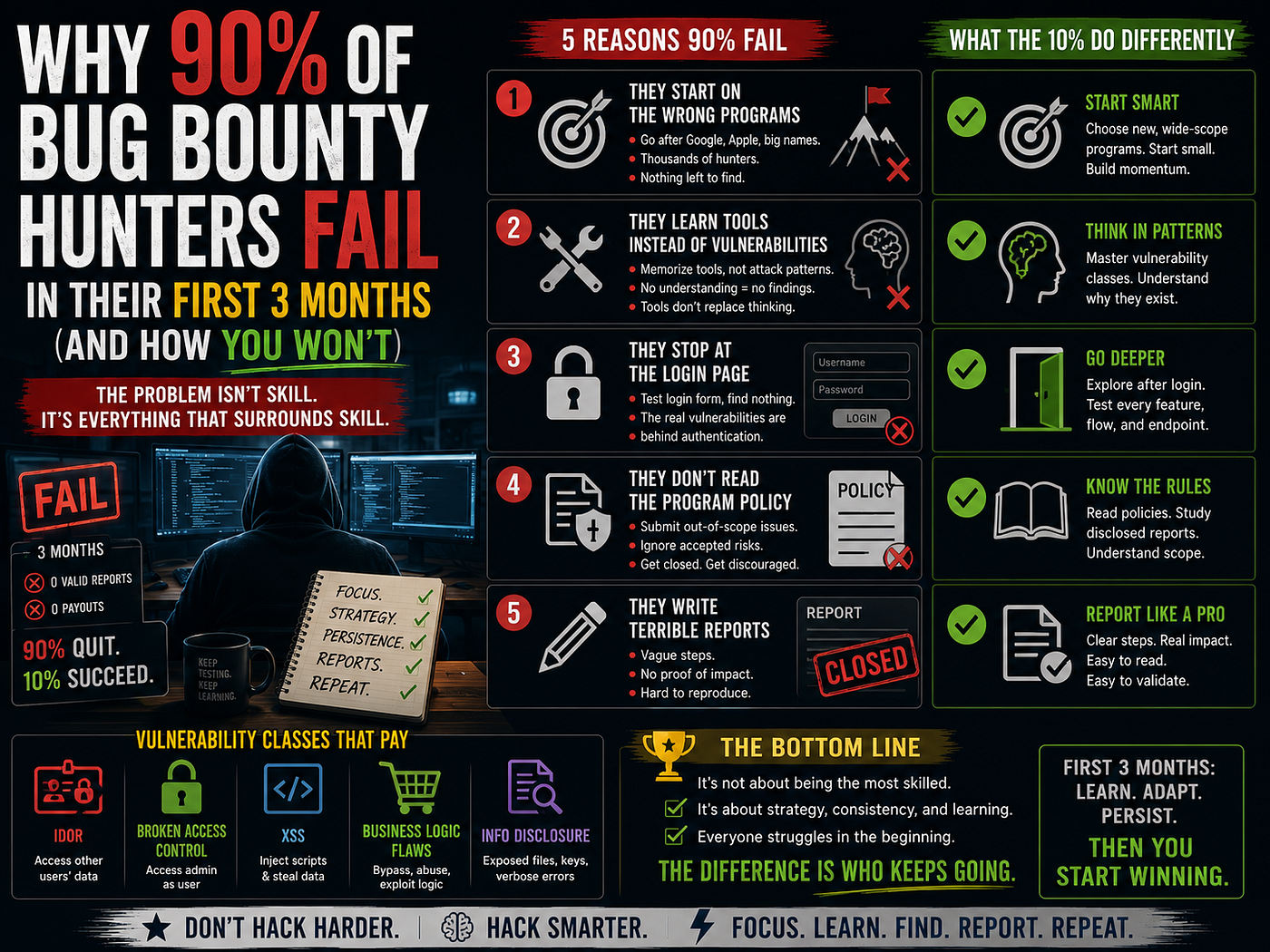
Why 90% of Bug Bounty Hunters Fail at Recon — And the Methodology That Changes Everything
Why 90% of Bug Bounty Hunters Fail at Recon — And the Methodology That Changes Everything
Why 90% of Bug Bounty Hunters Fail at Recon — And the Methodology That Changes Everything
Why 90% of Bug Bounty Hunters Fail at Recon — And the Methodology That Changes Everything

It was 2021. A hunter — let’s call him Marcus — had been staring at a top-ten bug bounty program for three weeks straight. Every endpoint he tested came back clean. Every subdomain he enumerated had been hammered by a hundred hunters before him. He was frustrated, convinced the program was dried up.
Then someone else dropped a critical SSRF on a subdomain Marcus had never seen. The asset? A forgotten staging environment that had been live for eight months. It wasn’t hidden. It wasn’t exotic. It was sitting in a Certificate Transparency log, waiting to be found. Marcus had just never looked there.
That’s not a story about skill. It’s a story about process.
Here’s the uncomfortable truth: most hunters aren’t failing because they don’t know how to exploit vulnerabilities. They’re failing because they never properly mapped what they were supposed to be attacking.
Introduction
Reconnaissance is the foundation of every successful security engagement — whether you’re a bug bounty hunter, a red teamer, or a full-scope pentester. It’s the phase where you define what exists, what’s exposed, and where the cracks are most likely to appear.
Yet it’s also the phase most hunters treat as a checkbox. Run Subfinder, pipe through httpx, open Burp, start clicking. That’s not reconnaissance. That’s optimism.
The data reflects the problem. Program managers from multiple major bug bounty platforms have noted that the majority of duplicate reports come from hunters who never checked whether their target had recently spun up a new subdomain, a forgotten API gateway, or an acquired company’s legacy infrastructure. They’re all hunting the same 15 endpoints because that’s all their tooling surfaces.
This article breaks down exactly why recon fails, what the top 5–10% of hunters actually do differently, and how to build a recon methodology that surfaces assets your competition doesn’t even know exist.
Why Recon Matters More Than Exploitation Skills
Before diving into methodology, let’s establish something counterintuitive: finding a bug is often easier than finding the right place to look for it.
A hunter who knows how to exploit SQL injection but only tests the login page will lose to a hunter who barely knows SQL injection but found the forgotten admin portal running a decade-old PHP application.
Surface area wins. Every additional asset you discover is another lottery ticket. And unlike exploitation, where skill caps your results, asset discovery is largely a function of how systematic and thorough your methodology is.
That asymmetry is why the best hunters invest disproportionately in recon infrastructure — sometimes spending days on recon before sending a single request to a target.
The Core Failure Modes
Let’s be specific about how recon breaks down. There are five common failure patterns.
Failure 1: Passive recon only, or active recon only.
Hunters who rely exclusively on passive sources (certificate logs, Shodan, VirusTotal) miss assets that aren’t indexed anywhere. Hunters who go straight to active brute-forcing miss context that passive sources provide cheaply and quietly. The best methodology combines both, in sequence.
Failure 2: Treating subdomain enumeration as the whole job.
Subdomains are one attack surface layer. Cloud assets, GitHub repositories, mobile app endpoints, third-party integrations, and acquired company infrastructure are others. A hunter who stops at subdomain enumeration has mapped roughly 30% of the actual surface.
Failure 3: No continuous monitoring.
Programs add new assets constantly. A hunter who does recon once and then pivots to exploitation is working with a snapshot that’s already aging out. The hunters who consistently find high-severity bugs on mature programs have monitoring pipelines that alert them when a new subdomain resolves or a new S3 bucket appears.
Failure 4: Poor scope interpretation.
Most programs define scope with wildcard notation like *.target.com. Many hunters take that to mean "enumerate subdomains of target.com." What it actually means is: any subdomain, any acquired domain the company operates, any infrastructure running on their ASN. Scope interpretation is a skill, and most hunters never develop it.
Failure 5: Ignoring the application layer entirely.
Even when hunters find the right assets, they frequently stop at the surface. JavaScript files contain internal API endpoints that never appear in any subdomain scan. Mobile APKs hardcode staging URLs. Swagger documentation exposes entire API schemas. These aren’t exotic techniques — they’re systematic steps most hunters skip.
The Methodology That Actually Works
Here’s how a complete recon engagement looks when done properly.
Phase 1: Organizational Intelligence
Before you touch a single tool, understand who you’re targeting at an organizational level.
Start with the company’s legal entity. Many programs list *.acme.com in scope, but Acme Corp may have acquired three companies in the past five years. Those acquisitions — TechStartup LLC, DevCo Inc., InfraServices Ltd. — have their own infrastructure, their own subdomains, and their own legacy codebases. They are frequently in scope under the wildcard, and they are almost never hammered by other hunters.
Where to look:
- Crunchbase and PitchBook for acquisition history
- LinkedIn for subsidiary and brand names
- SEC EDGAR (for public companies) for entity disclosures
- WHOIS and reverse WHOIS on known domains to find related registrations
- ASN lookups to identify IP ranges the organization owns
Tools: amass intel, whois, bgp.he.net for ASN data, Shodan with org: filters.
Once you have a list of root domains and IP ranges, you have your actual attack surface. Not just the one domain listed in scope.
Phase 2: Passive Subdomain Discovery
Now enumerate against every root domain you’ve identified.
Passive sources aggregate data without ever touching the target. They’re safe, fast, and rich with historical data.
Key sources:
- Certificate Transparency logs via
crt.sh,certspotter.com, or Chaos Project datasets. CT logs capture every TLS certificate ever issued for a domain — including internal staging environments that got a cert and were then forgotten. - DNS data aggregators: SecurityTrails, PassiveTotal, RiskIQ. These maintain historical DNS records and surface subdomains that resolved years ago but may still be active.
- VirusTotal graph for passive DNS lookups.
- Shodan and Censys with domain filters to find IP-hosted assets that share the same organization certificates.
- Google dorking:
site:target.com -wwwsurfaces indexed subdomains and forgotten pages. Addfiletype:pdf,filetype:xlsx, orinurl:adminto narrow.
Do not skip old data. A subdomain that last appeared in DNS records two years ago may have been re-provisioned last month. Historical data is a checklist, not a graveyard.
Phase 3: Active Enumeration
Passive sources give you the known universe. Active enumeration expands it with brute-forcing.
DNS brute-forcing works by resolving a wordlist of subdomain prefixes against the target domain. The quality of your wordlist determines the quality of your results. Generic wordlists like SecLists/Discovery/DNS/subdomains-top1million-110000.txt are a starting point, but top hunters build custom wordlists by:
- Extracting patterns from passive discovery results (if you see
api-v2.target.com, add prefixes likeapi-v3,api-internal,api-staging) - Scraping the company’s job postings and documentation for internal naming conventions
- Mining GitHub repositories for hardcoded subdomain references
Tools: subfinder, amass enum, dnsx for resolution, puredns for large-scale brute-forcing with wildcard filtering.
Wildcard filtering is critical. Many domains have wildcard DNS configured, meaning any subdomain resolves to the same IP. Without filtering these out, your output becomes noise. puredns and dnsx handle this automatically. Know when your tool is doing this and when it isn't.
After DNS resolution, pipe live hosts through httpx to identify which ones are serving HTTP/HTTPS. A subdomain that resolves in DNS but returns nothing over HTTP is lower priority than one actively serving content.
Phase 4: Port and Service Discovery
HTTP and HTTPS are two ports out of 65,535. Organizations frequently run services on non-standard ports — internal APIs, admin panels, database interfaces, IoT management consoles.
For in-scope IP ranges (identified from ASN data), run:
nmapwith service detection on common ports: 21, 22, 23, 25, 80, 443, 3306, 5432, 6379, 8080, 8443, 8888, 9200, 27017- Shodan with
net:filter for broader passive port data without active scanning
What you’re looking for: exposed Redis instances with no authentication, Elasticsearch clusters, Jupyter notebooks, Jenkins dashboards, Kubernetes API servers, internal admin panels. These are the bugs that pay $5,000–$50,000+.
Phase 5: Application-Layer Discovery
You now have a list of live HTTP/HTTPS services. Before you start clicking around, extract the endpoints they expose.
JavaScript analysis is consistently underutilized. Modern single-page applications load their routing logic, API endpoints, and sometimes authentication tokens directly into JavaScript files. Tools like getallurls (gau), waybackurls, and katana extract URLs from web archives, JavaScript files, and crawled responses.
Then run those JavaScript files through LinkFinder or SecretFinder to extract:
- API endpoint paths
- Hardcoded tokens and API keys
- Internal service URLs
- S3 bucket references
- Feature flags referencing internal infrastructure
Mobile applications deserve their own pass. Download the company’s iOS and Android apps, decompile with jadx (Android) or class-dump/frida (iOS), and grep for hardcoded strings:
- API endpoints that don’t appear in any web surface
- Staging environment URLs
- Debug flags and undocumented API versions
GitHub and GitLab intelligence. Search for the company name, their domain, and their internal project naming conventions. Look for leaked credentials, .env files, and developer tooling that exposes internal infrastructure. Tools: gitrob, truffleHog, GitHub's own search with dorking syntax (org:acmecompany "api_key").
Phase 6: Content Discovery
On every live HTTP service you’ve identified, run content discovery to find paths not linked from the application.
Wordlists matter here too. The default raft-medium-directories.txt from SecLists is fine for warm-up, but customize with:
- Technology-specific wordlists (if you identify Spring Boot, include actuator endpoints; if you see a Rails app, include Rails-specific paths)
- Paths extracted from your JavaScript analysis
Tools: feroxbuster, ffuf. Always configure appropriate rate limits — hammering a target with 10,000 requests per second will get you banned and may violate program rules.
Phase 7: Continuous Monitoring
This is what separates hunters who find one bug from hunters who consistently find bugs.
Set up automated pipelines that re-run your passive and active discovery on a schedule (daily or weekly depending on the program’s activity level) and alert you when:
- A new subdomain appears
- A new port opens on a known IP
- A new JavaScript file appears with new endpoints
- A new GitHub repository is published by the organization
Tools: subfinder + notify for new subdomain alerts, github-subdomains for automated GitHub monitoring, custom Python scripts wrapping the above into cron jobs or GitHub Actions pipelines.
The reason this matters: critical vulnerabilities are most often introduced when new infrastructure is deployed. That’s when engineers are moving fast, security reviews haven’t caught up, and default configurations haven’t been hardened. Being the first hunter to see a new asset is worth far more than being the hundredth hunter testing a year-old endpoint.
Real-World Attack Scenario
Scenario: Forgotten Acquisition, Critical SSRF
Attacker Goal: Find a high-severity bug in bigco.com, a mature program with an active hunter community.
Recon Phase 1 (Organizational Intelligence): Crunchbase shows BigCo acquired a startup called “DataPulse” eighteen months ago. DataPulse’s old domain datapulse.io is not listed in the program scope, but BigCo's program states "all assets operated by BigCo, Inc. are in scope." DataPulse is now a subsidiary. In scope.
Recon Phase 2 (Passive Discovery): CT logs for datapulse.io surface api.datapulse.io, dashboard.datapulse.io, and internal.datapulse.io. DNS resolution confirms all three are live. httpx shows all three return HTTP 200.
Recon Phase 3 (Application Layer): internal.datapulse.io serves a JSON API with no visible authentication. JavaScript analysis of dashboard.datapulse.io surfaces an endpoint: /api/v1/fetch?url= — a server-side URL fetch function used for PDF generation.
Exploitation: The url= parameter accepts arbitrary URLs. A test with http://169.254.169.254/latest/meta-data/ (AWS IMDS) returns EC2 instance metadata including the IAM role name. A follow-up request to /latest/meta-data/iam/security-credentials/[role-name] returns temporary AWS credentials.
Impact: Full read access to S3 buckets containing customer PII and internal databases. IAM privileges allow potential lateral movement to RDS and Lambda.
Business Consequences: Regulatory exposure under GDPR and CCPA, breach notification obligations, potential class action liability.
Payout: $25,000 critical bounty.
Root cause: The acquisition’s infrastructure was never brought under BigCo’s security review process. A staging API with no authentication and an SSRF-vulnerable endpoint had been live for eighteen months.
How to Actually Find These Issues
Let’s walk through the exact commands for a basic recon pipeline.
# Step 1: Passive subdomain discovery
subfinder -d target.com -all -o passive_subs.txt
amass enum -passive -d target.com -o amass_passive.txt
cat passive_subs.txt amass_passive.txt | sort -u > all_passive.txt
# Step 2: Active DNS brute-forcing
puredns bruteforce /path/to/wordlist.txt target.com -r /path/to/resolvers.txt -o active_subs.txt
cat all_passive.txt active_subs.txt | sort -u > all_subs.txt# Step 3: Resolve and identify live HTTP services
dnsx -l all_subs.txt -o resolved.txt
httpx -l resolved.txt -o live_hosts.txt -title -status-code -tech-detect# Step 4: Extract URLs from web archives and JavaScript
cat live_hosts.txt | gau --threads 5 | tee gau_urls.txt
katana -list live_hosts.txt -jc -o katana_urls.txt# Step 5: Run through nuclei for quick wins
nuclei -l live_hosts.txt -t /path/to/nuclei-templates/ -severity high,critical# Step 6: Content discovery on interesting hosts
ffuf -u https://TARGET/FUZZ -w /path/to/wordlist.txt -mc 200,301,302,403This is a skeleton. Real pipelines add filtering, deduplication, notification hooks, and custom logic for specific technologies.
Detection & Monitoring From the Defender Side
If you’re on the blue team, understanding how attackers do recon helps you detect it.
Certificate Transparency logs are public and immutable — there’s nothing to detect there. But active DNS brute-forcing produces distinctive patterns: high-volume NXDOMAIN responses from a single source IP in a short window. Configure your DNS logging to capture NXDOMAIN rates and alert on anomalies.
For content discovery, WAF logs showing sequential 404s with incrementing path patterns are a clear signal. Correlate source IPs and user agents to identify enumeration behavior.
GitHub leaks are harder to detect after the fact. Configure automated scanning of your organization’s public repositories using tools like git-secrets in pre-commit hooks and periodic scanning with truffleHog or gitleaks.
For subdomain takeover prevention, audit DNS records quarterly for dangling CNAMEs pointing to deprovisioned cloud services. Subdomain takeover remains one of the most prevalent and underappreciated issues in mature programs.
Advanced Insights
A few observations that rarely surface in beginner writeups:
ASN-based discovery outperforms DNS in old infrastructure. Organizations that have operated for more than a decade often have large IP ranges allocated under their ASN that contain services with no DNS records at all. Reverse-PTR lookups and Shodan scanning against IP ranges surfaces these. They’re frequently legacy systems that predate modern security practices.
HTTP/2 and HTTP/3 service fingerprinting reveals internal tooling. Servers using HTTP/2 often expose ALPN negotiation details and header order patterns that identify specific reverse proxy configurations. This helps you infer internal topology — is Nginx fronting a Tomcat server? Is there a load balancer with a health check endpoint? That topology knowledge guides where to look next.
SaaS integrations are overlooked attack surface. Many organizations integrate Salesforce, Zendesk, Workday, or Slack with their primary infrastructure using OAuth and API keys. Hunting in JavaScript bundles for salesforce.com, zendesk.com, or third-party API key patterns frequently surfaces credentials with meaningful API access.
Parameter discovery on API endpoints is chronically undertested. When you find an API endpoint that accepts parameters, run a parameter fuzzer (arjun, x8) against it. APIs frequently have undocumented parameters that expose debug modes, admin functionality, or internal data.
Future Trends
Several developments will reshape recon methodology over the next two to three years.
AI-assisted recon correlation. LLMs are becoming useful for analyzing large datasets of discovered assets and suggesting relationships — correlating a GitHub username found in a leaked commit with a developer’s side project domain that shares infrastructure with the main target. This kind of multi-source correlation is currently manual and slow; AI tooling will accelerate it significantly.
Increased cloud-native attack surface. As organizations move further into serverless and container-native architectures, traditional subdomain discovery becomes less relevant. Lambda function URLs, Cloud Run endpoints, and Azure Container App URLs follow naming conventions that require different discovery approaches. Hunters who adapt to cloud-native recon will find opportunities others miss.
Continuous Attack Surface Management (CASM) proliferating. More organizations are deploying CASM tools that automatically discover and monitor their own attack surface. This raises the floor — organizations will have fewer obviously forgotten assets — but it also creates a new category of target: the CASM tool itself, which often has broad permissions and API access to the organization’s infrastructure.
Certificate Transparency at scale. Projects like Facebook’s CT monitoring and Cloudflare’s CT architecture are making real-time CT monitoring more accessible. As hunters increasingly use CT feeds for continuous monitoring, the advantage shifts toward those who can most effectively filter signal from noise.
Key Takeaways
- Recon is not a tool. It’s a methodology. Running Subfinder and calling it done is why 90% of hunters miss what’s there.
- Organizational intelligence before technical enumeration. Know who you’re hunting before you scan anything.
- Subdomain enumeration is one layer of a multi-layer discovery process that includes cloud assets, mobile applications, GitHub intelligence, and acquired company infrastructure.
- Continuous monitoring beats one-time recon. The highest-value bugs live on new assets.
- Application-layer discovery — especially JavaScript analysis and mobile app decompilation — surfaces endpoints that no passive or active DNS scan will ever find.
- Passive and active methods complement each other. Neither alone is sufficient.
- Wildcard DNS filtering, wordlist quality, and output deduplication are operational hygiene that directly impacts result quality.
- Defenders can use these same techniques for their own continuous attack surface management.
FAQ Section
1. What is the most important step in bug bounty recon? The most overlooked step is organizational intelligence — understanding the full corporate entity, acquisition history, and subsidiary domains before running any tools. Hunters who skip this miss entire segments of in-scope infrastructure that competitors never touch.
2. What recon tools do professional bug bounty hunters use? The core stack most professionals use includes: subfinder and amass for passive discovery, puredns for active brute-forcing, dnsx and httpx for resolution and HTTP probing, katana and gau for URL extraction, nuclei for vulnerability scanning, ffuf or feroxbuster for content discovery, and truffleHog or gitleaks for credential scanning.
3. How do you find subdomains that other hunters miss? By combining passive CT log analysis (including historical data from SecurityTrails and PassiveTotal), active DNS brute-forcing with custom wordlists derived from the target’s naming conventions, ASN-based IP range scanning, and GitHub mining for hardcoded subdomain references in the organization’s code.
4. What is subdomain takeover and why does it matter in recon? Subdomain takeover occurs when a DNS record points to an external service (GitHub Pages, Heroku, AWS S3, etc.) that has since been deprovisioned. An attacker can claim the external resource and serve content under the legitimate subdomain. During recon, identify CNAMEs pointing to cloud services and verify whether those resources are still claimed by the organization.
5. How do you do recon on an acquired company that isn’t explicitly listed in scope? Read the program scope statement carefully. Most programs include language like “all assets operated by [Company]” rather than just listing specific domains. Cross-reference the company’s acquisition history via Crunchbase, PitchBook, or SEC filings. If an acquired company’s infrastructure is operated by the parent entity, it’s typically in scope — and worth clarifying with the program owner before submitting.
6. Is JavaScript analysis actually useful for bug bounty? Yes — consistently. Modern web applications load routing logic and API endpoint definitions into client-side JavaScript. Tools like LinkFinder and SecretFinder extract these mechanically. Hardcoded API keys, internal endpoint paths, and staging environment URLs in JavaScript files have resulted in critical-severity findings on major programs.
7. How often should you re-run recon on a target? For active programs with regular development cycles, weekly passive re-runs and daily monitoring for new subdomains is reasonable. Critical moments to re-check include right after major product announcements, mergers, or acquisitions, when new infrastructure is most likely to appear.
8. What’s the difference between passive and active recon, and when should you use each? Passive recon queries third-party data sources without sending traffic to the target — CT logs, Shodan, DNS history. It’s quiet and appropriate when you want to avoid triggering monitoring or alerting. Active recon sends requests directly to the target — DNS brute-forcing, port scanning, content discovery. It’s louder but surfaces assets passive methods miss. Use passive first to build context, then active to fill gaps.
9. Can you do recon without getting banned from a bug bounty program? Yes, with care. Respect rate limits, avoid destructive testing, and stay within scope. Active scanning should be done at reasonable request rates. If a program has specific rules about scanning tools or rate limits, follow them. Using a VPS with a dedicated IP helps isolate your testing traffic and avoids collateral impact on shared infrastructure.
10. What are the biggest mistakes junior bug bounty hunters make in recon? The three most common are: treating subdomain enumeration as complete recon (it’s one layer), using default wordlists without customization for the target’s conventions, and failing to monitor for new assets after the initial discovery phase. A fourth common mistake is ignoring non-HTTP services — exposed databases, Redis instances, and admin panels often run on non-standard ports and are trivially accessible.
11. How does GitHub recon work in practice? Search GitHub for the company’s name, domain, and any known internal project names. Use search operators: org:companyname "api_key", "target.com" "password", "internal.target.com". Tools like truffleHog and gitrob automate credential pattern matching across an organization's repositories. Look for leaked .env files, configuration scripts, and deployment workflows that expose internal infrastructure.
12. What is the relationship between recon quality and bug severity? There’s a strong correlation. The most commonly reported bugs — XSS on main application forms, basic IDOR on well-known endpoints — are found by hunters with minimal recon because those surfaces are obvious. High-severity bugs (SSRF, RCE, auth bypass on internal systems) are almost always found on assets that required thorough recon to discover. Better recon doesn’t just find more bugs; it shifts the severity distribution upward.
Suggested Featured Image Concept
A dark terminal window showing cascading subdomain enumeration output, with a branching network graph overlaid on the right side connecting root domains to subdomains to IP ranges. A single node in the graph is highlighted in red, labeled “CRITICAL ASSET — UNMONITORED.” The color palette is deep black with green terminal text and red/amber highlights. No logos or recognizable brand marks. Clean, technical, visually communicates the idea of a complex attack surface with one overlooked node.
LinkedIn Post Summary
Most bug bounty hunters run Subfinder, pipe the output into httpx, and call it recon. Then they wonder why they only find duplicates.
The hunters who consistently find critical bugs approach recon as an intelligence operation, not a scanning task.
They map corporate acquisitions before they touch a tool. They combine passive CT log analysis with active DNS brute-forcing. They extract API endpoints from JavaScript files. They decompile mobile apps. They monitor continuously — because the best bugs are on assets that were deployed last week, not assets that have been tested for two years.
I wrote a breakdown of the exact methodology that separates the top 10% of hunters from everyone else — covering all seven phases of a complete recon engagement, with the specific tools and commands used at each step.
If you’re hitting a wall on mature programs, your recon is the problem.
Twitter / X Thread Summary
🧵 Why 90% of bug bounty hunters fail at recon — and how to fix it (thread)
1/ Most hunters’ recon process: run Subfinder, open Burp, start clicking. That’s not recon. That’s hoping.
2/ The real failure modes:
- Passive-only OR active-only recon (you need both)
- Stopping at subdomains (that’s 30% of the attack surface)
- One-time recon with no monitoring
- Ignoring acquired company infrastructure
- Never touching JavaScript files or mobile apps
3/ The actual methodology has 7 phases. It starts before you touch a single tool — with organizational intelligence. Acquisitions, subsidiaries, ASN ranges. Most hunters skip this entirely.
4/ Passive discovery: CT logs, SecurityTrails, PassiveTotal, Shodan. Historical data surfaces subdomains that resolved years ago and may have been re-provisioned last month.
5/ Active enumeration: DNS brute-forcing with CUSTOM wordlists built from the target’s naming conventions. Default wordlists find what everyone else finds.
6/ Application layer: JavaScript analysis with LinkFinder, mobile app decompilation with jadx, GitHub recon with truffleHog. This is where the high-severity bugs live.
7/ Continuous monitoring. New assets = first-mover advantage = high-severity findings before anyone else sees them. Set up automated pipelines with alerting.
8/ The hunters who consistently find criticals on mature programs aren’t better at exploitation. They’re better at finding the right place to look.
메타데이터
- post_id
- 4ccfbe0473a4
- slug
- why-90-of-bug-bounty-hunters-fail-at-recon-and-the-methodology-that-changes-everything-4ccfbe0473a4
- url
- https://medium.com/@anand114bug/why-90-of-bug-bounty-hunters-fail-at-recon-and-the-methodology-that-changes-everything-4ccfbe0473a4
- canonical_url
- https://medium.com/@anand114bug/why-90-of-bug-bounty-hunters-fail-at-recon-and-the-methodology-that-changes-everything-4ccfbe0473a4
- author_url
- https://medium.com/@anand114bug
- status
- ok
- fetched_at
- 2026-06-11 12:34:08