I Did These 7 Things For 30 Days And My Brain Has Never Worked Better.
The Day I Realized I’d Been Doing “Smart” All Wrong
I Did These 7 Things For 30 Days And My Brain Has Never Worked Better.
The Day I Realized I’d Been Doing “Smart” All Wrong
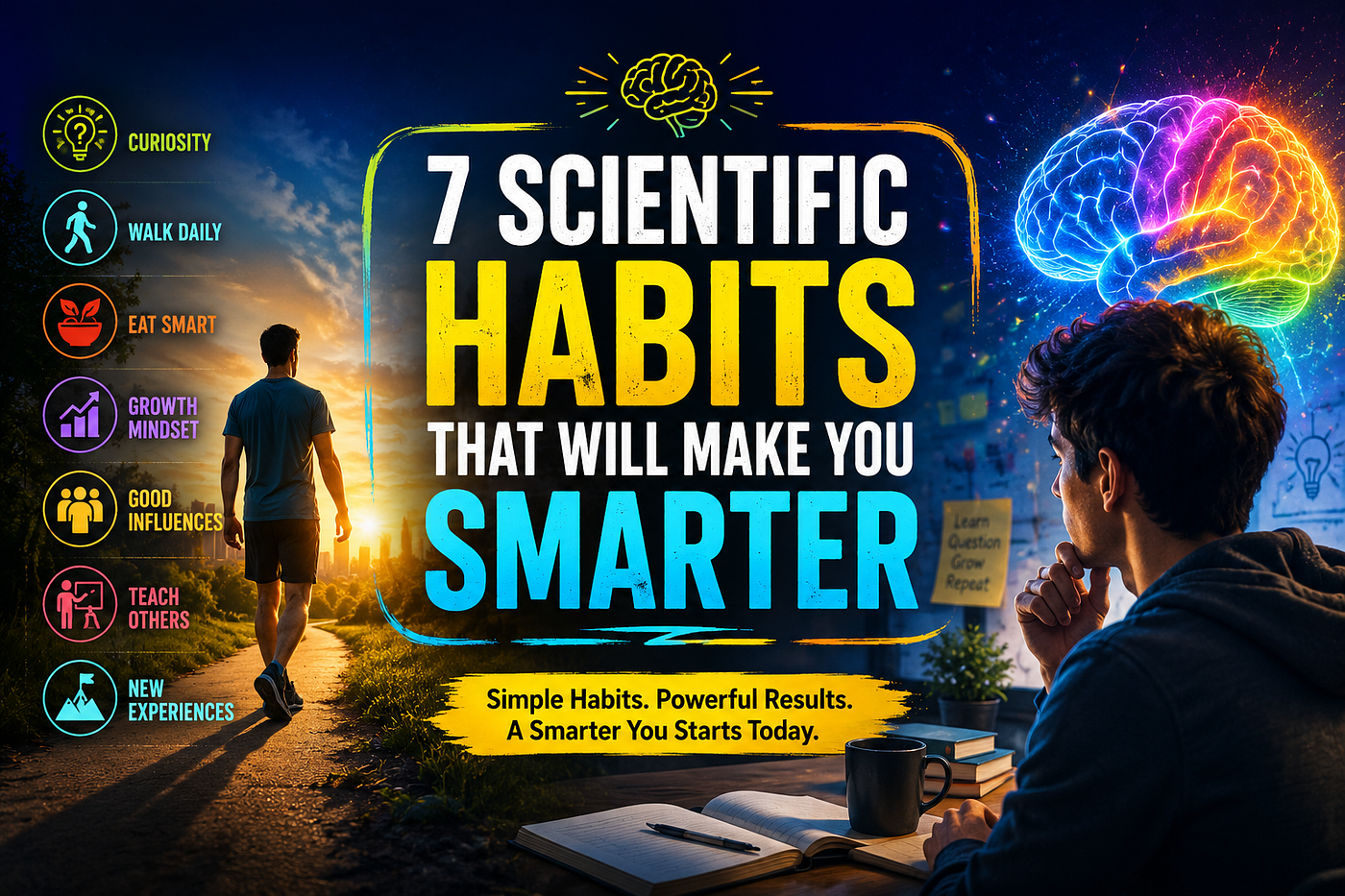
Most people will read this, nod along, and do absolutely nothing.
And a year from now, they’ll be in exactly the same place — foggy, frustrated, and wondering why some people just seem to get sharper with age while they don’t.
But a small handful will read this and actually do something.
Those people are about to discover that getting smarter has nothing to do with IQ, expensive courses, or being born lucky.
It has everything to do with seven surprisingly simple habits that science has quietly proven — and most people are completely ignoring.
This is for that small handful.
***Not a yet a member? View the entire article for free Click here.***
There’s a guy I know — let’s call him Dave.
Dave never finished college. Didn’t have a fancy degree hanging on his wall. Couldn’t tell you the difference between a balance sheet and a bedsheet.
But Dave was the sharpest person in every room he walked into.
I used to wonder why. Then one day I watched him fix a broken engine with nothing but a YouTube video and sheer stubbornness — and it clicked.
Dave wasn’t smarter because of what he knew. He was smarter because of what he did.
The Curiosity Trap Nobody Talks About
Most of us move through life nodding.
Someone explains something, we say “got it” — and move on. Dave never did that. Dave pulled the thread.
Every. Single. Time.
Turns out, that annoying habit of his isn’t just a personality quirk. Researchers at UC Berkeley found that curiosity physically changes how your brain stores information. It activates the hippocampus, floods your system with dopamine, and essentially switches your brain into a high-absorption state.
You don’t just learn more when you’re curious. Your brain actually encodes it deeper.
The fix is embarrassingly simple. Next time someone explains something — anything — ask one more question. Why does that work? How did that start? What happens if you do the opposite?
That’s it. That’s the whole habit. Compounded daily over years, it’s one of the most powerful cognitive advantages a person can build.
The Cheapest Brain Upgrade on the Planet
Here’s something that’ll make your gym membership feel like a scam.
A 10-minute walk outside does more for your brain than most people’s entire morning routine.
Walking triggers the release of BDNF — a protein neuroscientists literally call fertiliser for the brain. It grows new neurons. Strengthens memory. Protects against cognitive decline.
One long-term study found that people walking 7,500 steps a day delayed cognitive decline by seven years.
Seven years.
Meanwhile, we’ve built an entire civilization around sitting at desks for eight hours and calling it productivity. Science has a word for that lifestyle. It’s not a flattering one.
You don’t need a plan. You don’t need gear. You just need to go outside and move.
You Are What You Eat (Your Brain Especially)
Your brain is 2% of your body weight. It burns 20% of your calories.
It runs constantly — every breath, every thought, every decision you make today.
And most people are fuelling that engine with processed garbage — then wondering why they feel like they’re thinking through wet concrete by 3pm.
There’s actual biology behind that afternoon fog. Processed sugar spikes your blood glucose, then crashes it — cutting off the stable energy your prefrontal cortex needs to think clearly.
Think of it this way. You wouldn’t fill a high-performance engine with watered-down fuel. Your brain deserves at least the same consideration as your car.
Omega-3s, leafy greens, whole grains, healthy fats. Not a diet. Just fuel worth running on.
The Belief That Changes Everything
In the 1980s, Carol Dweck sat down with a group of school kids and discovered something that turned psychology on its head.
The biggest predictor of long-term success wasn’t IQ. Wasn’t resources. Wasn’t even how hard they studied.
It was what they believed about themselves.
Kids who thought intelligence was fixed — inherited, unchangeable — crumbled when things got hard. Failure felt like proof they’d hit their ceiling.
Kids who believed ability could be built through effort? They treated failure like a rough draft. Something to learn from and improve.
One belief system closes doors. The other keeps them open.
The neurological reason is almost poetic — believing growth is possible keeps you in the learning loop. You try, struggle, extract the lesson, adjust, go again. That cycle, repeated consistently, is how intelligence actually develops.
Not motivation. Not talent. Just the loop.
The People Around You Are Rewriting Your Brain
Think about the last person who genuinely challenged you.
Not the friend who agreed with every half-baked idea. Not the colleague who nodded along to avoid conflict.
The person who looked you dead in the eye and said: “That’s wrong. Here’s why. You can do better.”
Psychologist Robert Rosenthal proved something remarkable — that teacher expectations alone produced measurable IQ gains in students. Nobody changed the curriculum. Nobody gave extra lessons. Just belief.
When someone whose judgment you respect genuinely believes in your potential, your brain responds. It increases effort. It expands risk tolerance. It sustains persistence through difficulty.
Your inner circle isn’t just influencing your mood. It’s actively shaping your intelligence.
Choose accordingly.
The Fastest Way to Find Out What You Don’t Know
Want a humbling experience?
Try explaining something you think you understand to someone who knows absolutely nothing about it.
You’ll find the gaps in your knowledge faster than any test ever could.
Scientists call this the Protégé Effect. When you prepare to teach something, your brain is forced to organise information into a structure that actually makes sense — not just to you, but to someone starting from zero.
Every stumble in your explanation is a signpost. Here. This is where your understanding breaks down.
The best teachers in the world aren’t admired because they know the most. They’re admired because they can take something complex and make it blindingly clear to a complete beginner.
Find something you’ve recently learned. Explain it to someone. Notice where you stumble. Go back and fill those gaps.
That’s not just teaching. That’s how you get genuinely smarter.
Get Uncomfortable. On Purpose.
The brain loves the familiar.
Same routes. Same people. Same assumptions about how the world works. Familiarity is efficient — the brain rewards it with comfort.
But comfort has a cost. It caps your growth.
Novel experiences — new places, unfamiliar ideas, perspectives that challenge your defaults — trigger a neurological response that accelerates neuroplasticity and builds what scientists call cognitive reserve.
Think of cognitive reserve as your brain’s long-term insurance policy against decline. It’s built through a lifetime of varied, challenging mental engagement.
Neuroscientist David Eagleman said it plainly: Narrow inputs produce a narrow mind.
You don’t need to book a flight to Bali. A new book genre. A conversation with someone whose worldview differs from yours. A route you’ve never walked before.
Small doses of unfamiliar, taken consistently, compound into a fundamentally sharper mind.
So Here’s the Thing About Dave
Dave never set out to be the smartest person in the room.
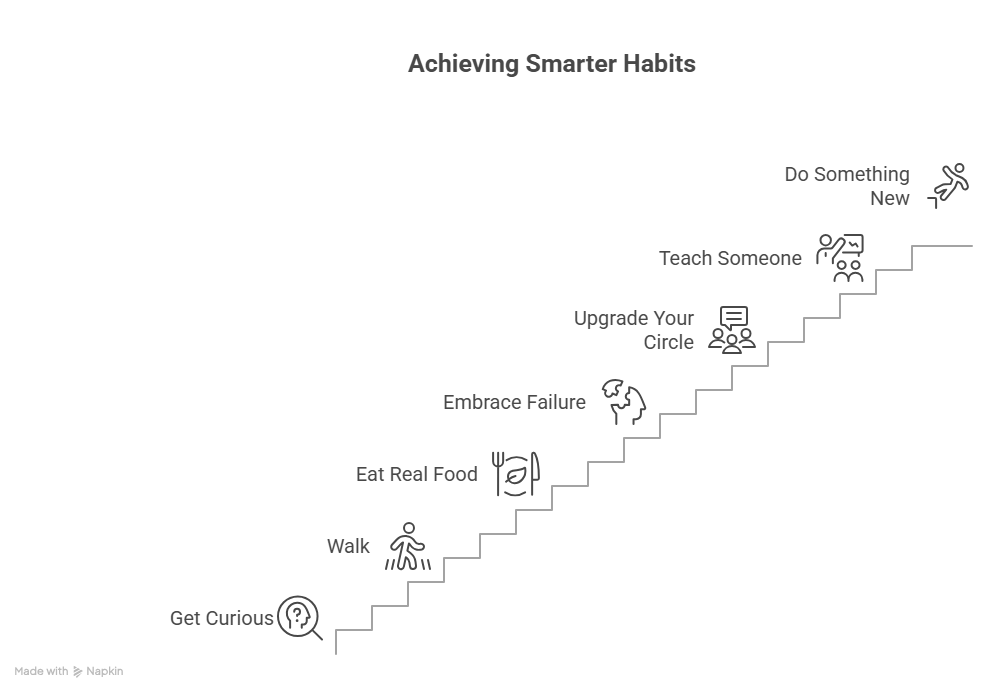
He just stayed curious. He walked everywhere. He ate real food. He surrounded himself with people who pushed him. He taught everything he learned to anyone who’d listen. And he never, ever stopped doing things that made him uncomfortable.
None of it was complicated. None of it cost much.
But compounded over years?
It made all the difference.
FAQs
Can curiosity actually be learned, or is it just a personality thing? It’s a habit, not a trait. Every time you deliberately ask why or how, you’re training your brain to be more curious. Like any habit, it builds with repetition.
How fast will changing my diet affect my thinking? Most people notice sharper focus and less brain fog within one to two weeks of cutting processed sugar and adding real nutrients. The longer-term protection against cognitive decline builds over months and years.
What if nobody in my life challenges me? Start with books, podcasts, and communities built around honest feedback and high standards. Mentors don’t have to be people you know personally — they just have to raise the bar.
Do I really need to teach others, or can I just study more? Teaching beats studying almost every time. It forces your brain to organise and reconstruct knowledge rather than just passively absorb it. The gaps you find while teaching become your clearest roadmap for what to learn next.
Does a “novel experience” have to be something dramatic? Not even close. A different podcast. A conversation with someone outside your usual circle. A book you’d normally never pick up. The brain responds to any input that breaks its familiar patterns — small and consistent beats big and occasional every time.
You might also find this helpful: Why The Smartest Person In The Room Is Usually The Broke One.
메타데이터
- post_id
- 4cd3b482716d
- slug
- i-did-these-7-things-for-30-days-and-my-brain-has-never-worked-better-4cd3b482716d
- url
- https://medium.com/@ameritor/i-did-these-7-things-for-30-days-and-my-brain-has-never-worked-better-4cd3b482716d
- canonical_url
- https://medium.com/@ameritor/i-did-these-7-things-for-30-days-and-my-brain-has-never-worked-better-4cd3b482716d
- author_url
- https://medium.com/@ameritor
- status
- ok
- fetched_at
- 2026-07-09 13:13:48