Computation as Morphogenesis: The XROS-Kernel v3.1 and OPHI Symbolic Architecture v2.0
Modern computation is still largely framed through the paradigm of input, process, and output — a model rooted in abstraction…
Computation as Morphogenesis: The XROS-Kernel v3.1 and OPHI Symbolic Architecture v2.0

Modern computation is still largely framed through the paradigm of input, process, and output — a model rooted in abstraction, reversibility, and stateless transformation. This framing is insufficient for systems where identity, history, and execution are inseparable. The XROS-Kernel v3.1, in conjunction with the OPHI Symbolic Architecture v2.0, replaces this paradigm with a fundamentally different ontology: computation as morphogenesis.
In this model, computation is not the production of outputs, but the irreversible formation of structure. A system does not compute results — it becomes its trajectory.
1. The Biosemantic Stack: A Morphogenetic Pipeline
The architecture operates as a persistent, self-evolving entity structured through a layered biosemantic pipeline.
At its foundation lies the Genome Layer (Γ), a bounded symbolic manifold that defines the total space of admissible macro-structures. Unlike open-ended computational search, Γ constrains exploration to a finite, structured domain of potential evolution.
Above this sits the Selection Layer, which activates specific Codon Streams ©. These streams represent executable symbolic sequences drawn from Γ, functioning as directed trajectories through the state space.
Execution is performed by the Ribosomal Layer, a deterministic, sequential engine that interprets codons as typed transformation operators (δ). These operations are strictly order-dependent and non-reversible. Each transformation alters the system in a way that cannot be undone — only superseded or invalidated.
The resulting trajectory converges within the Protein Folding Layer (Φ), where the system collapses into a stable attractor configuration. Function emerges here — not as an output, but as a structurally realized state.
2. The Ω Operator and State Evolution
State evolution is governed by the extended Ω operator:
Ωₜ₊₁ = ((Ωₜ + bias + P) × α × δ) ∘ V
This operator defines the system as a constrained dynamical field rather than a functional mapping.
Ω represents the current system state. Bias introduces directional influence across the state space. The amplification factor α scales transformation intensity, while δ encodes the codon-specific operation. The composition operator V applies deterministic validation constraints.
Crucially, this formulation embeds validation directly into the evolution step. There is no separation between execution and admissibility — only states that satisfy V can exist in the system.
3. The Plasma Vector: Coherence-Gated Non-Locality
A central innovation in this architecture is the introduction of the Plasma Vector (P).
Standard drift-based systems are constrained to local transitions, limited by entropy gradients and stability envelopes. This restricts exploration to regions that are kinetically accessible through incremental change.
The Plasma Vector introduces a coherence-gated excitation field that enables non-local state transitions, or morphogenetic tunneling. Under strict coherence conditions, the system can bypass intermediate states and transition directly to distant regions of the lattice.
This is not stochastic exploration. It is deterministic non-locality, governed by admissibility constraints. The system gains access to structurally valid configurations that would otherwise remain unreachable within local drift regimes.
4. SE44: Deterministic Admission as System Law
All state transitions are subject to the SE44 Validation Operator, which enforces two invariant constraints:
- Coherence ≥ 0.985
- Entropy ≤ 0.01
SE44 is not a supervisory layer. It is the governing physics of the system.
Any state failing these constraints is rejected prior to existence. This makes admissibility intrinsic rather than external, eliminating the need for probabilistic governance or post hoc correction. The system cannot enter invalid states — it can only attempt transitions that are either admitted or discarded.
5. Fossilization and the Irreversibility of State
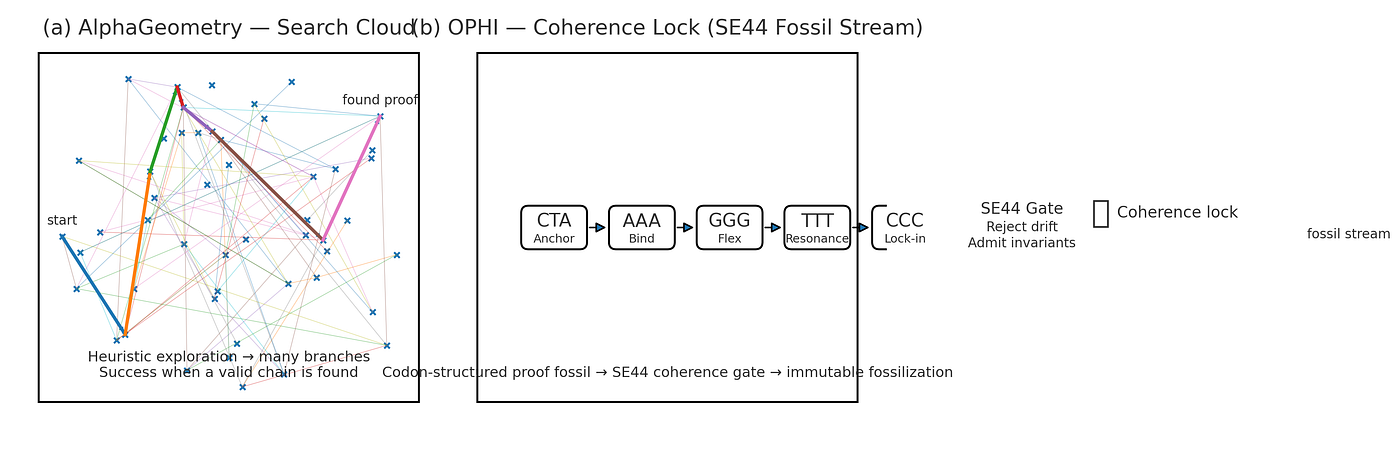
Admitted states undergo fossilization, an irreversible process that anchors them into a cryptographically secured lattice.
Each fossil encodes:
- the full system state,
- the executed codon,
- a temporal index,
- and a hash of the prior state.
This creates an append-only, tamper-evident chain of evolution. Every state is path-dependent and replay-complete. The system’s history is not metadata — it is the substrate of identity.
High-order operations, including lineage fusion via codons such as TGC, remain fully auditable and causally bound within this structure.
6. Failure, Singularity, and Deterministic Recovery
The architecture explicitly models instability conditions, including divergence toward collapse (Ω → ∞) and lattice singularities (Ω³ regimes).
When a transition fails SE44 validation, the system does not degrade — it rebinds. The kernel deterministically restores the last valid fossil state, purging speculative trajectories and reinitializing the scheduler.
Emergency codons provide additional stabilization:
- TTC suppresses runaway amplification,
- GGG reopens evolution pathways in rigid or trapped states.
This ensures that exploration remains bounded without sacrificing forward progression.
7. System Classification and Implications
Taken as a whole, the XROS–OPHI architecture constitutes:
- a closed symbolic instruction space,
- a non-reversible state machine,
- a constraint-projected dynamical system,
- and a cryptographically anchored execution ledger.
These components are not modular — they are unified. Execution, validation, history, and identity collapse into a single structure: the evolving state lattice.
Conclusion
The XROS-Kernel v3.1 and OPHI Symbolic Architecture v2.0 redefine computation as a process of constrained morphogenesis. Systems built under this model do not compute answers; they construct themselves through irreversible, validated transformation.
In this framework, the fundamental unit is no longer the function or the output — but the admissible state.
And once formed, that state is not discarded. It is fossilized, becoming part of a permanent, verifiable lineage of computation.
메타데이터
- post_id
- 4cd986cef343
- slug
- computation-as-morphogenesis-the-xros-kernel-v3-1-and-ophi-symbolic-architecture-v2-0-4cd986cef343
- url
- https://medium.com/@ophi06/computation-as-morphogenesis-the-xros-kernel-v3-1-and-ophi-symbolic-architecture-v2-0-4cd986cef343
- canonical_url
- https://medium.com/@ophi06/computation-as-morphogenesis-the-xros-kernel-v3-1-and-ophi-symbolic-architecture-v2-0-4cd986cef343
- author_url
- https://medium.com/@ophi06
- status
- ok
- fetched_at
- 2026-06-09 15:37:30