Reflections from W3C’s annual conference — Kobe, Japan (2025)
A few months ago — though it still feels like yesterday — our Web Standards group at SRUK attended the W3C TPAC conference. Standing on the…
Reflections from W3C’s annual conference — Kobe, Japan (2025)
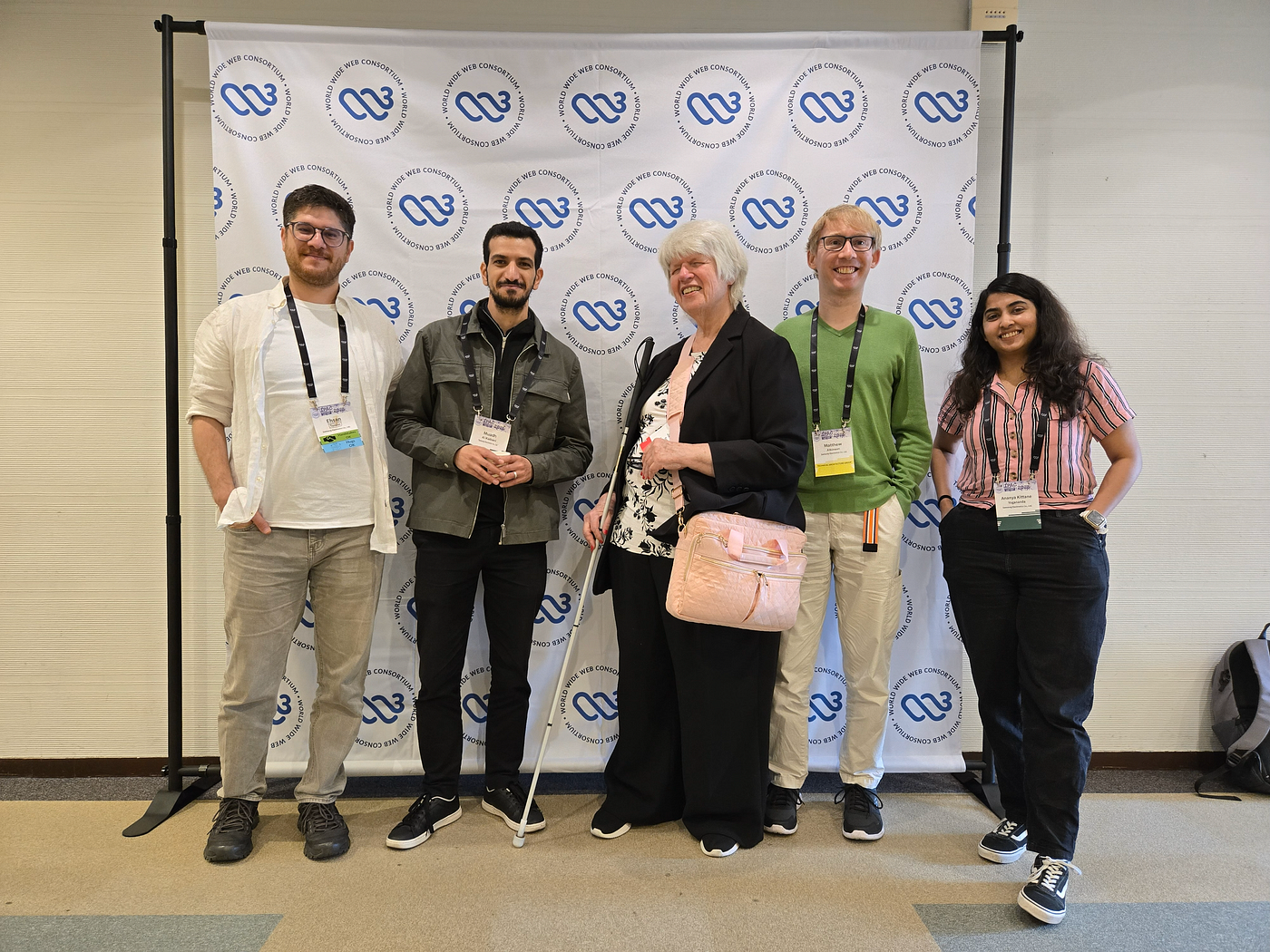
SRUK’s Web Standards Team (with honourary member Janina, Matthew’s co-chair)— in all its glory
A few months ago — though it still feels like yesterday — our Web Standards group at SRUK attended the W3C TPAC conference. Standing on the shoulders of giants — the previous incarnations of our team — this was the first time that many of us had attended the W3C’s annual conference. As such, this post captures our experiences and learnings from TPAC 2025 (Kobe, Japan), and also presents the perfect opportunity to officially introduce ourselves to all the great developer communities out there:
- Matthew Atkinson: Web Standards Group lead at SRUK.
- Muadh Al Kalbani: Web Standards Technologist (XR).
- Ehsan Toreini: Web Standards Technologist (Privacy).
- Ananya Kittane Yogananda: Web Standards Technologist (DX/UX).
We had heard people describe TPAC as ‘the most intense week of the year’ for anyone working on the Web platform. After attending our first TPAC this year in Kobe, Japan, we can confirm — it absolutely lived up to that description! We would see it as part conference, part meeting marathon, part reunion (for a few people) — and also a space where ideas crystallize at remarkable speed.
What is “TPAC” anyway?
The W3C (World Wide Web Consortium) is the convening body that brings together browser vendors, standards bodies, and the broader web community to collaborate and develop the specifications for the web features that web browsers implement today.
TPAC (Technical Plenary & Advisory Committee) is the W3C’s annual gathering where working groups (WG), community groups (CG), interest groups (IG) meet in person to coordinate, discuss specs, resolve issues, and plan for the future of the web. Throughout the year, these groups meet over regular teleconference calls to review specs, resolve issues, and coordinate work. But when TPAC happens, the groups come together in one physical location for face-to-face meetings. This really helps groups reach consensus, make key decisions faster, and collaborate more deeply with other groups.
To us, this first TPAC was largely about meeting people, going around and introducing ourselves to as many folks as we could, and making connections. It felt amazing to be under the same roof as hundred other smart people who make the web what it is today. It was a fantastic opportunity to meet people personally, ease into conversations, and many of those connections have already blossomed into friendships.
Location
TPAC 2025 was hosted at the Kobe International Conference Center in Japan. It’s a modern, beautifully designed venue with views of the Port Island waterfront — large enough to hold dozens of simultaneous meetings, but compact enough that you constantly bump into people in hallways, cafeterias. Those hallway conversations are often as valuable and meaningful as formal conversations.

Kobe International Conference Centre

Kobe port waterfront view
For some of us, being vegetarian — food turned out to be more of an adventure than we’d expected and planning this repeatedly, across language barriers required patience. Finding “Veggie Street” and enjoying a warm bowl of vegan ramen was a highlight, and a reminder that persistence often pays off deliciously.

Veggie Street, Kobe

Vegan ramen menu board
How do W3C meetings typically work?
We were so impressed with how equipped all the meetings were. The tools, processes in place and everything felt like a smooth stream of water.
- Groups meet in structured sessions with chair/s driving the agenda.
- An IRC channel runs in parallel for queue management with a set of commands for participants to signal their presence (present+), get added/removed (q+/q-) into the question queue and so on — for quick logging, comments, taking down minutes.
- A scribe takes notes in real time, capturing what each person said, decisions, resolutions etc.
- There is a bot ‘Zakim’ (and NO, Zakim is not a person) that helps manage the speaker queue, generation of minutes.
- Some groups also use shared Google Docs for collaborative minute-taking.
Overall, it felt like a super structured way to run meetings.
Highlights
The meetings
One of the best parts of TPAC is the sheer amount of great and valuable conversations one can have in every corner of the conference. Whether you’re in a meeting, a breakout session, a coffee break or having lunch, you were almost guaranteed a great conversation with other attendees. This is a great testament to the great work that happens across different groups within W3C — from browser engineers, spec editors, designers and fellow first time TPAC attendees, practically everyone is working on something interesting and great for the Web.
The meetings provided great opportunities to learn more about the latest updates across different facets of the Web Platform, some of the highlights include (but definitely not limited to): WCAG updates on Web Accessibility, new features in the WebRTC spec, more optimised formats for delivering media over the web, potential new pointer events to cater for more devices, new features in the Web Audio and Web speech specs and many, many, others. The meetings that particularly piqued our interest however, were those that introduced emerging and bold ideas that aim to lay solid foundations to ensure a bright and responsible future for the Web Platform. Global and societal topics such as sustainability, AI, monetization, privacy, smart cities, digital identities and many more were actively being discussed and tackled in TPAC, to ensure that W3C is not only working to make the Web a great place today, but also advancing the Web Platform to be great for many future generations to come. To be part of these conversations and contribute to them felt surreal, as we collectively — across different organisations, bodies and interests — work in tandem as one to push the Web Platform forward.
The breakouts
Breakouts are where most of the incubations and futuristic proposals get a chance to showcase their ideas for the future of the platform. Breakout sessions during TPAC are specialized meetings that focus on specific (usually novel and out-of-box) topics within the W3C ecosystem. These sessions provide a platform for experts, developers, and stakeholders to collaborate, share insights, and address challenges related to web technologies. They often cover a wide range of subjects, including web accessibility, privacy, security, and emerging technologies like Agentic AI and Web Monetization.
During these breakout sessions, participants engage in detailed discussions, brainstorming, and decision-making processes to shape the future of web standards. These sessions are crucial for fostering innovation and ensuring that the web remains open, interoperable, and inclusive.
During the week, breakouts are scheduled before the official start of the group meetings (8:00–9:00) or end of the day (17:00–18:00). However, one day is solely dedicated to the breakouts. It was an intense, and creative day with many interesting topics discussed. This ranged from research-focused study on threat modelling digital credentials API to how Agentic Web will impact the future of the web. The sessions dedicated to Agentic AI were particularly very popular. This indicates there is a clear hype for the topic and the web ecosystem is adapting to the coming wave.
Socialising and most used phrases — The TPAC way
Being part of TPAC was not limited to simply attending different meetings and breakout sessions, the conference also presented great opportunities to meet new people, make new friends and share ideas — adding a much needed fun aspect to an intense and productive week.


Socialising in and around Kobe
Given how much we enjoyed our first in-person TPAC experience, it feels right to end this post on a fun note. Picture this — our whole team is having a final dinner in Kobe with a few newly made friends before heading back to London. It was a normal fun dinner to unwind and reflect on an intense, productive week with all the expected conversation taking place: jetlag (past, present and future), food options, cold vs hot food, deciphering receipts, tiredness (past, preset and future), but then someone said the word “queue” — turning our meal into one of the funniest dinners we’ve had at TPAC, because that one word prompted every one around the table to say — out loud — a TPAC specific term that they’ve repeatedly heard in almost every meeting attended, so here goes some of the most used terms, for your amusement:
- “Can you share the link to the slides?”
- “Anyone on the queue?”
- “I will ACK myself” [term used to acknowledge a person that asked to speak (using “q+”) and removes the person from the queue accordingly].
- “Any volunteers to scribe?”
- “Can the people on the call hear us?”
- “RESOLUTION” [term used if participants of a group reach consensus on resolving a particular issue].
- “This is out of scope for this group”
- “Add an issue on GitHub”
- “Let’s continue this conversation over the break”
Looking back
A successful event is definitely one in which a lot of key, and high-quality, decisions were made, and blockers to progress resolved. Another way of measuring success is in the connections that we make, and the ongoing work that results. By all of these measures, we are happy to report TPAC 2025 was a great event. Here are some highlights…
- Having some engaging dialogue around the horizontal review process, particularly around accessibility, and how it can be improved for spec authors, and documented better for the members of our review group.
- Getting involved with revisions to the exciting work of the Second Screen Working Group — a group that allows web content to take advantage of additional displays attached to devices.
- Learning about the latest XR developments, particularly the impact of the work being done by different groups across the Web Platform, like pointer-events, media and sustainability, on the future of the immersive web.
- We were inspired by the dynamic discussions within the Web Machine Learning Working Group and the thought-provoking brainstorming sessions on agentic web and emerging trends. Therefore, the team has taken on a new role as the editor of the Translation API. This task-specific API represents a critical stepping stone toward the seamless integration of trustworthy machine learning (ML) and large language models (LLMs) into the web ecosystem.
- The Technical Architecture Group (TAG) getting an insight on upcoming work across the platform.
We also returned home with: a boatload of GitHub issues to work on, across a wide range of W3C repositories; a new appreciation for the power of ‘in real life’ (IRL) meetings; huge respect for the event organisers, and for the way that the W3C community conducts itself, to create positive fora for debate and solving the challenges we face.
Closing thoughts
We hope you’ve enjoyed this broad and personal view of what participating in this great and important annual event. Hopefully it has illuminated parts of the standards process for you. If it has inspired you to get involved in any W3C work, please do so! If you are working for a member organisation, we encourage you to talk with your Advisory Committee (AC) rep. If not, you can still join any Community Group (CG), where ideas are often incubated, and you have the option of applying to join a Working Group (WG), which can publish specifications, as an Invited Expert.
We hope to see you at a TPAC in future!
메타데이터
- post_id
- 4cf1c233bdb8
- slug
- reflections-from-w3cs-annual-conference-kobe-japan-2025-4cf1c233bdb8
- url
- https://medium.com/samsung-internet-dev/reflections-from-w3cs-annual-conference-kobe-japan-2025-4cf1c233bdb8
- canonical_url
- https://medium.com/samsung-internet-dev/reflections-from-w3cs-annual-conference-kobe-japan-2025-4cf1c233bdb8
- author_url
- https://medium.com/@ananyaky
- status
- ok
- fetched_at
- 2026-06-14 11:28:49