First Images from European Space Agency’s (ESA) Euclid Telescope
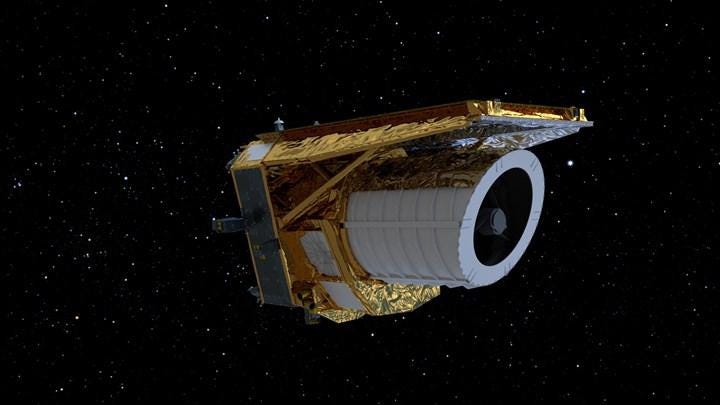
The European Space Agency’s (ESA) Euclid telescope has recently sent its first images to Earth. Along with the images being truly…
First Images from European Space Agency’s (ESA) Euclid Telescope
The European Space Agency’s (ESA) Euclid telescope has recently sent its first images to Earth. Along with the images being truly fascinating, it has also been confirmed that the telescope is functioning as expected.
As known, Euclid was launched on July 1 from the Cape Canaveral Air Force Station with the SpaceX Falcon 9 rocket and entered orbit at the point known as the second Lagrange point to join the James Webb Space Telescope as of July 28. The James Webb telescope was also sent into orbit at the second Lagrange point, 1.5 million km away from Earth. Both telescopes are located in orbit at a distance of about 1.5 million km from Earth. In the coming months, scientists will be busy testing and calibrating the telescope for better performance.
Named after the Greek mathematician Euclid, the “father of geometry”, this giant space telescope will spend about six years creating a three-dimensional map of the universe, covering two billion galaxies.
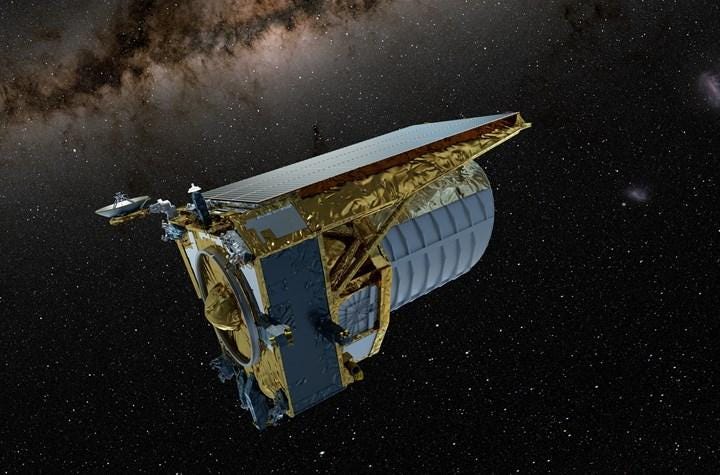
It is certain that the Euclid telescope will be one of the most important tools that humanity has sent into space, and it has already set its sights on galaxies billions of light years away.
Euclid’s success so far is truly exciting because its main goal is to map the “dark side” of our universe by analyzing billions of galaxies located approximately 10 billion light years away. Telescope aims to create a “3-dimensional” map, including time elements, to show how the universe has evolved along with its constantly expanding structure with this ambitious mission.
Now let’s take a look at the first images sent to Earth by Euclid, that fascinating and star-filled world.
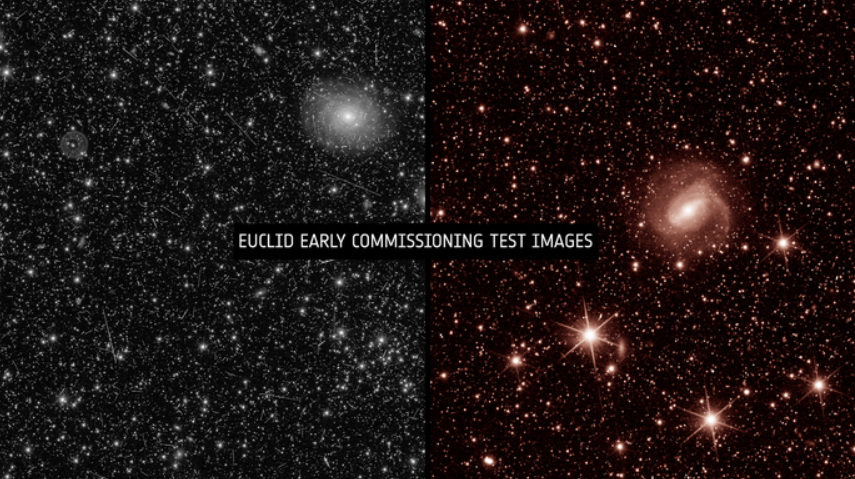
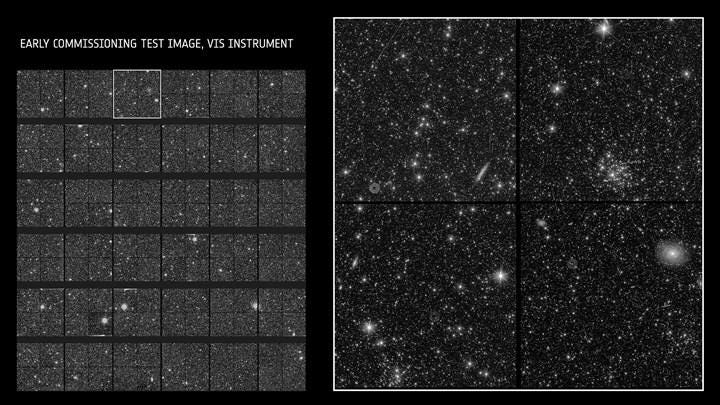
The images you see below were taken with an instrument called VIS, located on Euclid. As the name suggests, VIS captures the universe from the part of the electromagnetic spectrum that is visible to the human eye, that is, between 550 and 900 nanometers. On the left, you see the full field of view of VIS, and on the right, a zoomed-in version of a region. ESA compares the close-up area to about a quarter of the width and height of the full moon seen from Earth.
Next up is the NISP, which stands for Near-Infrared Spectrometer and Photometer, by Euclid. According to ESA, NISP has two roles.
The first one is that it can capture images of galaxies in infrared light or in the electromagnetic spectrum, between approximately 950 and 2020 nanometers, which is not visible to the human eye.
The second role of NISP is to precisely measure how much light each galaxy emits, which can tell us how far away these galaxies are.
The NISP images you see below are quite similar to the VIS set; the left side encompasses the entire NISP area, while the right side shows a zoomed-in section. Although these initial test images are not yet available for scientific purposes, they demonstrate that both instruments are working perfectly in space right now.
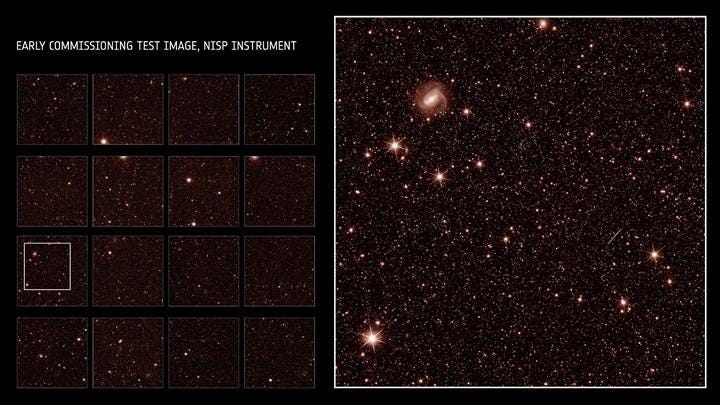
However, before the deep space light captured by Euclid reaches the NISP detector, it passes through some amazing filters. This leads to quite impressive results. These filters are able to measure certain infrared wavelengths of brightness that help NISP with galactic distance measurements.
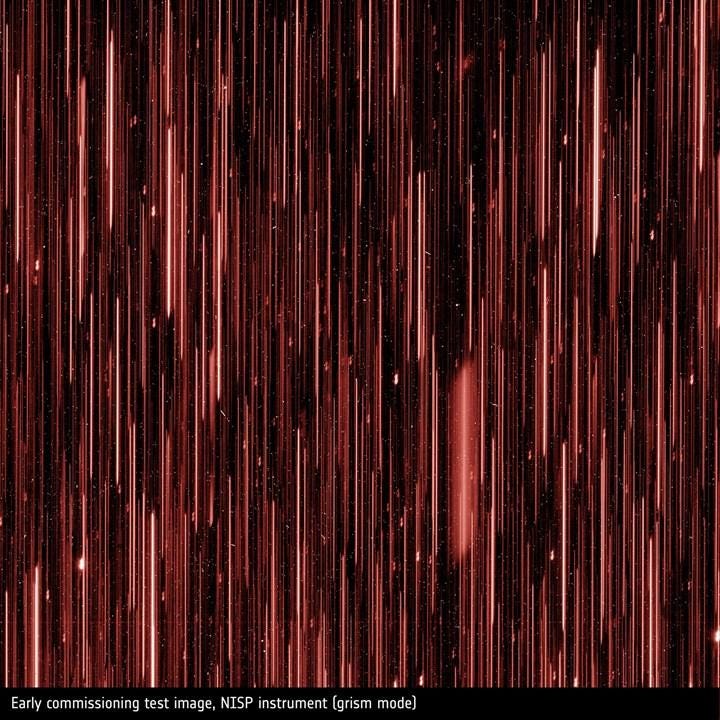
Euclid has a device called “grism” that can basically separate cosmic light into a complete wavelength spectrum before sending the data to NISP. Thanks to this process, scientists can determine, for example, how far a certain galaxy is and what it is chemically composed of.
What is the goal of the Euclid telescope?
Dark energy and its partner dark matter are among the biggest and most fascinating questions in astronomy today. Although both phenomena cannot be seen with the naked eye, they seem to hold our universe together.
✔️ What is Dark Matter?
Dark matter is a type of matter that does not interact with light or any other form of electromagnetic radiation. This means that it cannot be directly seen and its existence is inferred from the gravitational effects on visible matter. Scientists estimate that dark matter makes up approximately 85% of the total matter in the universe.
We can complete dark matter more easily as follows:
It seems that there is a kind of adhesive that keeps galaxies together and determines their arrangements, which ensures the location of galaxies within the expanding universe. For example, scientists calculate that intergalactic gas and stars seem to move as if there is an extra gravity on them. This invisible “glue” is called dark matter.
✔️ What is Dark Energy?
Dark energy is a mysterious force that causes the acceleration of the expansion of the universe. Like dark matter, it cannot be directly observed or detected, but its effects on the universe are clear. Scientists estimate that dark energy makes up about 68% of the total energy of the universe.
We can define dark energy in an easier way as follows:
As we know, space is constantly expanding in all directions like a balloon being inflated. However, what is strange is that this expansion seems to be happening at speeds that cannot be fully explained by all the visible things in our universe, so it is thought that there must be something else moving to accelerate cosmic expansion, and this “thing” is called dark energy by scientists.
Dark matter and dark energy are two of the most interesting and mysterious concepts in modern astrophysics. Although we cannot observe them directly, their effects on the universe are undeniable.
If Euclid’s mission to map the universe perfectly over the next six years is successful, scientists may obtain some clues as to what the dark universe actually is. As dark matter and energy interact with things in space, revealing the distribution and evolution of these things can show us where the dark universe fits into the story.
When Euclid is fully calibrated, it will create the largest 3D map of the sky to date.
🌟 We know that there is still a lot we do not know about dark matter and dark energy. However, as space exploration and observations continue, we will continue to learn more about these mysterious phenomena. This will help us better understand the universe we live in and make important discoveries. Additionally, even imagining where these discoveries will take us in the future is exciting. Perhaps the discovery of dark matter and dark energy will be one of the biggest discoveries since the birth of the universe.
Source:
*https://amp.cnn.com/cnn/2023/11/07/world/euclid-telescope-first-images-scn/index.html*
메타데이터
- post_id
- 4cff2d3eba4b
- slug
- first-images-from-european-space-agencys-esa-euclid-telescope-4cff2d3eba4b
- url
- https://medium.com/@hincalgunal/first-images-from-european-space-agencys-esa-euclid-telescope-4cff2d3eba4b
- canonical_url
- https://medium.com/@hincalgunal/first-images-from-european-space-agencys-esa-euclid-telescope-4cff2d3eba4b
- author_url
- https://medium.com/@hincalgunal
- status
- ok
- fetched_at
- 2026-07-27 14:47:49