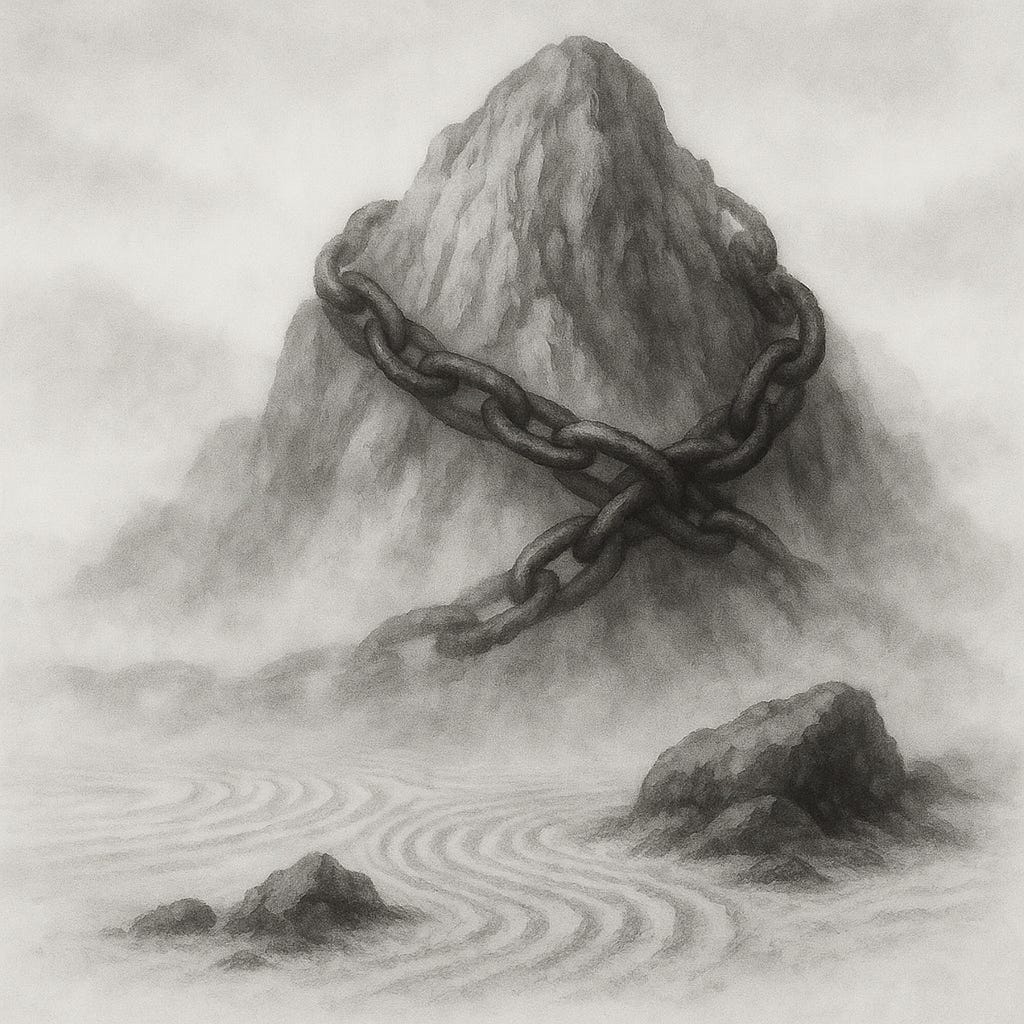
The Empty Boat
A Buddhist Concept of Inner Peace
The Empty Boat
A Buddhist Concept of Inner Peace

LEONORA Goldfield
In Buddhist philosophy, the metaphor of the “Empty Boat” is often used to illustrate the importance of letting go of ego, attachment, and the need for external validation. This simple yet profound concept is rooted in the teachings of Zen Buddhism, where the imagery of an empty boat drifting on a river becomes a powerful symbol for understanding how we interact with the world and the nature of our mind.
The “Empty Boat” parable is attributed to the Chinese Zen master, Chuang Tzu (Zhuangzi), who lived around the 4th century BCE. The story is simple:
A man is rowing a boat across a river when he sees another boat heading toward him. As the two boats approach, the man becomes angry, thinking that the other person is intentionally trying to collide with him. He shouts and curses at the approaching boat. However, when the boats meet, he realizes that there is no one in the boat — it’s empty. The anger vanishes instantly.
At its core, the “Empty Boat” teaches a profound lesson about our perceptions and reactions to the world. The key idea is that many of our emotions, particularly anger, frustration, and resentment, arise not from external events themselves but from our interpretations and attachments to those events.
The man in the story projected anger onto the empty boat, assuming that someone was causing harm to him. His emotional response was not due to the boat itself but the story he created in his mind. Similarly, in life, we often react based on our assumptions and attachments, not the actual situation.
The man’s anger was fueled by his attachment to his own sense of control and his ego. When he believed that someone was challenging him, he reacted with hostility. This reflects how our ego often creates conflict and emotional turbulence when we feel threatened or challenged.
The realization that the boat was empty allowed the man to let go of his anger. This moment of clarity highlights the Buddhist teaching of non-attachment. In life, letting go of our attachment to outcomes, expectations, and the opinions of others can lead to a more peaceful and harmonious existence.
Buddhism emphasizes the importance of mindfulness and awareness in our daily lives. The “Empty Boat” metaphor serves as a reminder to be present, to see things as they are, and to not react impulsively based on our inner narratives.
The story urges us to be aware of the thoughts and emotions that arise within us. Just as the man in the story could have chosen to remain calm and not assume that the boat was a threat, we too can learn to observe our thoughts without immediately reacting to them.
In Buddhism, attachment is seen as the root cause of suffering. Our attachment to possessions, people, or even specific outcomes can lead to emotional turmoil. The “Empty Boat” teaches that when we let go of these attachments, we open ourselves to greater peace and contentment.
The boat itself, like all things in life, is impermanent. By recognizing the transitory nature of all things, we can learn to appreciate the present moment without clinging to it. This aligns with the Buddhist concept of anicca — the impermanence of all things.
The man’s anger dissipated when he understood the true nature of the situation. In the same way, we can free ourselves from unnecessary emotional turmoil by understanding that our reactions are often based on misperceptions and attachments.
The “Empty Boat” is not just a philosophical idea; it is a practical tool for managing stress, conflict, and emotional disturbances. Here are a few ways to apply this concept in daily life:
When faced with a challenging situation or someone’s negative behavior, take a moment to pause. Ask yourself, “Is my anger or frustration based on reality, or is it a projection of my own mind?”
Recognize when your ego is at the center of your reactions. Let go of the need to be right or to win, and instead focus on responding with compassion and understanding.
The “Empty Boat” encourages us to see others as they truly are — without judgment or assumptions. By practicing compassion, we can dissolve the barriers that keep us emotionally reactive.
Accept that all experiences, both good and bad, are fleeting. This helps reduce our attachment to outcomes and fosters a greater sense of peace.
The “Empty Boat” parable is a timeless reminder of the power of perception, non-attachment, and emotional freedom. By understanding that much of our suffering comes from our reactions to external circumstances — rather than the circumstances themselves — we can cultivate greater inner peace. Through mindfulness and the release of ego-driven attachments, we can navigate life’s rivers with calmness and clarity, just as the man in the story would have if he had recognized the boat’s emptiness from the start.
메타데이터
- post_id
- 4d03314ec022
- slug
- the-empty-boat-4d03314ec022
- url
- https://medium.com/@LeonoraGoldfield/the-empty-boat-4d03314ec022
- canonical_url
- https://medium.com/@LeonoraGoldfield/the-empty-boat-4d03314ec022
- author_url
- https://medium.com/@LeonoraGoldfield
- status
- ok
- fetched_at
- 2026-06-26 21:52:29