Inside an AI-Powered Food Delivery App — Features That Matter
What the best food delivery apps do differently
This is what AI in food delivery actually means
Inside an AI-Powered Food Delivery App — Features That Matter
What the best food delivery apps do differently
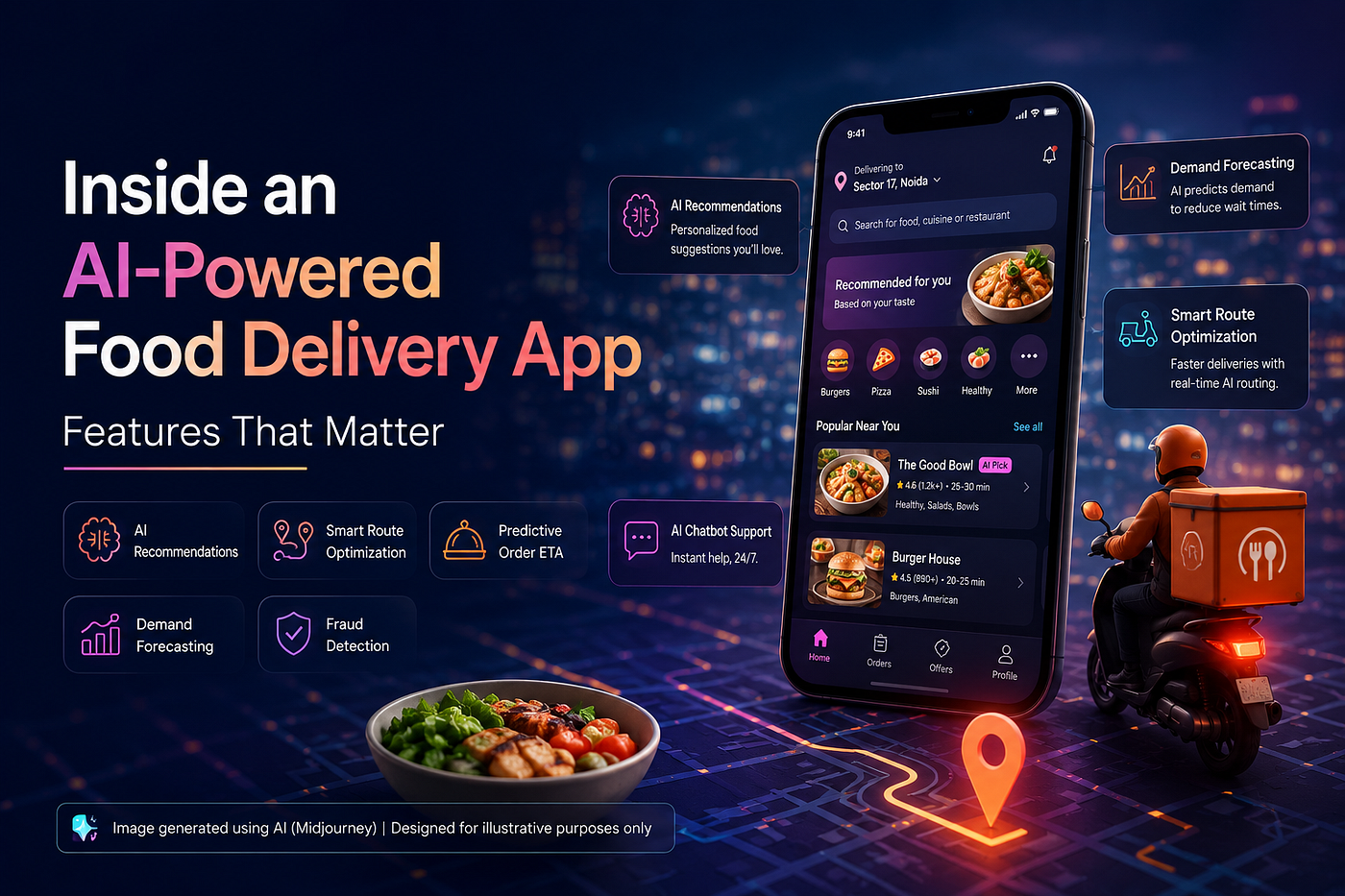
Featured image: AI-generated using DALL·E (OpenAI) for editorial and illustrative purposes.
I want to start with something that happened on a Tuesday evening about eighteen months ago that reframed how I think about AI in food delivery applications.
I was debugging a recommendation system for a food delivery client — a regional platform competing against the major players in a specific metropolitan market. The system had been live for about three months. By most surface metrics it was performing well. Click-through rates on recommendations were up. Average order value had increased. The product team was happy.
Then I pulled a specific slice of data I hadn’t looked at before: recommendation acceptance rate by time of day, cross-referenced against the specific restaurant and dish combinations being recommended. What I found was that the recommendation engine was doing something the product team hadn’t fully understood. Between 11 PM and 2 AM, it was systematically surfacing recommendations toward comfort food and indulgent options — not because anyone had programmed it to, but because the behavioral signals from late-night users strongly correlated with those choices in the training data.
That’s not a bug. That’s a feature. The AI was learning something real about how food preferences shift with context — time of day, weather data the system had access to, day of week — and applying that learning in ways that were producing better recommendations than the daytime algorithm produced. But nobody on the product team had known it was doing that, which meant nobody had evaluated whether it was doing it correctly, and nobody had thought through the edge cases where it might do it badly.
That experience is what this article is about. Not the surface layer of what AI-powered food delivery apps do — everyone knows about personalized recommendations and estimated delivery times. But the technical depth underneath those features, what separates implementations that actually work from those that look like AI but aren’t, and what the features are that genuinely matter for building a food delivery application in 2026 where AI is doing real work rather than providing a marketing claim.
Why Food Delivery Is One of the Hardest AI Problems in Consumer Software
Before going into the features, I want to establish why food delivery is technically more interesting and more demanding than most people who haven’t built in this space realize.
Food delivery operates at the intersection of several domains that are each independently complex and that interact with each other in ways that multiply the complexity. You have the restaurant supply side — menus that change daily, preparation times that vary by dish and by kitchen load, quality that fluctuates with ingredient availability and staffing. You have the delivery logistics side — routes that change with traffic, driver supply that fluctuates with time of day and weather, delivery time estimates that need to be accurate to within minutes to satisfy user expectations. You have the consumer demand side — preferences that are contextual, highly personal, and influenced by factors that range from time of day and weather to social context and recent experience. And you have the financial side — dynamic pricing, promotions, driver incentives, and margin management that all need to be balanced in real time.
The AI in a food delivery application isn’t solving one problem. It’s simultaneously solving several interrelated problems, and the solutions to each problem affect the others. A recommendation engine that improves order conversion by suggesting popular dishes from a specific restaurant creates additional load on that restaurant’s kitchen, which affects preparation times, which affects delivery time accuracy, which affects customer satisfaction. These second and third-order effects are what make food delivery AI genuinely hard and what distinguish implementations that understand the system from those that optimize individual metrics without understanding how those metrics interact.
The other thing that makes food delivery demanding for AI is the real-time nature of the data. Unlike product recommendation in e-commerce, where the inventory changes slowly and the behavioral patterns are relatively stable, food delivery operates on a constantly changing surface. Restaurant availability changes by the minute. Driver location changes by the second. Traffic conditions change continuously. Weather affects both demand patterns and delivery logistics simultaneously. An AI system that was accurate fifteen minutes ago may not be accurate now, which means the infrastructure needs to support continuous model updates rather than periodic batch retraining.
The Features That Are Actually Powered by AI — And the Ones That Aren’t
One of the things that frustrates me about how AI food delivery apps are discussed is the looseness of the term “AI-powered.” Most food delivery apps claim AI capabilities. The actual AI depth varies enormously, and understanding what features require genuine AI infrastructure versus what features just use the label helps evaluate what’s actually been built.
Features that genuinely require AI infrastructure include personalized recommendation systems that model individual user preferences across multiple dimensions, dynamic ETA prediction that accounts for real-time traffic and restaurant load alongside distance, demand forecasting that anticipates ordering patterns before they manifest, and fraud detection that identifies anomalous transaction patterns in real time. These require model training, feature engineering, and inference infrastructure that goes well beyond simple rule-based systems.
Features that are often labeled AI but don’t require sophisticated AI infrastructure include basic menu filtering by category or dietary restriction, static promotions triggered by time of day, simple distance-based restaurant ranking, and rule-based chat support that follows decision trees. These are legitimate product features, but they’re not meaningfully AI-powered regardless of how they’re described in marketing materials.
The distinction matters practically because the development investment required for genuine AI infrastructure is significantly higher than for rule-based systems, and because the ongoing maintenance and data requirements are different in kind rather than just in degree. Building a food delivery application with genuine AI capability requires thinking about data collection, model training pipelines, inference infrastructure, and model monitoring from the architecture stage — not as features to be added after the core platform is built.
The sections that follow focus on the features where genuine AI depth makes a real difference — where the implementation of a real AI system produces meaningfully better outcomes than a rule-based alternative.
Feature One: Personalized Recommendation Engine
The recommendation engine is the AI feature with the highest direct impact on business metrics in food delivery applications — conversion rate, average order value, and repeat order frequency all improve with better recommendations. It’s also the feature where the gap between good and poor AI implementation is most visible in business outcomes.
A surface-level recommendation system ranks restaurants and dishes by popularity or by rating. This produces defensible recommendations — popular restaurants with high ratings are reasonable choices — but it’s not personalization. It’s aggregation.
A genuine personalized recommendation system models individual user behavior across multiple dimensions simultaneously. Purchase history creates the baseline — what cuisines this user has ordered, from which restaurants, at what price points, and whether they’ve reordered from the same source. But purchase history alone is insufficient for good recommendations because food preferences are highly contextual.
The contextual dimensions that matter include time of day — breakfast choices differ from dinner choices differ from late-night choices in ways that are predictable but vary by individual. Day of week matters — many users have patterns where Monday through Thursday ordering skews toward lighter or healthier options and Friday through Sunday ordering skews toward more indulgent choices. Weather is a well-documented influence on food preference — cold weather correlates with comfort food, hot weather with lighter options, rain with delivery preferences over pickup. Location matters in platforms where users order from different locations — home ordering patterns differ from office ordering patterns.
The interaction between these contextual factors and individual preference history is what makes the recommendation problem genuinely complex. A user who strongly prefers Thai food on weekday evenings at home might consistently choose pizza on Friday evenings. A user who typically orders light salads might systematically order heavier meals when it’s raining. These individual contextual patterns can’t be learned from population-level data — they require enough individual behavioral data to model the user specifically, combined with enough population data to fill in the gaps where individual data is sparse.
The feature engineering required to capture these patterns involves creating representations of all the relevant contextual factors as model inputs, handling the cold start problem for new users who don’t yet have behavioral history, and updating recommendations in near real-time as contextual factors change rather than serving cached recommendations from a batch process.
Beyond restaurant recommendations, the AI opportunity extends to dish-level recommendations within a selected restaurant. Users who order from the same restaurant repeatedly often explore only a fraction of the menu. A recommendation system that identifies dishes similar to what a user has ordered and enjoyed — based on ingredient similarity, flavor profile matching, and behavioral signals from users with similar preference profiles — can increase average order value and introduce users to menu items they’re likely to enjoy but wouldn’t have discovered through manual browsing.
This is the kind of feature depth that agencies specializing in **AI Food Delivery App Development** — like Triple Minds, whose AI development practice covers custom recommendation system architecture and the real-time data pipelines that power them — build into food delivery applications from the architecture stage rather than retrofitting onto existing platforms. The infrastructure choices made at the beginning determine what personalization depth is achievable, and those choices are hard to change after the platform is live.
Feature Two: Dynamic ETA Prediction
Delivery time estimation is the feature that most directly affects customer satisfaction in food delivery, and it’s one where the gap between naive implementation and sophisticated AI is most commercially significant.
A naive ETA implementation adds a fixed preparation time estimate to a distance-based delivery time estimate. This produces an ETA that might be accurate on average but that has high variance around that average — sometimes significantly faster, sometimes significantly slower — because it doesn’t account for the real-time variables that determine actual delivery time.
The variables that matter for accurate ETA prediction include restaurant-specific preparation time variance — the same restaurant prepares the same dish faster at 1 PM than at 7 PM on a Friday evening when the kitchen is at peak load. Driver availability at the time of order affects pickup time. Real-time traffic conditions along the delivery route affect transit time. Weather conditions affect both driver speed and demand-supply balance. Order composition matters — a complex multi-item order takes longer to prepare than a simple single-item order from the same restaurant.
A sophisticated ETA model integrates all of these inputs in real time. The restaurant preparation time component is a model trained on historical preparation time data for each restaurant, conditioned on time of day, day of week, current order queue depth, and order complexity. The driver availability and routing component integrates with real-time driver location data and traffic APIs. The whole system updates continuously as new information becomes available — if a driver is assigned to an order and their current location is known, the ETA updates to reflect the actual driver position rather than a statistical estimate of driver availability.
The commercial impact of accurate ETA prediction extends beyond customer satisfaction. Accurate ETAs allow customers to plan around their order, which reduces the support contact rate for “where is my order” inquiries. They provide better information for the platform’s driver dispatching system, which can sequence pickups more efficiently when it has accurate preparation time estimates. And they provide the restaurant side with better demand signals, which helps kitchens manage preparation timing to reduce both wait time for drivers and time between preparation completion and pickup.
ETA accuracy is measurable and should be tracked as a first-class product metric. The gap between predicted ETA and actual delivery time, tracked as mean absolute error, tells you how well the system is working. Most food delivery platforms have ETA MAE that’s higher than it should be because the model hasn’t been trained with the feature engineering depth required to capture the real-time variables that drive variance.
Feature Three: Demand Forecasting and Supply-Side Management
Demand forecasting is the AI feature that operates most visibly on the supply side of the food delivery marketplace — and the one that creates the most value in the aggregate even though individual users rarely interact with it directly.
The core problem demand forecasting solves is the mismatch between when orders arrive and when drivers and restaurants are ready to handle them. Without accurate demand forecasting, restaurants staff reactively — guessing at expected order volume based on historical patterns and general intuition. Drivers are available where they happen to be rather than where demand is likely to be. The result is that peak demand periods are characterized by both restaurant overload and driver scarcity simultaneously, which produces long wait times, poor ETA accuracy, and customer dissatisfaction.
A demand forecasting system predicts order volume at the restaurant level, the geographic zone level, and the platform level, across different time horizons. Short-horizon forecasting — the next 15 to 30 minutes — is used for driver dispatching, directing available drivers toward zones where demand is predicted to increase. Medium-horizon forecasting — the next 2 to 4 hours — is used for restaurant preparation planning, helping kitchens anticipate volume and staff appropriately. Long-horizon forecasting — day-ahead and week-ahead — is used for driver incentive planning and restaurant partnership management.
The inputs to a demand forecasting model include historical order volume at multiple granularities, weather data and forecasts, local events that affect ordering patterns, day of week and time of day patterns, and promotional calendar data for planned campaigns. The model needs to handle the interaction between these inputs — a major local sporting event combined with cold weather creates a demand spike that is larger than either factor would produce independently, and the model needs to capture this interaction rather than treating each factor independently.
The output of the forecasting system feeds into a set of operational decisions that are themselves becoming increasingly automated in sophisticated platforms. Driver surge pricing and incentive structures respond to predicted demand-supply imbalances before they materialize rather than after. Driver repositioning recommendations direct available drivers toward zones where demand is predicted to increase. Restaurant preparation recommendations suggest staffing levels based on predicted order volume. These operational responses, when calibrated correctly, reduce the peak-period strain that produces the worst customer experiences on food delivery platforms.
Feature Four: Real-Time Driver Dispatch and Route Optimization
Driver dispatching is the logistics optimization problem at the heart of food delivery operations, and it’s one where AI systems produce outcomes that rule-based systems genuinely can’t match at scale.
The dispatch problem in food delivery is to assign orders to available drivers in a way that minimizes total delivery time, maintains driver utilization, and handles the continuous arrival of new orders without creating large backlogs. It’s a variant of the vehicle routing problem — a class of problems that are computationally hard in the general case and that require heuristic or learned approaches rather than exact solutions at the scale food delivery platforms operate.
A sophisticated dispatch system makes several types of decisions simultaneously. Order-to-driver assignment matches orders to drivers based on driver location, driver current order load, restaurant preparation time estimate, and predicted delivery route. Batch ordering — assigning multiple orders to a single driver for sequential pickup and delivery — requires reasoning about the additional complexity it introduces to the delivery timeline while reducing per-order driver cost. Driver repositioning between orders directs drivers toward zones of predicted demand rather than letting them idle in their current location.
The AI component in dispatch is a combination of optimization algorithms and learned prediction models. The optimization algorithms solve the assignment problem given a set of inputs. The prediction models produce those inputs — preparation time estimates, traffic predictions, demand forecasts — that the optimization algorithm needs to make good decisions. The quality of the dispatch system is therefore dependent on the quality of all the upstream prediction systems.
Route optimization within the delivery itself has become increasingly sophisticated with the integration of real-time traffic data. A route that was optimal when the driver picked up the order may not be optimal fifteen minutes later if traffic conditions have changed. Systems that continuously re-optimize routes as conditions change — updating turn-by-turn directions based on real-time traffic rather than static routing — produce systematically shorter delivery times at the cost of additional computational complexity.
Feature Five: Dynamic Pricing and Promotional Optimization
Pricing in food delivery applications operates across multiple dimensions simultaneously — delivery fee pricing, restaurant menu pricing where platforms have influence, driver surge pricing during high-demand periods, and promotional discount pricing as a demand lever. The optimization of these pricing dimensions in real time is an AI problem that has significant impact on platform economics and on customer behavior.
Delivery fee dynamic pricing adjusts the delivery fee based on real-time demand-supply conditions. When driver supply is abundant relative to demand, delivery fees can be reduced or waived to stimulate demand. When driver supply is scarce relative to demand, delivery fees increase to both moderate demand and incentivize additional drivers to come online. The calibration of these price changes — how quickly they respond, how large the changes are, how they’re communicated to users — requires learning from historical price elasticity data to avoid customer experience degradation while still achieving the supply-demand balancing objective.
Promotional optimization determines which users should receive which promotions at which times to maximize the incremental revenue generated by the promotional spend. A blanket discount sent to all users produces the promotional benefit for users who would have ordered anyway — which represents pure cost without incremental revenue — alongside incremental orders from users who wouldn’t have ordered without the promotion. A targeted promotion system identifies the users most likely to respond incrementally to a specific promotion — the users who are on the margin of ordering, whose probability of ordering increases meaningfully with a discount — and directs promotional spend toward those users rather than distributing it uniformly.
This targeting requires a propensity model that predicts the likelihood of each user ordering within a defined time window with and without a promotion, and the difference between those probabilities represents the uplift that determines whether the promotional spend is worth making. Building this model requires experimental data — running promotions with randomized treatment and control groups — to learn the causal effect of promotions rather than the correlation between promotional receipt and ordering that observational data alone would produce.
Feature Six: AI-Powered Search and Natural Language Understanding
Search within a food delivery application is a feature that most platforms have implemented at a basic level — keyword matching against restaurant names and menu item names — and that most platforms have significant opportunity to improve through better natural language understanding.
The gap between keyword search and intent-aware search in food delivery is wide and practically significant. A user who searches “something light and healthy” is expressing a preference that no keyword matching system can fulfill — there’s no restaurant called “light and healthy” and no menu item that literally matches those terms. A natural language understanding system that can interpret this query as expressing a preference for calorie-conscious options and return restaurants with strong salad, grain bowl, or protein-focused options is providing meaningfully more value.
The natural language understanding required for this goes beyond intent detection to preference interpretation. “I want something different” is an intent that requires knowing what the user has ordered before in order to interpret correctly. “Something quick” requires knowing the user’s location and the current preparation and delivery times for nearby restaurants. “The same thing I had last Tuesday” requires understanding the reference and retrieving the historical order it points to.
Voice search adds an additional layer of natural language processing requirements — speech recognition that performs well in noisy environments, dialect and accent handling, and the interpretation of voice-specific speech patterns that differ from typed query patterns. With the increasing adoption of voice interfaces in mobile applications, food delivery apps that handle voice search well provide a meaningfully different user experience from those that treat it as a minor input modality.
Feature Seven: Fraud Detection and Trust and Safety Systems
Fraud detection is the AI feature that operates most invisibly to users and that creates the most risk when it works poorly in either direction — too aggressive and legitimate users are blocked, too lenient and fraudulent transactions impose costs on the platform and its participants.
Food delivery fraud takes several forms. Account creation fraud uses stolen identity information or synthetic identities to claim new user promotions. Payment fraud uses stolen payment methods for orders. Refund fraud exploits the platform’s customer service policies by claiming non-delivery or quality issues for orders that were legitimately fulfilled. Driver fraud involves manipulation of location data, acceptance of orders with no intention of fulfilling them, or exploitation of driver incentive programs.
Each of these fraud patterns has a distinct signal profile and requires different detection approaches. Payment fraud detection uses transaction anomaly detection — identifying transactions that deviate from established user behavior patterns or that match known fraud signatures in card network data. Refund fraud detection requires modeling the relationship between claimed issues and observed delivery data — comparing the claimed problem against GPS data, restaurant confirmation data, and historical claim patterns for the user and the restaurant. Driver fraud detection requires analysis of location data patterns, acceptance and completion rate patterns, and behavioral anomalies that distinguish legitimate driver behavior from fraudulent exploitation.
A sophisticated fraud detection system applies machine learning models trained on labeled fraud data to evaluate each transaction, claim, or behavioral event in real time, producing a risk score that determines whether the action is approved, flagged for review, or blocked. The challenge is calibrating these models to minimize both false positives — blocking legitimate users — and false negatives — allowing fraudulent transactions — which requires continuous evaluation of model performance and regular retraining as fraud patterns evolve.
Feature Eight: Customer Support AI and Conversational Assistance
Customer support in food delivery generates high contact volume around a relatively small set of issue categories — delivery delays, missing items, quality issues, order cancellations, payment disputes. The structured nature of these issues makes them well-suited to AI-powered support automation, and the real-time nature of many of them makes fast automated response more valuable than slower human response.
A well-built customer support AI for food delivery has access to the real-time context that makes automated resolution genuinely helpful rather than frustratingly generic. When a user contacts support about a delivery delay, the system should immediately have access to the current order status, the driver’s real-time location, the predicted remaining delivery time, and the platform’s relevant policies — and be able to provide a specific, accurate, contextually relevant response based on that information rather than a generic acknowledgment that the team is looking into it.
The escalation design for customer support AI is as important as the automation capability. Situations that require human judgment — complex disputes, situations where the user is distressed, cases where the automated resolution options available don’t address the actual issue — need to escalate to human support with full context already gathered rather than requiring the user to re-explain the situation. The quality of the escalation experience determines whether the AI support layer improves or degrades the overall support experience.
Proactive support — reaching out to users before they contact support when the system predicts a likely support need — is an AI capability that reduces support contact volume while improving customer experience. A system that detects a delivery that is significantly late relative to the predicted ETA and proactively communicates updated information and a compensation offer preempts the support contact that would otherwise follow and produces a better customer experience outcome than reactive response after the user is already frustrated.
Feature Nine: Menu Intelligence and Restaurant Performance Analytics
The restaurant side of the food delivery marketplace is a significant beneficiary of AI capabilities that most consumer-facing discussions of food delivery AI don’t address — specifically, the menu intelligence and performance analytics tools that help restaurant partners optimize their menu, pricing, and operations for delivery success.
Menu intelligence uses platform-wide behavioral data to surface insights that individual restaurants can’t develop from their own data alone. Which menu items have the highest abandonment rate — items that users view but don’t add to cart — suggests pricing or presentation issues. Which items have the highest reorder rate suggests the dishes that drive loyalty. How a restaurant’s performance compares to similar restaurants on key metrics — preparation time, order accuracy, customer rating — benchmarks operational quality in ways that help restaurants identify improvement areas.
Demand prediction for individual restaurants helps kitchen managers anticipate order volume and staff appropriately. A restaurant-specific demand forecast — what volume do I expect in the next two hours — allows proactive rather than reactive kitchen management, reducing both preparation time variance and the quality issues that come from overwhelmed kitchen staff.
Pricing optimization helps restaurants set menu prices that balance competitiveness with margin — understanding how price changes affect order volume from the platform’s behavioral data rather than from small-scale manual experiments that individual restaurants could run on their own.
These restaurant-side AI features create value for the platform by improving the supply-side quality that determines customer experience — faster preparation times, better order accuracy, more competitive pricing — which in turn drives demand growth that benefits the platform commercially.
Feature Ten: Real-Time Personalization of the App Experience
Beyond the recommendation engine, AI personalization can extend to the broader app experience — the ordering flow, the interface layout, the communication style, and the default options presented to users based on their demonstrated preferences and current context.
Interface personalization adapts the app’s default view based on what a specific user typically looks for. A user who consistently uses the cuisine filter to narrow to specific options sees those filters prominently without having to apply them manually. A user who consistently reorders from the same restaurants sees those restaurants prominently surfaced rather than having to search for them. A user who consistently applies dietary filters has those filters applied by default.
Communication personalization adapts how the app communicates with users based on their preferences and behavior. Users who respond to push notifications at specific times of day receive notifications at those times rather than at fixed broadcast times. Users who have indicated preference for minimal communication receive update notifications at lower frequency than users who check order status frequently. Message content personalization adapts the language and offers in promotional communications based on individual user response history.
The cumulative effect of this personalization across the full app experience is a product that feels like it knows the user — that anticipates what they’re looking for and reduces the friction of getting it — rather than a generic experience that every user navigates the same way.
Putting It Together: What Building This Actually Requires
Having walked through ten distinct AI feature areas, I want to close with an honest assessment of what building a food delivery application with genuine AI depth across these areas actually requires — because the scope is significant and the organizational implications are worth understanding clearly.
Building real AI capability in food delivery requires data infrastructure that most teams underestimate at the planning stage. Every AI feature described in this article depends on data — behavioral data, operational data, contextual data — being collected, stored, and made available for model training and inference at the right quality and latency. Building that data infrastructure is foundational and needs to happen before the AI features can be built, not as an afterthought when the features are ready to deploy.
It requires ML engineering capability that goes beyond API integration with AI providers. Integrating an existing LLM API can deliver some AI capabilities, but the recommendation engine, the demand forecasting system, the fraud detection system, and the ETA prediction model all require custom model development — feature engineering, training pipeline development, model evaluation, and inference optimization — that requires ML engineering expertise rather than just software engineering expertise.
It requires ongoing operation, not just initial development. AI systems need to be monitored for performance drift, retrained as behavioral patterns and business conditions change, and updated as fraud patterns evolve. The operational burden of maintaining AI systems is significant and needs to be planned for as part of the ongoing cost structure rather than treated as a one-time development investment.
And it requires organizational alignment on what the AI is supposed to achieve — not just “improve recommendations” or “reduce delivery time” but specific, measurable objectives that the team can evaluate model performance against and that drive the training and evaluation decisions that determine how well the systems work.
Building all of this well takes time, expertise, and the right architecture decisions made early. The food delivery applications that are winning on AI in 2026 started making those architecture decisions two or three years ago. The ones starting now are working with better tools than existed two years ago but are still facing the same fundamental requirements — good data, genuine ML expertise, operational commitment, and clear objectives.
The AI isn’t the product. The product is the food delivery experience. The AI is what makes that experience better in the ten specific ways described in this article — and what makes the platform that gets those ten things right consistently more valuable to users, restaurants, and drivers than the one that gets them partially right or not at all.
Support writers. All our nonprofit’s offerings here.
Click for Wordsmith, Mystery Writing, Write Like Stephen King, more

By the EIC Susan Brearley with Ideogram
메타데이터
- post_id
- 4d038f93b1bc
- slug
- inside-an-ai-powered-food-delivery-app-features-that-matter-4d038f93b1bc
- url
- https://medium.com/it-chronicles/inside-an-ai-powered-food-delivery-app-features-that-matter-4d038f93b1bc
- canonical_url
- https://medium.com/it-chronicles/inside-an-ai-powered-food-delivery-app-features-that-matter-4d038f93b1bc
- author_url
- https://medium.com/@henrywill
- status
- ok
- fetched_at
- 2026-08-01 14:11:17