5 Claude AI Techniques That Boost Results
You Just Need to Learn How to Use It 🔥
5 Claude AI Techniques That Boost Results
You Just Need to Learn How to Use It 🔥

Image made with AI
Did you know there are five Claude techniques that can completely change the quality of what it produces for you? I’ve been using all five for the past year and they’re the reason I stopped rewriting everything Claude gives me.
The first skill is the one that changed my output quality more than anything else. And it starts with telling Claude to stop writing. The typical approach is to open Claude.
Type something like, “Write me a marketing strategy.” and Claude immediately produces two pages of generic recommendations that could apply to any company in any industry.
The output is technically correct but completely useless because Claude had zero context about your audience, your budget, your competitive landscape, what you’ve already tried, or what your CEO actually cares about seeing in a strategy document.
The way you fix it is with a single instruction. Before Claude writes anything, tell it to interview you first. I’ll type interview me about every aspect of this project before you produce anything.
Ask one question at a time until you fully understand what I need. By the time Claude has asked 10 to 15 questions, it has more context than most team members get in a briefing meeting.
The recommendations are specific to your company. The metrics reference your actual targets and the language matches the tone your leadership team expects. The interrogation forces it to ask instead of assume.
And the quality difference between assumed context and provided context is the difference between a draft you delete and a draft you send.
The second skill is about catching problems before anyone else does, and it works by having Claude review its own work from perspectives that aren’t yours.
The problem is that you’re reviewing it from one angle, your own, but the people receiving it are reading it from a completely different one. Your CFO reads it for financial rigor.
Your client reads it for relevance to their problem, and your board reads it for strategic risk.
After Claude produces any deliverable, I run three perspective reviews before I accept it.
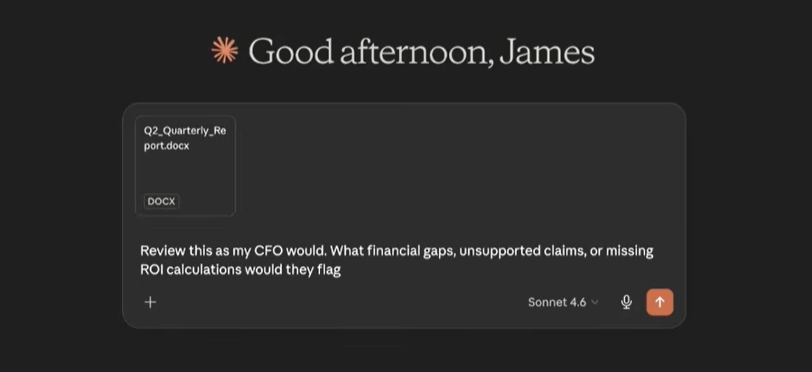
📌First pass, I’ll type review this as my CFO would. What financial gaps, unsupported claims, or missing ROI calculations would they flag?

Screenshort
📌Then I run a second pass. I’ll type, “Now review this as our biggest client would. What feels generic? What doesn’t address their specific situation?”
📌Third pass, I’ll type review this as a skeptical board member. What risks aren’t addressed? What assumptions haven’t been validated? And where are the logical gaps?
The full three perspective review adds less than 10 minutes to your workflow, and the output that survives three different perspectives is significantly stronger than anything a single review produces.
The third skill changes how you approach any deliverable that’s longer than a single page. The default approach is to try to get Claude to produce a full document in one prompt.
Instead, you break the deliverable into phases where each phase builds on the last and gets validated before the next one begins.
Phase one is the brief. Claude produces a focused brief that becomes the blueprint for everything that follows.
Phase two is research. You get structured research for each question in the brief.
Phase three is the outline. The outline is where the structure of the final document takes shape. And reviewing an outline is 10 times faster than reviewing a full draft.
Phase four is the full draft, which Claude writes with the brief, the research, and the outline all in context. The document that comes out of four phases reads like something a team produced over a week.
The arguments build on each other. The data supports the claims, and the structure flows logically because each phase was validated before the next one started.
The fourth skill is for any project that’s big enough to feel overwhelming. When a project lands on your desk, the temptation is to start working on whatever feels most urgent.
But urgency and importance aren’t the same thing, and starting with the wrong task can create bottlenecks that cost you weeks.
Instead, I give Claude the full scope of a project and tell it to decompose it. I’ll type, “Here’s the full scope of our product launch. Break this down into independent tasks.
For each task, tell me what it depends on, what it blocks, and what can run in parallel.” Claude identifies the dependencies that aren’t obvious. It also identifies tasks that can run in parallel.
The breakdown also becomes a communication tool. It turns a vague we’re on track into a specific status report that builds confidence.
The fifth skill is about eliminating the setup cost that slows down every conversation you have with Claude. If you’re using Claude without projects or custom instructions, you’re starting every conversation from zero.
Every time you ask for something, you have to reexplain your role, your company, your industry, your writing preferences, and the context of what you’re working on.
The way around it is to set up a Claude project and load it with your persistent context.
Once that context is loaded, every conversation inside the project starts with Claude already knowing who you are, what you do, and how you like things done.
The difference is like working with a new contractor versus someone who’s been on your team for 6 months. The new contractor needs a briefing every time. The team member just needs the task.
These five skills compound and make your process faster every time you use Claude.
I’m sure that, after some time, you may want to revisit this article, to read it again, or for reference. So, please save it to your reading list. This is my kind request.

You know, medium writers don’t earn much, so a single coffee can really help support my work. Thank you for your kindness!
By me a coffee
Make sure to subscribe for more like this.
https://medium.com/@James_98/subscribe
Don’t forget to check this out!
[embed]List: Cloude Tips | Curated by James | Medium Cloude Tips · 14 stories on Mediummedium.com
[embed]List: Youtube Tips | Curated by James | Medium Youtube Tips · 10 stories on Mediummedium.com
[embed]List: AI Tips | Curated by James | Medium AI Tips · 6 stories on Mediummedium.com
메타데이터
- post_id
- 4d056cd90773
- slug
- 5-claude-ai-techniques-that-boost-results-4d056cd90773
- url
- https://medium.com/the-money-guide/5-claude-ai-techniques-that-boost-results-4d056cd90773
- canonical_url
- https://medium.com/the-money-guide/5-claude-ai-techniques-that-boost-results-4d056cd90773
- author_url
- https://medium.com/@James_98
- status
- ok
- fetched_at
- 2026-06-23 17:05:31