The Real Villain in The Third Way of Love Isn’t a Person – It's Timing
There’s a poster for The Third Way of Love that’s been living in my head ever since the day I first found it. You know the one with Lin…
The Real Villain in The Third Way of Love Isn’t a Person – It's Timing

There’s a poster for The Third Way of Love that’s been living in my head ever since the day I first found it. You know the one with Lin Qizheng standing in profile, jaw set, eyes somewhere else entirely, while a giant clock looms behind him like it’s been cast for the role of "Antagonist". And right there, in small italic type, the line that gives the whole movie away before you’ve even pressed play: “If only we met earlier…”
That line wrecked me because that’s not a throwaway tagline. That’s the thesis statement. That’s the entire movie, distilled into five words and a wristwatch.
Everyone who reviews The Third Way of Love wants to talk about class. Rich CEO, scrappy lawyer, family pressure, melodrama, the whole “Cinderella and the conglomerate heir” machinery creaking along in the background. And sure, that’s all technically there. But if you actually sit with the film, really sit with it, the way I do at 11pm with a cup of tea going cold while I take notes like this is a thesis defence and not a fan rewatch, you start to notice that money was never the obstacle. Status was never the obstacle. The actual villain of this tale lacks a face, gets not one bit of dialogue, but is always present regardless of that fact: timing.
A Love Story Where the Clock Is the Casting Director
Think about how Lin Qizheng and Zou Yu actually meet. It’s not some carefully engineered setup. It’s an accident on a flight, a stranger handing tissues to a crying woman who isn’t even crying about him. By the time their lives properly collide, Zou Yu is already carrying the weight of her sister’s heartbreak over this very same man. The film hands us a love story that begins with the worst possible timing baked right into the premise: she meets him after he’s already broken someone close to her, even if unintentionally. There’s no clean slate. There never was one.
That’s the pattern the whole film keeps repeating, scene after scene. Every genuinely tender moment between these two arrives with an asterisk. Every time it looks like they might get a clear runway, no family obligations, no professional complications, and no third party standing in the wreckage. Something has already shifted, some door has already half-closed, and some confession comes one beat too late to land the way it should have. It’s less a love story interrupted by circumstance and more a love story that circumstance was always going to win, because the two people in it are perpetually a few steps out of sync with each other’s readiness.
And here’s the part that I think gets criminally underdiscussed: Lin Qizheng isn’t written as a man who doesn’t know how to love. He’s written as a man who keeps arriving at the right realisation at the wrong moment. That’s a much sadder, much more human flaw than “rich guy learns to feel things.” It’s not an emotional deficiency. It’s a temporal one. He can love. He just can’t seem to do it on time.
Song Seung Heon’s Quiet Math
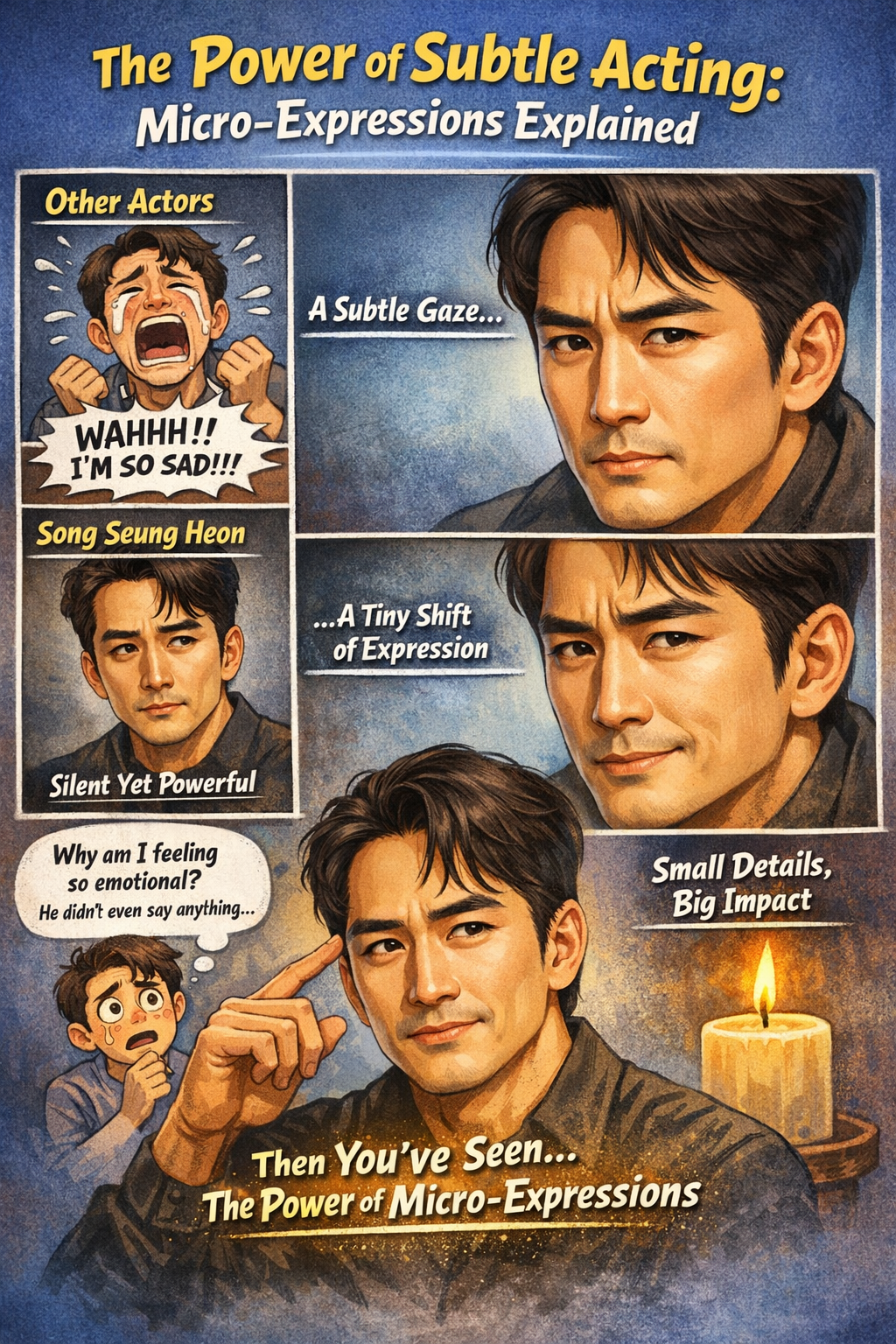
Can we talk about the performance for a second? Because I think it gets flattened in a lot of reviews into “stoic rich guy, occasionally cries". That’s not what’s happening on screen. What Song Seung Heon is doing with Lin Qizheng is something much more controlled; he’s playing a man who is constantly doing arithmetic in his head. You can see him calculating, in almost every scene, whether this is the moment to say the thing he’s actually feeling, and almost every single time, he decides it isn’t. Not because he’s a coward. Because he’s been trained by family, by position, and by the sheer architecture of his life to believe there will be a better, safer, more appropriate later.
That’s the performance. Not big swings of emotion, but a man perpetually deferring himself. When the dam finally breaks, and it does break, in the kind of unguarded, almost embarrassing way that real grief looks rather than movie grief, it doesn’t feel like a switch flipping. It feels like the bill is finally coming due on years of postponement. That’s restraint used correctly. He’s not underplaying the emotion; he’s playing the cost of delaying it.
I’ll be honest with you, Mr Song, that's the version of you I find the most quietly devastating to watch. Not the dramatic crying scene everyone clips and reposts (although yes, I have watched it more times than I will admit in print). It’s the smaller moments right before it. The pauses. The almost saying. Because that’s where the “timing as villain” theme actually lives, not in the big dramatic confession, but in everything that didn’t get said in time to matter.
Why “If Only We Met Earlier” Is the Cruelest Kind of Line
There’s something particularly merciless about a love story whose obstacle can’t be negotiated with. You can fight a rival. You can win over a disapproving parent. You can even, eventually, out earn a class divide if the script is feeling generous. But you cannot argue with a calendar. You cannot show up earlier than you showed up. The Third Way of Love understands this, and it’s why the film lingers the way it does, longer, honestly, than its mixed critical reception might suggest it should.
Most romance films let you leave the theatre believing love conquers all, given enough effort. This one quietly suggests something more unsettling: that effort isn’t always the variable that’s missing. Sometimes two people do everything right and the relationship still doesn’t survive, because survival required a version of events that simply never had the chance to happen. That’s a much colder thesis to sit with, and I think it’s exactly why this movie keeps getting reduced to “the rich CEO and lawyer one” in casual conversation because naming the real theme out loud is a little too uncomfortable. It’s easier to blame a person. People can be villains in a satisfying way. Timing just sits there, unbothered, undefeated, completely unconcerned with how unfair it is.
I think that’s also why the poster works on me the way it does, clock and all. There is no bad guy in this movie. There isn’t one. There’s just a series of moments that almost lined up and didn’t. So don’t waste your time trying to
The Part Where I Make This Personal, Because Of Course I Do
I’ll be honest and say that this theme comes up in my mind way more often when thinking of real life situations than it does when watching any movie. What rebuilding one’s life after a fire tells us is a very uncomfortable truth: not all that gets taken away happens to you because someone made a mistake or was to blame for doing so. There are times when a spark, a breeze, or just your not being there at a certain point in time makes choices that cannot be voted upon by love and hard work afterward.
So when The Third Way of Love refuses to give its leads a villain to blame, refuses to give them a clean fight to win, and instead just lets the clock keep running until it’s run the relationship entirely, yeah. That lands somewhere real for me. Maybe that’s projection. Maybe that’s just what good melodrama is supposed to do: hand you a fictional ache that’s shaped suspiciously like one of your own.
Either way, Mr Song, you played a man whose biggest enemy was the second hand of a clock and somehow made that feel like the most tragic kind of romantic lead there is. Most actors get cast against a villain with a face. You got cast against time itself, and you still made me root for a love story I knew, going in, couldn’t win.
If you’ve seen The Third Way of Love and you also walked away thinking, "This would’ve worked if they’d just met three years earlier," come talk about it with me. Drop your timestamp theories, your most devastating scenes, and your hot takes on whether timing is a cop out theme or the most honest one in the genre.
@oppaVibesSSH where we treat clocks as plot devices and Song Seung Heon’s filmography as required reading.
👉 Follow @oppaVibesSSH on Instagram for more of this, and find the full archive of film breakdowns on Medium.
메타데이터
- post_id
- 4d0925d0ef31
- slug
- the-real-villain-in-the-third-way-of-love-isnt-a-person-its-timing-4d0925d0ef31
- url
- https://medium.com/@oppavibessh/the-real-villain-in-the-third-way-of-love-isnt-a-person-its-timing-4d0925d0ef31
- canonical_url
- https://medium.com/@oppavibessh/the-real-villain-in-the-third-way-of-love-isnt-a-person-its-timing-4d0925d0ef31
- author_url
- https://medium.com/@oppavibessh
- status
- ok
- fetched_at
- 2026-07-14 22:07:17