Review: The AI Doc
The AI Doc: Or How I Became an Apocaloptimist (trailer), a new film by Daniel Roher, the Oscar-winning director of Navalny, opened this…
Review: The AI Doc
*The AI Doc: Or How I Became an Apocaloptimist (trailer), a new film by Daniel Roher, the Oscar-winning director of [Navalny](https://www.youtube.com/watch?v=ZF_HsKCWEHw)*, opened this weekend in theaters across the United States. It is a brilliant and beautifully crafted film that plays well on the ambiguity within its title: It is a documentary that tells a story about a real issue through interviews and evidence from a real world; the story it tells is true. But it is also a film that plays the role of a doctor of sorts, diagnosing our ills and offering us remedies for the ills it has diagnosed. That duality is wrapped in the most human experience possible: the decision to have a child and the anxiety of wondering whether having a child now makes sense. The film is shot through with a single question asked again and again and again by Roher, himself a father-to-be: Am I making a mistake having a child now?
Roher has taken on the most important and urgent question facing humanity. If that problem is a large and glittering diamond, his film does a masterful job of walking us across each facet of that diamond. The film begins with the pessimists, or “doomers,” as they’re called. When their story becomes too dark, the film flips to the optimists, to people who see only or primarily the good in these technologies. And then, just when everything seems like honey and light, he spins back to the character who is most central and important in the film: Tristan Harris, ex-Googler, co-founder of the Center for Humane Technology, and star of the last great technology/society documentary, *The Social Dilemma*. Harris gets Roher to see the inherent duality in the technology the film is describing: that we cannot get the good without the bad. So if the bad means ending civilization, how good exactly is the good?
No single film could begin to address the complexity of the problems, challenges, hopes, or opportunities that AI presents. Those questions require a series at least. The subject is meet for a podcast, not a theater release. (My favorite, The Last Invention, should continue year after year, trying to tell the same story again and again.) Because inside this film are many different questions, all just talking past each other.
One set of questions we could call the runaway problem. Will we be able to control the intelligence we’re building? The film is beautifully clear about the fact that within a very short period of time—whether that’s two years or ten doesn’t really matter—the technology that these companies are racing to build will exceed human intelligence in practically every domain. And so when they are wildly smarter than us, will they have any need for us?
The film likens the problem to our relationship with ants. It’s not that we desire to wipe ants out, but if ants get in the way, we have no hesitation wiping them out. That analogy, however, is actually wildly optimistic: Will we really be like ants to them, essentially allowed to do our thing most of the time, ignored by the machines most of the time? Or will we be like rats or cockroaches to the machines? Or even worse (if more likely) chickens on a factory farm? (The ultimate truth of The Matrix.)
Missing in the film, however, is exactly why the runaway problem is a problem. The issue with AI is not its intelligence; it’s its intelligence tied to agency. It’s not the fact that it’s the smartest creature in the room. It’s that it’s a creature that can connect to the real world and direct how things happen in the real world. Some of the deepest thinkers in AI, such as Yoshua Bengio, one of the early inventors of the technology that gave us LLMs and prominent in the film, have long argued that we could solve the runaway problem simply by neutering the agentic capacity of AIs. They can’t take over the world if all they’re doing is giving us genius ideas and knowledge and discoveries. Think of the books on your shelves: No matter how brilliant their ideas or scheming their Machiavellian political plots are, they are inert until carried by a human into the real world. AI is not inert; it is tied to the real world. And if that link were severed, the risks it creates would be ended as well.
Yet that obvious solution to this humanity-threatening problem is just not on the table because, of course, there is no market in perfecting a digital professor. The market incentive is all about building technologies that do things in the world, even if no one can promise us that those technologies won’t in the end end the world.
Runaway risks, however, are not the only challenge that AI presents, or that the film addresses. There are immediate challenges of bias. There are immediate challenges to the environment, such as the carbon costs of building data centers and generating the electricity to fuel them. And finally, and presented almost as an afterthought, there are the macroeconomic costs to society itself: When the machines can do everything that humans do as well as humans, if not better, why will we need the humans anymore? Or, more precisely, what exactly will the humans do? When Amazon can lay off [half a million employees](https://www.cnet.com/tech/amazons-big-holiday-plan-replacing-600000-human-workers-with-robots-a-new-report-says/ () and replace them with robots, what work will those former employees do? How will they feed themselves? Who gives them health care?
It’s that question—essentially left unanswered—that triggered my greatest fury watching this film. Because in the need to wrap the story in a happy diagnosis by this film-director-doctor, the film leaves us with the happy thought not that the problems have been solved, but that there are smart people trying to solve them. And that maybe — just maybe!—they’ll do it! We’ve done it before! We can do it again!
The most compelling structural feature of the film is Roher’s representation of himself as climbing a mountain, trying to get to the truth. When we finally get to the top of the mountain, the truth is to be delivered to us — by five executives leading the five major AI companies, two of whom, Zuckerberg and Musk, don’t even show up!
Nothing better captures the insanity of this moment in human history— both because the assurances these executives give us have nothing to do with the most important problems the film had identified, and because the moment reveals, without even naming it, the most important challenge that we, as humanity, or at least as Americans, face here. We’ve climbed to the top of a mountain to find the answers to the challenge we face, only to discover that we are living a production of Hamlet without the prince.
Because this is obvious, isn’t it? Isn’t this obvious? Why isn’t this more obvious? That whatever problems these technologies create for humanity, they are not going to be solved by the corporations that are creating the problems. Philip Morris was not going to cure cancer. Exxon was not going to end climate change. And these five technology companies are not going to solve the society-wrecking consequences of the technologies they are deploying. If these problems are going to be solved, we need a functioning government. But this is precisely what we do not have.
Sam Altman and Dario Amodei are refreshingly honest about the runaway risk. Do they have it solved? No, they don’t. Do they know how to solve it? No, they don’t. Do they at least have protocols for addressing it if, in fact, it happens? Yes, they have protocols. What are those protocols? Well, there’s a playbook that if it happens, if it runs away, if they lose control, they know who in the government to call and in what order. Do they believe the government will have something to do about it? Sam Altman tells us, for this problem, yes, he believes the government will solve it. We in the audience want to believe him. We want to believe that the technology won’t run away and destroy humanity. The executives try to assure us. They can’t promise it won’t, but they’re doing what they can. And though we want to believe them when they tell us that their machines won’t treat us like rats, the film subtly undermines our confidence. Altman addresses the trust most directly, but Altman never looks us directly in the eyes as he explains why we should have confidence. It’s not clear whether this was intended, but his eyes are not quite to the camera. It is not a strategy for building trust.
But here is the big point: nothing that Dario or Sam or Demis are promising has anything to do with the most important societal problems that we know AI will create. Sure, if the model starts running away, destroying electricity grids or stock markets or eating the internet or disabling Elon’s electric car fleet, there might be people we can call to stop the steal. But if unemployment spikes to 30%, is there a protocol for dealing with that? Has Sam Altman run that scenario? And who exactly is the person to call in the United States government then? When a massive slice of America loses the hope that it has a future for it or its kids, do the tech billionaires have a solution to that problem too?
Because there is truth to the story that this is the most hopeful moment in human history. There is truth to the claim that we are on the cusp of a time when technology offers us the elements for utopia. It is true that we are just one click away from a technology that could deliver cheap, clean energy, which would itself solve some of the most fundamental human problems, including water desalination and food production at a fraction of the cost that we face today. And it is true that the intelligence being delivered by AI has the capacity to solve the most intractable problems humanity faces, from disease to education.
But utopia is not a technology; utopia is a political choice. And yet nowhere in this film is there even the acknowledgement that we have lost the capacity to make political choices. The optimists point to all the moments in human history when humans succeeded in overcoming their challenges and solving great problems. True, when we had a capacity to govern, we could govern. But the challenge we face now is that we have lost the capacity to govern. That problem will not be solved by five tech billionaires, two of whom can’t even be bothered to show up to explain how.
That problem, of course, is not wholly AI’s fault, but it is partly AI’s fault.
The core problem that America faces right now is the corrupting influence of money inside of America’s government. We can’t make sensible judgments about how to deal with critical problems because the single overriding concern of people inside our government is how their decisions will affect their ability either to raise money for their campaigns or to fuel the family fortune of the most powerful man in the world. The economists are right. Everything is a matter of incentives. But when we’ve built a government whose incentives are focused on how to raise money, either to benefit the leaders privately or to fund campaigns, that government cannot solve fundamental problems sensibly.
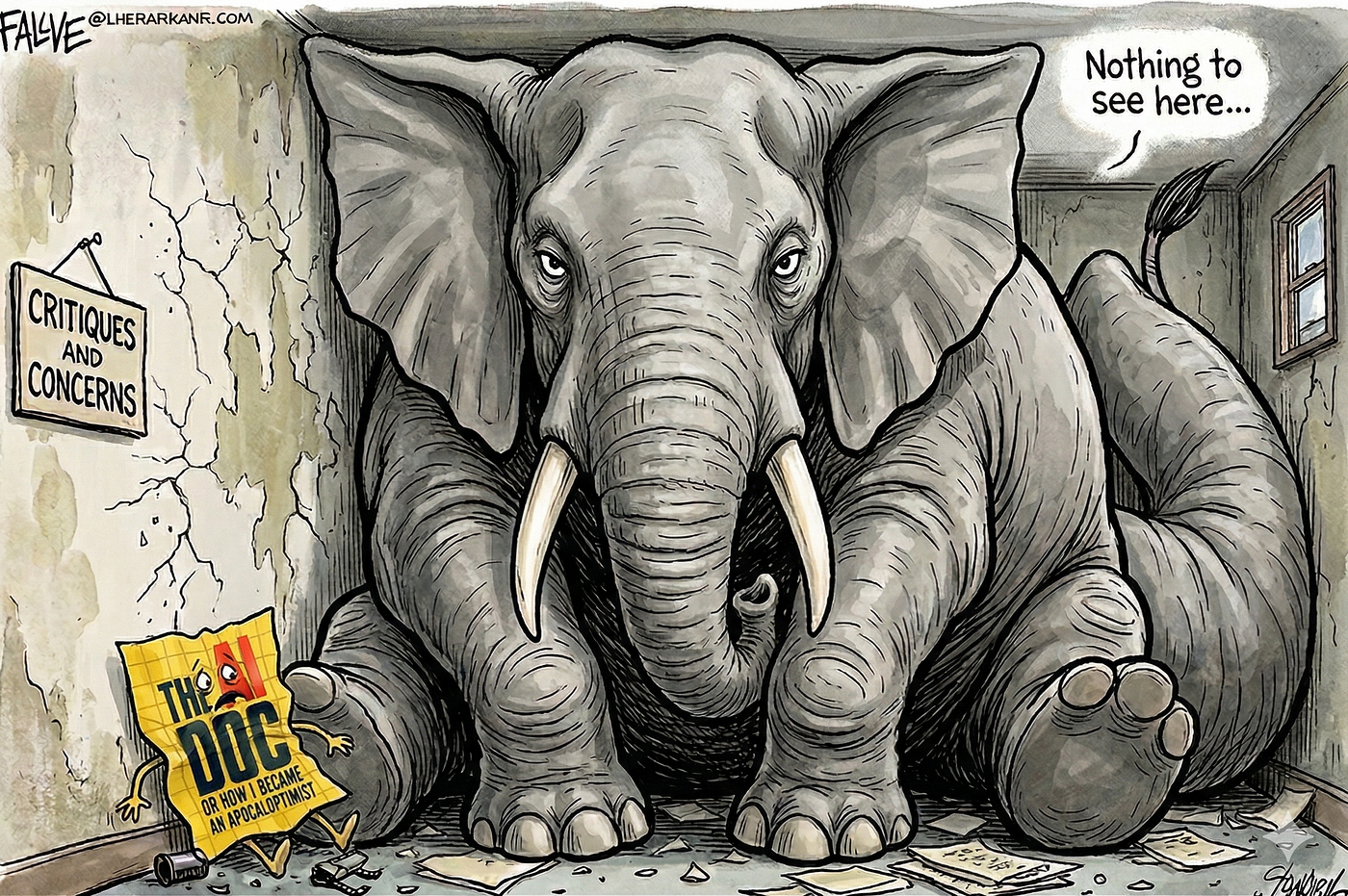
This is the obvious elephant in the room, and yet nowhere is it even acknowledged. Not once in the five minutes of experts mentioning the solutions to the problem that they would offer does anyone address the fundamental incapacity of our government to govern because our government is bought and those who own it are the five kings at the top of the mountain.
Or, if not today do they own it, tomorrow they will. We’ve already seen the capacity of super PACs to make sensible governance in America impossible. The Democratic base is wholly alienated from the leadership in the Democratic Party about Palestine because of a super PAC: AIPAC. Crypto policy in America went from flawed but in good faith to an insane system of deregulation because of a triumvirate of super PACs that flipped government policy in one election. Now AI-related super PACs promise to spend hundreds of millions of dollars to drive Congress to the policies it supports.
That part of the problem, of course, AI didn’t create. The part it did create was remarked upon by Sam Altman in a tweet at the end of 2024 when he said, “algorithmic feeds are the first at-scale misaligned AIs.”
What Altman was remarking was that social media, or more generally, engagement-based media, had rendered us democratically incoherent. AI does that — the simple, stupid AI at the core of the algorithms that choose what we see, what gets amplified, and what gets suppressed. Because of this AI, we just didn’t understand the problems that we as Americans had to face, and that was because the promise of our motto, e pluribus unum, has been betrayed. The AI-driven technology of social media means e pluribus semper plura — out of many, always many. We live in our own bespoke realities. We can’t understand together the common problems we face, and therefore we do not, as a nation, have the political capacity to rally to address and solve those problems together.
Maybe we did have that power before. In the age of broadcast democracy, enormous problems were addressed and solved through the struggles of a political process that balanced power against power: Vietnam, the environment, civil rights, Watergate. These were big problems that we took up and addressed. But to say that we can do it today because we did it then is to say that Mike Tyson could beat any competitor today because he could beat any competitor 40 years ago.
The fundamental truth is this: We have lost the capacity to govern. Until we address that loss, none of the big problems that this extraordinary film has identified will be problems that we solve.
The film comes incredibly close to acknowledging this in what, for me, was the most emotional part of the film. Right at the end of the beginning third, just as the Doomer narrative is wrapped most powerfully, Roher asks a range of technologists, all men, whether they want or would have children just now. None say that they would. The film pauses and waits as we watch the struggle of its central character, Tristan Harris. He seems to hold back tears as he thinks through that question, and then he delivers the most terrifying indictment: “Let’s be honest, I know people who work on AI risk who don’t expect their children to make it to high school.”
That’s terrifying because what he’s saying is that the people who know the most about this problem are the least convinced we can solve it. But then Harris tries to stand up a framing that gives him hope: “If we can be the most mature version of ourselves, there might be a way through this.” (That’s followed in the trailer by Aza Raskin, another co-founder of CHT, delivering, as he always does, a brilliantly succinct statement of where we are: “This is the last mistake we’ll ever get to make.”)
There are two ways to hear Harris’ statement: an optimistic way and a realistic way. The optimistic way is that it can be done, that we could in fact navigate this challenge and achieve the best despite the threat of the worst.
The realistic way to read that statement, however, was unavoidable at the moment we were all watching that film.
The premiere I saw was at the AMC Boston Common. I had come to the film after standing on the Common with tens of thousands of Americans participating in what was the largest single-day protest in the history of America. More people went to the streets that Saturday than have ever gone to the streets in America for anything, for any cause, ever before.
Many will read that protest as a protest against Donald Trump, and of course it was that. But it also marked a more fundamental point in Tristan Harris’s terms: that we are nowhere close to being “our most mature version of our selves.”
Yes, maybe. Maybe we could navigate this course. Maybe we could find a way through the Scylla and Charybdis that AI has given us. Maybe we could do that if we had the capacity to govern.
But so long as we live with this corrupted democracy, so long as we, the people, are informed through the high hits of engagement-based media, we will not have the capacity to govern. We can see our ship entering the straits with mines on all sides. That’s what this film shows us. But we should recognize that for all the energy devoted to solving the truly difficult challenges of figuring out how we might control superintelligent AI, we should devote at least a fraction of that energy to restoring our ability to actually steer the ship. To restoring the capacity for the most powerful government in the world to actually respond to facts and to respond in a way that is not sensitive to those who happen to have the most money on the field, but to the will and desires of ordinary citizens informed and deliberated in democratically meaningful ways.
The hardest problem in AI governance is not the AI part; it’s the governance part. And the most terrifying takeaway from this extraordinary film is that not even it could acknowledge this most fundamental problem. Better to think this is a technology problem. Sexier to think this is a technology problem. Because who is going to go to the theater to watch a movie about the fact that we, on the cusp of the 250th anniversary of our Declaration of Independence, and of our launching of the most extraordinary democracy humanity had then known, are now a failed democracy?
메타데이터
- post_id
- 4d0f5dc7973e
- slug
- review-the-ai-doc-4d0f5dc7973e
- url
- https://medium.com/@lessig/review-the-ai-doc-4d0f5dc7973e
- canonical_url
- https://medium.com/@lessig/review-the-ai-doc-4d0f5dc7973e
- author_url
- https://medium.com/@lessig
- status
- ok
- fetched_at
- 2026-06-11 15:16:29