Waterfall Model vs Agile Methodology: Understanding Modern Software Development
Introduction to SDLC
Waterfall Model vs Agile Methodology: Understanding Modern Software Development
Introduction to SDLC
Have you ever wondered how applications like Amazon, Netflix, or Google Pay are built and continuously improved? Behind every successful software product lies a structured development process known as the Software Development Life Cycle (SDLC). Over the years, organizations have adopted different SDLC approaches, with Waterfall and Agile emerging as the two most widely used methodologies. Understanding their differences is essential for software professionals, business analysts, and data analysts alike.
What is SDLC?
The Software Development Life Cycle (SDLC) is a structured framework used to plan, design, develop, test, deploy, and maintain software applications throughout their entire lifecycle.
It provides a systematic approach that helps organizations deliver reliable software while effectively managing time, cost, and quality.
Why is SDLC Important?
SDLC is important because it:
- Improves project planning and management
- Reduces development risks
- Ensures software quality
- Controls project costs and timelines
- Enhances collaboration among team members
- Increases customer satisfaction
Key Stages of SDLC
The SDLC typically consists of the following stages:
- Requirement Gathering
- Planning
- System Design
- Development
- Testing
- Deployment
- Maintenance
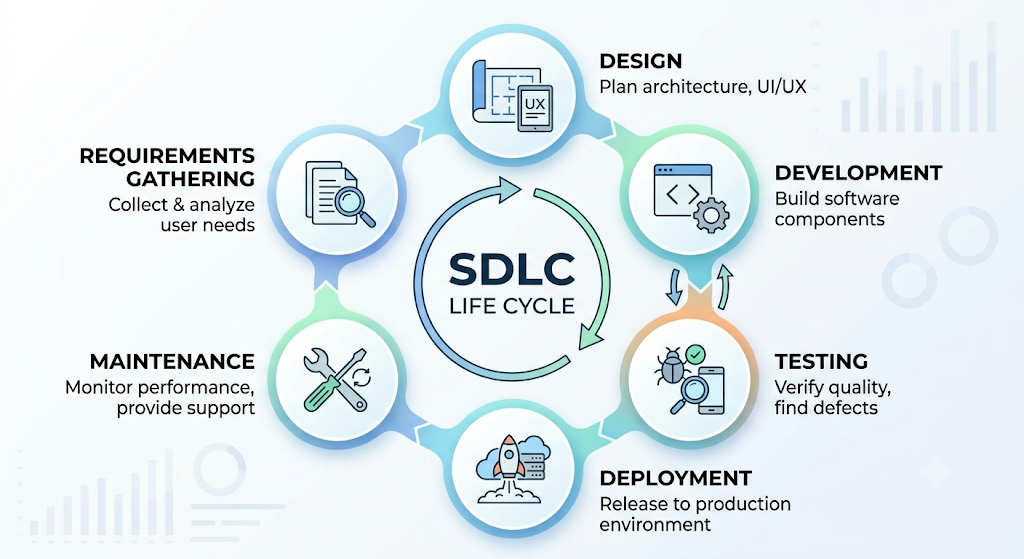
SDLC Lifecycle
Over the years, different SDLC methodologies have been developed. Two of the most widely used approaches are the waterfall model and Agile methodology.
Understanding the Waterfall Model
Definition
The Waterfall Model is a traditional software development methodology where project activities are completed in a sequential order. Each phase must be finished before moving to the next phase.
The development process flows downward like a waterfall, which is why it is called the Waterfall Model.
How It Works
The project progresses through the following phases:
Requirements → Design → Development → Testing → Deployment → Maintenance
Once a phase is completed, revisiting it becomes difficult and costly.
Advantages of Waterfall Model
The Waterfall Model offers several advantages, particularly for projects with clearly defined requirements and strict documentation needs.
- Simple and easy to understand
- Well-defined project structure
- Clear documentation at every stage
- Easy to manage timelines and budgets
- Suitable for projects with fixed requirements
Challenges of Waterfall Model
- Limited flexibility
- Difficult to accommodate requirement changes
- Customer involvement is minimal after requirement gathering
- Testing occurs late in the project
- Higher risk of discovering issues near project completion
Real-World Use Cases
Waterfall is commonly used in:
- Government projects
- Healthcare systems
- Defense applications
- Manufacturing software
- Regulatory compliance projects
These projects often have clearly defined requirements and strict documentation standards.
Understanding Agile Methodology
Definition
Agile is a modern software development methodology that focuses on flexibility, collaboration, and continuous improvement. Instead of building the entire product at once, Agile delivers software in small, incremental releases.
How Agile Works
Agile divides work into smaller units called iterations or sprints. Teams develop, test, and release features continuously while gathering customer feedback throughout the process.
Sprint Concept
A sprint is a short development cycle, usually lasting 1 to 4 weeks.
Each sprint includes:
- Sprint Planning
- Development
- Testing
- Review
- Retrospective
At the end of every sprint, a working version of the product is delivered.
Continuous Feedback Approach
One of Agile’s biggest strengths is continuous customer feedback.
Instead of waiting until project completion, customers review the product regularly and suggest improvements. This allows teams to make adjustments early and reduce risks.
Advantages of Agile
Agile offers several benefits. Because work is delivered in smaller increments, businesses can start receiving value much earlier. Continuous customer involvement helps teams identify issues quickly and adapt to changing requirements. This flexibility often leads to better product quality and higher customer satisfaction.
- Highly flexible
- Faster delivery of features
- Better customer involvement
- Early identification of issues
- Improved product quality
- Faster response to market changes
Challenges of Agile
Despite its advantages, Agile is not without challenges. Successful Agile implementation requires strong communication, active stakeholder participation, and continuous collaboration.
- Requires active stakeholder participation
- Project scope may change frequently
- Documentation may be less detailed
- Difficult to predict exact timelines for large projects
- Requires strong team collaboration

Agile Development Cycle
Waterfall vs Agile Comparison

The comparison clearly shows that Waterfall emphasizes predictability and documentation, while Agile prioritizes flexibility and customer collaboration. Organizations choose between these approaches based on project complexity, business needs, and the likelihood of changing requirements.
Real-World Project Example: E-Commerce Platform
Let’s consider an online shopping platform similar to Amazon or Flipkart.
How It Would Be Executed Using Waterfall
Phase 1: Requirement Gathering
The team collects all requirements, including:
- User registration
- Product catalog
- Shopping cart
- Payment gateway
- Order tracking
Phase 2: Design
System architecture and database design are completed.
Phase 3: Development
Developers build all features based on approved requirements.
Phase 4: Testing
The complete application is tested after development.
Phase 5: Deployment
The entire platform is released to users.
Limitation
If customers request a new feature during development, implementing it may significantly delay the project.
How It Would Be Executed Using Agile
Sprint 1
- User registration
- Login functionality
Sprint 2
- Product listing
- Product search
Sprint 3
- Shopping cart
Sprint 4
- Payment integration
Sprint 5
- Order tracking
After each sprint, customers review the product and provide feedback. Improvements are incorporated into future sprints.
Benefit
The business starts using valuable features much earlier instead of waiting for the entire project to finish.
For example, if customers request a wish list feature after Sprint 2, the requirement can simply be added to the product backlog and prioritized in a future sprint without disrupting the entire project.
Agile in Data Analytics & Business Analysis
Today, Agile has become the preferred methodology across many industries because businesses need faster delivery and quick adaptation to changing market demands.
Why Agile is Widely Used Today
Modern organizations face the following:
- Rapid technological changes
- Evolving customer expectations
- Competitive markets
- Frequent requirement changes
Agile helps organizations respond to these challenges efficiently.
Role of a Business Analyst in Agile Projects
A business analyst acts as a bridge between stakeholders and development teams.
Responsibilities include:
- Gathering requirements
- Writing user stories
- Prioritizing backlog items
- Clarifying business needs
- Participating in sprint planning sessions
- Supporting stakeholder communication
Role of a Data Analyst in Agile Projects
Data analysts contribute by:
- Analyzing business data
- Creating dashboards and reports
- Defining KPIs
- Supporting decision-making
- Providing insights during sprint reviews
- Validating data quality
Agile enables data analysts to deliver insights continuously instead of waiting until project completion.
For example, a Data Analyst may build an initial sales dashboard during one sprint, gather stakeholder feedback, and enhance the dashboard in future sprints based on business requirements.
Importance of Jira, Backlog, Sprint Planning, and Daily Standups
Jira
Jira is a project management tool used to track tasks, user stories, bugs, and sprint progress.
Product Backlog
A backlog is a prioritized list of features, improvements, and tasks that need to be completed.
Sprint Planning
Sprint Planning helps teams decide what work will be completed during the upcoming sprint.
Daily Standups
Daily standups are short meetings where team members discuss:
- What they completed yesterday
- What they will work on today
- Any blockers they are facing
These practices improve transparency, collaboration, and productivity.
Key Takeaways
- SDLC provides a structured framework for software development.
- The Waterfall Model follows a sequential approach and works best when requirements are stable.
- Agile methodology focuses on iterative development and continuous feedback.
- Agile enables faster delivery and easier adaptation to change.
- Business Analysts and Data Analysts play important roles in Agile teams.
- Tools such as Jira help teams manage sprints, backlogs, and collaboration effectively.
Key Learnings & Conclusion
Understanding SDLC methodologies is essential for anyone pursuing a career in software development, business analysis, or data analytics.
The waterfall model provides a structured and predictable approach that works well when requirements are stable and clearly defined. However, its rigid nature makes it difficult to handle changing business needs.
Agile methodology offers greater flexibility, continuous customer involvement, and faster delivery of value. This is why Agile has become the preferred choice for many modern organizations.
One key insight I gained from this comparison is that there is no universally "best" methodology. Waterfall works effectively when requirements are stable and well-defined, while Agile excels in environments where change is frequent and customer feedback is critical. As businesses continue to evolve rapidly, Agile has become the preferred choice for many organizations, but understanding both approaches remains essential for every aspiring technology professional.
For aspiring business analysts and data analysts, understanding Agile concepts such as Jira, backlogs, sprint planning, and daily standups is increasingly important because these practices are widely used in modern workplaces.
Ultimately, both Waterfall and Agile aim to deliver successful projects. The key difference lies in how they approach planning, execution, and change management.
메타데이터
- post_id
- 4d167944f892
- slug
- waterfall-model-vs-agile-methodology-understanding-modern-software-development-4d167944f892
- url
- https://medium.com/@sampathsanju97/waterfall-model-vs-agile-methodology-understanding-modern-software-development-4d167944f892
- canonical_url
- https://medium.com/@sampathsanju97/waterfall-model-vs-agile-methodology-understanding-modern-software-development-4d167944f892
- author_url
- https://medium.com/@sampathsanju97
- status
- ok
- fetched_at
- 2026-07-16 22:36:45