Queue Detection Using YOLO
Introduction: In today’s fast-paced world, optimizing processes is crucial for efficiency. Queue detection, pivotal in sectors from retail…
Queue Detection Using YOLO
Introduction: In today’s fast-paced world, optimizing processes is crucial for efficiency. Queue detection, pivotal in sectors from retail to transportation, can be significantly improved using advanced technologies like YOLO (You Only Look Once). This blog explores how YOLO can revolutionize queue management, offering real-time insights and actionable data.
1. Understanding Queue Detection: Queue detection involves identifying and analyzing queues or lines of people or objects waiting for service. Traditional methods rely on manual observation or basic computer vision techniques, which are often limited in accuracy and scalability. Automated queue detection using YOLO addresses these challenges by providing real-time, accurate detection and monitoring capabilities.
2. Introduction to YOLO: YOLO (You Only Look Once) is an advanced real-time object detection system. Unlike traditional approaches that involve multiple stages (like region proposal and feature extraction), YOLO performs object detection in a single step. This makes it extremely fast and suitable for applications where real-time performance is crucial, such as queue management in dynamic environments.
3. Implementing YOLO for Queue Detection:
Data Preparation:
- Dataset Annotation: Prepare a dataset of images where queues are annotated with bounding boxes. Tools like roboflow allow you to manually annotate images and export annotations in formats readable by YOLO.
- Data Augmentation: Enhance the diversity of your dataset through techniques like rotation, flipping, and scaling to improve the robustness of the trained model.
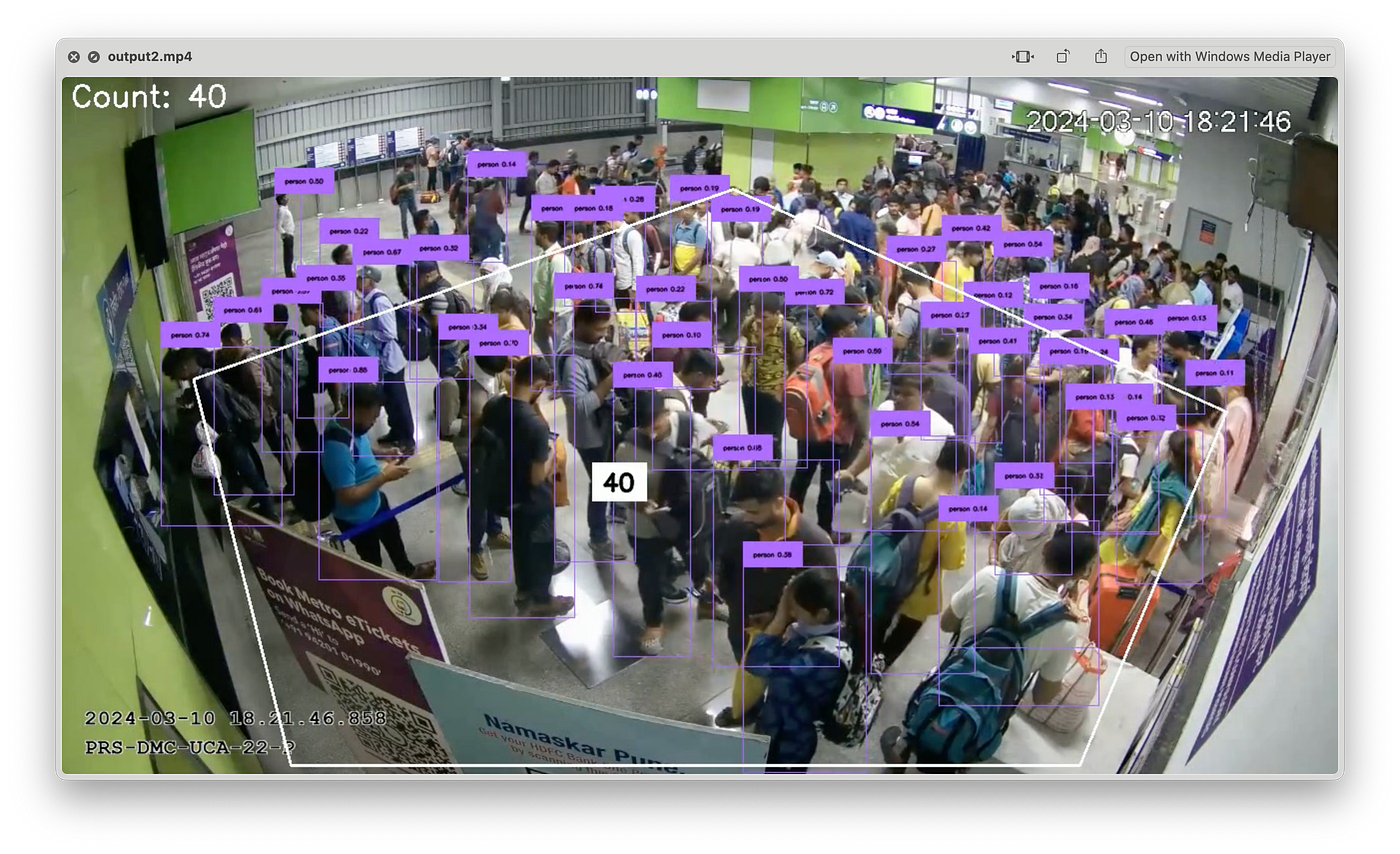
Training Process:
- Choosing YOLO Version: Select a YOLO version (e.g., YOLOv8, YOLOv9) based on your hardware capabilities and accuracy requirements. Newer versions often offer improved performance and accuracy.
- Configuring YOLO: Adjust configuration files (
yolov8.cfg,yolov9.cfg) to define the neural network architecture, including the number of classes (queues) to detect and input image dimensions. - Training on GPU: YOLO training is computationally intensive and benefits greatly from GPU acceleration. Utilize frameworks like TensorFlow or Darknet with CUDA and cuDNN enabled to accelerate training speed.

Fine-tuning and Evaluation:
- Transfer Learning: Start with a pretrained YOLO model (trained on a large dataset like COCO) and fine-tune it on your specific queue detection dataset. This process helps the model adapt to your unique data characteristics.
- Evaluation Metrics: Measure the performance of your trained model using metrics such as precision, recall, and mean Average Precision (mAP) on a validation set. These metrics indicate how well the model detects queues under different conditions and perspectives.
4. Real-world Applications
- Retail: Optimize checkout processes by monitoring queue lengths in real-time and dynamically allocating resources.
- Transportation: Manage queues at ticket counters or security checkpoints efficiently, improving passenger flow and reducing waiting times.
- Healthcare: Monitor patient queues in hospitals or clinics, ensuring timely service and resource allocation based on real-time demand.
5. Enhancing Efficiency and Customer Experience:
Implementing YOLO for queue detection offers several benefits:
- Real-time Monitoring: Continuous monitoring of queue dynamics allows for immediate response to changes in queue length or structure.
- Operational Efficiency: Automate queue management processes, minimizing human intervention and optimizing resource allocation based on real-time data insights.
- Improved Customer Experience: Reduced wait times and efficient service management contribute to enhanced customer satisfaction and loyalty.
6. Future Trends and Innovations
- Edge Computing: Deploy YOLO models on edge devices for real-time inference without relying on cloud services, enhancing scalability and reducing latency.
- Multi-camera Integration: Integrate YOLO with multiple camera feeds to monitor queues across larger areas or multiple locations simultaneously, facilitating comprehensive queue management solutions.
Conclusion: YOLO’s application in queue detection showcases the transformative potential of AI in optimizing operational processes. By leveraging advanced object detection capabilities, organizations can streamline operations, enhance customer experiences, and maintain competitiveness in dynamic market environments.
메타데이터
- post_id
- 4d1f8d2194d1
- slug
- queue-detection-using-yolo-4d1f8d2194d1
- url
- https://medium.com/@snehalshetye10/queue-detection-using-yolo-4d1f8d2194d1
- canonical_url
- https://medium.com/@snehalshetye10/queue-detection-using-yolo-4d1f8d2194d1
- author_url
- https://medium.com/@snehalshetye10
- status
- ok
- fetched_at
- 2026-07-22 06:28:09