On this day in history: Palmyra’s last guardian
18 August 2015
On this day in history: Palmyra’s last guardian
18 August 2015
On 18 August 2015, a story came from the Syrian desert city of Palmyra. But this story was not imaginary or an ancient legend. It was about a real-life hero called Khaled al-Asaad.
Al-Asaad was killed by fighters from the Islamic State (ISIS) after he refused to disclose the location of artefacts that he had hidden to protect them from destruction or vandalism. He was 83 years old.
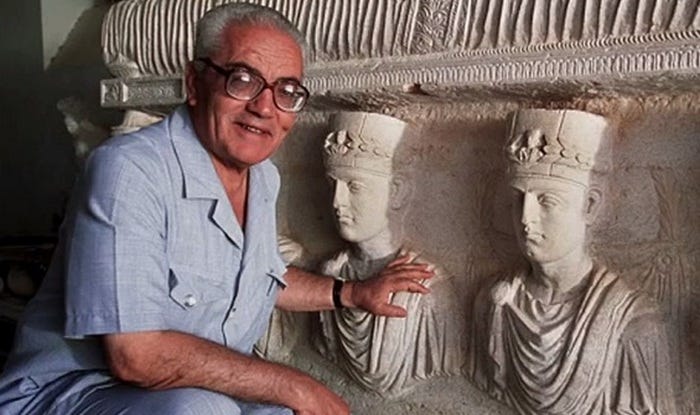
AL-Asaad in front of an ancient sarcophagus (2002) (photography by Marc Deville) — Reddit
For more than 40 years, Khaled had worked to preserve the ancient city’s ruins, documenting its history, guiding research, and helping to safeguard one of the most significant archaeological sites in the Middle East and the world. His death marked not only the loss of a one-of-a-kind scholar, but also the sighting of a man whose life traced the relics of the ancient civilisations that once stood on his land. This day marked the end of how people see and feel the city.
“Working in the Palmyra museum didn’t feel like a normal job,” said Saleem, one of the staff members who worked with Al-Asaad. “Every object had a story. You felt connected to something much bigger than yourself.”
[embed]

The Great Colonnade of Palmyra Credit: james_gordon_losangeles
Pearl of the Desert, whose culture?
Palmyra, an ancient oasis city in Syria (in Arabic, Tadmor), was a vital commercial hub on the Silk Road, connecting the Roman Empire with the East. Situated between the Euphrates River and the Mediterranean coast, it thrived as a caravan city in the first few centuries AD, facilitating the trade of luxury goods while blending Greco-Roman and Persian cultures. The remains of the city include large temples, long rows of stone columns, and open spaces that once formed part of a thriving urban centre. In 1980, Palmyra was recognised as a UNESCO World Heritage Site for its cultural and historical importance. Before the war in Syria started, visitors came from across the world. For those who lived nearby, however, the ruins were not something distant or unfamiliar.
“When tourists came from around the world, we felt proud to show them the story of our city.” Saleem said. “Palmyra was not just ruins in the desert. It was part of who we were.”

Asaad giving the King and Queen of Spain (Juan Carlos and Sofia) a tour of the Palmyra ruins (2015) (photography by Abaca Press)- Reddit
A life dedicated to a lofty goal Khaled al-Asaad was born in Palmyra in 1932. Over the course of his career, he became one of the leading specialists on the site. As director of antiquities, he oversaw excavations and worked with international teams studying the city. But his role extended beyond academic work. He was also a constant presence in Palmyra itself.
“People respected him not only because of his knowledge,” said Saleem, “but because he stayed committed to the city for so many years. He never separated himself from it.”
His work helped ensure that Palmyra was not only studied but also understood, both locally and internationally. Even after his retirement in 2003, he continued working at the museum and conducting historical research, helping many students and other researchers from all over the world.

Google maps
When Palmyra came under attack In May 2015, fighters from ISIS launched an offensive on Palmyra, eventually taking control of both the modern town and the ancient site.
The attack raised immediate international concern, not only because of the threat to civilians, but also because of the group’s record of targeting cultural heritage. Alongside the destruction of monuments, ISIS was widely reported to have looted archaeological sites and trafficked artefacts, selling them on the black market to generate revenue. These activities were seen as part of a broader strategy to finance their operations. For those inside the city, the situation unfolded quickly and with growing fear.
“ People were worried, not only for themselves, but for what might happen to the city,” Saleem said. “I left the city because I was afraid for my life, I’m not gonna lie”
In the days before and during the takeover, efforts were made to move museum artefacts to safer locations. But much of Palmyra’s heritage — its temples, columns and monumental structures — could not be removed or hidden, leaving them exposed as both symbols and targets.

Waleed Alassad, Khaled’s son with his father’s picture — credit: SANA
A decision under pressure After ISIS took control of the city, Khaled al-Asaad was detained. Reports indicate that he was questioned about the location of artefacts he had hidden to prevent them from being looted or destroyed. He did not provide that information. On 18 August 2015, he was executed. His death was widely reported and condemned internationally. For those who knew him, it was also a deeply personal moment.
“When the news came that he had been killed, it was very painful. I couldn’t believe it! ” Saleem said. “I cried for days; it was really hard to process.”
damage to the site Following the takeover, ISIS carried out acts of destruction across parts of Palmyra. Several major structures were damaged or destroyed, including the Temple of Bel and other historic features that had stood for centuries. Images of the destruction circulated widely, prompting reactions from governments and international organisations concerned with cultural heritage.
“It wasn’t only about losing buildings,” Saleem said. “It felt like losing something that belonged to all of us.”

The Monumental Arch of Palmyra Credit: SANA
Developments after 2015 In February 2021, Syrian authorities announced that remains believed to belong to Khaled al-Asaad had been discovered near Palmyra, several years after his death.
The announcement brought renewed attention to the events of 2015 and the individuals connected to them.
[embed]
“What happened in Palmyra is something we will always remember,” Saleem said. “Not only because of the destruction, but because of the people who tried to protect it.”
Nearly a decade later, the city still rises from the desert — changed, but not erased. Its ruins carry the marks of both history and conflict, while the story of Khaled al-Asaad endures as a reminder of what was defended and what was lost.
메타데이터
- post_id
- 4d32470d4e99
- slug
- hero-of-palmyra-4d32470d4e99
- url
- https://westminsterworld.com/hero-of-palmyra-4d32470d4e99
- canonical_url
- https://westminsterworld.com/hero-of-palmyra-4d32470d4e99
- author_url
- https://medium.com/@nouraa.y.mh
- status
- ok
- fetched_at
- 2026-07-08 02:40:31