Forecasting Mortgage Rates with Machine Learning and Macro Scenarios
Building a data-driven mortgage rate forecasting system with probabilistic outcomes
Forecasting Mortgage Rates with Machine Learning and Macro Scenarios
Building a data-driven mortgage rate forecasting system with probabilistic outcomes
Mortgage rates are driven by a combination of macroeconomic and market forces. Mortgage rates play a central role in housing affordability, consumer decisions, and the broader economy. Yet their behavior is difficult to forecast with consistency.
Most approaches rely on simple heuristics or short-term statistical models. These methods can work over short horizons, but they tend to break down over longer periods when macroeconomic forces begin to dominate. In this project, I built a forecasting system designed to address that gap. The goal was not just to predict the next move in mortgage rates, but to understand how they might evolve under different economic conditions.
The system combines three ideas:
- A structural decomposition of mortgage rates into underlying components
- Machine learning models for short-term prediction
- A scenario-based simulation framework for long-term uncertainty
This transforms a single prediction into a distribution of possible outcomes over the next year.
Decomposing Mortgage Rates
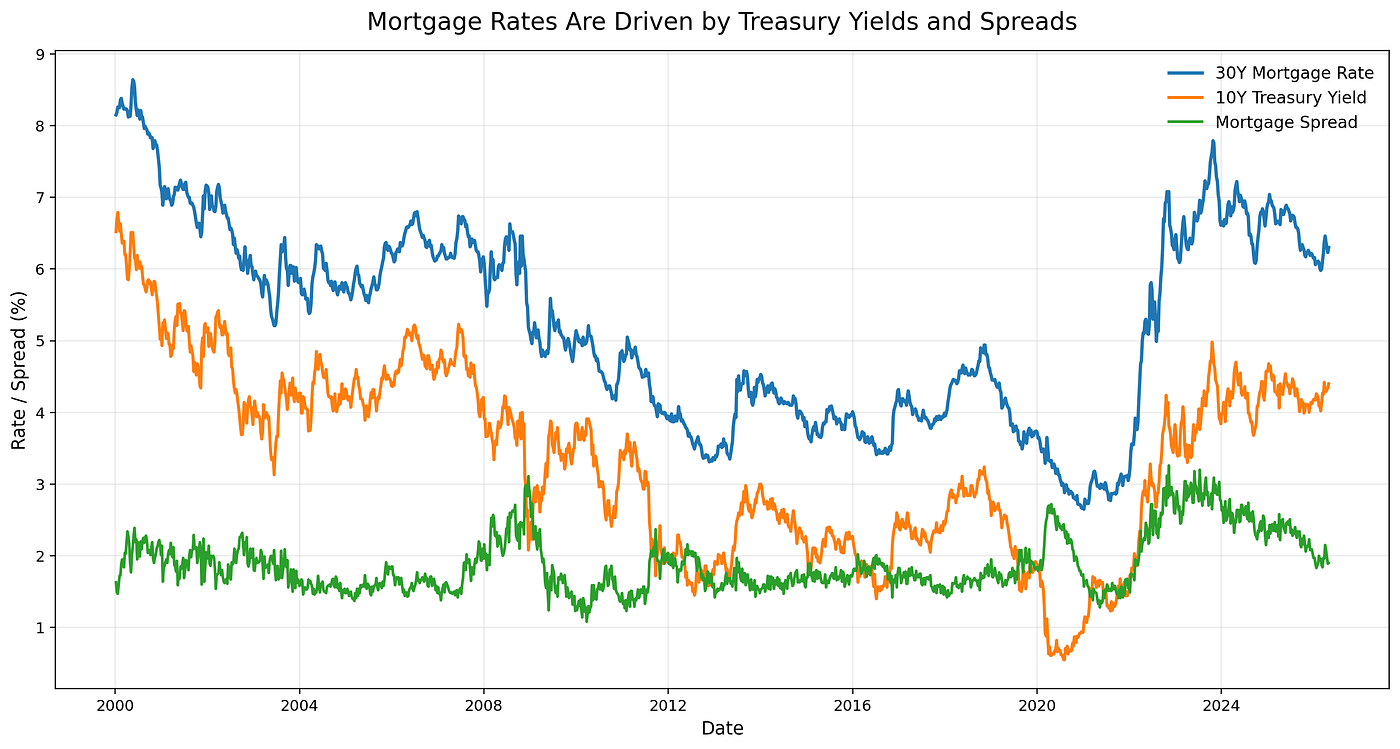
Instead of forecasting mortgage rates directly, I modeled them as:
Mortgage Rate = 10-Year Treasury Yield + Mortgage Spread
This decomposition provides a clearer structure:
- The 10-year Treasury yield reflects macroeconomic conditions and monetary policy
- The mortgage spread captures credit risk, liquidity, and market stress
Modeling these components separately improves both predictive performance and interpretability.
Building the Models
Using macroeconomic and financial data from Federal Reserve Economic Data, I trained two models:
- One model predicts changes in the 10-year Treasury yield
- One model predicts changes in the mortgage spread
The feature set includes:
- Yield curve data
- Volatility indicators such as the VIX
- Credit spreads
- Rolling statistics and momentum features
dgs10_model = Pipeline([
    ("scaler", StandardScaler()),
    ("ridge", Ridge(alpha=1000)),
])

spread_model = Pipeline([
    ("scaler", StandardScaler()),
    ("ridge", Ridge(alpha=500)),
])

dgs10_model.fit(X_dgs10_train, y_dgs10_train)
spread_model.fit(X_spread_train, y_spread_train)
For short-term horizons between one and four weeks, this approach consistently outperformed baseline models.

The Problem with Long-Term Forecasts
As the horizon extends to twelve months, the problem changes.
Point forecasts become less reliable because:
- Macroeconomic regimes shift
- Uncertainty compounds over time
- Multiple future paths become plausible
So instead of asking:
“What will mortgage rates be in twelve months?”
A better question is:
“What range of outcomes is realistically possible?”

A Better Approach: Scenario-Based Monte Carlo
To answer that question, I built a Monte Carlo simulation framework.
Each simulated path evolves over 52 weeks using:
- Predictions from the trained models
- Random shocks calibrated from historical residuals
Mean reversion:
- Treasury yields move toward a long-run equilibrium near 4 to 4.5 percent
- Mortgage spreads move toward their historical averages
The key addition is the use of macroeconomic scenarios. This shifts the problem from predicting a single path to understanding how different economic conditions shape the range of outcomes.

Modeling Economic Scenarios
The simulation incorporates five scenarios:

Each scenario changes the behavior of:
- Interest rate drift
- Spread dynamics
- Volatility
From Scenarios to Probabilities
Each scenario is assigned a probability weight. These weights represent a structured macroeconomic view rather than a model output.
Example weighting:
- Base Case: 40 percent
- Higher-for-Longer: 25 percent
- Soft Landing: 20 percent
- Recession: 10 percent
- Financial Stress: 5 percent
This setup captures:
- Inflation persistence risk
- Downside risk from economic contraction
- Tail risk from financial instability
Results: A Distribution, Not a Point Estimate
The simulation produces a full distribution of possible mortgage rate paths.
Here’s the 12-month forecast across different economic views:
At the 52-week horizon:
- Median forecast: ~6.4%
- Central range (25th–75th): ~5.9% to ~7.0%
- Wider range (5th–95th): ~5.1% to ~7.8%

Interpreting the Results
Several patterns emerge:
1. Rates remain elevated in most scenarios
Mortgage rates cluster in the mid-6 percent range across the majority of simulations.
2. Inflation persistence drives higher outcomes
Higher-for-longer scenarios push rates upward through sustained Treasury yields.
3. Recession lowers rates, but not dramatically
Falling yields are partially offset by wider spreads.
4. Tail risk is asymmetric
Financial stress scenarios increase rates through spread expansion.

Why This Approach Matters
Traditional models produce a single number. This framework produces a range of outcomes with associated probabilities.
That distinction is important. It reflects how professional investors and macroeconomic analysts approach forecasting. Short-term forecasting focuses on precision. Long-term forecasting focuses on distributions.
Conclusion
This project began as a machine learning exercise and evolved into a broader forecasting system:
- A decomposed model of mortgage rates
- A macro-aware simulation engine
- A probabilistic view of future outcomes
Instead of trying to predict a single value, the system provides a more realistic answer:
“Here is what is likely, and here is what could happen.”
Github repo can be found here:
메타데이터
- post_id
- 4d3608d5f3fe
- slug
- forecasting-mortgage-rates-with-machine-learning-and-macro-scenarios-4d3608d5f3fe
- url
- https://medium.com/@mattsomm/forecasting-mortgage-rates-with-machine-learning-and-macro-scenarios-4d3608d5f3fe
- canonical_url
- https://medium.com/@mattsomm/forecasting-mortgage-rates-with-machine-learning-and-macro-scenarios-4d3608d5f3fe
- author_url
- https://medium.com/@mattsomm
- status
- ok
- fetched_at
- 2026-06-09 15:37:30




