A/B Testing Your Ranking Algorithm: Data Science for Feed Engagement
A/B Testing Your Ranking Algorithm: Data Science for Feed Engagement
A/B Testing Your Ranking Algorithm: Data Science for Feed Engagement
A/B Testing Your Ranking Algorithm: Data Science for Feed Engagement
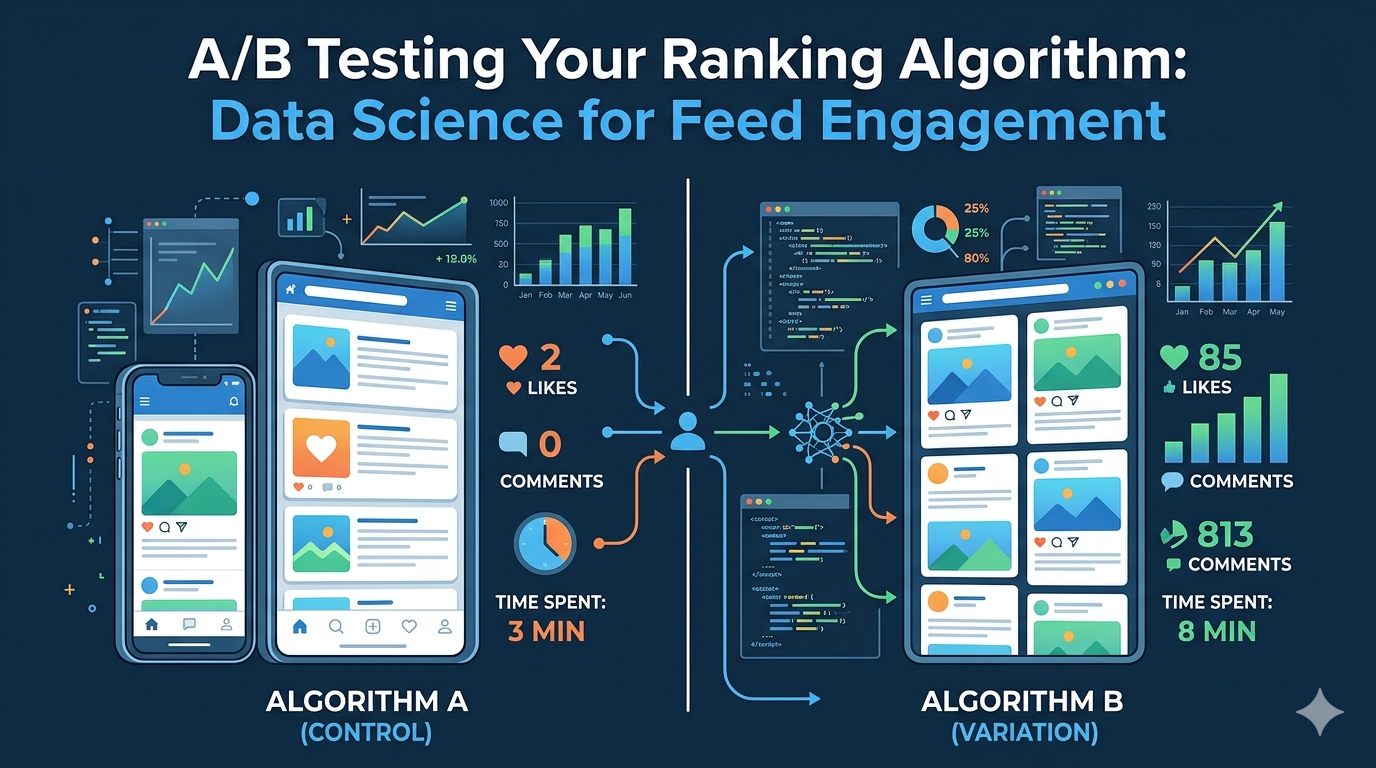
Social media applications compete for one thing above all else: attention. Every swipe, click, pause, share, or comment is influenced by one invisible system — the feed ranking algorithm. Whether users stay engaged or abandon an app often depends on how effectively content is surfaced at the right moment.
In today’s highly competitive social media ecosystem, relying on intuition to improve feeds is no longer enough. Product teams increasingly depend on ranking algorithm A/B testing social apps methodologies to improve user retention, content discovery, and overall platform engagement.
By combining experimentation frameworks with data science, developers can continuously refine feed performance, improve personalization, and maximize meaningful interactions. This guide explores how A/B testing helps optimize ranking systems and why data-driven feed design is essential for modern social platforms.
What Is a Feed Ranking Algorithm?
A feed ranking algorithm determines the order in which users see content inside a social application.
Instead of showing posts chronologically, modern social platforms prioritize relevance by predicting which content users are most likely to engage with.
Popular social apps use ranking algorithms to organize:
- News feeds
- Video recommendations
- Stories and reels
- Community discussions
- Sponsored content
The ultimate goal is simple: maximize user satisfaction while improving platform engagement.
Chronological vs Algorithmic Feeds
Historically, feeds displayed content in the order it was published.
Chronological Feed
- Shows newest content first
- Simple implementation
- Minimal personalization
However, chronological feeds often overwhelm users with irrelevant content.
Algorithmic Feed
- Prioritizes relevance over time
- Uses behavioral signals
- Personalizes recommendations
Modern social media apps heavily favor algorithmic ranking because it improves engagement and retention.
Key Inputs Behind Ranking Algorithms
Ranking systems analyze hundreds of signals.
Common ranking features include:
User Behavior Signals
- Likes
- Shares
- Watch time
- Scroll depth
- Previous interactions
Content Quality Signals
- Engagement velocity
- Post freshness
- Creator reputation
Relationship Signals
- Friend interactions
- Follow history
- Shared interests
Together, these variables support advanced ranking optimization strategies.
Why Ranking Algorithms Need A/B Testing
Feed ranking systems constantly evolve because user behavior changes over time.
Without experimentation, developers risk optimizing feeds based on assumptions rather than actual outcomes.
Why Static Ranking Models Fail
A ranking model that performs well today may become ineffective tomorrow.
Challenges include:
- Changing user interests
- Viral content shifts
- Seasonal engagement patterns
- Platform growth
One-size-fits-all ranking often reduces relevance for different user groups.
User Behavior Is Unpredictable
Not all users engage similarly.
For example:
Casual Users
- Shorter sessions
- Passive browsing habits
Power Users
- High posting activity
- Frequent interactions
A single ranking strategy rarely works equally for all audiences.
How A/B Testing Solves Ranking Problems
A/B testing compares multiple feed-ranking approaches using live user behavior.
Instead of guessing, teams can validate:
- Which ranking signals improve retention
- Whether personalization boosts engagement
- How feed changes affect session duration
This makes ranking algorithm A/B testing social apps a core strategy for feed improvement.
Core Components of Ranking Optimization
Effective ranking systems combine multiple scoring models to prioritize relevant content.
Relevance Scoring Systems
Ranking engines assign scores to content based on predicted user interest.
Scoring often considers:
- Past interactions
- Similar user behavior
- Engagement likelihood
Higher scores mean higher feed visibility.
Engagement Prediction Models
Machine learning models estimate user actions such as:
- Likes
- Comments
- Shares
- Watch completion
This prediction layer helps maximize engagement opportunities.
Balancing Recency and Relevance
One major challenge in ranking optimization is deciding whether to prioritize:
Fresh Content
or
Highly Relevant Content
Most platforms use time-decay systems where older content gradually loses visibility unless engagement remains strong.
Personalization Signals
Modern feed systems heavily personalize experiences.
Signals may include:
- Follow graph relationships
- Device behavior
- Location-based interests
- Session history
Behavioral clustering groups users into similar preference categories.
Exploration vs Exploitation
Platforms must balance:
Exploitation
Showing content users already enjoy.
Exploration
Introducing new creators or content categories.
Too much exploitation causes repetitive feeds, while excessive exploration reduces relevance.
How Data Science Powers Feed Ranking Experiments
Modern social apps generate enormous volumes of behavioral data.
This is where data science becomes essential.
Collecting User Interaction Data
Every action becomes a ranking signal.
Common tracked events include:
- Feed impressions
- Scroll velocity
- Time spent on posts
- Click-through behavior
- Video completion rate
This data fuels experimentation models.
Key Metrics for Ranking Evaluation
Several KPIs determine ranking success.
Click-Through Rate (CTR)
Measures how often users interact with surfaced content.
Session Duration
Tracks how long users remain active.
Retention Rate
Measures repeat visits across days or weeks.
Interaction Ratio
Combines:
- Likes
- Comments
- Shares
- Saves
Higher interaction ratios often signal stronger feed quality.
Dwell Time
Measures how long users pause on content.
Dwell time has become increasingly important for ranking accuracy.
Machine Learning in Ranking Systems
Social platforms rely heavily on machine learning.
Popular approaches include:
Collaborative Filtering
Recommends content based on similar user behavior.
Deep Learning Ranking Models
Analyze complex engagement patterns.
Reinforcement Learning
Continuously adjusts ranking based on user feedback loops.
Feature Engineering for Feed Models
Feature engineering transforms raw data into ranking signals.
Examples include:
- Post freshness score
- Engagement momentum
- User affinity score
- Creator relevance index
Well-designed features dramatically improve feed performance.
Continuous Learning Systems
Modern ranking engines adapt in real time.
They constantly retrain models using:
- User feedback
- Engagement shifts
- Trending topics
This creates adaptive feed systems capable of evolving automatically.
Designing A/B Tests for Ranking Algorithms
Successful ranking experiments require structured testing frameworks.
Step 1: Define Experiment Objectives
Every test must align with business goals.
Common objectives include:
- Increasing retention
- Improving engagement
- Boosting content discovery
- Increasing ad interaction rates
Without clear objectives, experiments produce misleading outcomes.
Step 2: Create Ranking Variants
Teams typically compare multiple feed models.
Variant A: Chronological Feed
Focuses on freshness.
Variant B: Relevance-Based Feed
Uses engagement prediction.
Variant C: Hybrid Model
Balances freshness with personalization.
This comparison reveals which system produces stronger results.
Step 3: Segment Users Properly
Segmentation prevents biased outcomes.
Typical segments include:
New Users
Require onboarding-friendly feeds.
Active Users
Prefer highly personalized experiences.
Power Creators
Need visibility optimization.
Geographic Segments
Different regions engage differently.
Step 4: Randomization and Control Groups
Random assignment ensures fairness.
Without proper randomization:
- Bias increases
- Data becomes unreliable
- Results become misleading
Step 5: Run Experiments at Scale
Large social apps handle millions of feed requests.
Testing frameworks must support:
- Real-time logging
- High throughput systems
- Low-latency experimentation
Infrastructure scalability is critical.
Step 6: Evaluate Statistical Significance
Winning variants should be selected based on:
- Confidence intervals
- Lift percentage
- Engagement improvement
- Retention gains
Data-backed validation reduces decision risk.
Common Mistakes in Ranking Algorithm A/B Testing
Even advanced companies make experimentation errors.
Testing Too Many Variables
Changing:
- Ranking score formula
- Content freshness
- Ad frequency
simultaneously makes attribution impossible.
Ignoring Long-Term Metrics
Short-term clicks can be misleading.
For example:
- Clickbait increases CTR
- But reduces retention
Long-term engagement matters more.
Poor User Segmentation
Combining all users into one experiment often hides meaningful trends.
Different users react differently to feed ranking.
Overfitting to Click Metrics
Focusing only on clicks can create poor experiences.
Platforms should optimize for:
- Meaningful engagement
- Watch quality
- Session satisfaction
not vanity metrics alone.
Real-World Examples of Ranking Optimization
Many successful platforms continuously test ranking systems.
Short-Video Platforms
Video apps prioritize:
- Watch completion
- Replay behavior
- Scroll pauses
These signals improve recommendation accuracy.
Social Networking Platforms
Social feeds often prioritize:
- Friend interactions
- Shared interests
- Content recency
Discovery Platforms
Content discovery apps rely on hybrid recommendation engines combining:
- Personalization
- Trend signals
- Behavioral predictions
Continuous experimentation improves relevance.
Tools and Infrastructure for Ranking Experiments
Building feed-ranking systems requires scalable technology stacks.
Common technologies include:
Data Streaming
- Apache Kafka
Processing Systems
- Apache Spark
- Flink
Machine Learning
- TensorFlow
- PyTorch
Experimentation Platforms
- Optimizely
- Internal testing systems
Analytics Platforms
- Amplitude
- Mixpanel
Together, these systems support scalable data science experimentation.
How Development Partners Improve Ranking Systems
Building advanced ranking engines requires expertise across backend systems, machine learning, analytics, and experimentation infrastructure.
This is where **social media app development services** become valuable. These services help companies implement:
- Personalized feed systems
- Scalable ranking pipelines
- Experimentation frameworks
- Behavioral analytics tracking
- AI-driven recommendation engines
Businesses that invest in expert development partnerships often reduce experimentation costs and improve ranking accuracy faster.
Why Businesses Choose JPLoft for Social App Intelligence
Many companies collaborate with JPLoft because they specialize in building scalable, engagement-focused digital ecosystems.
They help businesses develop advanced social applications powered by:
- AI-driven ranking systems
- Real-time analytics pipelines
- User behavior tracking frameworks
- Machine learning recommendation models
- Engagement-focused experimentation tools
They also support businesses in implementing ranking algorithm A/B testing social apps frameworks that continuously optimize feed relevance and improve retention.
Their focus on scalable infrastructure and behavioral intelligence helps companies transform basic feeds into highly personalized engagement systems.
Conclusion: Feed Ranking Is a Continuous Experiment
The future of social media feeds is deeply connected to experimentation, personalization, and machine learning.
Successful platforms no longer rely on assumptions. Instead, they depend on ranking algorithm A/B testing social apps methodologies to continuously improve feed quality and engagement.
By combining ranking optimization, behavioral analytics, and data science, businesses can create smarter feed systems that adapt to evolving user preferences in real time.
As competition increases, social platforms that continuously test, learn, and optimize ranking systems will be best positioned to improve retention, maximize engagement, and deliver stronger long-term growth.
메타데이터
- post_id
- 4d397cf64963
- slug
- a-b-testing-your-ranking-algorithm-data-science-for-feed-engagement-4d397cf64963
- url
- https://medium.com/@strackajmesh786/a-b-testing-your-ranking-algorithm-data-science-for-feed-engagement-4d397cf64963
- canonical_url
- https://medium.com/@strackajmesh786/a-b-testing-your-ranking-algorithm-data-science-for-feed-engagement-4d397cf64963
- author_url
- https://medium.com/@strackajmesh786
- status
- ok
- fetched_at
- 2026-06-09 15:37:30