Why the Number Seven Is So Sacred to Hindus
In Hinduism, the number seven, or Sapta, appears so often that it almost seems woven into the very fabric of existence.
Why the Number Seven Is So Sacred to Hindus
In Hinduism, the number seven, or Sapta, appears so often that it almost seems woven into the very fabric of existence.
From the womb to the cosmos, from music to spirituality, from sacred geography to human consciousness, seven repeatedly emerges as a symbol of completeness, balance, and divine order.
The journey begins even before birth.
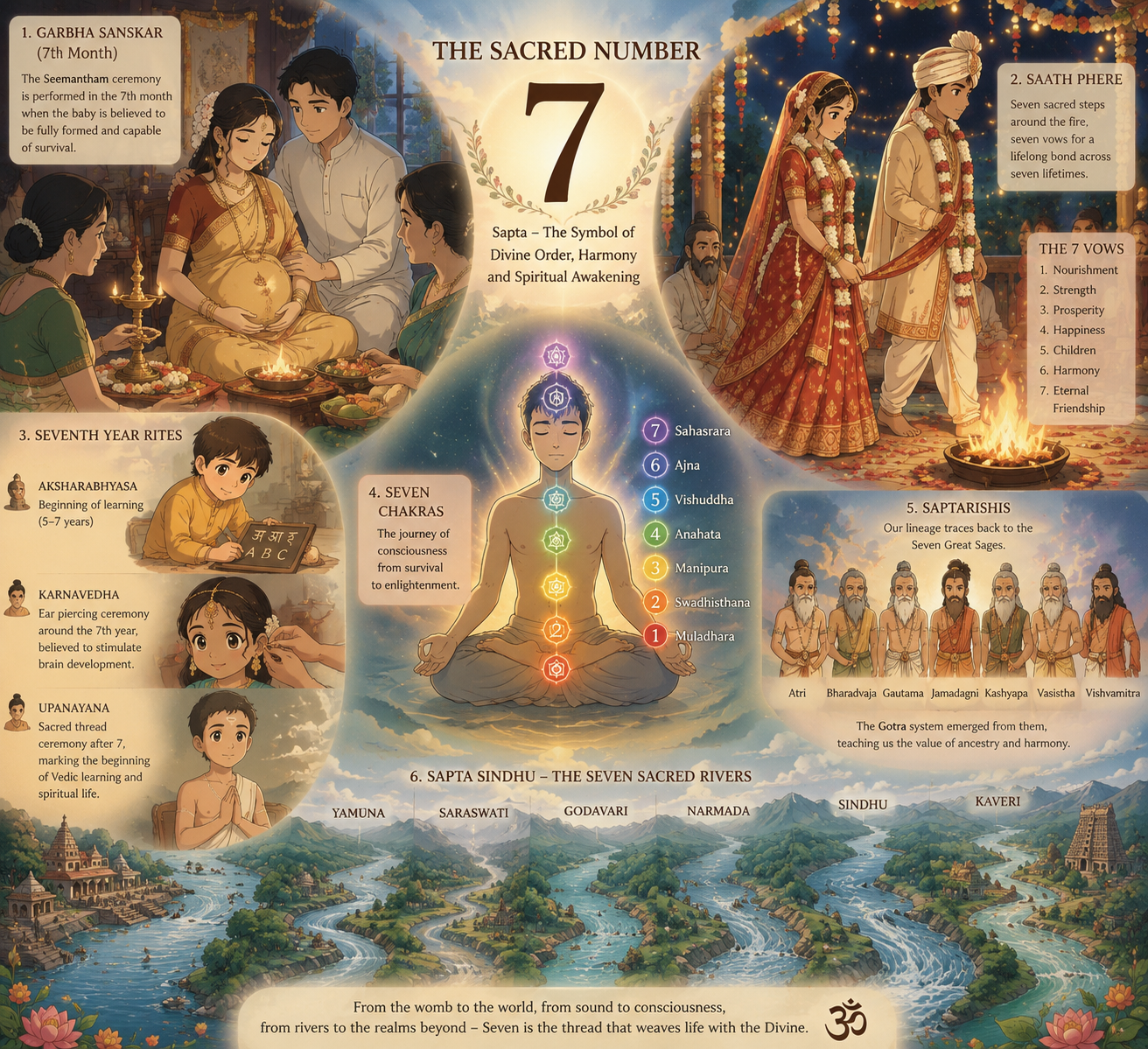
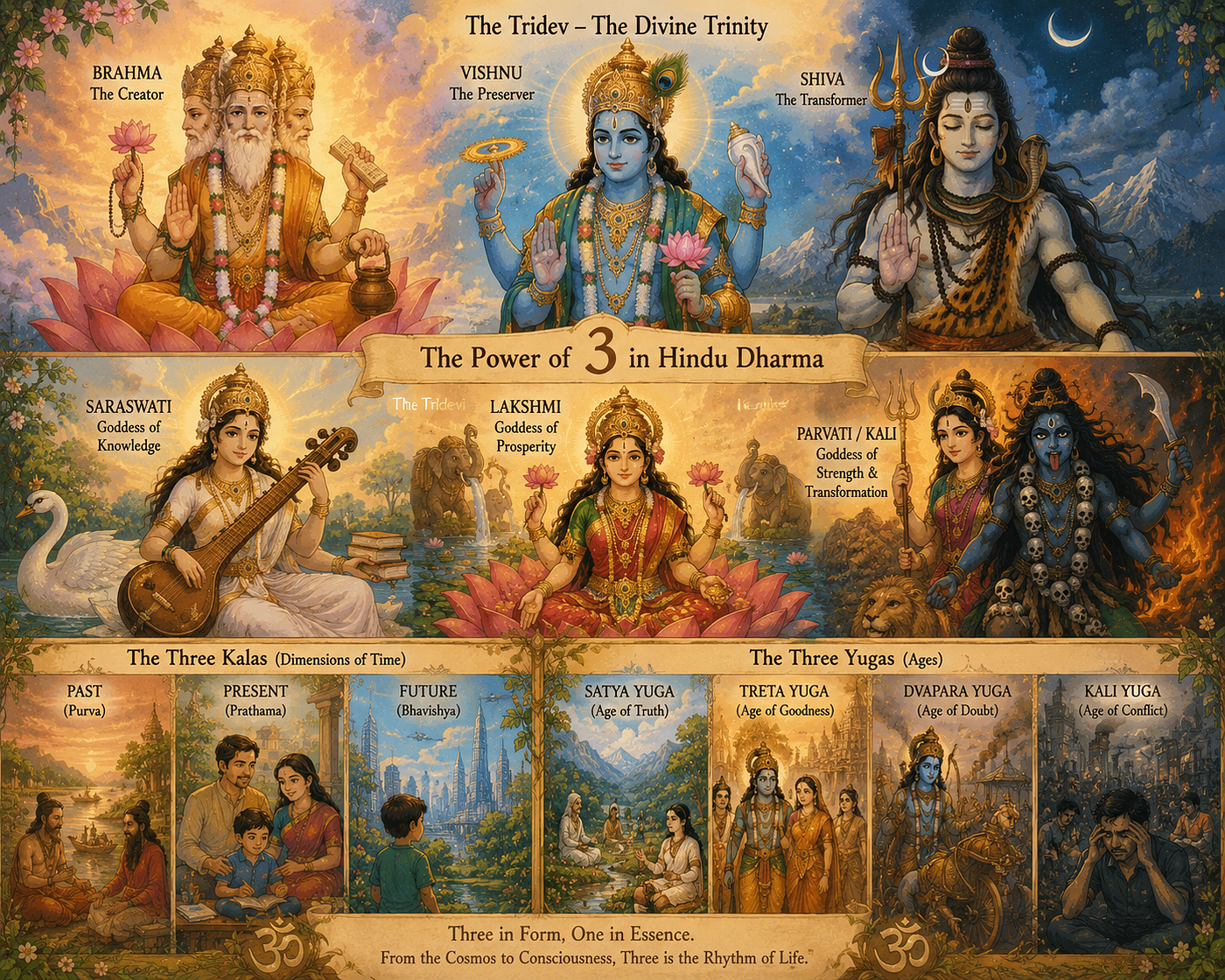
Seven significance-created using chatgpt
Many Hindu families perform the Seemantham or Garbha Sanskar ceremony during the seventh month of pregnancy. Traditionally, it was believed that by this stage the fetus was fully formed and capable of surviving if born prematurely. Interestingly, modern medical science tells us that babies born around 28 weeks can indeed survive with appropriate medical support. My own aunts, born at seven months more than sixty years ago, stand as living testimony to this belief.
The significance of seven continues into childhood.
Traditionally, many important rites of passage occurred around the seventh year. Aksharabhyasam, the formal introduction to learning and letters, was often performed between five and seven years of age.
Karnavedha, the ear-piercing ceremony, was also commonly conducted around this time. Ayurveda associates certain points in the ear with stimulation of the nervous system and brain development. Around the same age, children would begin their formal education.
The seventh year also marked the beginning of spiritual education through the Upanayana ceremony. This sacred thread ritual symbolized a child’s “second birth” and entry into Vedic learning under the guidance of a Guru.
Beyond the individual lies ancestry.
Every Hindu lineage can be traced through the Gotra system to the revered Saptarishis — the Seven Great Sages:
Atri, Bharadvaja, Gautama, Jamadagni, Kashyapa, Vasistha, and Vishvamitra.
Traditionally, marriage within the same Gotra was discouraged because all members were considered descendants of the same ancient lineage. Whether one interprets this historically, genetically, or symbolically, the underlying idea was the preservation of social and familial harmony.
Then comes one of Hinduism’s most recognizable rituals: the Saat Phere.
As bride and groom walk seven times around the sacred fire, each circumambulation represents a solemn vow. Together, the seven steps bind them in duty, companionship, prosperity, family life, and spiritual growth, symbolizing a union believed to extend across lifetimes.
The symbolism of seven also exists within us.
Chakras and rivers
Yogic traditions describe seven primary chakras, beginning with the Muladhara chakra of survival and culminating in the Sahasrara chakra of enlightenment. Though advanced yogic systems speak of many more energy centers, these seven provide a powerful map of human growth — from basic existence to spiritual realization.
The sacred landscape of India is also marked by seven.
There are the Sapta Sindhu, the seven sacred rivers: Ganga, Yamuna, Saraswati, Godavari, Narmada, Sindhu, and Kaveri.
There are the Sapta Puri, the seven holy cities: Ayodhya, Mathura, Haridwar, Kashi, Kanchipuram, Dwarka, and Ujjain.
Music, too, follows the rhythm of seven. Indian classical music is built upon the Sapta Swaras — Sa, Ri (Re), Ga, Ma, Pa, Da, and Ni — the seven notes from which countless ragas emerge. Even our experience of time is organized around the seven days of the week.
Hindu wisdom also identifies seven major vices, known as Sapta Vyasanas: womanizing, gambling, hunting for pleasure, intoxication, harsh speech, excessive punishment, and reckless spending. These are seen as habits capable of destroying both character and society.
At Tirumala, Lord Venkateswara resides amidst the famed Sapthagiri — the Seven Sacred Hills: Seshadri, Garudadri, Venkatadri, Narayanadri, Vrushabhadri, Anjanadri, and Vrushadri. Together they form one of Hinduism’s holiest pilgrimage destinations.
The number seven extends even further into Hindu cosmology.
Ancient texts speak of the Sapta Dweepas, the seven great continents or island realms: Jambu, Plaksha, Salmali, Kusha, Krauncha, Saka, and Pushkara. During many religious rituals, we still identify ourselves as inhabitants of Jambu Dweepa.
The universe itself contains the Sapta Samudras or seven sacred seas and the Sapta Lokas, the seven higher worlds: Bhur, Bhuvar, Svar, Mahar, Jana, Tapa, and Satya. Beneath them lie seven lower realms known as Atala, Vitala, Sutala, Rasatala, Talatala, Mahatala, and Patala.
When viewed individually, these may seem like isolated traditions. But together they reveal a fascinating pattern.
Seven Generations
Many Hindu rituals invoke blessings for:
- Seven generations before us
- Seven generations after us
This emphasizes that an individual’s actions affect an entire lineage across time
The number seven appears in Hinduism not because of superstition but because it became a symbolic pattern through which ancient sages understood reality.
Seven marks completion without finality.
There are seven notes, yet infinite melodies. Seven chakras, yet endless spiritual growth. Seven rivers, yet countless streams. Seven vows, yet a lifetime of marriage. Seven sages, yet generations of descendants.
Perhaps that is why Hinduism keeps returning to seven: it represents a complete cycle while still leaving room for the infinite.
Also do read parvathi’s article on seven mothers.
메타데이터
- post_id
- 4d4ebb902333
- slug
- why-the-number-seven-is-so-sacred-to-hindus-4d4ebb902333
- url
- https://medium.com/the-pillionaire-diaries/why-the-number-seven-is-so-sacred-to-hindus-4d4ebb902333
- canonical_url
- https://medium.com/the-pillionaire-diaries/why-the-number-seven-is-so-sacred-to-hindus-4d4ebb902333
- author_url
- https://medium.com/@radhanarayanan_85248
- status
- ok
- fetched_at
- 2026-07-10 06:10:56