Orchestrating a Submission-to-Quote Workflow with Multi-Agent Systems
In the evolving landscape of insurance underwriting, automating the Submission-to-Quote (S2Q) process is key to improving speed, accuracy…
Orchestrating a Submission-to-Quote Workflow with Multi-Agent Systems
In the evolving landscape of insurance underwriting, automating the Submission-to-Quote (S2Q) process is key to improving speed, accuracy, and scalability. Multi-agent systems — teams of specialized AI agents working collaboratively — offer a powerful approach to orchestrating complex workflows like S2Q. In this post, we’ll explore how different multi-agent orchestration patterns and agent types come together to build an efficient, scalable, and maintainable S2Q pipeline.
1. Introduction
Multi-agent systems are collections of autonomous agents that collaborate to achieve complex tasks. Agent orchestration is about structuring these teams to work efficiently — sometimes in parallel, sometimes sequentially, and sometimes dynamically routing tasks based on context.
To ground these concepts, we’ll use the Submission-to-Quote (S2Q) workflow common in insurance underwriting. This involves:
- Intake of a new insurance submission,
- Processing various attachments and forms,
- Validating extracted data,
- Performing risk assessment,
- Generating a tailored insurance quote.
By following this concrete example, you’ll see how multi-agent orchestration patterns and agent types solve real-world challenges in insurance automation.
2. The Submission-to-Quote Workflow at a Glance
Here’s a high-level view of the S2Q workflow stages:
- Submission Intake: Receive submission and its attachments (Statements of Values, loss runs, ACORD forms, etc.).
- Attachment/Document Processing: Extract structured data from each attachment.
- Validation: Verify data completeness and accuracy.
- Risk Assessment: Analyze risk exposure based on validated data.
- Quote Generation: Generate an insurance quote tailored to the submission details.
Workflow Diagram
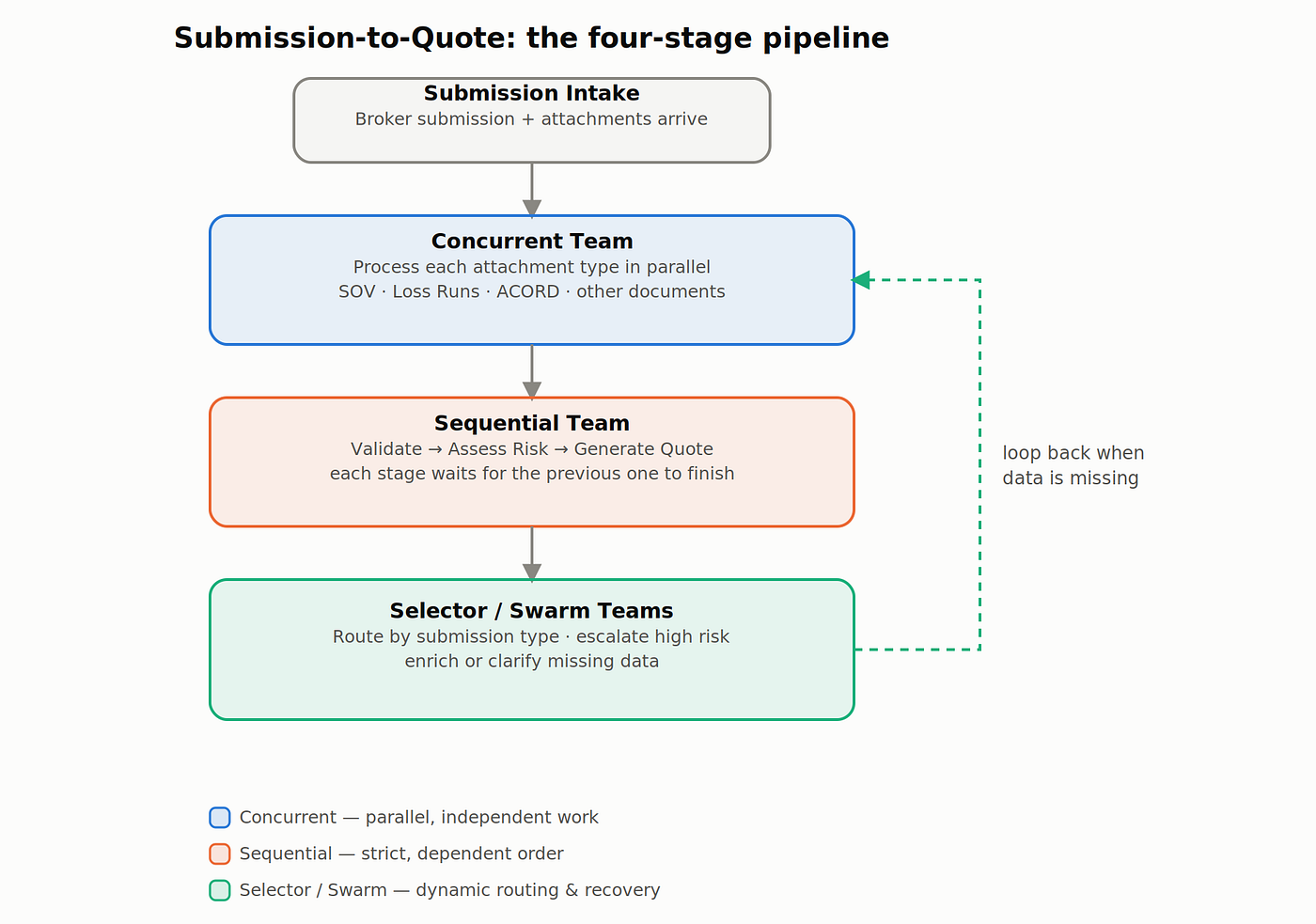
This architecture uses different orchestration patterns at various stages to optimize throughput and reliability.
3. Concurrent Team: Parallel Processing of Attachments

Submissions often arrive with multiple attachments, each requiring specialized extraction logic. For example:
- Statements of Values (SOVs),
- Loss runs,
- ACORD forms,
- Other supporting documents.
Each document type demands a different parser and extraction approach. To handle this efficiently, we apply the Concurrent Team pattern:
What is the Concurrent Team Pattern?
It involves agents working in parallel, independently processing parts of a larger task, then aggregating results.
Applying Concurrent Teams to Attachment Processing
Multiple Document Processor Agents are assigned to different attachment types:
- One agent extracts values from SOVs.
- Another agent parses loss runs.
- A third agent handles ACORD forms.
- Additional agents handle other document types.
All run simultaneously, speeding up overall processing.
Benefits
- Speed: Parallel processing dramatically reduces latency.
- Fault Tolerance: Failure in one document processor doesn’t block others.
- Modularity: Easy to add new Document Processor Agents for new document types.
After extraction, results are aggregated into a unified data set for the next stage.
4. Sequential Team: Validation → Risk Assessment → Quote Generation

Once all data is extracted, the workflow moves into a linear pipeline where each step depends on the previous output:
What is the Sequential Team Pattern?
A sequence of agents where each agent waits for the previous one to finish before starting.
Applying Sequential Teams to S2Q
- Validation Agent: Checks if all required data fields are present and logically consistent.
- Risk Analysis Agent: Assesses the submission’s risk exposure based on validated data.
- Quote Agent: Uses the risk profile and validated data to generate a quote.
The pipeline ensures that:
- Only valid data proceeds to risk assessment.
- The quote is generated only after risk is fully assessed.
Why Sequencing Matters
Each step depends on the prior output’s correctness. Skipping or reordering stages risks inaccurate quotes or underwriting errors.
5. Selector / Swarm Teams: Dynamic Routing

Insurance submissions can vary widely, requiring dynamic decision-making in the workflow:
- Different submission types (property, casualty, etc.) need different handling.
- Missing or inconsistent data may require looping back to the submitter.
- Complex underwriting rules may trigger escalation to human underwriters.
What are Selector and Swarm Teams?
- Selector Teams: Choose one agent or path dynamically based on conditions.
- Swarm Teams: Agents operate on a handoff basis rather than broadcast/consensus. Each agent is configured at creation time with a predefined set of possible handoff targets — the specific agents it’s allowed to transfer control to. During execution, the currently active agent decides which single agent to hand off to next, based on the applicable condition, and control moves to that agent. If an agent’s handoff set includes multiple candidates, it evaluates the conditions and picks one to hand off to — not all of them. Execution proceeds as a chain of one-at-a-time handoffs rather than a fan-out to multiple agents.
Applying to S2Q
- Selector Team: Routes submissions to specialized pipelines based on type.
- Swarm Team: When data is incomplete, swarm agents may simultaneously attempt data enrichment from different sources or request clarifications. The best or earliest response is taken.
- Escalation decisions can be made by selector agents that evaluate risk thresholds or validation failures.
This dynamic routing adds flexibility and robustness to the workflow.
6. Agent Types Involved in the Workflow
Here’s how specific agent types map to stages of the S2Q workflow:
- Workflow Assistant Agent: Kicks off the S2Q workflow when a new submission is received, triggering the downstream agent pipeline.
- User Proxy Agent: Serves as the human-in-the-loop interface — sends notifications and routes cases to a human when underwriter approval or manual review is needed before the workflow can proceed.
- Document Processor Agents: Handle parsing, classification, extraction, and writing of structured data from each attachment, running in parallel across documents.
- Rule Validation Agent: Performs data validation checks sequentially after extraction.
- Risk Analysis Agent: Evaluates risk exposure based on validated data.
- Query Assistant Agent: Retrieves information from external sources — open APIs, Elasticsearch, databases, etc. — to support data enrichment and clarification.
- Quote Agent: Generates the quote based on the combined risk, validation, and enrichment outputs.
Each agent type encapsulates a specialized function, enabling modularity and scalability.
7. Workflow Termination Strategies (Brief, Applied)
Termination strategies determine when a multi-agent process is considered complete:
- Max Message Termination: The concurrent Document Processor Agents terminate when all attachments are processed or a max number of retries reached.
- Text Match Termination: Validation halts if critical errors are detected, triggering escalation.
- OR Termination: Sequential pipeline can stop early if a fatal validation error occurs, avoiding wasted computation.
These strategies ensure efficient resource use and clear workflow progression.
8. Why This Matters: Choosing the Right Pattern
In the context of insurance S2Q workflows:
- Concurrent Teams excel when processing independent, heterogeneous data sources — attachments arriving together but processed separately.
- Sequential Teams are essential when data dependencies dictate strict processing order, such as validating before risk assessment.
- Selector/Swarm Teams introduce agility required for real-world variability — routing, missing data loops, and escalations.
Choosing the right orchestration pattern is key to building scalable, maintainable multi-agent systems that mirror real business workflows.
9. Conclusion
By combining orchestration patterns — Concurrent, Sequential, Selector, and Swarm — with specialized agent types, we can design an end-to-end Submission-to-Quote pipeline that:
- Processes submissions rapidly and accurately,
- Validates and assesses risk reliably,
- Adapts dynamically to varying submission types and data quality,
- Delivers tailored quotes efficiently.
This approach is not limited to S2Q and can extend naturally to other insurance workflows like claims processing and policy renewals, offering a blueprint for intelligent, automated insurance operations.
If you’re building AI-driven automation in insurance, understanding and applying these multi-agent orchestration patterns is a critical skill to master.
메타데이터
- post_id
- 4d9112e42bee
- slug
- orchestrating-a-submission-to-quote-workflow-with-multi-agent-systems-4d9112e42bee
- url
- https://medium.com/imaginist/orchestrating-a-submission-to-quote-workflow-with-multi-agent-systems-4d9112e42bee
- canonical_url
- https://medium.com/imaginist/orchestrating-a-submission-to-quote-workflow-with-multi-agent-systems-4d9112e42bee
- author_url
- https://medium.com/@gopika.v.pillai3
- status
- ok
- fetched_at
- 2026-08-20 05:48:05