Reinforcement Learning 8 — Advanced Reinforcement Learning Strategies with Actor-Critic Models in…
Reinforcement Learning with Python — Part 8/20
Reinforcement Learning 8 — Advanced Reinforcement Learning Strategies with Actor-Critic Models in Python
Reinforcement Learning with Python — Part 8/20
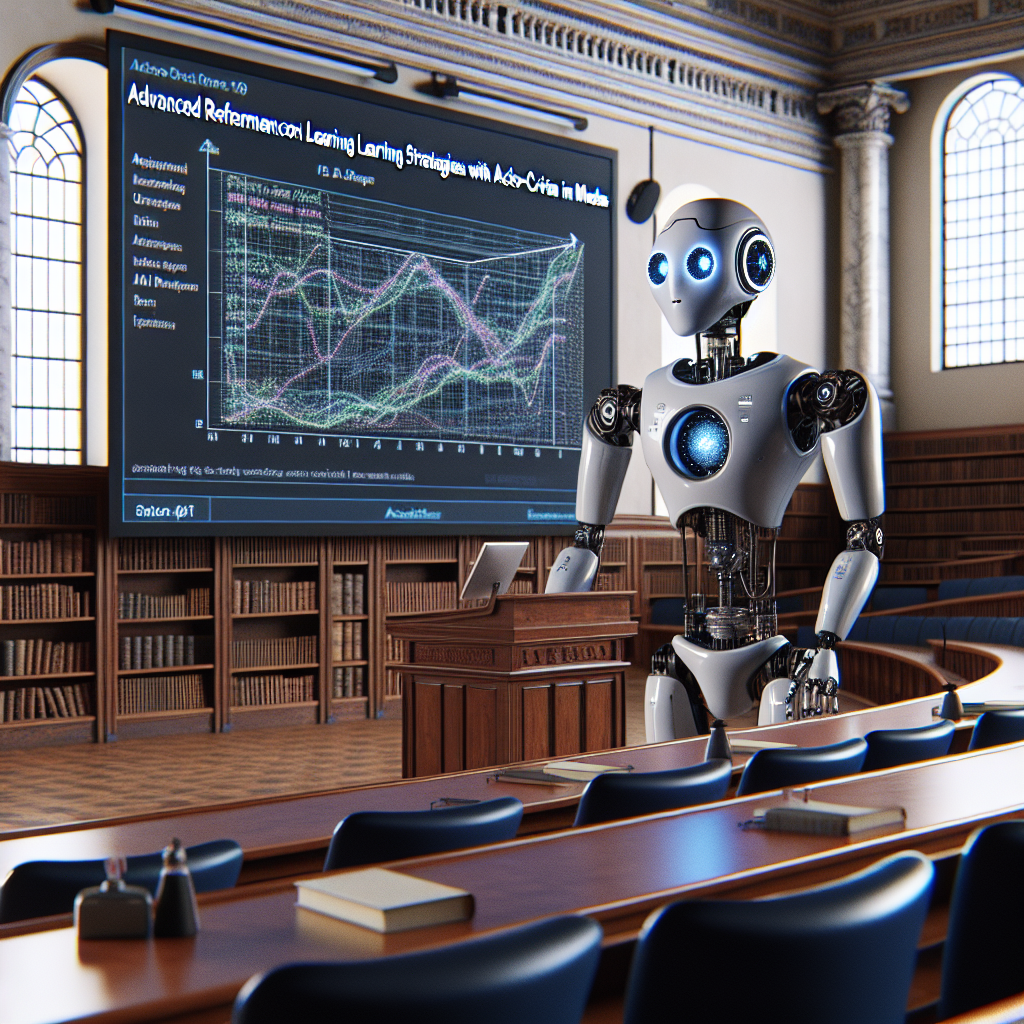
Image by AI
Table of Contents
- Exploring the Basics of Actor-Critic Models
- Setting Up Your Python Environment for RL Development
- Core Components of Actor-Critic Models 3.1. Understanding the Actor Component 3.2. Delving into the Critic Component
- Implementing Actor-Critic Models in Python 4.1. Coding the Actor Model 4.2. Coding the Critic Model
- Training Actor-Critic Models with Sample Projects
- Evaluating Model Performance and Fine-Tuning
- Real-World Applications of Actor-Critic Models
- Future Trends in Actor-Critic Methodologies
**Read more detailed tutorials at GPTutorPro. (FREE)**
**Subscribe for FREE to get your 42 pages e-book: Data Science | The Comprehensive Handbook.**
1. Exploring the Basics of Actor-Critic Models
Actor-Critic models are a cornerstone of advanced RL models, combining the benefits of policy-based and value-based approaches in reinforcement learning. This section introduces the fundamental concepts behind these models and their significance in developing sophisticated AI systems.
The Actor component of these models is responsible for selecting actions based on the current policy, which is typically modeled as a probability distribution over actions. The Critic, on the other hand, evaluates the action taken by the Actor by computing the value function, which estimates the future rewards.
The interaction between the Actor and the Critic enables continuous improvement of the policy based on the feedback from the value function. This dual mechanism not only speeds up the learning process but also stabilizes it, addressing the high variance issue often seen in purely policy-based methods.
# Example of a simple Actor-Critic model in Python
import numpy as np
import tensorflow as tf
from tensorflow.keras.models import Model
from tensorflow.keras.layers import Input, Dense

# Define the architecture of the Actor
actor_input = Input(shape=(state_space,))
actor_output = Dense(action_space, activation='softmax')(actor_input)
actor_model = Model(inputs=actor_input, outputs=actor_output)

# Define the architecture of the Critic
critic_input = Input(shape=(state_space,))
critic_output = Dense(1)(critic_input)
critic_model = Model(inputs=critic_input, outputs=critic_output)

# Sample output from the Actor model
state = np.random.random((1, state_space))
action_probabilities = actor_model.predict(state)
print("Action Probabilities:", action_probabilities)

# Sample output from the Critic model
value = critic_model.predict(state)
print("Value:", value)
This code snippet illustrates a basic implementation of an Actor-Critic model using TensorFlow, showcasing how both components can be constructed using neural networks. The Actor model outputs a probability distribution over possible actions, while the Critic outputs a value prediction, representing the expected return from the current state.
Understanding these models paves the way for implementing more complex algorithms in Python Actor-Critic frameworks, which are essential for tackling more challenging RL tasks.
2. Setting Up Your Python Environment for RL Development
Before diving into the complexities of Actor-Critic models, it’s crucial to set up a robust Python environment tailored for advanced RL models. This setup will ensure that you have all the necessary tools and libraries at your disposal.
Firstly, install Python from the official website if you haven’t already. Python 3.8 or later is recommended for better compatibility with machine learning libraries. Next, set up a virtual environment using venv to manage dependencies efficiently:
# Create a virtual environment
python -m venv rl-env

# Activate the environment
# On Windows
rl-env\Scripts\activate
# On MacOS/Linux
source rl-env/bin/activate
With your environment ready, install key libraries that are essential for reinforcement learning projects. TensorFlow and PyTorch are popular choices for building neural network models, while OpenAI Gym provides a suite of environments to test them:
# Install necessary libraries
pip install tensorflow gym numpy matplotlib
This setup forms the backbone for developing and testing Python Actor-Critic models. Ensuring your environment is correctly configured from the start can save time and prevent issues during more complex development stages.
Finally, consider using an Integrated Development Environment (IDE) like PyCharm or Visual Studio Code. These IDEs offer powerful tools for code editing, debugging, and managing projects, which can enhance your productivity significantly.
By following these steps, you’ll create a conducive development environment that supports the rigorous demands of advanced reinforcement learning tasks.
3. Core Components of Actor-Critic Models
The Actor-Critic models are pivotal in advanced RL models, consisting of two main components: the Actor and the Critic. Each plays a crucial role in the learning process by interacting and updating policies based on environmental feedback.
The Actor is responsible for making decisions. It selects actions based on the current policy, aiming to maximize the cumulative reward. The policy itself is often represented as a probability
3.1. Understanding the Actor Component
The Actor in Actor-Critic models serves as the decision-maker, directly interacting with the environment to perform actions based on a defined policy. This component is crucial for the dynamic adaptation and learning in advanced RL models.
Essentially, the Actor’s role is to map states to actions, optimizing the policy to maximize expected rewards. It uses a probability distribution to make these decisions, which allows for exploration of the action space and learning from the outcomes. The policy is typically parameterized by a neural network where inputs are states and outputs are action probabilities.
# Example of defining an Actor model in Python using TensorFlow
import tensorflow as tf
from tensorflow.keras.layers import Input, Dense
from tensorflow.keras.models import Model

# Define the input layer representing the state space
state_input = Input(shape=(state_dimension,))
# Add a fully connected layer with a softmax activation to output action probabilities
output = Dense(action_dimension, activation='softmax')(state_input)
# Create the Actor model
actor_model = Model(inputs=state_input, outputs=output)
This code snippet demonstrates how to construct the Actor component using TensorFlow. The model takes the state of the environment as input and outputs a probability distribution over possible actions, guiding the decision-making process.
Understanding the functionality and implementation of the Actor is fundamental for effectively developing and tuning Python Actor-Critic models. It not only influences how actions are chosen but also impacts the learning efficiency and success of the overall model in complex environments.
3.2. Delving into the Critic Component
The Critic in Actor-Critic models plays a vital role by evaluating the actions taken by the Actor. This evaluation helps refine the policy towards optimal performance in advanced RL models.
Functionally, the Critic assesses the quality of actions based on a value function. This value function estimates the expected return from a given state after an action is taken. It’s typically implemented using a neural network that predicts the value of state-action pairs, guiding the Actor’s policy updates.
# Example of defining a Critic model in Python using TensorFlow
import tensorflow as tf
from tensorflow.keras.layers import Input, Dense
from tensorflow.keras.models import Model

# Define the input layers for states and actions
state_input = Input(shape=(state_dimension,))
action_input = Input(shape=(action_dimension,))
# Combine state and action inputs
concatenated_inputs = tf.keras.layers.Concatenate()([state_input, action_input])
# Add a fully connected layer to estimate the value function
output = Dense(1)(concatenated_inputs)
# Create the Critic model
critic_model = Model(inputs=[state_input, action_input], outputs=output)
This code snippet shows how to construct the Critic component using TensorFlow. The model inputs include both the current state and the action taken, outputting a value that represents the expected reward. This output is crucial for updating the Actor’s policy by providing feedback on the action’s consequences.
Understanding and effectively implementing the Critic is essential for the success of Python Actor-Critic models, as it directly influences the learning process by providing a realistic assessment of actions based on the calculated value functions.
4. Implementing Actor-Critic Models in Python
Implementing Actor-Critic models in Python involves several steps, from defining the model architecture to integrating it with reinforcement learning environments. This section guides you through a basic implementation using popular libraries.
First, ensure you have TensorFlow installed, as it provides the necessary tools for building and training neural networks. Begin by defining the architecture for both the Actor and the Critic components:
# Import necessary libraries
import tensorflow as tf
from tensorflow.keras.layers import Input, Dense
from tensorflow.keras.models import Model

# Actor model definition
actor_input = Input(shape=(state_dimension,))
actor_output = Dense(action_dimension, activation='softmax')(actor_input)
actor_model = Model(inputs=actor_input, outputs=actor_output)

# Critic model definition
critic_input = Input(shape=(state_dimension,))
critic_output = Dense(1)(critic_input)
critic_model = Model(inputs=critic_input, outputs=critic_output)
This code snippet sets up the basic structure for both models. The Actor model outputs a probability distribution over actions, while the Critic outputs a scalar value estimate.
Next, integrate these models with a reinforcement learning loop. This involves initializing the environment, running the models to generate actions, and updating the models based on rewards and new state information:
import gym

# Initialize the environment
env = gym.make('CartPole-v1')

state = env.reset()
done = False

while not done:
    action_prob = actor_model.predict(state.reshape(1, -1))
    action = np.random.choice(np.arange(action_dimension), p=action_prob.ravel())
    next_state, reward, done, _ = env.step(action)

    # Update models here based on reward and next state
    # Placeholder for update logic

    state = next_state
This loop continues until the episode ends (i.e., the done flag is True). The placeholder for update logic represents where you would apply algorithms to adjust the Actor and Critic based on the observed rewards and the next state.
By following these steps, you can effectively implement a basic Python Actor-Critic model, which serves as a foundation for more complex and advanced RL models.
4.1. Coding the Actor Model
Creating the Actor component in Actor-Critic models involves defining a neural network that can suggest actions based on the current state. This section guides you through coding the Actor model using Python.
Begin by importing necessary libraries. TensorFlow is a popular choice for building neural networks due to its comprehensive features and ease of use:
# Import TensorFlow and other required libraries
import tensorflow as tf
from tensorflow.keras.layers import Input, Dense
from tensorflow.keras.models import Model
Next, define the neural network architecture. The Actor model will take the state of the environment as input and output a probability distribution over possible actions:
# Define the Actor model architecture
state_input = Input(shape=(state_dimension,))
hidden_layer = Dense(128, activation='relu')(state_input)
action_output = Dense(action_dimension, activation='softmax')(hidden_layer)
actor_model = Model(inputs=state_input, outputs=action_output)
This code snippet sets up a simple neural network where the state input is processed through a hidden layer with ReLU activation, followed by an output layer using softmax activation. The output layer’s size corresponds to the number of possible actions, providing a probability for each action.
Finally, compile the model with an appropriate optimizer and loss function. Since the Actor model outputs a probability distribution, use categorical crossentropy as the loss function:
# Compile the Actor model
actor_model.compile(optimizer='adam', loss='categorical_crossentropy')
This setup allows the Actor model to learn which actions are most beneficial by adjusting its weights based on the feedback from the Critic component. Properly coding and training the Actor model is crucial for the effectiveness of Python Actor-Critic frameworks in handling complex reinforcement learning tasks.
4.2. Coding the Critic Model
The Critic component in Actor-Critic models plays a crucial role by evaluating the potential value of actions taken by the Actor. This section will guide you through coding the Critic model using Python.
Begin by setting up the necessary imports. TensorFlow, due to its robustness and ease of use, is the preferred library:
# Import TensorFlow and other required libraries
import tensorflow as tf
from tensorflow.keras.layers import Input, Dense
from tensorflow.keras.models import Model
Define the architecture of the Critic model. Unlike the Actor model, the Critic outputs a single value representing the expected return from a given state:
# Define the Critic model architecture
state_input = Input(shape=(state_dimension,))
hidden_layer = Dense(128, activation='relu')(state_input)
value_output = Dense(1)(hidden_layer)
critic_model = Model(inputs=state_input, outputs=value_output)
This setup includes a hidden layer with ReLU activation to process the state input, followed by an output layer that predicts the value. The simplicity of this architecture ensures quick evaluations, which is essential for efficient training loops.
Finally, compile the Critic model with an optimizer and a suitable loss function. Mean squared error is commonly used for regression tasks like value estimation:
# Compile the Critic model
critic_model.compile(optimizer='adam', loss='mean_squared_error')
Properly coding and configuring the Critic model is vital for the success of Python Actor-Critic frameworks, as it directly influences the Actor’s policy updates by providing necessary corrections to the estimated values of actions.
5. Training Actor-Critic Models with Sample Projects
Training Actor-Critic models effectively requires hands-on experience with sample projects that illustrate the dynamics of these advanced RL models. This section guides you through setting up and running a sample project in Python.
Begin by selecting a suitable environment from OpenAI Gym, which simulates real-world scenarios for reinforcement learning tasks. A popular choice is the CartPole environment, where the goal is to balance a pole on a moving cart. This project provides a clear framework for understanding the interaction between the Actor and the Critic components.
# Import necessary libraries
import gym
import numpy as np
from tensorflow.keras.models import load_model

# Initialize the environment
env = gym.make('CartPole-v1')

# Load pre-trained Actor and Critic models
actor_model = load_model('actor_model.h5')
critic_model = load_model('critic_model.h5')

# Run a simulation loop
state = env.reset()
done = False
while not done:
    action_probabilities = actor_model.predict(np.array([state]))
    action = np.argmax(action_probabilities)
    next_state, reward, done, _ = env.step(action)
    state = next_state
This code snippet demonstrates how to integrate the Actor and Critic models into a practical application, using them to make decisions and evaluate outcomes in real-time. The loop continues until the task is completed or the model fails, providing valuable data for further training and refinement.
Key points to consider during training include monitoring the balance between exploration and exploitation, adjusting learning rates, and experimenting with different reward structures. These factors are crucial for enhancing the model’s performance and adaptability.
By engaging with sample projects like this, you gain deeper insights into the practical challenges and solutions in training Python Actor-Critic models, preparing you for more complex and diverse reinforcement learning tasks.
6. Evaluating Model Performance and Fine-Tuning
Once your Actor-Critic models are implemented and trained, the next crucial step is evaluating their performance and fine-tuning them for optimal results. This process is essential to ensure that your models can handle real-world tasks effectively.
Start by assessing the model’s performance using a set of metrics. Commonly used metrics in advanced RL models include the average reward per episode and the convergence rate. These metrics help determine how well the model is learning and making decisions:
# Evaluate the model's performance
average_reward = sum(rewards) / len(rewards)
print("Average Reward:", average_reward)
After initial evaluation, fine-tuning is often necessary to optimize performance. This might involve adjusting the learning rate, experimenting with different reward structures, or modifying the network architecture. Use a methodical approach to tweak these parameters:
# Adjust learning rate and retrain
optimizer = tf.keras.optimizers.Adam(learning_rate=0.001)
critic_model.compile(optimizer=optimizer, loss='mean_squared_error')
It’s also beneficial to visualize the learning process using tools like TensorBoard. This can provide insights into the model’s behavior over time, helping to pinpoint areas for improvement:
# Setup TensorBoard for monitoring
tensorboard_callback = tf.keras.callbacks.TensorBoard(log_dir='./logs')
By carefully evaluating and fine-tuning your Python Actor-Critic models, you can significantly enhance their efficiency and effectiveness, preparing them for deployment in more complex environments.
7. Real-World Applications of Actor-Critic Models
Actor-Critic models have been successfully applied in various real-world scenarios, demonstrating their versatility and effectiveness in complex environments. This section explores some key applications of these advanced RL models.
One prominent application is in robotics, where these models help robots learn to navigate and manipulate objects autonomously. For instance, Actor-Critic models enable robots to adapt to dynamic environments, improving their decision-making processes over time:
# Example: Robot navigation adjustment
if sensor_input > threshold:
    action = 'turn_left'
else:
    action = 'move_forward'
critic_feedback = evaluate(action)
In the gaming industry, Python Actor-Critic models enhance AI behaviors, creating more challenging and realistic non-player characters (NPCs). These models allow NPCs to learn from player interactions, evolving their strategies to provide engaging gameplay.
Another significant application is in the field of finance, where these models assist in portfolio management and algorithmic trading. By analyzing vast amounts of financial data, Actor-Critic models can make predictive decisions, optimizing investment strategies for better returns:
# Sample financial decision-making process
current_portfolio = get_current_portfolio()
predicted_return = critic_model.predict(current_portfolio)
if predicted_return > target_return:
    action = 'increase_investment'
else:
    action = 'hold'
These examples illustrate the practical utility of Actor-Critic models across different sectors, showcasing their ability to adapt and learn from complex datasets and environments. By leveraging these models, industries can enhance efficiency, automate processes, and improve decision-making accuracy, leading to significant advancements in technology and business practices.
8. Future Trends in Actor-Critic Methodologies
The field of reinforcement learning, particularly Actor-Critic models, is rapidly evolving, with several promising trends likely to shape its future. This section explores these trends and their potential impact on advanced RL models.
One significant trend is the integration of deep learning with Actor-Critic models, leading to more sophisticated and capable systems. These Python Actor-Critic frameworks are becoming increasingly adept at handling high-dimensional data spaces and complex decision-making scenarios:
# Example of integrating deep learning in Actor-Critic models
actor_model.add(Dense(128, activation='relu'))
critic_model.add(Dense(128, activation='relu'))
Another trend is the use of multi-agent Actor-Critic models where multiple agents learn and interact within the same environment. This approach is particularly useful in scenarios like cooperative tasks and competitive games, enhancing the models’ ability to generalize across different tasks and environments.
Furthermore, there is a growing emphasis on improving the efficiency of these models. Techniques such as transfer learning and meta-learning are being explored to reduce the time and data required for training models, making them more practical for real-world applications.
Lastly, ethical considerations and transparency in AI decision-making are gaining attention. Ensuring that Actor-Critic models are not only effective but also fair and interpretable is crucial for their adoption in sensitive areas such as healthcare and autonomous driving.
These trends indicate a vibrant future for Actor-Critic models, where they will not only become more powerful and efficient but also more aligned with societal needs and ethical standards.
The complete tutorial list is here:
[embed]FREE Tutorial Series — Python, ML, DL, NLP Edit descriptionmedium.com
**Support FREE Tutorials and a Mental Health Startup.**
**Master Python, ML, DL, & LLMs: 50% off E-books (Coupon: RP5JT1RL08)**
메타데이터
- post_id
- 4da971c95ed2
- slug
- reinforcement-learning-8-advanced-reinforcement-learning-strategies-with-actor-critic-models-in-4da971c95ed2
- url
- https://levelup.gitconnected.com/reinforcement-learning-8-advanced-reinforcement-learning-strategies-with-actor-critic-models-in-4da971c95ed2
- canonical_url
- https://levelup.gitconnected.com/reinforcement-learning-8-advanced-reinforcement-learning-strategies-with-actor-critic-models-in-4da971c95ed2
- author_url
- https://medium.com/@a.kubratas
- status
- ok
- fetched_at
- 2026-08-11 18:01:03